

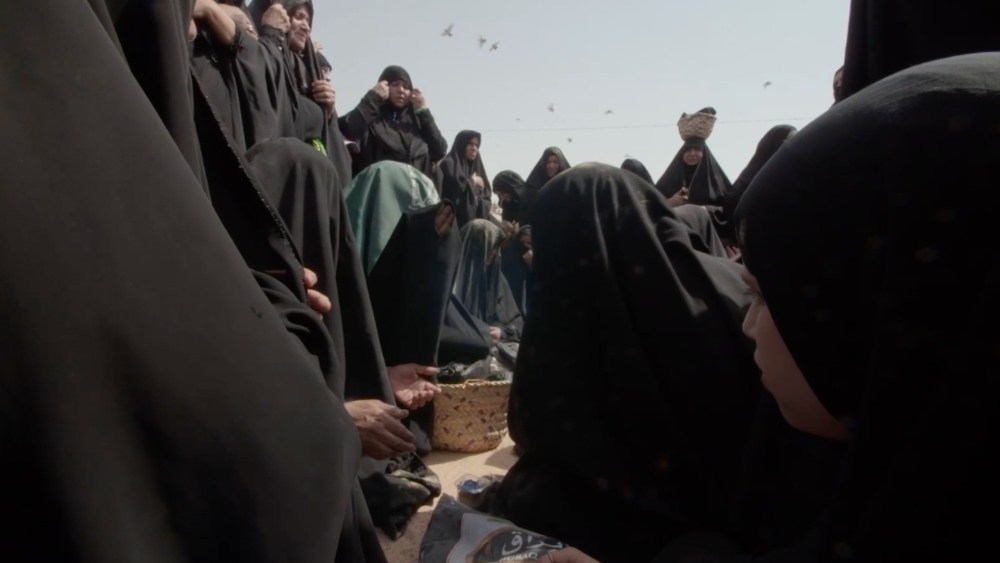
At this year’s Cairo Intl. Film Festival, Iraqi filmmaker Zahraa Ghandour marks a notable milestone with “Flana,” a documentary centered on the lived realities of Iraqi women. After its world premiere in Toronto, the film arrived in Cairo as part of the Horizons of Arab Cinema competition, not just as a promising debut but as a rare work in Iraqi cinema, shaped by a woman living inside the country and focusing on stories too often sidelined or silenced.
Ghandour’s path to filmmaking began more than a decade ago, not in film school, but on Iraqi television. At barely 20, she began presenting and eventually directing the popular documentary show “52 Minutes,” a program she now calls her “foundation.” Week after week, she travelled across the country to report on social issues like early marriage, domestic violence, inequitable laws, women’s prisons — stories so pervasive that colleagues and audiences alike joked she worked only on “women’s issues.” Yet for Ghandour, these were not “women’s issues,” they were the systemic realities Iraqi women navigate every day. “There were endless subjects to cover,” she recalls. “And I loved it. I went everywhere in Iraq because of this show.”
But even as she acted in several Iraqi independent films, she felt none went far enough. “They were all about complicated women, but none were written or directed by women,” she notes. When she began working on “Flana” in 2018, she realized she could no longer hide behind other women’s stories without confronting her own. Growing up, she recalls being treated as “less” than her brother, not by him, but by a society structured to celebrate boys to the detriment of girls. “I felt it was missing the truth if I didn’t speak about the story I knew the most,” she reflects. “It’s all connected.”
“Flana” begins with Ghandour’s desperate search for her childhood friend, Noor, whose disappearance two decades earlier haunts her to this day. It expands into an excavation of the systemic violence facing Iraqi women, from patriarchal traditions to the country’s unresolved legal failures around honor killings. For Ghandour, the personal becomes a rallying cry. “If these personal things aren’t addressed in a fair way, then they’re political,” she argues. “People should be shouting nonstop in the streets to stop little girls from being thrown out on the streets, to stop these criminals from murdering their wives and daughters, to have fair laws.”
Bringing that truth to the screen, however, required not just artistic clarity but constant strategizing, and immense risk. Ghandour speaks openly about the fear that has accompanied the project from the beginning. “Sometimes I fear the reaction physically,” she admits, pointing to worries about retribution. She was more nervous for her Arab premiere in Cairo than for Toronto “because of how this society thinks and because there were many Iraqis in the audience, I was nervous about the possible reaction.”
Her concern stems from experience. When she has spoken publicly about gendered violence in the past, she has been accused of “destroying the Iraqi image,” as though acknowledging injustice were a betrayal rather than a demand for accountability. “There is a lot of denial in society,” she laments. “People take it personally because they’re not doing anything about it.”
During production, she often had to lie to authorities in order to shoot safely, submitting a fake synopsis about empowered Iraqi women gaining opportunities. Within private homes, birth rooms, and shelters, the women who allowed her to film trusted her with their identities and, in some cases, with their lives. Several women initially refused to appear on camera, though one changed her mind after building trust with Ghandour. Even then, Ghandour made the difficult decision to remove entire characters from the film if she feared for their safety. In one case, she excluded a key figure because presenting her story might expose her to retaliation.
The core of the film, however, centers on two women: Ghandour’s aunt, a midwife whose home becomes a refuge, and Natalie, also known by the pseudonym Leila, whose journey through shelters and family violence reveals the human cost of Iraq’s legal vacuum where women are concerned. Both women have seen the film. Ghandour’s aunt offered an emotional, encouraging response, while Natalie was struck by her on-screen appearance, conscious of the reconstructive surgery she needs for her injured chin, a result of the violence she faced. The team is now helping raise funds for the operation.
The film’s title captures the erasure Ghandour is fighting against. In Iraq, “flana” is a term used for a woman whose name is forgotten or dismissed, “as if she’s not worthy to mention,” she explains. She deliberately turned it into a name, a presence.
Internationally, “Flana” is arriving at a moment when Arab women directors are gaining unprecedented visibility. Ghandour, fresh off of screening the film at IDFA, sees this momentum clearly. “Women are working more on films and having the chance they deserve,” she observes. In Iraq, the film arrives amid a small but significant shift: the country issued its first-ever public film fund this year, and young filmmakers from the 1980s and 1990s generations are forging a path without formal film schools or established industry infrastructure.
Yet “Flana” is singular. It is the first Iraqi film about women made by a woman living in Iraq. “That mattered to me more than being selected by a major festival,” she remarks. “It’s a point on the road, one of many. But it’s noticed.”
Cairo, unexpectedly, became a turning point. “I didn’t expect people to care,” she recalls of the film’s sold-out screening at the Opera House. “That theater being full changed something in me. It gave me trust, in ‘Flana’ and in Arab audiences.”
Next, Ghandour plans an Iraq premiere, a national screening tour in towns without cinemas, and a companion book of essays, poetry and comics inspired by the film. Broadcasters across the region are in conversation. Al Jazeera, for example, has expressed interest.
But at its heart, Ghandour hopes “Flana” sparks something far simpler and far more pressing: a reckoning with the shelters, honor killings, and the everyday brutality facing women across Iraq, and further, a path toward accountability.
“The experience showed me it’s possible to do more, to keep pushing,” she concludes. “And for anyone who tries to undermine us, we know exactly what we’re doing.”
