

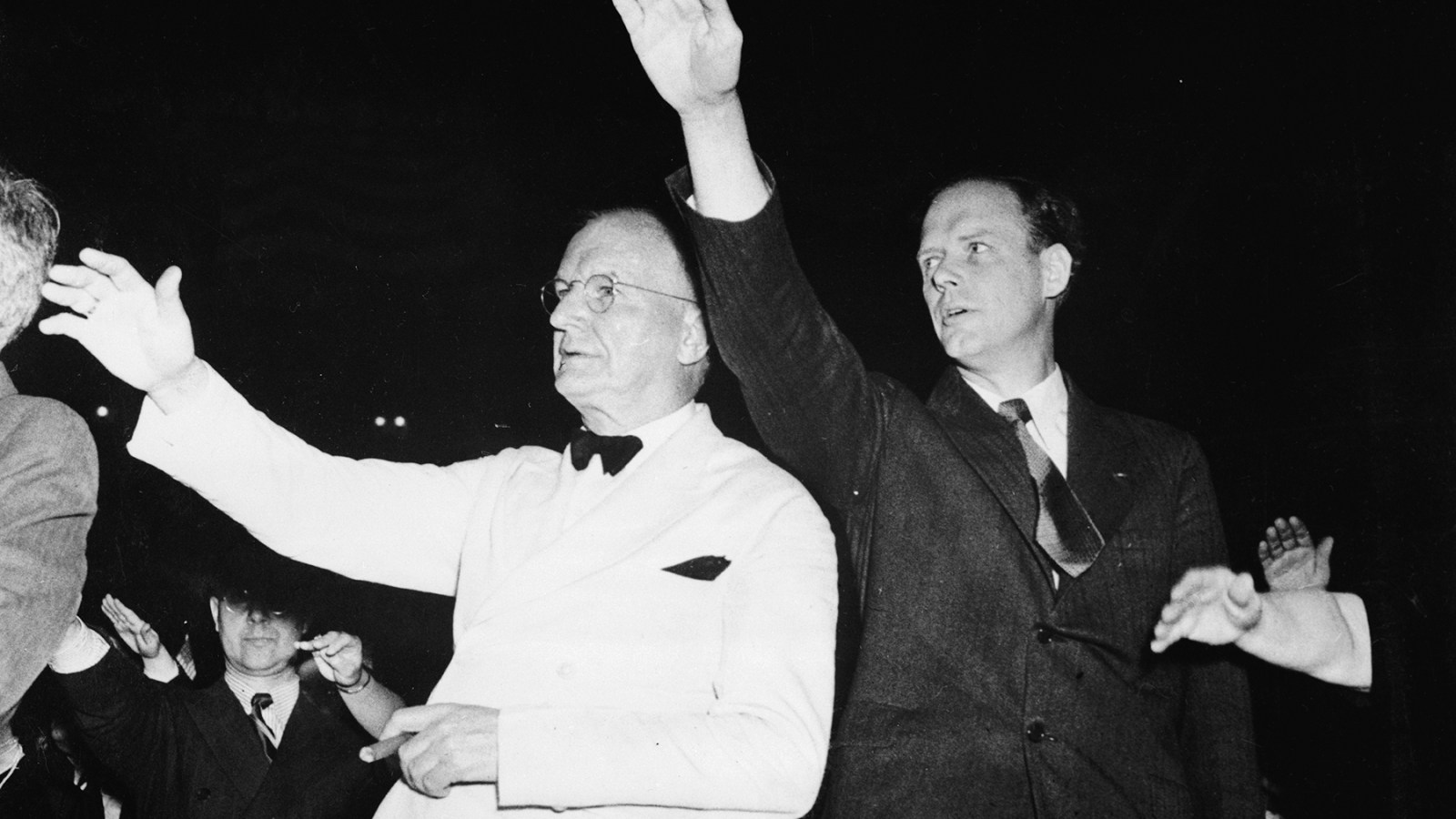
A century ago, Charles Lindbergh was the most famous man in the world, the pilot who first flew New York to Paris in 33 hours. Today, I am looking at his grave. It is located on the far side of the world on the edge of an island, 5,000 miles from Washington, D.C. His companions in eternal rest are not fellow American heroes, his wife, or any of his children. No, they are apes named Kippy, George, and Keiki, who loved to wear Bermuda shorts.
What does that say about Donald Trump, the current most famous man in the world? More than you think.
It is November and I’m writing this on Maui. I come here a couple of times a year — an indulgence I financially rationalize by the fact I drive a 2014 Honda Civic and pray that my son will choose a publicly funded university. I stay north of Lahaina in a high-rise that has all the charm of a Warsaw Pact-era midrise. Still, the views are out-of-sight. I watch from my bird shit-covered balcony at magic hour as catamarans skim by, filled with honeymooners and pensioners on sunset cruises.
Maui is my American Demerol, the place I go to sedate myself after burning out on reporting on L.A. wildfires, ICE protests, and Trump rallies. That’s how Charles Lindbergh ended up here. He was hiding from America.
I’d been fascinated with Lindbergh since I was 10 and my father took me to the Smithsonian’s National Air and Space Museum where Lindbergh’s Spirit of St. Louis hung suspended from the ceiling. My dad was a Navy pilot and a quiet man. I rarely remember him as animated as the day he pointed up to the frail silver plane and told me about Lindbergh’s achievement. He didn’t mention anything about his darker beliefs and history.
Lindy’s Maui refuge is three hours away from Lahaina. I must drive past an American tragedy to get there. I wake at 5 a.m. and, within minutes, my rented Chevy Malibu is snaking past the devastation left by the 2023 Lahaina fire. Up on the hill is Lahainaluna High School, where Friday Night Lights happen on Saturday, and the kids and grannies wear T-shirts embossed with the faces of loved ones lost. Then there are the remains of a building that housed a used bookstore where the clerk was elderly and kind, and I wonder if she got out in time. There’s a detour so I can’t see the ash of Fleetwood’s, Mick’s place where I once listened to the drummer play the ukulele for his 90-year-old mum who told imagined stories of arriving in Maui as a stowaway.
It’s all gone now.
THERE ARE TWO WAYS to Hana. The tourist-clogged road involves hundreds of turns and switchbacks featuring bros in topless Jeeps driving like idiots as their golden-shouldered girlfriends question their life choices. But there’s another way, through the island’s interior on gutted roads lined with abandoned general stores and cows that refuse to yield. The drive is so treacherous and remote that rental car agencies have prohibited taking their vehicles this way, but I consider myself a Maui veteran, which means that I’m just another asshole tourist who thinks he knows better.
I pass grass fields that lead down to the blue-and-white-capped Pacific Ocean. The view is so hypnotic that I pay little attention as I pass a garbage truck paused at the top of Nuanualola Gulch. I think the driver is just being courteous. I give a wave and head downhill at 40 mph. Turns out he isn’t being courteous; he’d spotted a garbage truck about to make his way up the hill. I see the truck late on a hairpin curve on the barely single-lane road. I yank my car to the shoulder and brake hard, maybe 10 feet from where the road ends and a 50-foot drop to the sea begins.
Lindbergh hated the press, so maybe he would not have minded my Malibu plunging into the sea. He saw them as vipers and bloodsuckers. Almost a century later, Donald Trump has picked up his scepter, calling female reporters piggies and insubordinate, chronically furious that journalists have had the audacity to cover his porn-star payoffs, ICE raids, and pardoning drug kingpins.
Lindbergh came to his hatred more honestly. In 1927, he piloted the Spirit of St. Louis from New York City to Paris solo, sometimes dropping his plane down to just 10 feet above the Atlantic, hoping the icy ocean spray would keep him awake. He landed at Le Burget Field in Paris, greeted by a crowd of 150,000, only escaping the happy mob when a smart French cop put Lindbergh’s leather helmet on a reporter, redirecting the throng and allowing the pilot to slip away.
The taciturn pilot from Minnesota became the most famous man alive. Lindbergh initially prospered from it — a quickly written autobiography sold hundreds of thousands and a Spirit of St. Louis tour with stops in all 48 states brought attention to his future plans for commercial travel and air mail.
But then he felt caged. He’d open his hotel-room door and be met by a dozen reporters who had paid off the staff. The crushed glass of spent flash bulbs soundtracked his every walk, his every dash for a waiting car.

Lindbergh standing in front of his plane, the Spirit of St. Louis.
© Hulton-Deutsch Collection/CORBIS/Getty Images
He married Anne Morrow, a senator’s daughter, in 1929 and a son bearing his name was born the following year. The family settled on a 300-acre estate near Princeton, New Jersey, hoping for peace. It did not happen. Instead, evil invaded their careful sanctuary. On March 1, 1932, Lindbergh’s son was kidnapped from his second-floor nursery. A manhunt was launched and a ransom was paid, but Charles A. Lindbergh Jr.’s skeletal remains were found by the side of a nearby New Jersey road that May. A few days later, a tabloid photographer snuck into the mortuary holding the body and opened the coffin. He snapped grisly photos and put them on the wire.
Eventually, Bruno Hauptmann, a German immigrant, was arrested for the crime. With his trial in Flemington, New Jersey, the so-called Crime of the Century morphed into the Trial of the Century, with thousands of tourists visiting the small courtroom on weekends so they could be photographed in the witness box. Hauptmann was convicted and executed in 1936. Lindbergh saw no peace for his family in America, so his wife Anne and a new baby slipped away to Europe in the middle of the night and settled in England.
Back on the road, there are still 10 miles to go until I reach Lindbergh’s grave. My Maui experience has devolved into lips trembling and God-bargaining as the broken roads turn from crumbling pavement to gravel and dirt. There’s no going back. I mean this literally; there is no place to turn around. All there is left to do is move uncertainly forward, paranoid and afraid, not unlike America in Trump’s second term.
The above tortured metaphor is a necessary transitional evil in what is called a braided essay where personal anecdotes are blended with the American experience to tell a larger story. These essays are sometimes set in Malibu. Alas, I’m just driving a high-mileage Chevy Malibu from Dollar Car Rental and have just voided the comprehensive insurance policy.
CHARLES LINDBERGH WAS blade thin, earning him the nickname of Slim. Donald Trump is not and has been likened to a Cheeto. Still, they share a common heritage. Both of their grandfathers fled their homelands, a step ahead of law enforcement, a factual inconvenience that their grandsons never mentioned in their campaigns against others fleeing similar dire circumstances.
Ola Månsson abandoned his wife and children in Sweden and moved to America with his teenage mistress. He became Augustus Lindbergh, and his son was christened Carl August Lindbergh. Frederick Trump dodged conscription and was banned from his native Bavaria. In New York City, he denied his German heritage, claiming the Trumps were Swedish. It was a family lie that lasted a century, with Donald promoting his Swedish origins as late as 1987’s pseudo-memoir The Art of the Deal.
Lindbergh and Trump quickly evolved into “Fuck you, I’m here, now lock the door” immigrants — a.k.a. true Americans.
Lindbergh attended Sidwell Friends in D.C., where he made no friends and watched as his congressman father turned his attention to keeping the United States out of the Great War. His father left Congress in 1917 disgusted that Woodrow Wilson ran for re-election in 1916 on the original America First platform with the slogan “He kept us out of war” and then proceeded to get the United States into the war in 1917.
The elder Lindberg spent the rest of the year writing Why Is Your Country at War. It was scheduled to be published in early 1918, but the book’s printing plates were destroyed under wartime American censorship laws. A few copies survived.
Lindbergh Senior wrote:
“It is impossible according to the big press to be a true American unless you are pro-British. If you are really for America first, last and all time, and solely for America and for the masses primarily, then you are classed as pro-German by the big press which is supported by the speculators.”
“Speculator” was already code for the Jews.
His son absorbed it all. Charles Lindbergh despised psychiatry — he berated his wife Anne for seeing an analyst — but a therapist could have predicted where he was heading politically in the 1930s and 1940s. A man raised on political isolationism and who craved seclusion for his family became an America Firster.
His time in exile solidified his beliefs. Lindbergh was the world’s most famous pilot and that gave him an in across Europe. He toured air bases in England, France, Russia, and Germany at the request of FDR. Only the Luftwaffe impressed him. Lindbergh attended the opening of the 1936 Berlin Olympics and on another trip dined with Reich Marshal Hermann Goering at his Berlin mansion, one that would be eventually outfitted with masterpieces stripped from persecuted German Jews. After lunch, the men retreated to Goering’s study where they talked about air warfare until Goering’s pet lion pissed on the German’s pants.
Lindbergh returned to Berlin in 1938, again at FDR’s urging, to gather more information. He toured German airfields lined with shiny fighters and bombers. This time, Goering gave him a medal of a golden cross studded with four tiny swastikas as a sign of German affection for him. Lindbergh became so enamored with German efficiency that he wrote to Ambassador Joseph Kennedy in 1938 that he planned to move his family to Germany for a few months.
But then Kristallnacht happened. The Nazis burned down synagogues, arrested Jews, and confiscated their property. Lindbergh reacted like a disappointed father, according to excerpts from his diaries published in A. Scott Berg’s biography Lindbergh.
Lindbergh, far left, meeting with Herman Goering (center) and German citizens surrounded by Nazi paraphernalia.
Bettmann Archive/Getty Images
“My admiration for the Germans is constantly being dashed against some rock such as this.” He canceled his family’s Berlin move but did so with clueless reasoning. “I do not wish to cause embarrassment to our Government, or to the German Government. Moving to Berlin under present circumstances might easily do this.”
With war looming, Lindbergh headed back to America. On the voyage home, he had a conversation about how the Jews on his boat were beset with seasickness. He wrote in his diary: “Imagine the United States taking these Jews in in addition to those we already have. There are too many in places like New York already. A few Jews add strength and character to a country, but too many create chaos. And we are getting too many…”
At first, Lindbergh observed from the sidelines as the America First Committee formed at Yale in 1940. Unlike the past and future definitions of America First, the AFC of 1940 had altruistic intentions. (Early AFC supporters included future president Gerald Ford and Sargent Shriver, the 1972 Democratic vice-presidential nominee.) In the early days of World War II, the idea of America getting involved in another European war seemed like madness to many; the country’s intervention in World War I had cost 115,000 American lives.
Lindbergh operated on a darker parallel path. He modulated his pro-German stance to one of Western defeatism, firmly believing the Nazis could not be defeated by the British, a morally corrupt empire that was no match for German efficiency.
Besides, what was our interest? He proclaimed, “These wars in Europe are not wars in which our civilization is defending itself against some Asiatic intruder. This is not a question of banding together to defend the white race against foreign invasion.”
(Close your eyes and you can hear J.D. Vance saying, “I gotta be honest with you, I don’t really care what happens to Ukraine one way or another.”)
Lindbergh began to give speeches, filling up arenas across America, attracting well-meaning supporters as well as stridently antisemitic followers like Father Coughlin, whose popular 1930s radio show is the ancestor of Rush Limbaugh and Tucker Carlson.
By the summer of 1941, Lindbergh sensed he was losing the fight — Congress had approved the Lend-Lease Act giving significant aid to England — but winning the argument. He argued that FDR’s claim that America was the arsenal of democracy was a hypocritical sham now that they were arming Stalin’s totalitarian regime after Hitler invaded Russia in June.
That August, he gave a speech in Des Moines where he named names. America was heading to war, according to Lindbergh, because of the Brits, the Roosevelt Administration, and the Jews. Sub in the U.N. for the U.K. and the deep state for FDR and Lindbergh’s speech could be a groyper post on X.
“No person with a sense of the dignity of mankind can condone the persecution of the Jewish race in Germany. But no person of honesty and vision can look on their pro-war policy here today without seeing the dangers involved in such a policy, both for us and for them. Instead of agitating for war, the Jewish groups in this country should be opposing it in every possible way, for they will be among the first to feel its consequences…Tolerance is a virtue that depends upon peace and strength. History shows that it cannot survive war and devastation.”
Lindbergh’s remarks might have disappeared if he had stopped there, but he did not.
“A few far-sighted Jewish people realize this, and stand opposed to intervention. But the majority still do not. Their greatest danger to this country lies in their large ownership and influence in our motion pictures, our press, our radio and our government.” (Trump has adopted the same approach, just with a different minority, saying, “I love Muslims” and then seeking to ban them from America.)
Lucky Lindy had survived multiple air crashes as a young pilot, but this self-inflicted spiral was one he could not pull out of before hitting the ground. Yes, America First firebrands continued to support him — he filled Madison Square Garden that October — but most dismissed him as a Hitler lover.
After Pearl Harbor, Lindbergh got behind the war and asked FDR to restore him to the rank of colonel in the Army Air Corps Reserve. The president refused. Lindbergh eventually served as a civilian aviation consultant and surreptitiously flew air missions against the Japanese in the Pacific. By all accounts, he flew bravely, but it didn’t wash off the stain of the Des Moines speech.
After the war, Lindbergh was dispatched to Europe to study Germany’s military progress in the field of rockets and jet fighters. He visited the Mittlebau-Dora Concentration Camp, adjacent to the larger Buchenwald camp. He saw mounds of skeletons, and a teenage survivor dug into the dirt and handed him a knee bone. He made an entry in his diary:
“Of course, I knew these things were going on, but it is one thing to have the intellectual knowledge, even to look at photographs someone else has taken, and quite another to stand on the scene yourself, seeing, hearing, feeling with your own senses.”
Lindbergh wrote about the experience with searing prose, but never admitted his America First stance had been a mistake. He would cite his repulsion at Nazi atrocities but always hasten to add that American troops had committed war crimes against the Japanese in the Pacific. For Lindbergh, there was no moral difference between the two.
Eighty years later, Donald Trump rewrote the sentiment to rationalize Vladimir Putin’s invasion of Ukraine.
FURTHER CONNECTING THE DOTS between Lindbergh and Trump’s America First is not hard.
Philip Roth’s The Plot Against America cemented Lindbergh’s fallen reputation for a new generation. Roth’s 2004 novel creates an alt history where Lindbergh’s speeches catapult him to the presidency. He sues for peace with Nazi Germany and signs laws to accelerate the assimilation of American Jews by forcibly relocating them to rural America, a twist that anticipates Donald Trump’s deporting-of-actual-American-citizens policy.
Dumping on Great Britain and Western Europe is another shared pastime. On Dec. 5, the Trump administration released a global strategy statement reprising Lindbergh’s 1940 view that our European allies are sliding toward cultural oblivion and we should concentrate on Western Hemisphere domination. It stated, in part, that “[Europe’s] economic decline is eclipsed by the real and more stark prospect of civilizational erasure.”
Last month, the British government declined to share intelligence that might assist the United States in its indiscriminate bombing of alleged drug boats off the coast of South America. This did not please the Trump administration.
“I don’t think the U.K. is a friend of this country,” said Tom Homan, Trump’s border czar.
Trump jump-started his political career by claiming with relish that President Obama was a secret Muslim not born in the United States. In foreign policy, Trump mirrored Lindbergh’s cozy relationship with Goering and still butters up Putin. He begged the Russian dictator to release hacked Hillary Clinton emails and praised his executive skills, proclaiming, “The man has very strong control over a country. Now, it’s a very different system and I don’t happen to like the system, but certainly in that system, he’s been a leader. Far more than our president has been a leader.”
In Trump’s second term, Putin continues playing him like a chump, with Trump repeatedly proclaiming progress on ending Russia’s war with Ukraine, only for Putin to renege each time. Meanwhile, Trump has followed up a first-term Muslim ban with masked men descending on Home Depots and day-care centers, looking to apprehend a different shade of brown people. His minions have tackled a Latino United States senator at a news conference for asking why de facto martial law had been declared in Los Angeles. Much as Lindbergh professed that the real threat wasn’t Hitler, but “Asiatic intruders,” Trump doesn’t see a Russian dictator or a convicted Honduran drug smuggler/president as a problem. No, he is too busy deporting your undocumented abuela.
Trump’s America First has emboldened the fringes on the American right just as Lindbergh emboldened the “Hitler’s not so bad” crowd. These days, Tucker Carlson sees no problem with fluffing Putin in a reverential interview and following it up with a wide-eyed rave about the affordability of Russian grocery stores and their squeak-free shopping carts. He gleefully platforms non-historians proclaiming that, actually, the British and Churchill were the baddies in World War II. (This stance must have Lindbergh’s ghost pumping his fist in Hades.) Meanwhile, Nick Fuentes says Hitler is awesome and the Taliban has the right idea about how to treat women. His reward was a dinner with Trump at Mar-a-Lago.
Trump’s America First isn’t logical. Despite his Lindberghian proclamation to leave the defense of Europe to the Europeans the defense budget is up 13 percent and now tops $1 trillion. There’s no Pax Americana as the president threatens Venezuela with invasion and boasts about possibly annexing Canada and Greenland. No one is safer or better off because of America First. In fact, the rage factor is so amped up that Trump’s base says America First is no longer good enough. They now demand America Only policies.
We remain angry and afraid. And that is precisely the point.
THERE’S NO ROAD SIGN directing visitors to Charles Lindbergh’s grave, and I pass the turnoff on my first try. Soaked in flop sweat, I eventually take a right onto a rutted dirt road and pull my car into the Palapala Ho’omau Church Cemetery.
I am the only pilgrim this morning. There’s a wooden chapel with a stained-glass Jesus behind a simple altar. Christ is looking outward toward the graves and a view that — even by Maui standards — makes an atheist believe it only could have been made by the hands of God. Coconut and banana trees line a sloping lawn that ends at a cliff that provides a panoramic view of crashing waves and open ocean.
Few men have found a more suitable resting place than the politically and personally isolated Lindbergh. (If you flew south, the next land mass is French Polynesia, 2,700 miles away, about a 24-hour flight in the Spirit of St. Louis.) He first came to Hana at the invitation of Sam Pryor, an airline executive friend in 1968. Pryor had built his own Xanadu here, with no electricity and roads that were even more impassable a half century ago. There was plenty of space for Pryor’s gibbon apes to roam peacefully, sometimes dressed in shorts and shirts. Lindbergh immediately fell in love with Hana and asked his friend for guidance on where to build his own home.
All of this was classic Lindbergh and exemplified the inherent traits of America Firsters throughout the decades, namely “one international law for thee, another international law for me.” Lindbergh had railed against the far-flung British empire during his isolationism years. Now, he had decided to settle in a tropical outpost of the American empire, 2,500 miles from the mainland.
Pryor did Lindbergh one better and ceded five acres of his 1,000-acre spread to his friend. Lindbergh built a simple A-frame and called it Argonauta, after a seashell that was featured in his wife Anne’s book, A Gift From the Sea. Lindbergh promised Anne that Argonauta would be their special place after decades of wandering. She moved out to Maui and Lindbergh quickly departed, his constant movement conveniently preventing him from ever trying to understand his life, a trait that Donald Trump knows well. Anne was left in a house plagued by monsoons, rats, and her own loneliness.
Lindbergh spent the three decades after the Des Moines speech rehabilitating his American image. He became a trusted friend of the Apollo astronauts and devoted much of his life to conservation. (This is a quality that Trump and Lindbergh do not share.) Shortly after Lindbergh’s arrival in Hana, Pryor told Lindbergh that his son-in-law was an Alaska state senator trying to pass legislation protecting the state’s arctic wolves. He wasn’t having much luck. A few days later, Lindbergh flew to Juneau and gave an impassioned speech before the Alaska legislature that is credited with getting the bill passed. It was his first public speech in 15 years.
Lindbergh’s gravesite at the Palapala Ho’omau Church Cemetery in Maui.
iStockphoto/Getty Images
Lindbergh died on Aug. 26, 1974, and was put in the ground the same day. There is no sign or official marker, so I have to hunt a bit before finding his grave under a Java plum tree. Crushed coral outlines the grave and a faded brown inscription quotes from Psalm 139: “If I take the wings of the morning, and dwell in the uttermost parts of the sea.”
Lindbergh’s obituary covered the front page of every American newspaper. His infatuation with Goering, Nazi Germany, and America First was buried deep after the jump.
But that isn’t the end. In 2003, a German woman named Astrid Bouteil released 150 letters detailing a post war affair Lindbergh had with her mother Brigitte Hesshaimer. The liaison resulted in three children. It was later revealed that Lindbergh had two more German children with Brigitte’s sister and another two with his German translator. DNA testing confirmed that, in the end, Charles Lindbergh had six children with Anne and another seven with his secret families. It turns out that Lindbergh’s pathological love for Germany didn’t end in 1941.
I head back to my car near noon as the heat turns sweltering. There’s a beat-up white pickup truck parked next to my car. It belongs to a young couple on their honeymoon. The man is Hawaiian and his bride is European, possibly Spanish. We talk for a few minutes, and they share some fresh fruit with me.
The man mentions that eventually they want to move to the mainland, but for now, he is uncomfortable bringing his European bride to Trump’s America, with ICE raids sweeping from New York to Chicago and Los Angeles.
“Hawaii is America, but it’s not that America,” says the man. “Maybe after Trump leaves office.”
I say goodbye and they wish me safe travels on the drive back. I take the safer, longer route home. A week later, Donald Trump calls Somali Americans “garbage.” And I realize that Faulkner is right.
“The past is never dead. It’s not even past.”
