

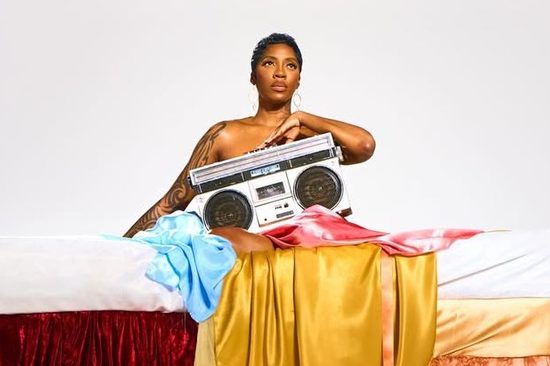
Tiwa Savage is the kind of personality who you can feel enter a room seconds before you actually see them. It’s not just the rustle of her impeccably fashionable clothes, but that certain intangible presence that many of the most magnetic performers share; the fragrance that fills the room soon after only amplifies the impression.
But her excitement is palpable as well, because she’s eager to talk about her fourth studio album and her official first foray into R&B, “This One Is Personal.” After helping shape the sound of modern African music for over a decade (and earning the title “the Queen of Afrobeats”), Savage is taking more risks both thematically and sonically.
The set finds her circling back to her roots: first as a jazz student, then as an R&B songwriter, reigniting the passion that made her fall in love with performing in the first place. Savage first broke out with her 2011 single “Kele Kele (Love)” under Don Jazzy’s Mavin Recordings, now home to Ayra Starr, Rema, and more. The Grammy-nominated singer spent the early 2010s racking up hits in Europe and Africa, then sent her momentum into overdrive with an appearance on Beyoncé’s 2019 “The Lion King: The Gift” and her 2020 U.S. breakthrough album “Celia.” She began work on the new album in 2023.
“This project is bringing me back to when I first started,” she says. “I can’t wait to tour and bring it to life.”
At 45, the Nigerian superstar is letting her hair down, pairing sonic expansion with themes of industry stressors, romance, insecurity, and casual entanglements (highlighted on latest single “10%”), which she jokes, “That’s just me being naughty for a second. Like, Ooh, I’m outside.”
The title of “This One Is Personal” is no accident: much of the album was cut live in jam sessions, with contributions from rising Nigerian talent Taves, UK rap titan Skepta, and Grammy-winning songwriter James Fauntleroy (Rihanna, SZA, Justin Bieber).
Variety caught up with Savage earlier in the fall to talk about the new album and her plans around it.
What has the reception to your R&B debut been like?
I’m so excited. Especially being here in America and having people love it. You could do a record and people are like, “You should just stay in your Afrobeats lane.” But I’m getting so much love from people like a Joe Budden and the different people I’ve spoken to. Them loving it and really giving me that co-sign is incredible.
This album is more of a return to your foundation as a graduate from Berklee College of Music and an R&B songwriter. Was there anyone you were hoping to get approval from, or someone’s opinion that mattered to you?
Normally, before, I would definitely play my album to certain people in the industry I respected. But I didn’t with this one. Not because I was being cocky or arrogant, but it was so personal to me that your opinion wouldn’t have changed anything. I was so intentional with this record. I took over two years to complete it from start to finish. If anything, maybe my fans. I hoped they would understand and connect to it, which they have — more than any other project I’ve done.
Initially, I thought, oh, it’s a bit too personal and people might not connect. But we are all human and we all go through the same thing.
You had only a few features on this project. Was this a ‘less-is-more’ approach?
I didn’t set out to be like, I want this type of person on my record. I went to the studio, played a couple of records to Skepta in London, and we’d always talked about going in the studio. I played him [“You 4 Me”], he loved it, and I asked him to jump on it. We’ve not really seen him in this light. He’s tough, but here he was rapping and being romantic and sweet. I loved that.
And when I did the song “Addicted,” I thought this sounds like something Taves would do and I couldn’t think of anybody else. James Fauntleroy, I’ve known him for so long and always wanted to work with him, especially on something more R&B-leaning.
Last year while speaking to Variety about your acting debut, “Water & Garri,” you mentioned being bored with the traditional album and promotion cycle. Do you feel inspired to reintroduce yourself this time around, especially with new music and and a new sound?
To be honest, I didn’t feel like I was low-key because I was in the studio working. It just felt like such a busy period. But publicly, it might have appeared that I was low-key. I recorded in Nashville, San Francisco, Malibu, London, L.A. — different camps everywhere.
I was very intentional with this project. I wanted to bring live music into it, because we don’t really have that anymore. On “10%” and a few other records, the instrumentation is all live. In Nashville I flew over the guitarist, the bass player, the keys, and we had a live horn section. All of that on “10%” is live. It was crazy trying to mix live instruments, but it was important for me because a lot of people don’t know my music education background. How would they if I don’t put it into my project? It was important for me to showcase my musicality.
You started off as an R&B songwriter. During that time, you connected with Frank Ocean. How do you reflect on knowing him then?
People are gonna think I’m capping, but I’m not. We’re not connected now, but when we were coming up as songwriters, I knew he was special. There was something incredible about him. Very quiet, very reserved, but when he spoke it was profound. When he went into the booth and put down a melody, you knew there was something about his tone.
Being around him, around James [Fauntleroy] — it prepared me for this moment. To go with my gut and believe in myself. Before, I played more into what the audience wanted, the Afrobeats audience. I was calculating, creating hit records and pop records. Now, I’m getting back into that mentality I learned from people like James and Frank — you just have to be authentic and true to yourself and the music.
“The Lion King” album in 2019 was such an introduction for so many people into African music. Now you’re coming into R&B — it almost feels like a swap. How has it been navigating more of the urban, R&B space?
First of all, huge shout-out to Beyoncé for even doing that project. It introduced a lot of people to myself and other amazing African artists. That opened a lot of doors. For me, going back to R&B, it’s been incredible to be given the opportunity to be on these platforms and do something people didn’t really know me for. I’m grateful because I know the music is good, but having it received like this is reassuring that I’m doing the right thing.
What has been the biggest difference between African media and U.S. or U.K. mainstream media?
I’ve shied away from [Nigerian media] before, but I don’t want my people to feel like I’ve forgotten about Nigerian or African media. The huge difference is, interviews abroad are really focused on me, not my personal life. Back home it’s different. Maybe because they don’t know all the controversies, or maybe they do but they’re more respectful. To them, that doesn’t matter.
Like me having tattoos — it’s such a big deal in Africa. I can’t imagine Joe Budden being like, “Yo, you got tats.” To them it’s not news. That’s the big difference.
Even with you making this pivot into R&B, there’s been a conversation about the state of African music and Afrobeats. What’s your opinion?
I understand where Afrobeats artists are coming from. Just because you’re African, it feels like we’re boxed in — that we can’t do hip-hop, country, or R&B. But globally, genre is blending so much. Hip-hop artists sing now, they mix that, so are they R&B, hip-hop, trap soul? It’s hard to box any artist. I don’t know the solution, but I know it’s not just for us. It’s a general music industry conversation.
You’ve “relinquished” the title Queen of Afrobeats to a degree. You’ve said there are others who’ve also contributed to the growth of the genre, so you don’t want it just zoned in on you. But is that you being modest, or is that really how you feel?
I do embrace it. I can’t run from it. A friend told me yesterday, you can’t run away from it because you were one of the pioneers and one of the first females to do a lot or be the first of many things. So I’m learning to embrace it. While I’m embracing it, I’m also appreciating others. As women, we don’t always get our flowers. So while I’m receiving mine, I’m extending some to other women, too.
What’s one thing you know now that you wish you knew earlier in your career?
Not the very beginning, but earlier — I wish I’d done this type of R&B leaning project with my full chest. I wish I’d done it a lot earlier.
