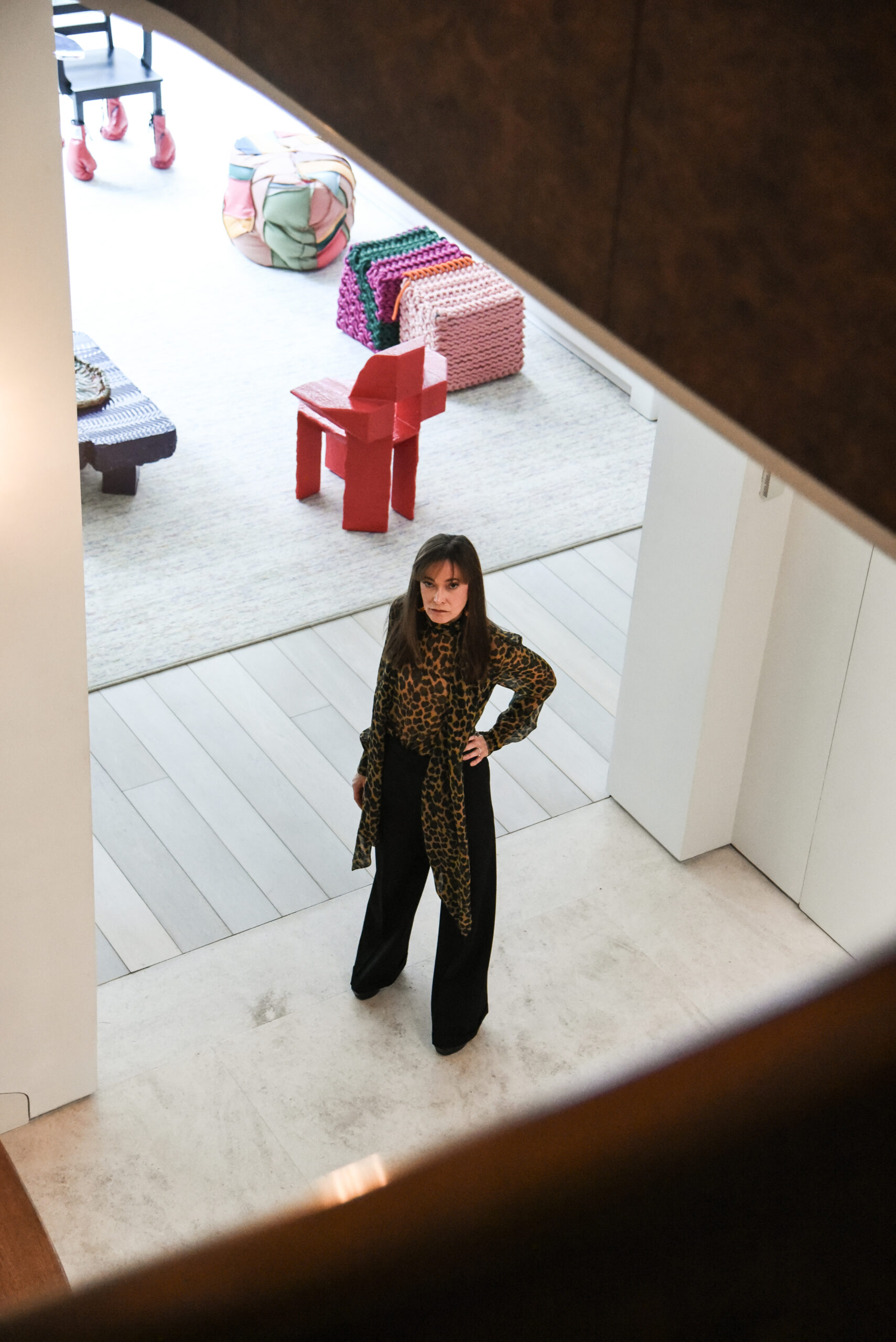

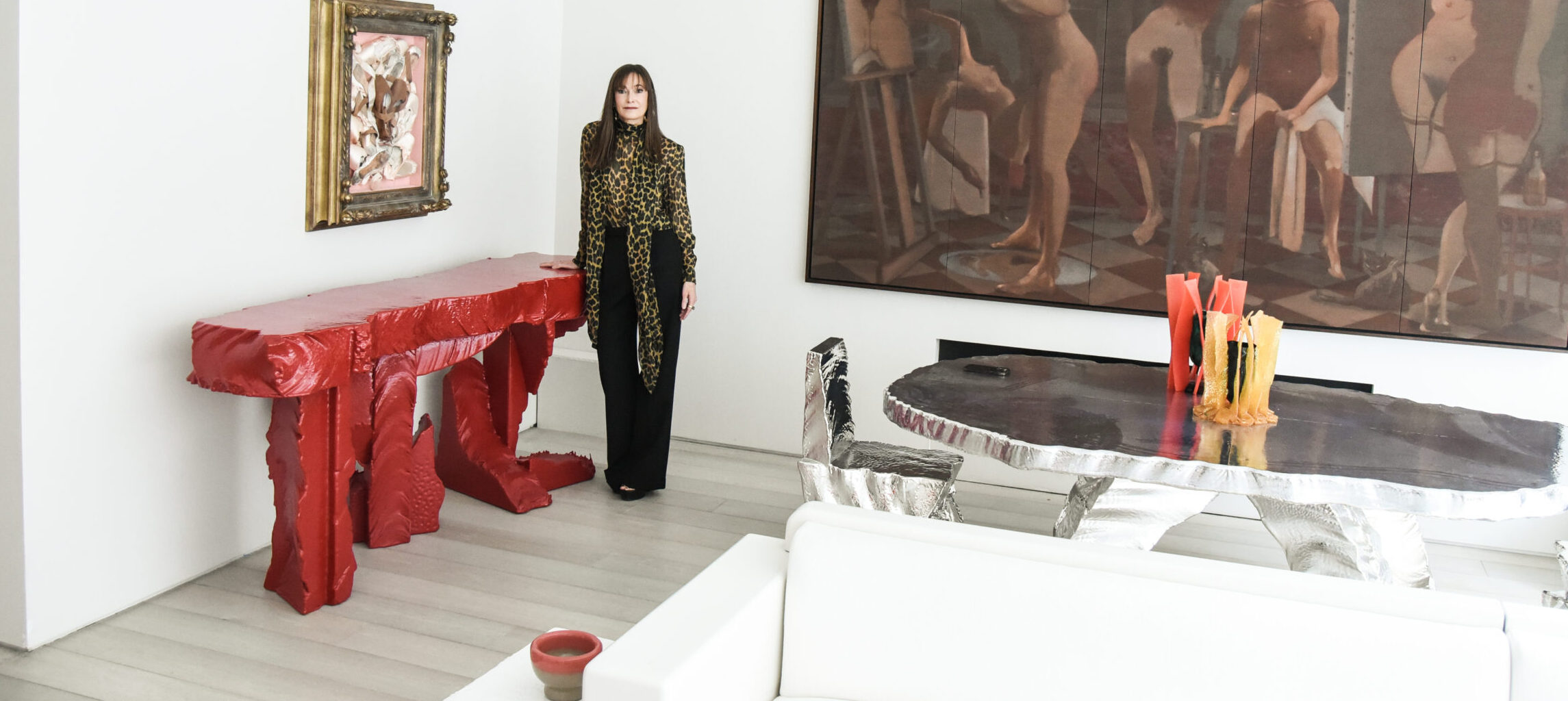
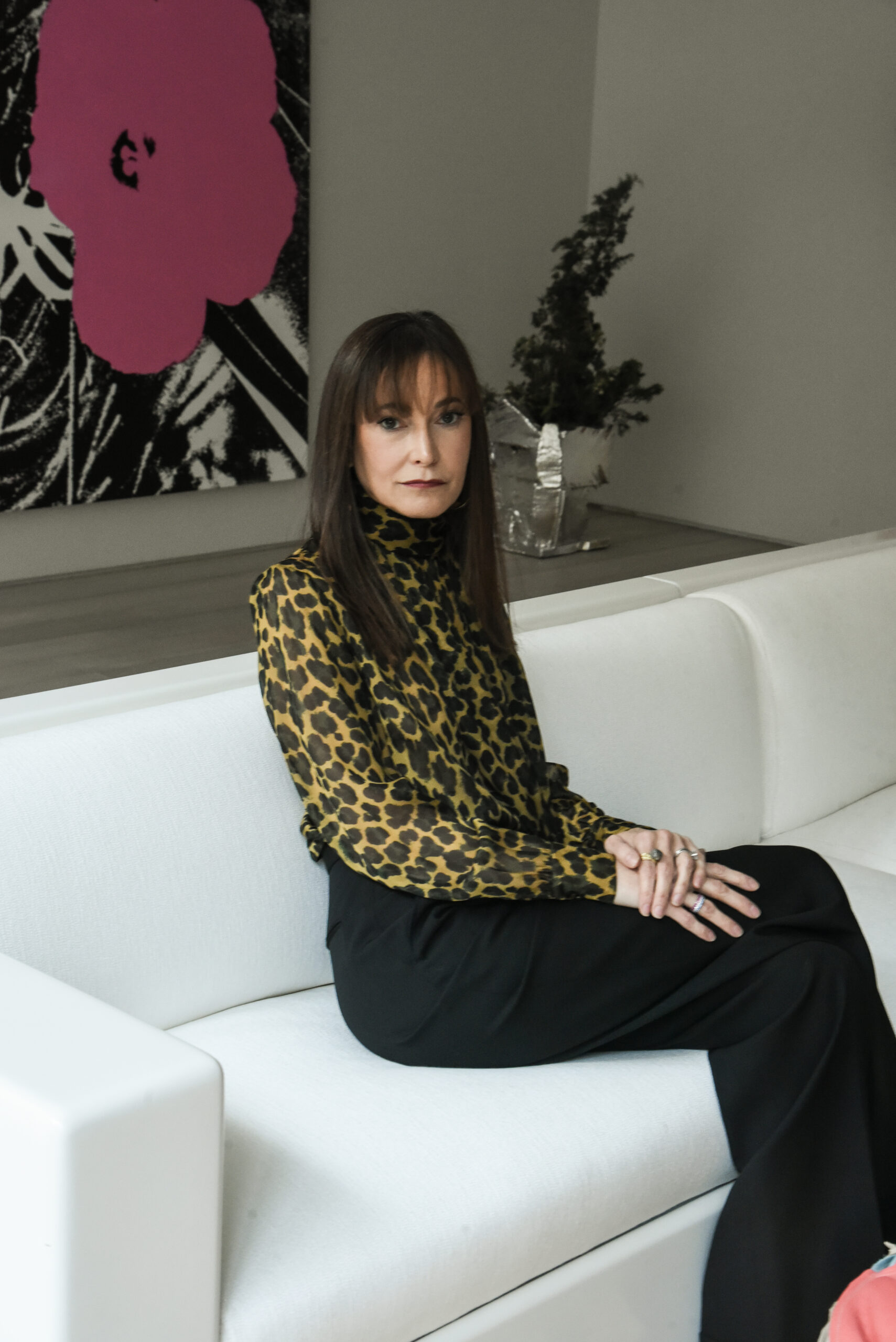
Jeanne Greenberg Rohatyn, photographed by Matt Weinberger.
During a walkthrough of Jeanne Greenberg Rohatyn’s Upper East Side townhouse last month, she described her home as something of a laboratory: a testing ground for her curatorial fixations and artistic affinities, some of which make their way over to Salon 94, her nearby gallery, and others she keeps for herself. Steering me through her personal collection, the 58-year-old curator lingered at a corner where a vase by the Kenyan artist Magdalene Odundo rests on a “frou-frou” antique Beaux-Arts French wine cooler (an heirloom she’s just inherited from her parents, seasoned art dealers themselves). Just beside it, a faintly humorous, gloopy sculpture gifted to her by the architect Gaetano Pesce sits by its lonesome. The grouping feels charming and assertive, emblematic of Greenberg Rohatyn’s commitment to discord. “I don’t ask anybody what they think the Pesce looks like with the Odundo. I actually don’t care,” she laughs. “That’s kind of rude to say, but it’s very specific. My job is to think in a much more forward manner about putting unlike objects together—of different speeds and different sensibilities” It’s a job she’s been doing, and a skill set she’s been refining, for over three decades. And though Greenberg Rohatyn is most often cited as a pioneering force merging the worlds of design and fine art, she’s held in equally high regard for having championed the careers of artists like Huma Bhabha, Marilyn Minter, and Laurie Simmons. Who else, then, might this art world tastemaker have her eye on? As we glided from floor to floor, she delved further into the pieces that inspire and continue to reframe her own vision, including works by Karon Davis, David Hammons, and the french designer Maria Pergay.
———
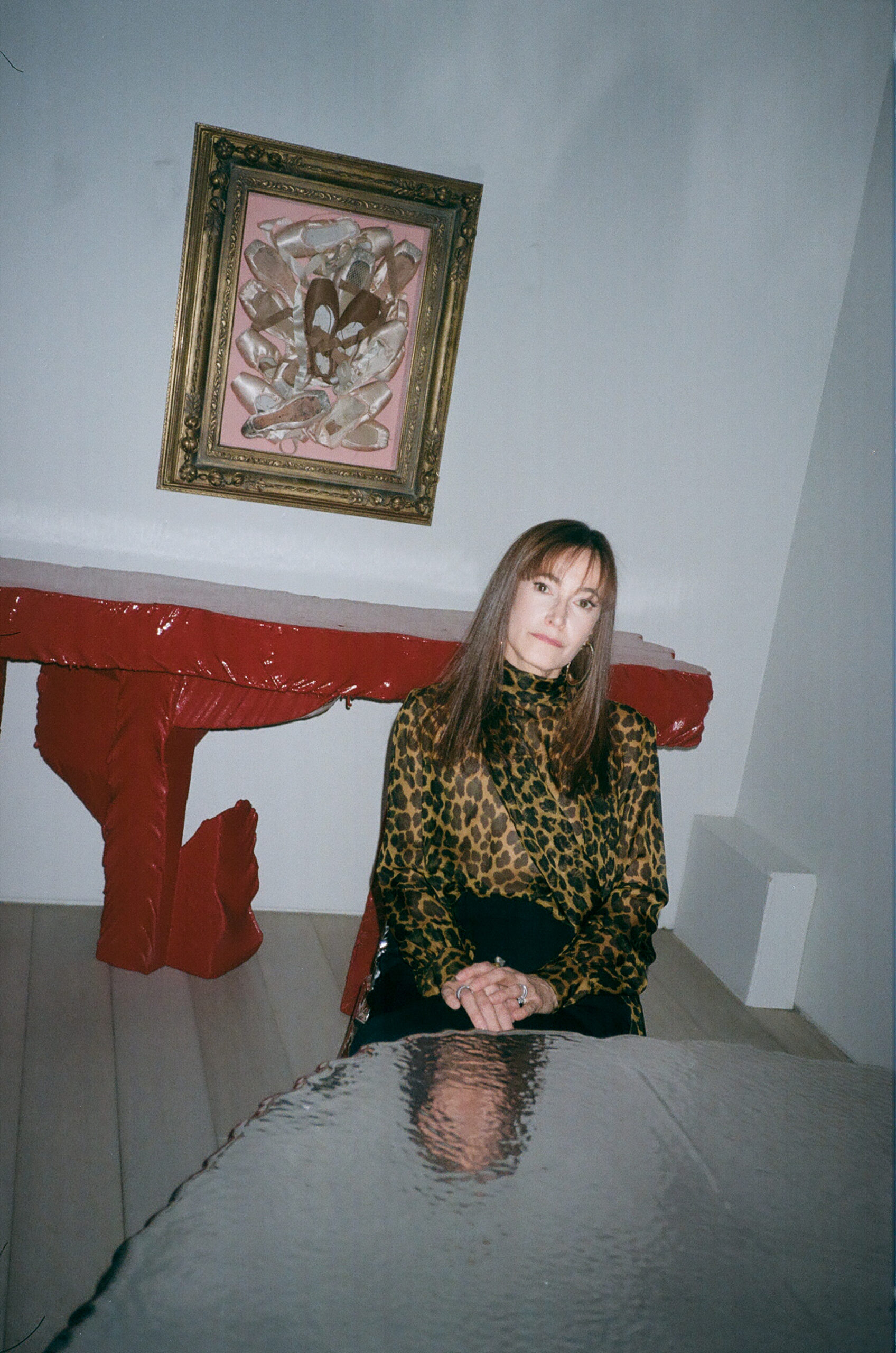
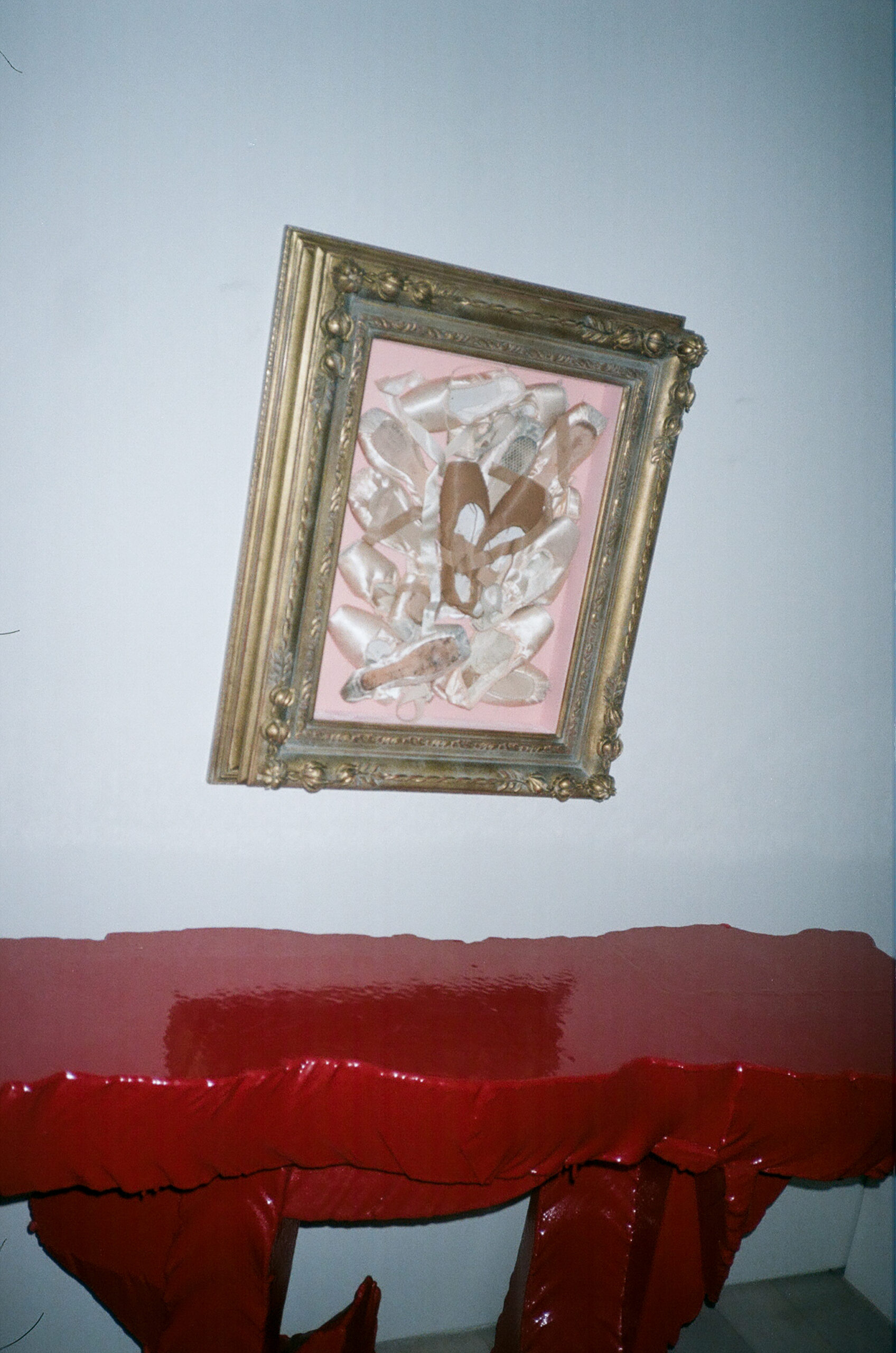
“When we did Beauty Must Suffer by Karon Davis at the gallery, we had so many Black dancers come by and tell us their stories. One sat down with her legs wide open, her elbows down on the ground just crying, talking about pancaking, and her toe shoes growing up. You can only get brown toe shoes special order, so most of the Black ballerinas still have to pancake their shoes to match their skin. And in ballet, you want that full extension, so your toe shoes are supposed to match whatever stockings you’re wearing. Karon grew up in a household where her mother and sister were constantly dyeing their stockings brown. This shows you the one pair of pancaked shoes with the other used slippers or toe shoes. The frame itself we made for the exhibition. It has these cotton flowers which reference cotton-picking, and also the cotton that the ballerinas fill their toe shoes with. When you take them off, most of the cotton is all bloodied from being on their toes. It’s one of the last art forms to adjust to multiculturalism. The fact that this is such a glaring indication of that, there’s a bit of a heartbreak there, but it’s also incredibly beautiful. I love this idea that you dance one performance and then your toe shoe is done. There’s this element of performance that’s so fleeting. A dance troupe goes through something like 8,000 toe shoes in a year.”
———
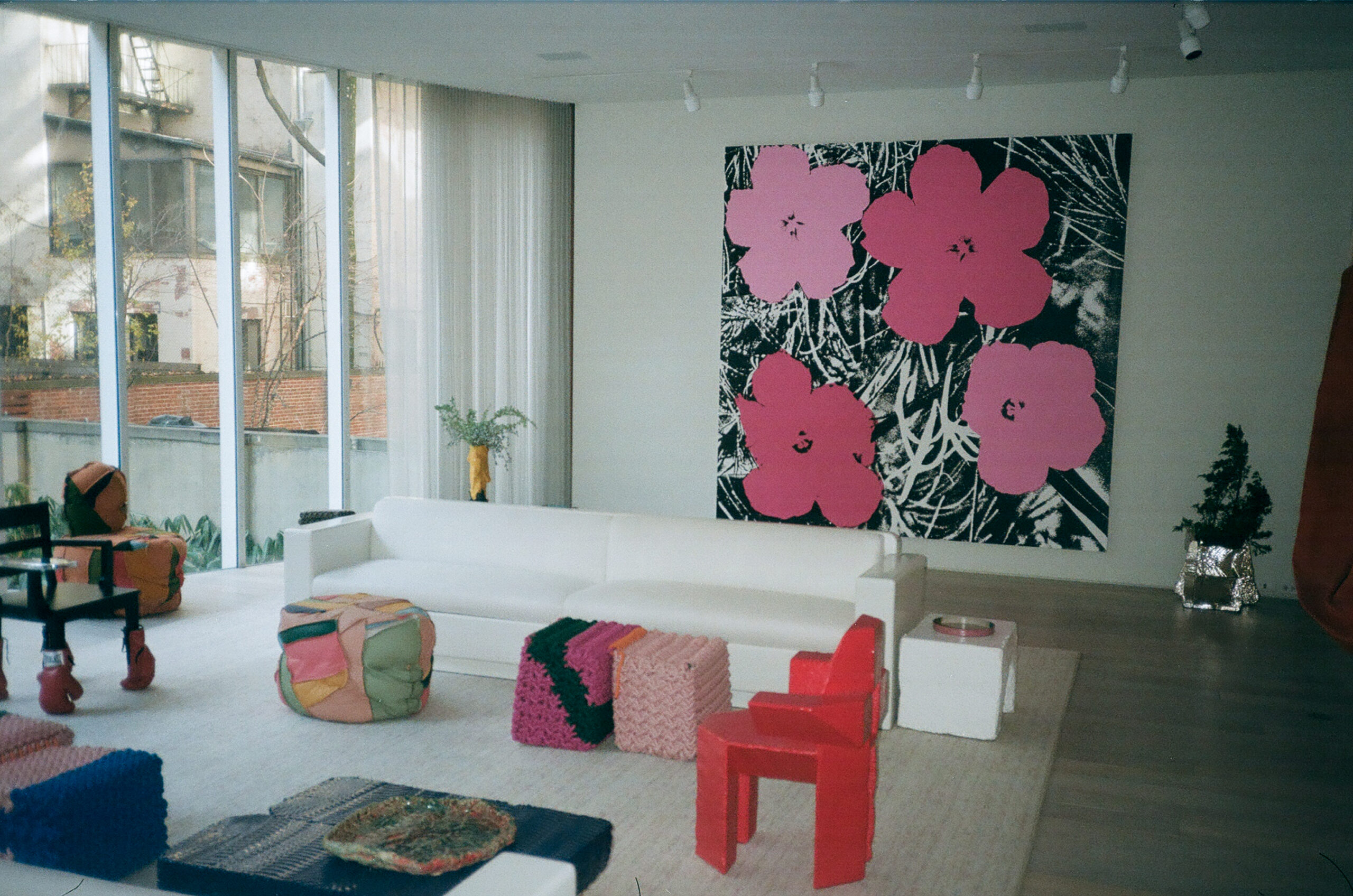
“It’s the perfect collaboration between [Andy] Warhol and female artists as well. These actually come from the pictures of John F. Kennedy’s funeral. The first time he showed the flowers was when he showed the Jackie O. pictures from the funeral where there’s her crying and he’s the smiling. They’re actually part of his Death & Disaster Series. They’re really kind of funeral… They’re an American event.”
———
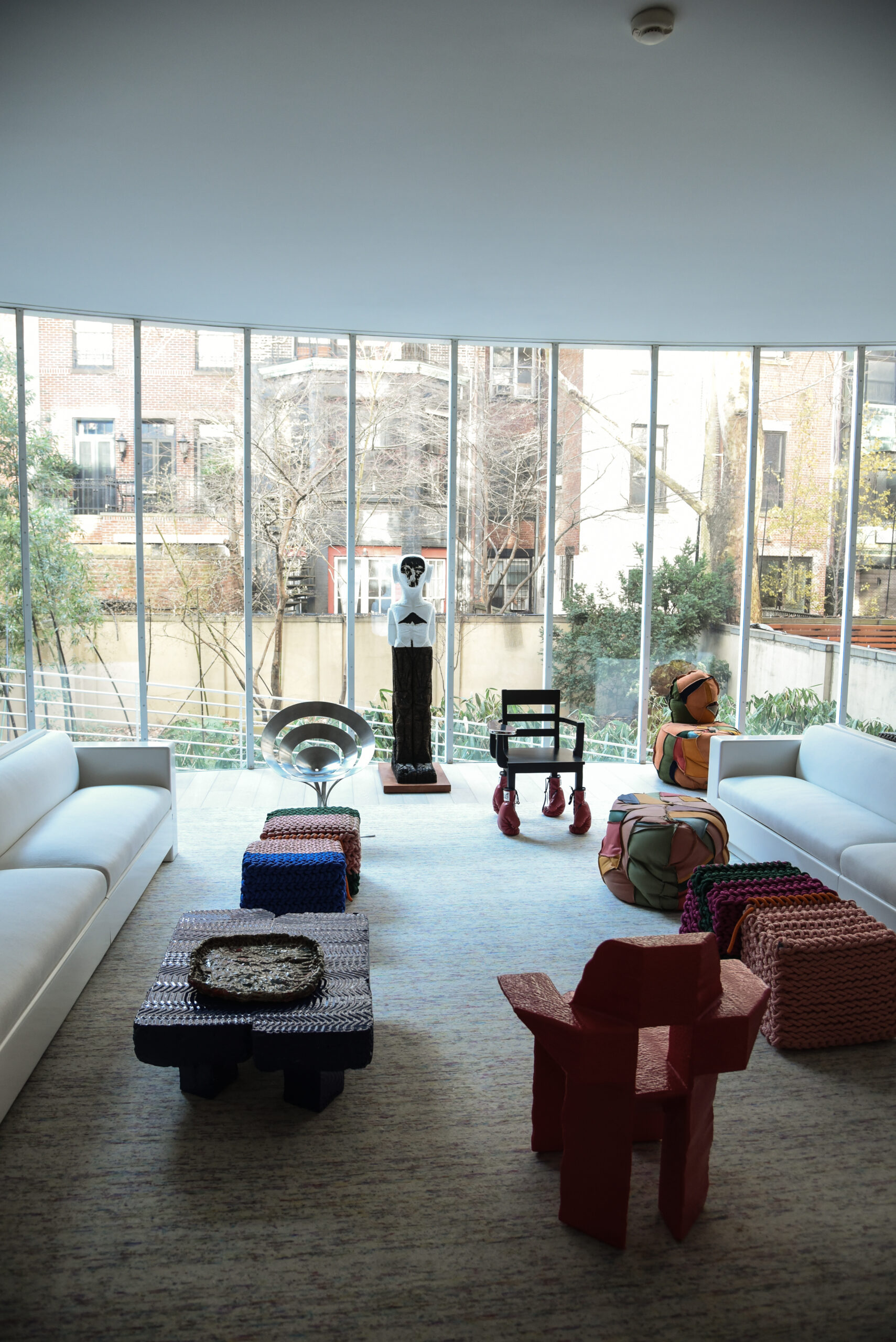
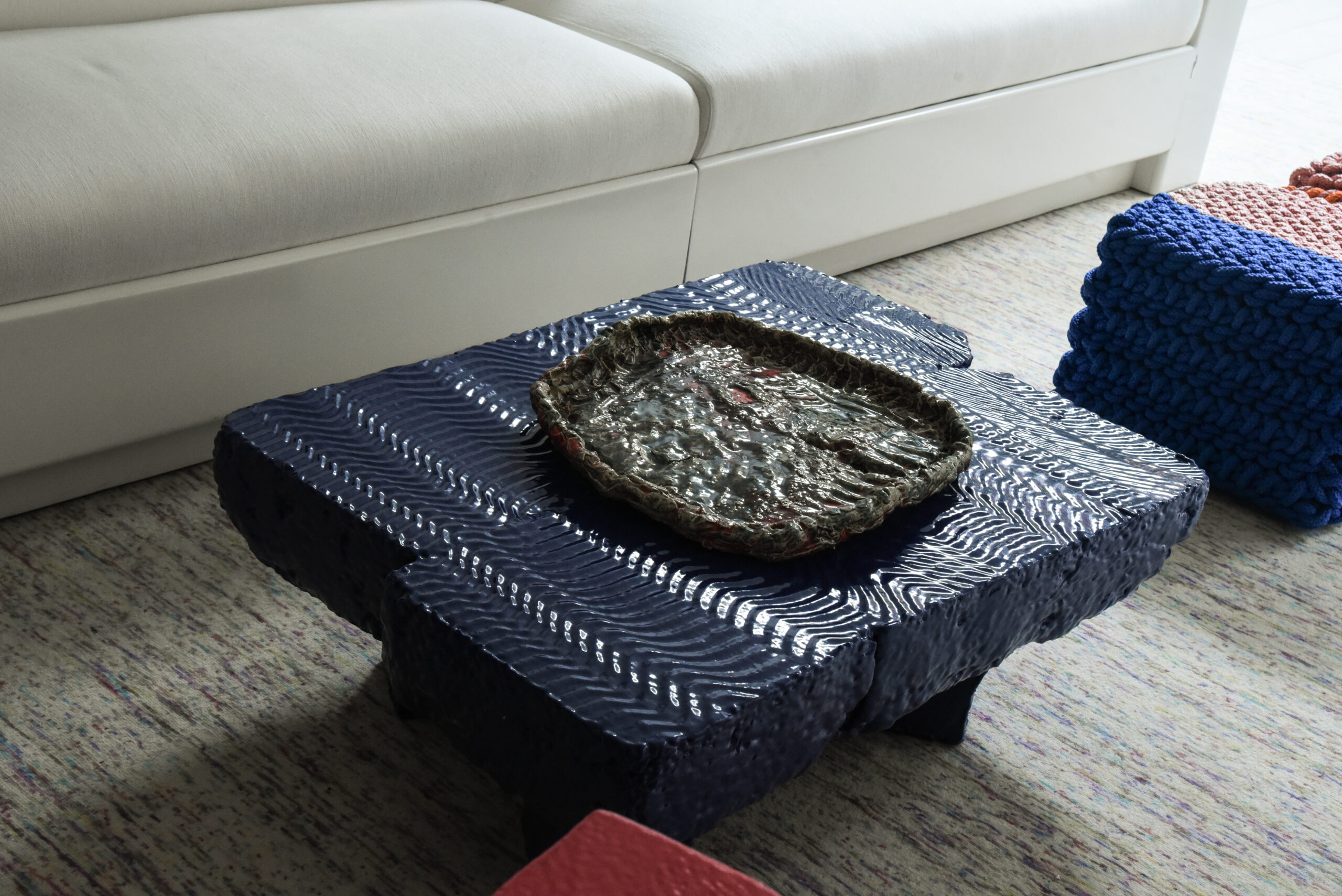
“The tray is a Sterling Ruby. The story is that when he went to take his first ceramic class, they said, Okay, we’re not making pinch pots, because the pinch pot is the first thing you learn when you’re manipulating clay. Of course, he spent the entire class for the next several months making pinch pots. This is an extension of that. There is a sense of the handmade and the used that is a through line throughout my collection. But it’s so elemental, too. And his glaze is so good.”
———
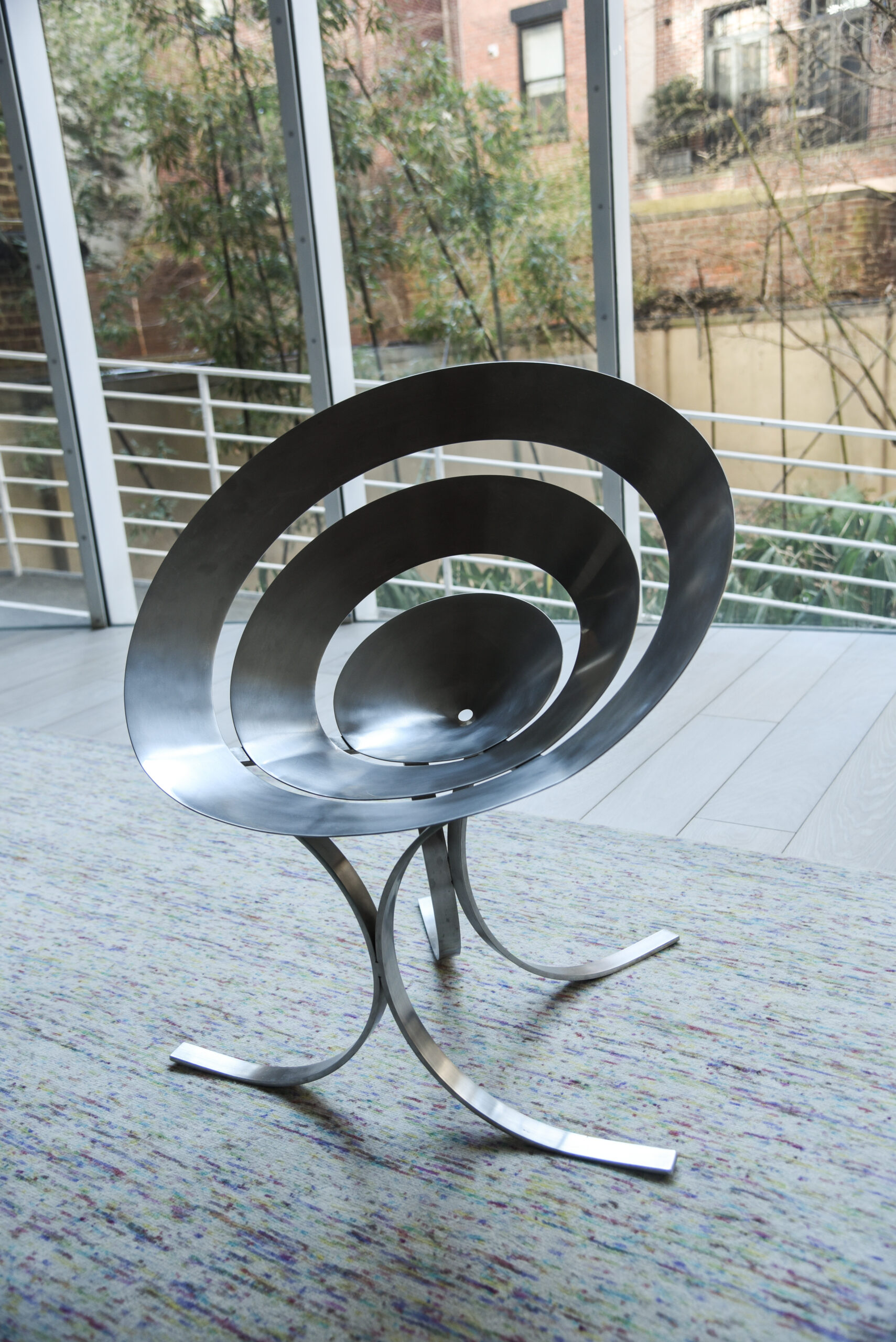
“This Maria Pergay chair is new. We just started working with her estate a few months ago. The rings either come in threes or fours. One of the famous stories of Maria Pergay is that she got the idea of this ring chair by peeling an orange for her son. I always love this idea of being inspired by a simple domestic activity. The way I learned the story was through A.I. I asked it, Can you tell me a story about Marie Pergay as a mother that relates to her design? and that’s the story it gave me. I love asking it kooky questions.”
———
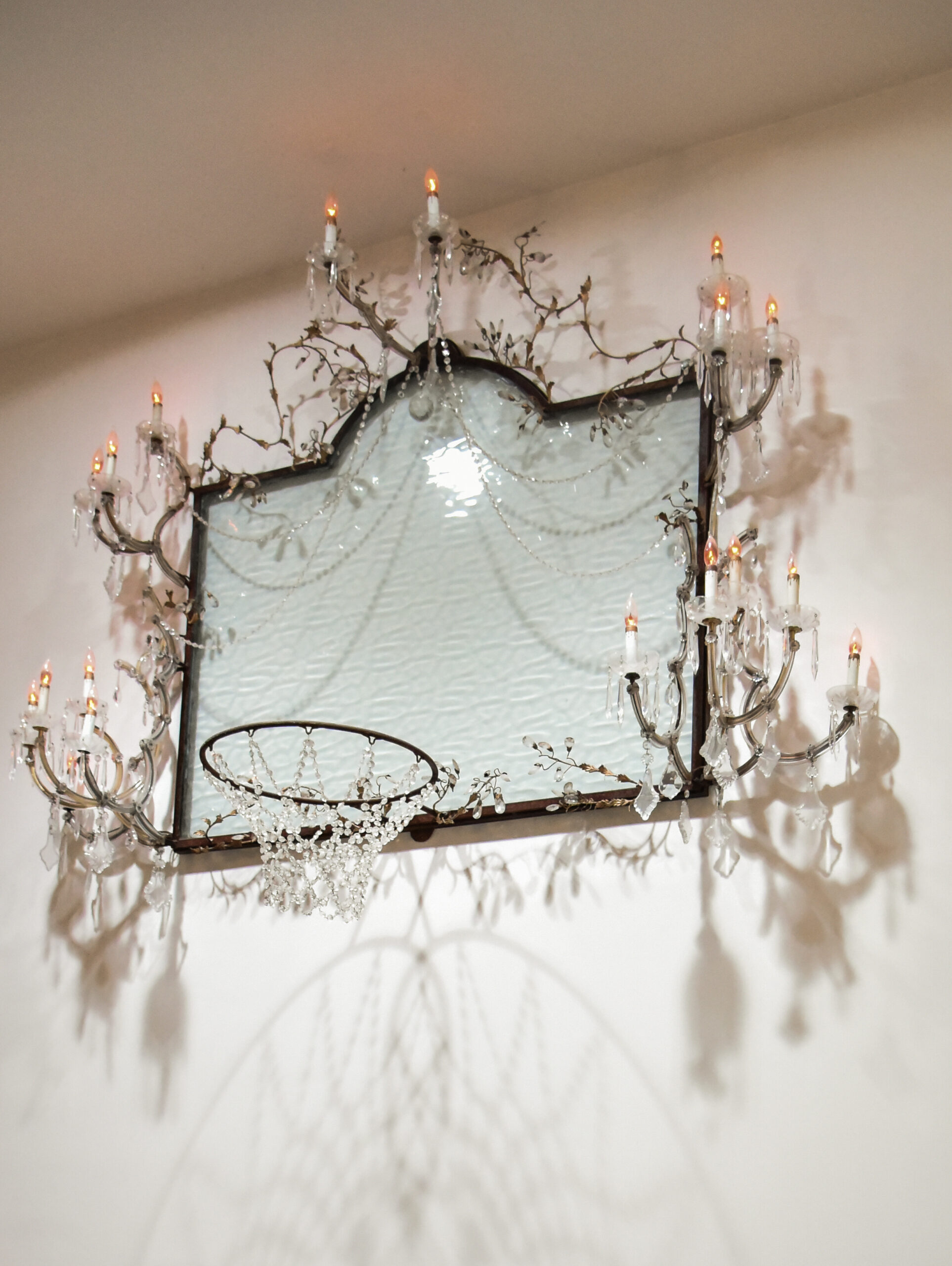
“This is the most iconic piece in the house, don’t you think? It’s actually the first work of art that we put in here. David [Hammons] chose it when we were building the house. It’s called Basketball Chandelier. He sat right there [gestures to couch] and there were these riggers, these guys with these big hands. But they couldn’t quite get a handle on where to grab on to the basketball because there’s all this other stuff there, and he was directing them where to go. It was great. I wish I had pictures of the installation day. It must have been 23 years ago. He did a big show with Hauser & Wirth, but he’s the OG of self-representation. In fact, he famously put a basketball chandelier himself into auction.”
———
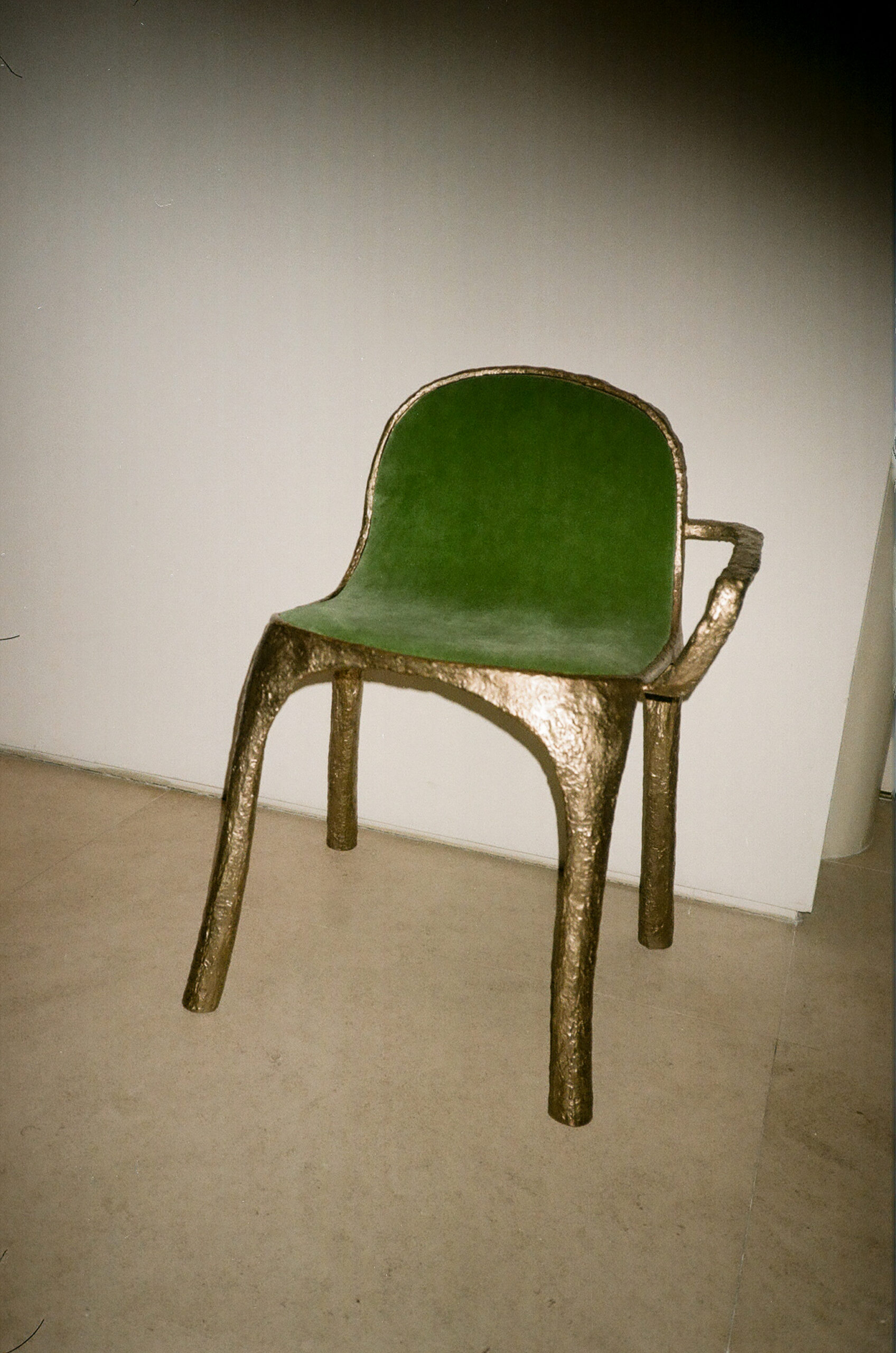
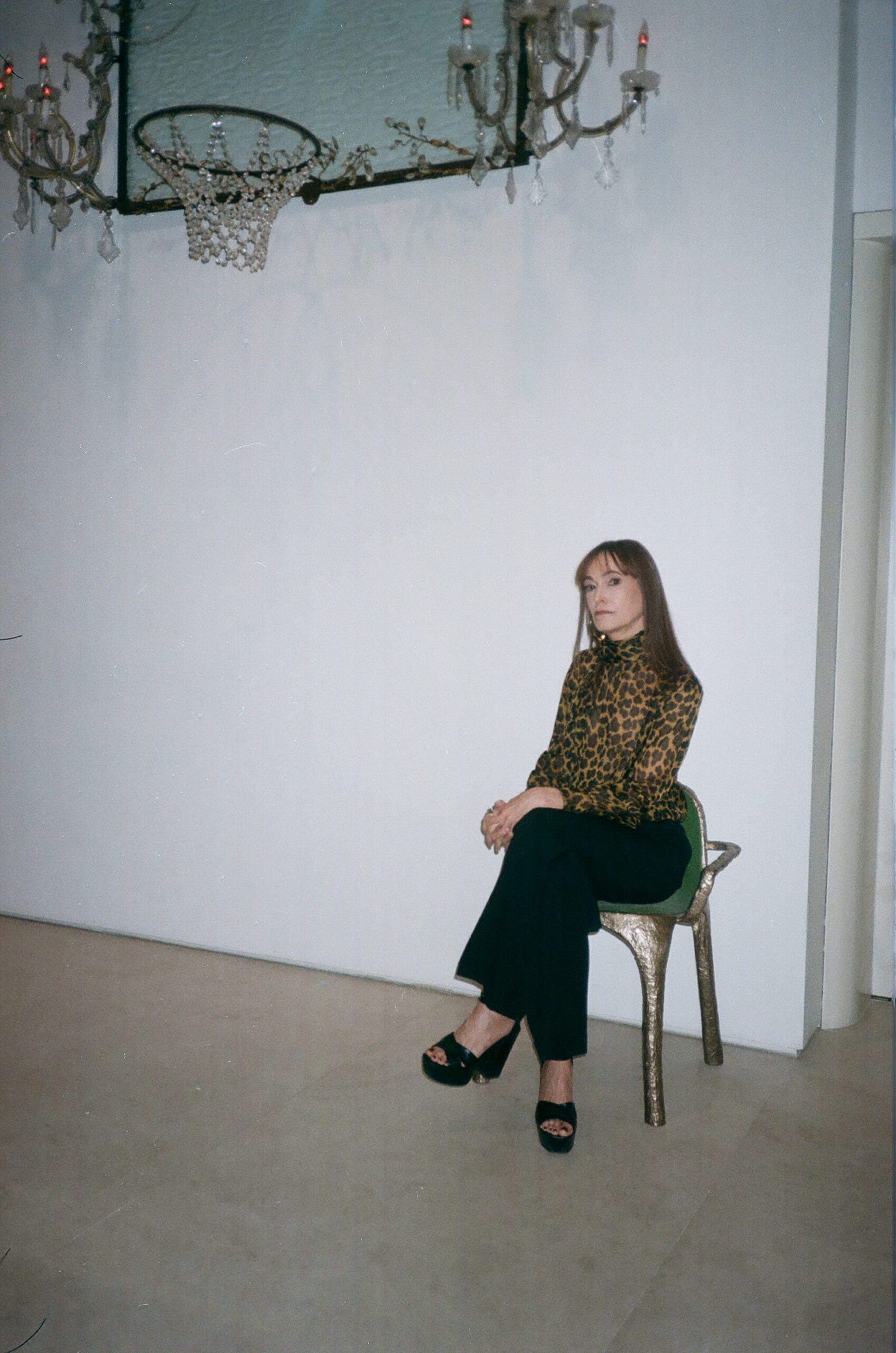
“This is a David Wiseman bronze chair. All of his work is related to nature. The upholstery that you see is imitating a body of moss. This almost looks like a branch and then there’s a little signature on the back, a little fish here. We’ve been working with David for a while, but one of the things that I love about his practice is how artisanal it is, and everything is made in his studio in Frogtown, L.A. He has his own foundry and does all of his porcelain work there. And he has this beautiful garden that’s part of the inspiration. It’s a very singular chair, but a lot of the work is lonely.”
———
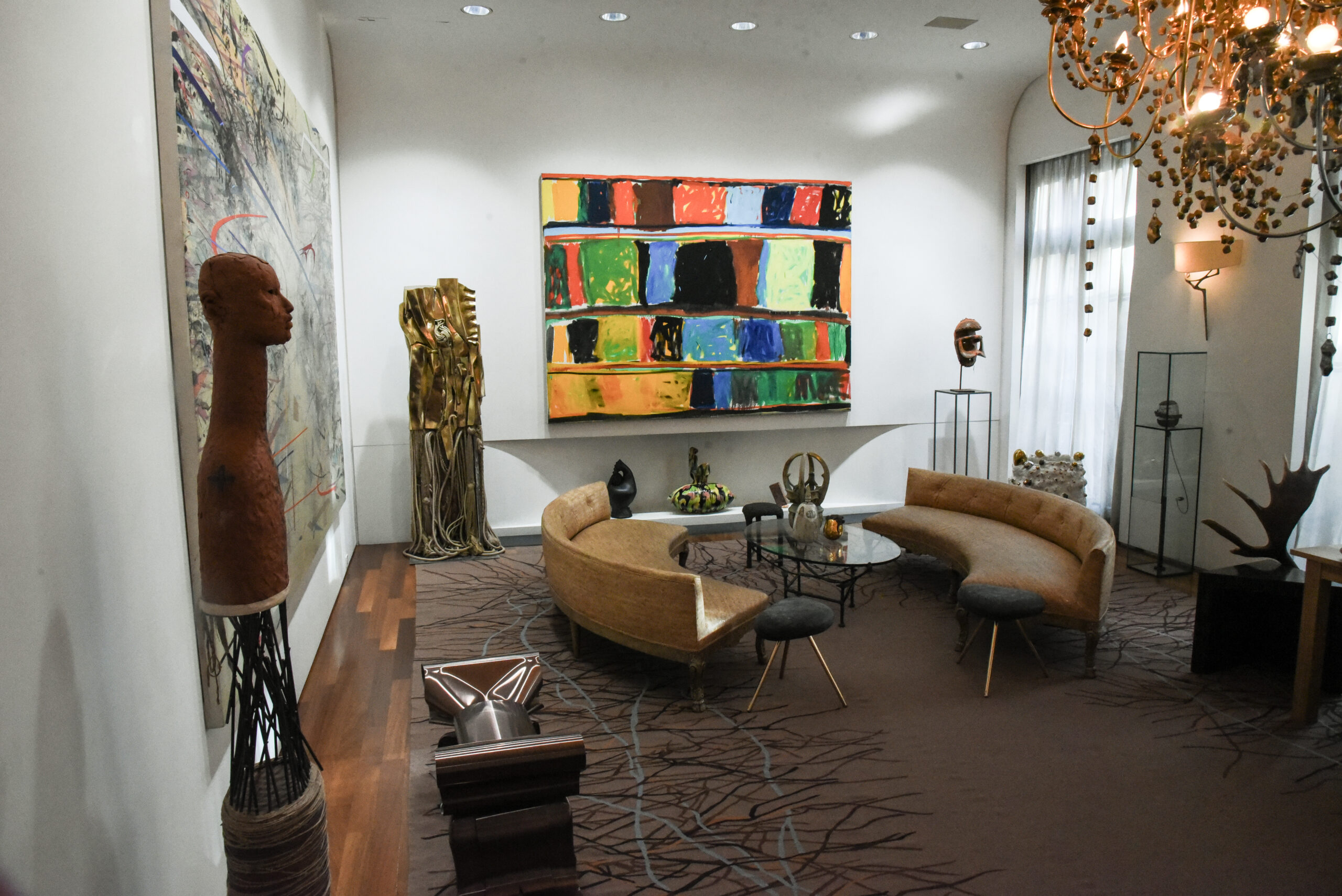
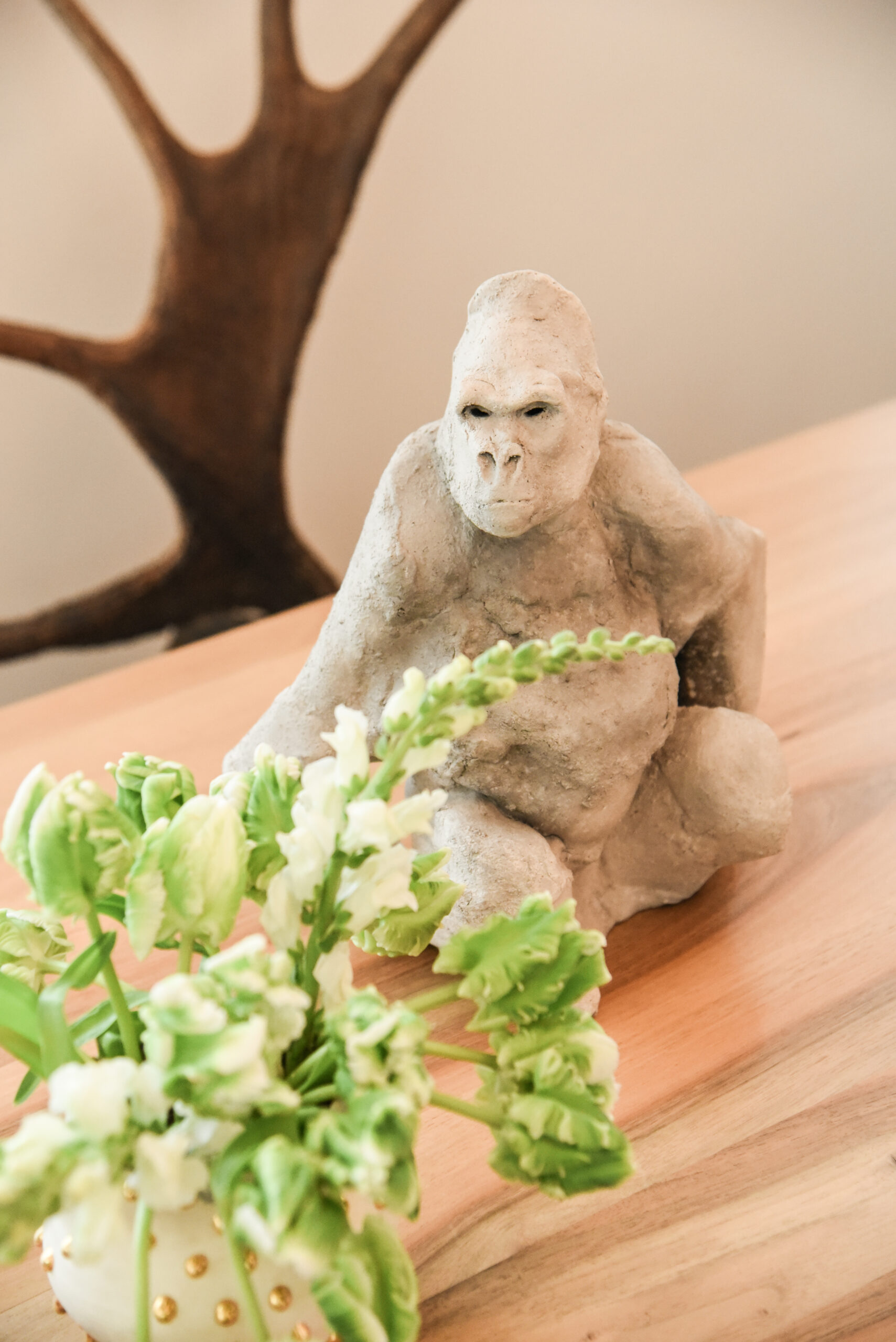
“The gorilla by Daisy Youngblood is very much about being alone–or being alone and facing a gorilla in nature. It’s about mortality in a sense. It’s is so otherworldly and human, and yet so much a gorilla. It’s kind of anthropomorphized. I’ve always been in love with Daisy Youngblood. She doesn’t make that much work, so I pursued finding the exact one that I wanted for many years. He’s amazing, very human. But is he very gorilla? Or are you just reading into it because a gorilla is part-human? What’s so uncanny about it is, you’re never face to face with a gorilla, but I imagine if you were, that gorilla might look like this. Is that a good way describing it? You definitely feel your own mortality next to it. It’s called Little Gorilla, but it’s got such a huge presence in my world.”
———
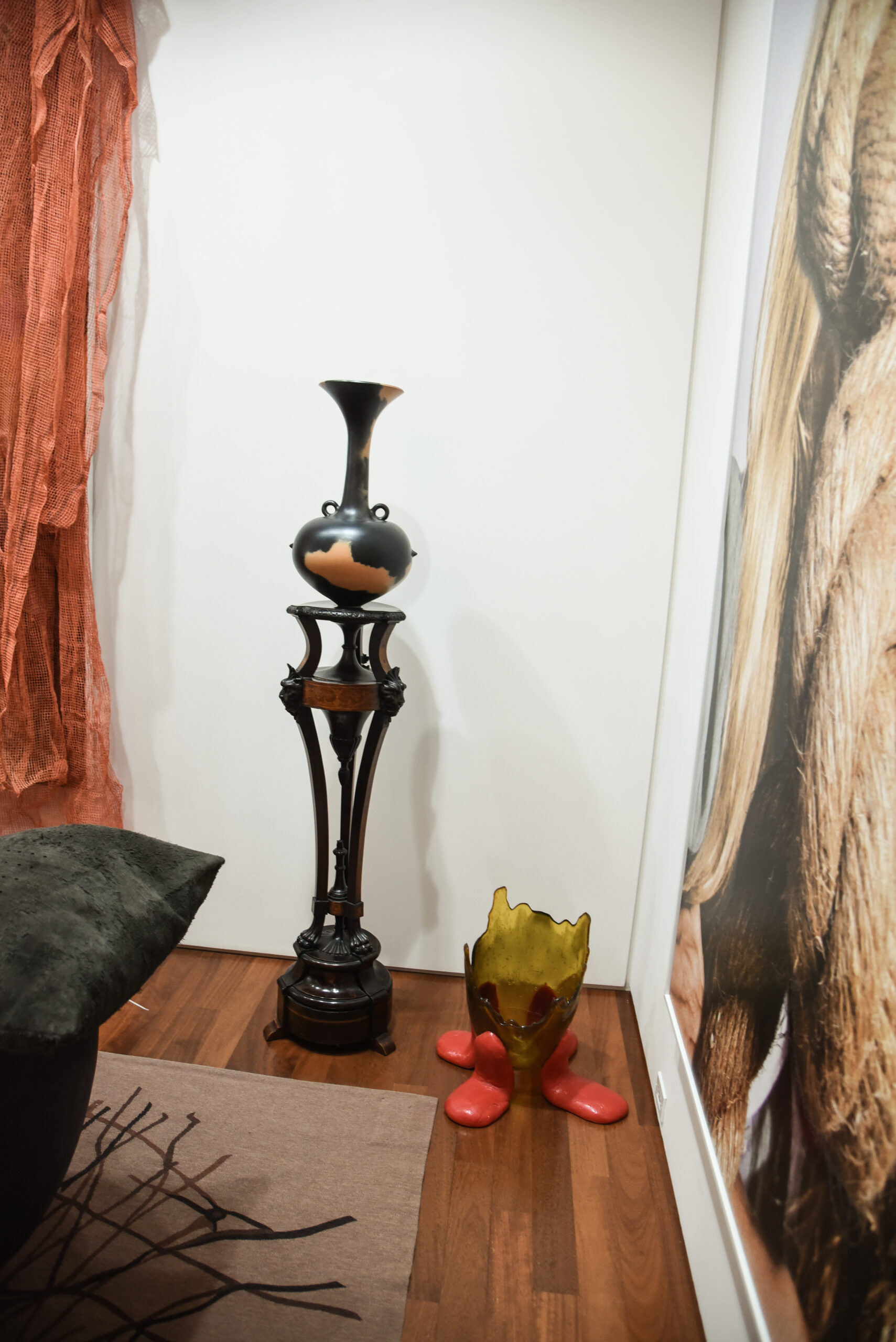
“This is a gift Gaetano Pesce gave me [right], next to the Magdalene Odundo ceramic vase [top left]. He gave it to me about maybe four or five years ago. It’s so gloppy. I bring home works as individual objects that have moved me, but when they exist in my living space, they definitely share a dialogue with something else. I’ve always imagined putting something special on my parents’ Beaux-Arts French frou-frou pedestals [bottom left], and it took me many years to imagine what would be the right objects to go on top of them. This room is a test in a sense that, if something can hold their place, and be autonomous and have its own integrity, then that means it’s a working object. It’s communicating at its own speed with its own language, but that it’s able to carry on a conversation amongst other very charismatic objects. Each object has its own speed and charisma and attitude. I’m only talking about how the objects function amongst other objects. I don’t ask anybody how they think that the Gaetano looks with the Odundo. I actually don’t care. I only care about how I feel with them. I’m sorry, that’s kind of rude to say, but it’s very specific. It’s very specific because my job is to think in a forward manner about putting unlike objects together, and taking different speeds and different sensibilities and allowing them to exist together and have a conversation together. If I can’t do that, then I’m not doing my job. Because, my job is to present you as a viewer with something that you haven’t seen before–and at the gallery, especially.”
———
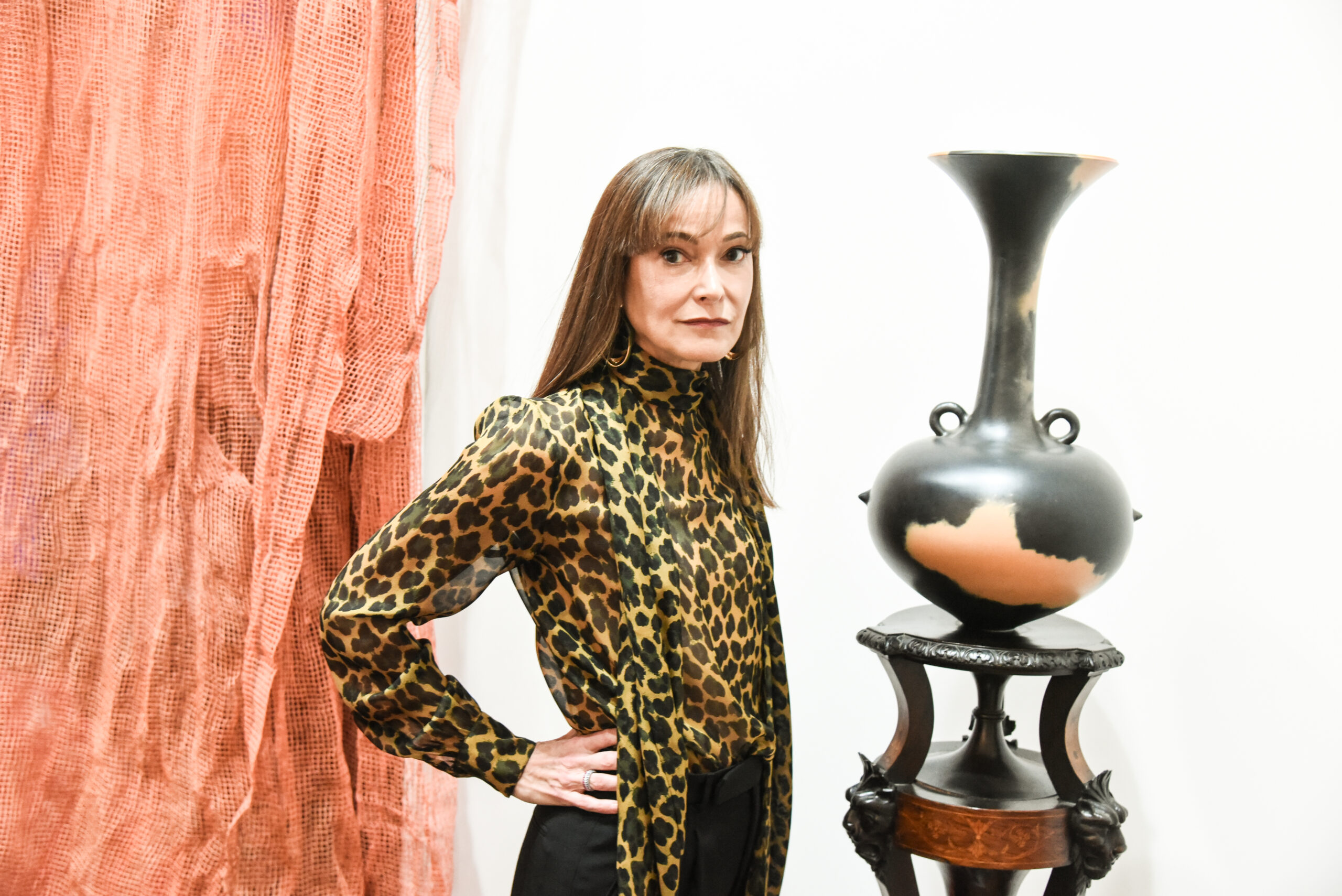
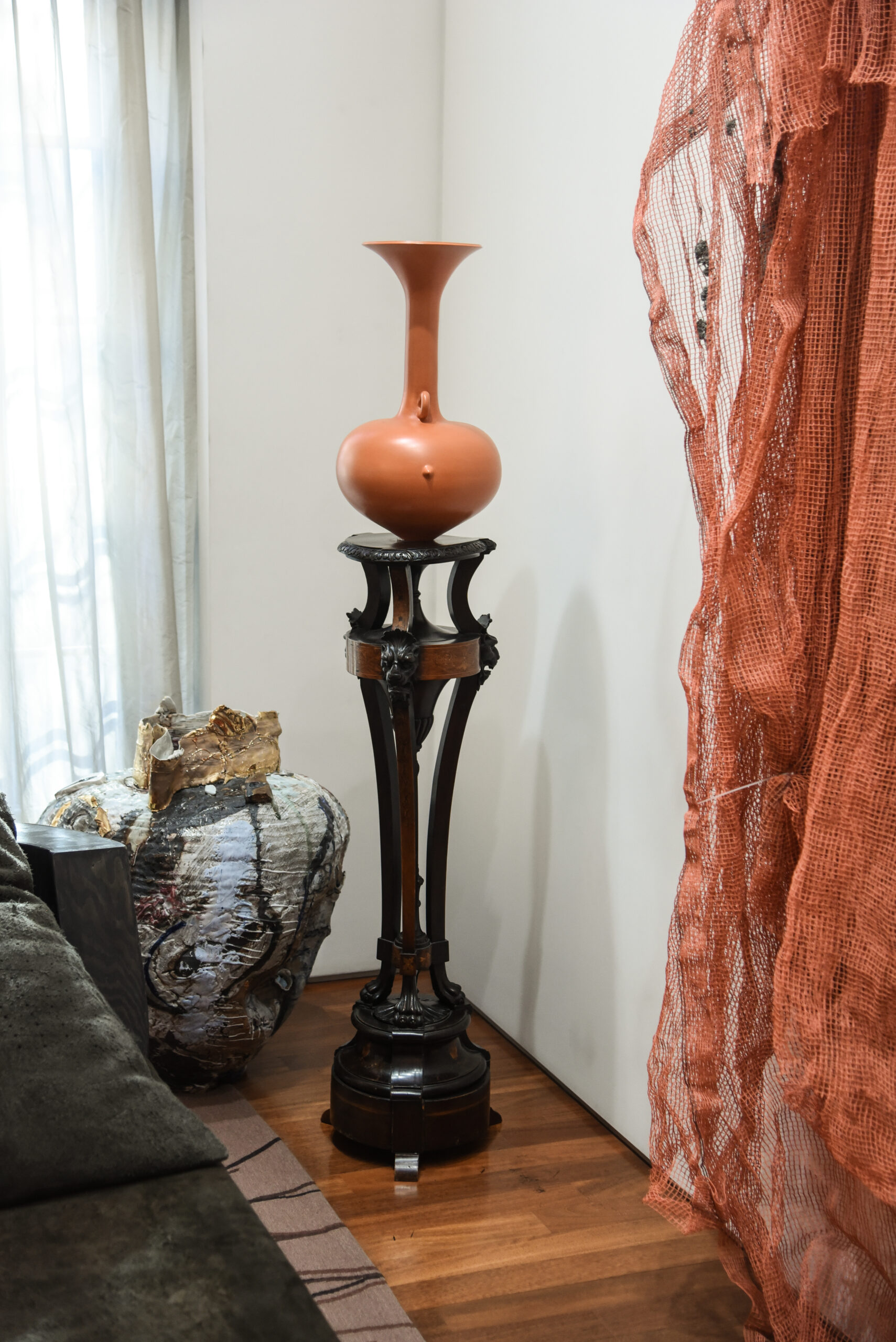
“This space is just a small laboratory where I can do that. A lot of people will say, Pesce, oh, my gosh, you can’t put that with anything. He’s a radical designer. But it’s my job to take these things and put them together and say, No, they can coexist in a space. Look at the different textures and materials. You have different processes. You have resin, which is a poured process which is very quick, whereas the Odundo vase is literally years of work and practice. She builds her ceramic vessel through a coil-based work, and then a burnishing. The impossibility of hand-making a vessel with this beautiful tall neck–I mean, talk about anthropomorphic. It’s almost like a woman with her hands on her hips. You’ve got these wonderful nipples or belly buttons. You know it’s holding something special inside. You just feel how special this is as being a female, as a vessel, and the handmadeness and every detail on it. The other thing is, when I talk about different attitudes–something that has humor, something that’s very serious, something that’s lonely–we want to cover all of the emotional spectrum when we’re looking at art. You don’t want it all to have the same measure, or the same volume. I want to have things that represent different emotional states. When Pesce gave it to me, I just plopped him in the corner, and he’s stayed there ever since. But feel him. Feel it. It’s silicone. It’s soft, but it looks like it’s supposed to imitate glass, which is really funny as well. Well, that’s the other thing with sculpture, a lot of it is meant to be touched. I have objects that you can touch, you can sit in, you can put flowers in. But the Odundo is clearly ceremonial. I want you just to look at it. I want you to be able to look around it, I want you to be able to experience it, but I don’t want you touching it.”
———
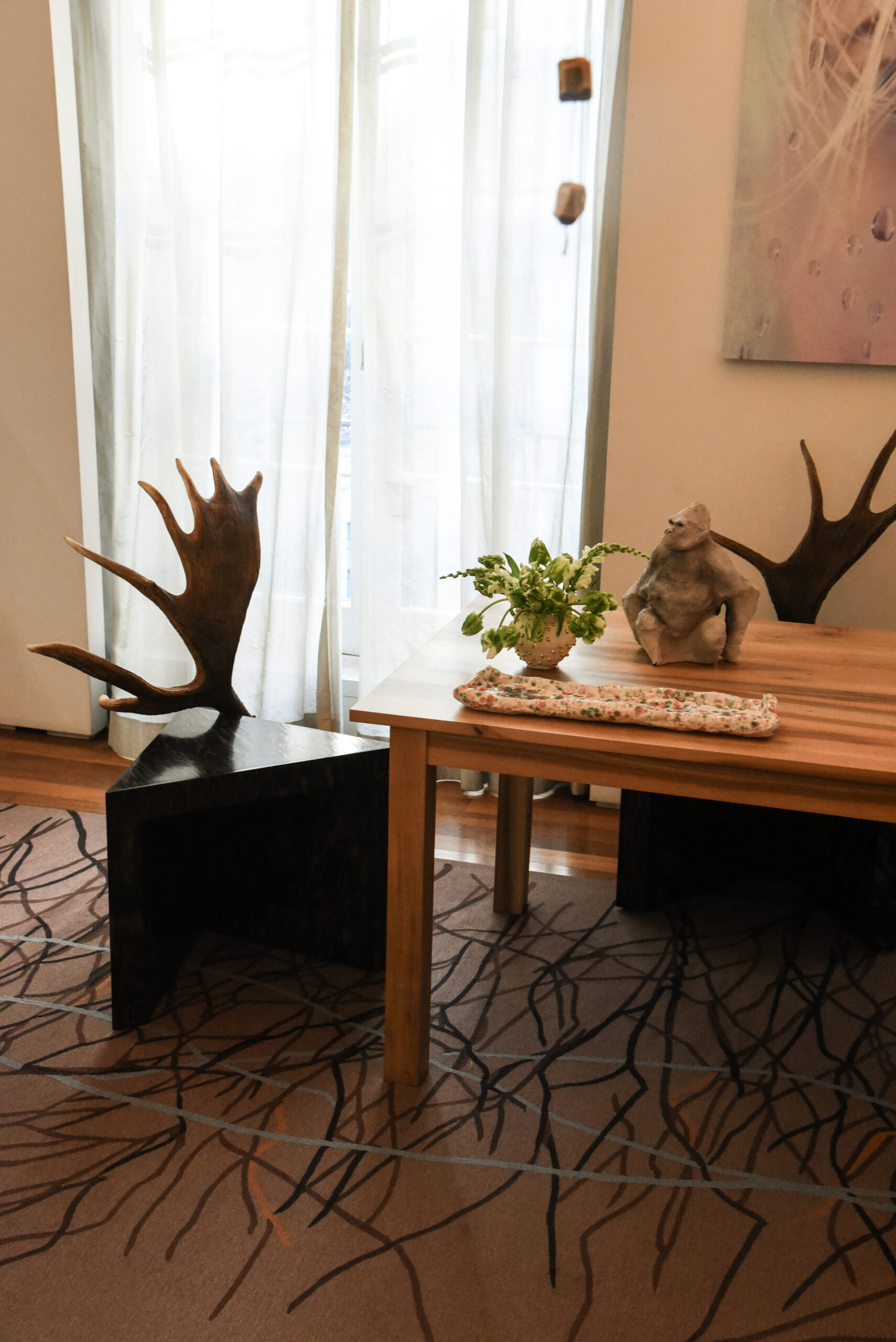
“This is a new Rick Owens antler chair. It’s a new material for him. It’s called tigerwood, which is not a real wood. It’s rather a treatment of a simple piece of plywood, and then it’s stained and shined and stained and shined to create this tiger print. So it’s very artisanal, and very upscale, but a also very modest material, which I love. And then of course the moose antlers are shed. They get them mostly in Canada.”
———
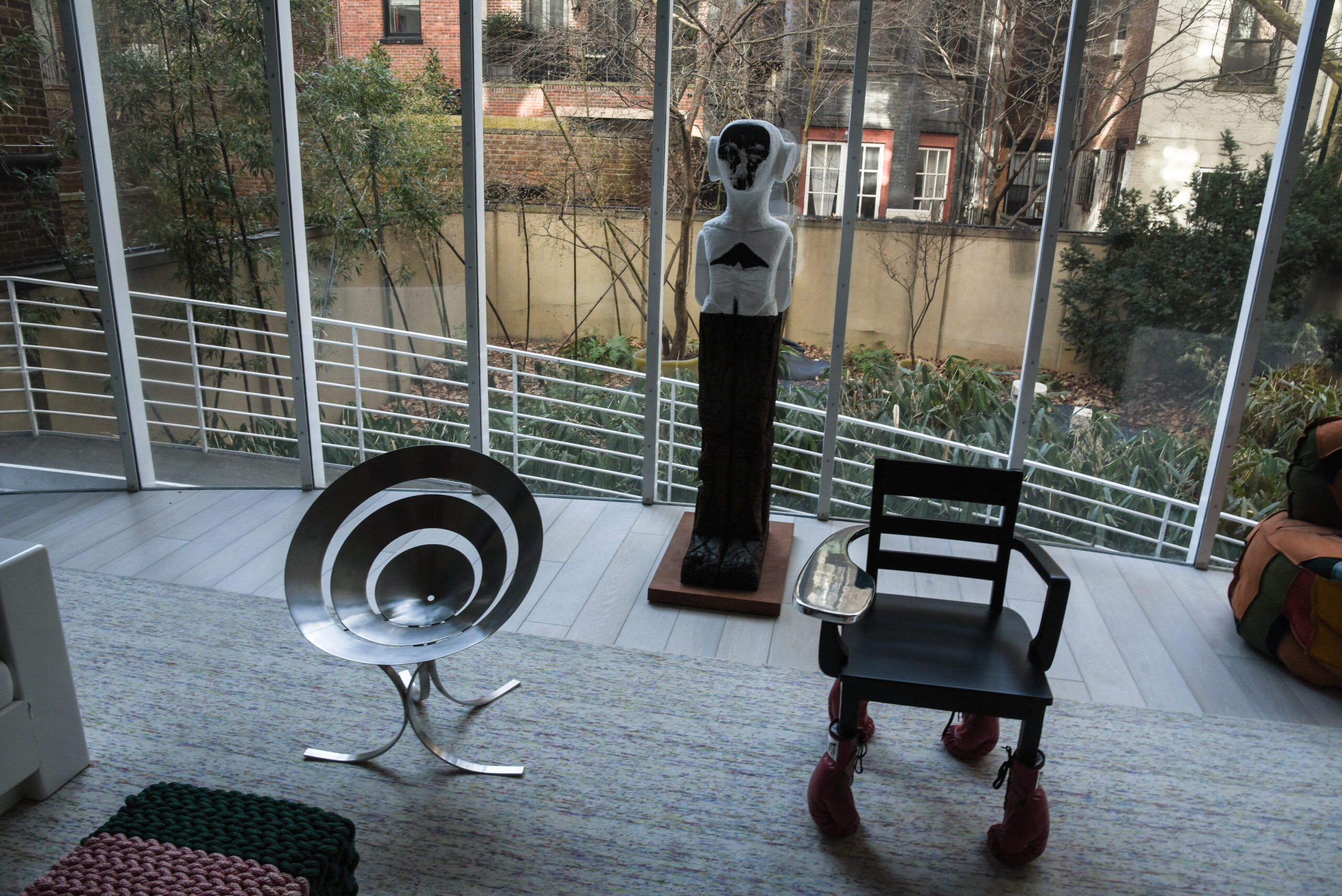
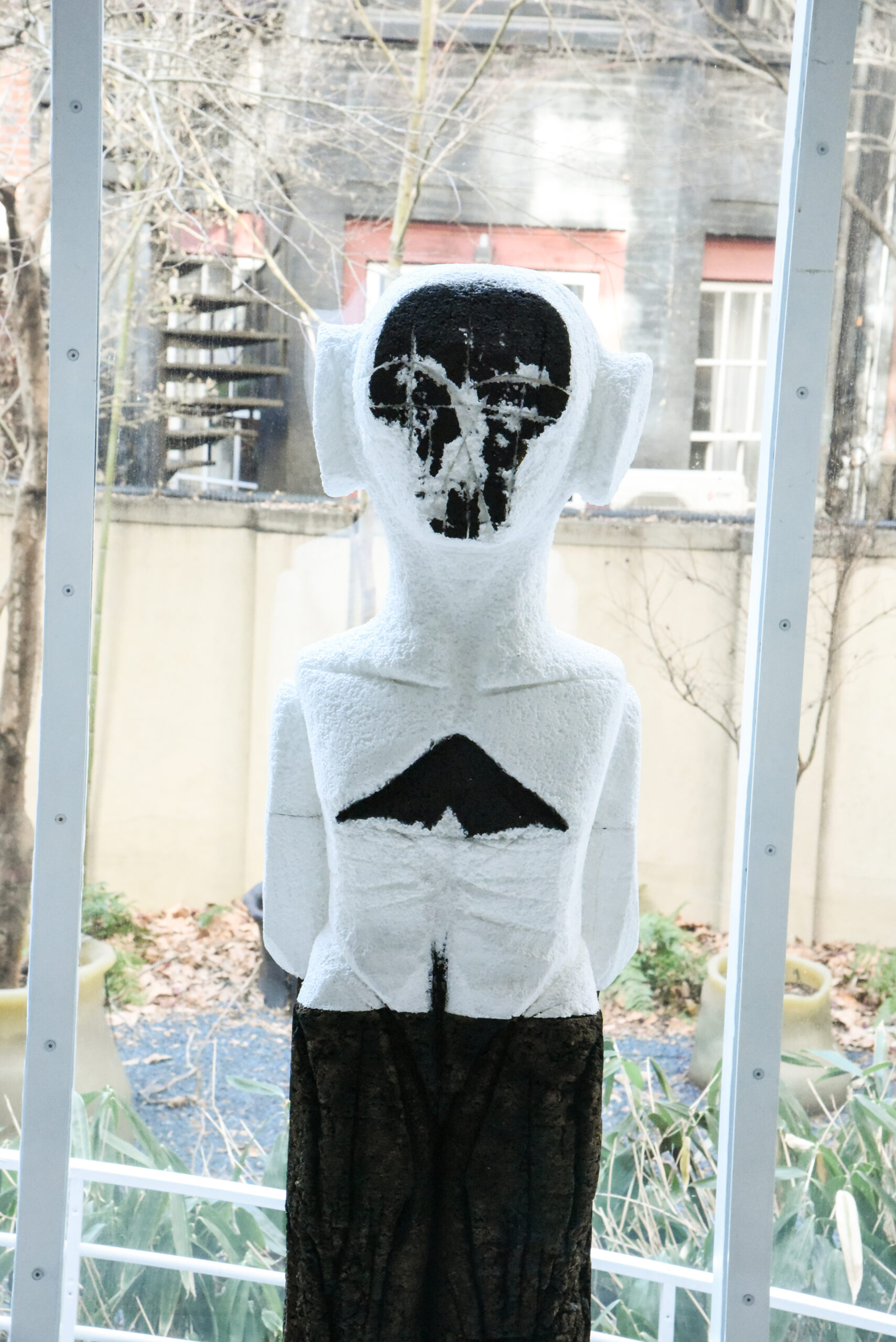
“This is styrofoam and cork sculpture by Huma Bhabha. It is very light, and I can move it around myself. When she’s carving cork, it’s actually incredibly soft bur it looks super violent and hard, and like it’s burned, but it’s not. It’s actually just charcoal. It’s very malleable, that material. Smell the cork. Styrofoam doesn’t smell, but the cork, doesn’t it smell delicious? Don’t you love things that play a little bit with gravity and weight? Alev [Ebüzziya Siesbye], who has a vessel upstairs, is the exact opposite. She says any object should look like its weight, which is something to think about.”
———