

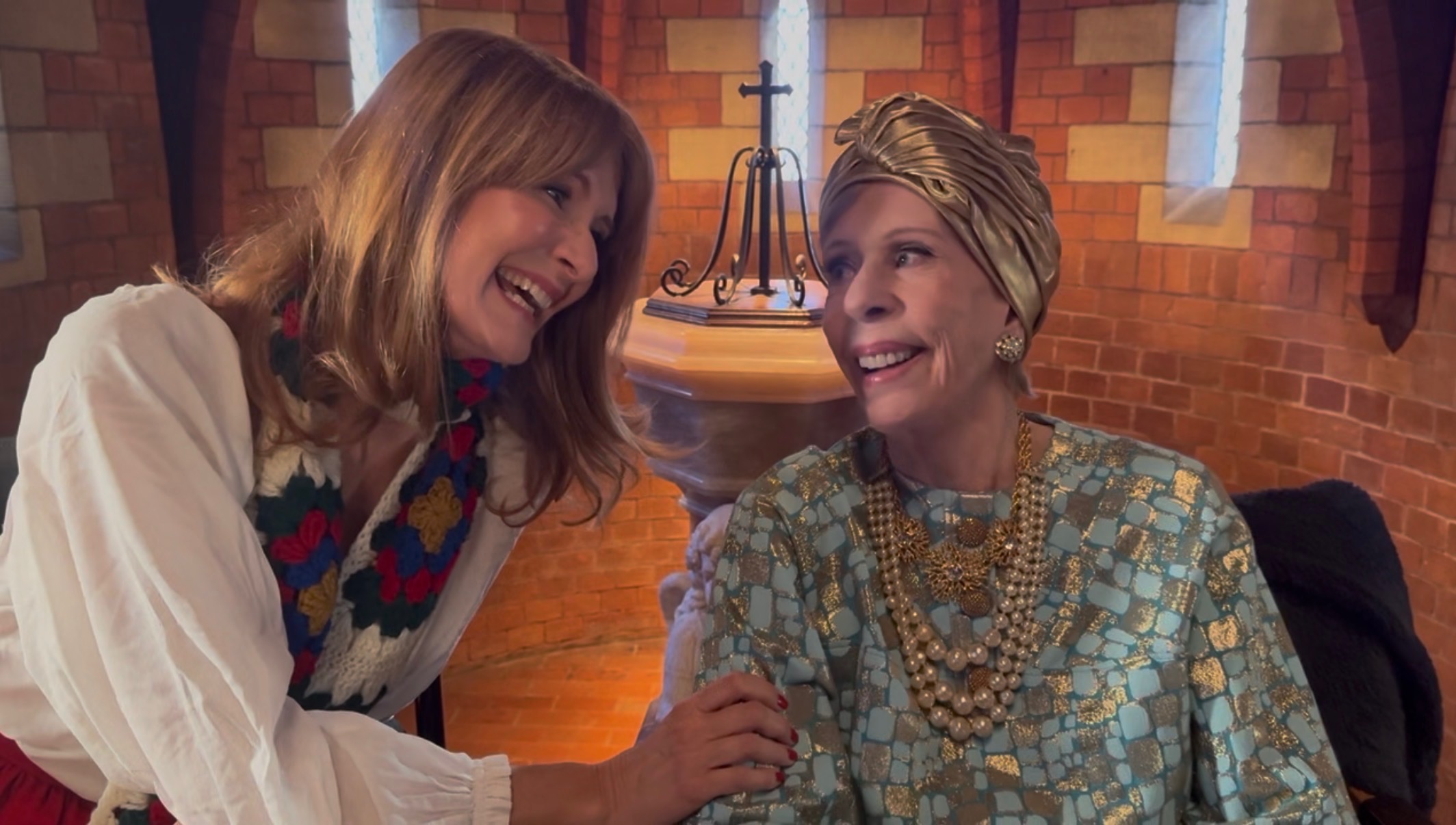
Photo courtesy of Laura Dern.
There are few people in show business who’ve been working long enough to have had the chance to perform—and become friendly with—Lucille Ball. Except, of course, for the legendary Carol Burnett, who Ball affectionately referred to as “kid” when the two struck up a friendship in the early 1960s. On a call with her Palm Royale co-star Laura Dern last week, Burnett, who Andy Warhol interviewed for this very magazine in 1979, reflected fondly on her relationship with the I Love Lucy superstar, who came to Burnett’s side when producers of The Carol Burnett Show, still foolishly skeptical of a woman’s ability to headline a variety special all on her own, demanded Burnett bring in a major guest star to pinch-hit. “Hey Kid,” Ball told Burnett. “When do you want me?” Burnett, the recipient of seven Golden Globes, another seven Emmy Awards, a Presidential Medal of Freedom, and the prestigious Mark Twain Prize, has spent seven decades paying it forward. “You were my childhood hero growing up,” Dern gushed, reflecting on Burnett’s outsize presence on the Palm Royale set. “But it moves me so much to see you have that kind of power and never need to use it in any way but with grace.” As they prepared for the release of the season two finale in which their characters’ respective arcs come into collision, the two enjoyed a wide-ranging conversation about ambition, influence, choosing happiness, and making it in a man’s world.
———
CAROL BURNETT: So how are you, Laura?
LAURA DERN: I’m so good because I’m on the phone with you. I know we started our conversation trying to make plans, because I’ve got to come up and see you. But at least this can be our appetizer.
BURNETT: Right.
DERN: And we were just having that discussion about what it was like when you wanted to do the [The Carol Burnett] Show. It is incredible to reflect on that time, how they already had the gift of Lucille Ball and yet still they were making you feel that it was a man’s game.
BURNETT: Well, I was second banana, as they called it, on The Garry Moore Show in the ’60s, and it was a musical comedy variety show that was very popular at the time. Durward Kirby and me, we were the second bananas to Garry. And then CBS assigned me to a 10-year contract where I would do one hour-long special a year and two guest slots on their sitcoms. And there was a clause in this 10-year contract, which nobody ever had before or since, that Ted Ashley, who was the agent, came up with that said within the first five years of the 10-year contract if I, Carol, wanted to do an hour-long comedy variety show, all I had to do was push the button and they would have to put it on for 30 shows.
DERN: Oh my god.
BURNETT: And I thought, “Well, hell, no, I’ll never want to do that.” Actually, I wanted to just do Broadway music and be like Ethel Merman or Mary Martin and be in shows like Annie Get Your Gun. Well, it turned out that the first five years were almost up and I was married and we already had Carrie [Hamilton, Burnett’s daughter]. We had a down payment on a house in Beverly Hills, and I was not very in-demand at that time. We had one week to go before that part of the contract, it was between Christmas and New Year’s, so we looked at each other and we said, “Oh, maybe we ought to push that button.” I called Mike Dann, who was then one of the CBS vice presidents, and he said, “Oh, did you have a good Christmas?” We were in California and he was in New York. And I said, “Mike, I’m calling and I want to push that button.” It was a long pause, he totally forgot. He goes, “What button?” And I explained, and that’s when he said, “Oh, Carol, musical comedy, it’s a man’s game, it’s not for you gals. It’s Milton Berle and Jackie Gleason and Dean Martin.” And he said, “We have this sitcom we’d love you to do called Here’s Agnes.” Oh my god, can you picture?
DERN: Full Circle Agnes.
BURNETT: I said, “But I don’t want to be Agnes every week. I want to do what I did on The Garry Moore Show. We could do different characters every week, different songs every week, different music every week.” And they had to put us on the air. So when you talk about Lucy, yes, but she was Lucy every week, so it was different from doing a musical comedy hour-long show every week. But she was adorable and very smart, I have to say, and we became very good friends. She came to see me when I was doing an old Broadway show called Once Upon a Mattress, and she came backstage to my dressing room and was so supportive. She called me “Kid.”
DERN: That’s my favorite, that that was her nickname for you.
BURNETT: I think she was 22 years older and she said, “Kid, if you ever need me for anything, give me a call.” And about three or four years later—because that was 1959 or ’60—I had a variety hour that I was going to do for ABC or NBC, I can’t remember. And they said, “But you need to get a major guest star if you’re going to do this one-hour show.” And the producer said, “Call Lucy.” So I got up the nerve and I got her on the phone at her office and she said, “Hey, Kid, you’re doing great. What’s happening?” And I was all over the place. She stopped and she said, “When do you want me?”
DERN: Oh my god.
BURNETT: So I told her what it was and she said, “I’ll be there.” So it was 1960-something, and the other guest star was Zero Mostel. It was just Lucy, Zero and me. And we had the best time. And then, later on, after I Love Lucy went off the air, she had other shows, like when she played Lucy Carmichael and—
DERN: Right, The Lucy Show.
BURNETT: Yes, The Lucy Show. And I was a guest on that several times.
DERN: How many times was she on The Carol Burnett Show?
BURNETT: I think three times.
DERN: Wow.
BURNETT: I’ve told this story, but I think it bears repeating. She was doing my show, and my husband, Joe Hamilton, was producing, because he produced The Garry Moore Show too, so he was producing our show. We had a dinner break and Lucy and I went across the street to a little Chinese restaurant. She’s having a couple of whiskey sours and she said, “You know, Kid, it’s great, you’ve got Joe to be the good cop or the bad cop on the show and everything.” She said, “When I was married to the Cuban, he did everything. He was smart. He took care of the scripts, he invented the three-camera system by putting them on wheels. And all I had to do was come in and be silly Lucy every week.”
She said, “And then we got divorced and I realized I had to be like Desi.” So they had the first reading of one of the Lucy shows and she goes, “It just was terrible. I didn’t know what to do because Desi wasn’t there to fix it. I realized I had to be like Desi and not mince words or anything, but just tell them exactly what I think.” So she went back after lunch and she said, “I told them in no uncertain terms what was wrong with the script.” Because if you were Sid Caesar or Jackie Gleason, you’d say, “Hey, this sucks, fix it.” But a woman, it’s a little tough, because when she gets tough they label her with another word. And then she said, “Hey, Kid, that’s when they put the S on the end of my last name.”
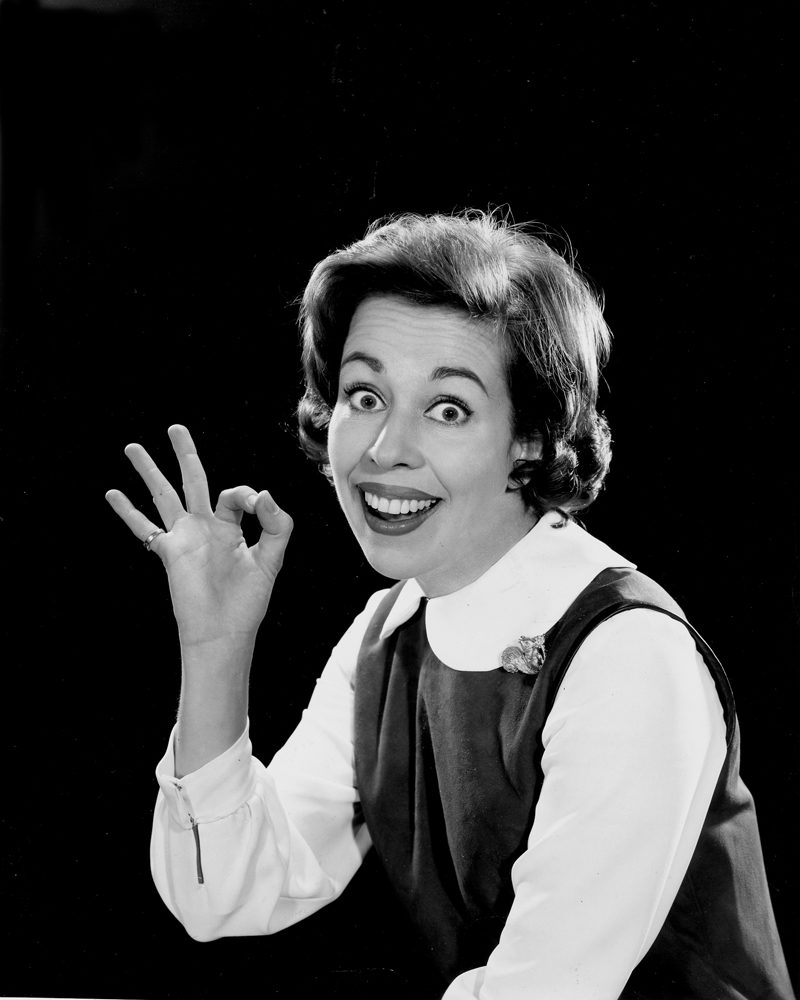
Carol Burnett, courtesy of the Neal Peters Collection.
DERN: That is genius. Isn’t it amazing? As much progress as there has been because of true pioneers and heroes like yourself, it’s amazing how in all our different industries—and obviously we can easily include politics in this country—the minute a woman is strong, you hear them being referenced in such derogatory ways, and they’re not words I’ve ever heard used for men. Being raised by two actors, I would literally be sitting with my mom as she was talking to a director or a studio head and they would say, “Whoa, man, that’s ballsy. You’re really ambitious.” Like it was a dirty word.
BURNETT: Oh my god.
DERN: And then I would go visit my dad on set and they’d be like, “Are you so proud of your dad? He’s so incredible. He’s so ambitious.” Same word, like it was just the best quality anyone could have. And I remember even as a little kid thinking, “How does ambitious mean two completely different things depending on—”
BURNETT: It just depends on who’s saying it.
DERN: Yeah, yeah. The minute you say, “I don’t agree with this script, it doesn’t feel honest to me,” it’s like you’ve spit in someone’s face. Thanks to you, it’s been so much easier for me and for Tina [Fey] and for Amy [Poehler] and for Kristen [Wiig] and for Meryl Streep and so many actors of my generation, whether we were doing dramatic films or we were comedians or trying to produce our own things. It’s still hard, as you know. But even with dignity and respect and humor and grace, it still comes off to others like we’re being too tough or out of our lane.
BURNETT: I would have a way of getting around that when I was doing my show. If a sketch wasn’t working, I would call upstairs to the writers and instead of saying, “Come on guys, this isn’t working,” I would say, “Hey, guys, can you come down and watch us do this? I’m having a tough time and I need your help.” And they would come down and we would talk about it very nicely and they would fix it. But I had to massage it.
DERN: I remember when my kids were little and went to a progressive school here in Los Angeles, the teacher was teaching them that when you share your feelings with someone else or someone has hurt you or upset you, always start with an “I” message. Like, “I feel sad when you” or “I feel hurt because,” et cetera. And I remember at the time, my husband and I were like, “Can you imagine if anyone had taught us that at the beginning of our lives or our careers to be able to communicate?” Now, I’ve been acting for a very long time because I started as an 11-year-old, and I think that I’ve been a professional my whole life and I’ve learned to trust myself enough as an actor, not always as a person, but as an actor, to really enjoy flaws, to really enjoy missing the mark, because you and I both know that that’s often the very thing you need to understand to get it to the truth of the thing or the comedy of it. And I was working with a filmmaker and I said, “On that one take, I didn’t realize how emotional I was going to be.” But I think on that first take, I had to get so emotional to understand it,” and what I was trying to explain to him was that on the next take, I didn’t need to be so emotional, but I had to feel it all to then hold back. The person said to me, “Yeah, but that was your first mistake.”
BURNETT: Oh my god.
DERN: And the minute I heard, “Your first mistake,” my whole body shut down, and I just thought, “Oh my god, no one ever taught him or me how to handle a different kind of language.” And it was unfortunate because I just shut down because I felt like I’d been a bad person, I’d done a bad thing—
BURNETT: “You’ve been a bad girl.”
DERN: [Laughs] And people will say, “Oh, well, that’s how you get what you want.” But it’s not only that; it’s how to create a thriving, creative, collaborative community.
BURNETT: It’s interesting how sometimes a man thinks you’re insulting him if you want to make a suggestion. I remember I was doing a song medley with the wonderful Eydie Gormé and we were rehearsing and we were walking down the stage towards the audience at the end of the song. We were doing “Everything’s Coming Up Roses” from Gypsy. And it was natural for us to step down off of the little platform we were on and go the rest of the way to the edge of the stage in front of our studio audience. This was rehearsal, so nobody was there, and our director was in the booth and over the loud speaker said, “Okay, ladies, let’s do it again, but don’t step off the platform.” But our instinct was to get closer to the audience for the finish, so we did it again. And then, again, he said, “Girls, I told you, don’t step off the platform.” Now, being a good little soldier, I was going to try to do that. Eydie never censored herself for anything and she said, “So what’s the matter? Why can’t we step off the stage? Why can’t we get closer to the audience?” And he said, “Because you’re not lit for down there.” And there was a pause, and she said, “So why don’t you hit us with a spotlight like in real show business?” I wanted to kiss her feet. So that’s what they did, they hit us with a spotlight like in real show business.
DERN: Oh, that’s amazing. It’s been so moving to be with you for so many reasons, Carol, and you know all of them. But particularly at this time, to be close to you, to look in your eyes, to get to reveal the mother-daughter story together, and to look in your eyes and just tell you how much I love you as a human being. Because you were my childhood hero growing up and you showed me that the comedy is in making it truthful. To watch your power and your strength and your clarity in what you wanted and what you needed as an actor on set—as the first person on set, as the first person ready for camera, waiting in your chair while the camera was still needing to adjust—you always brought such incredible humility. Really, I’m not trying to compliment; it’s the facts, the facts of who you have been and how many people you’ve lifted up. It’s just established that you have this level of iconic status where you can silence a room. When you arrived on set, everyone became more professional, more reverent, more on top of it, checking to make sure things were in place and that they were ready for you. But it moves me so much to see you have that kind of power and never need to use it in any way but with grace. I wish the world was that way in all arenas, because you taught everyone on that set what real power looks like, what real influence looks like.
BURNETT: Well, Laura, I’m gobsmacked by what you’re saying. I’m speechless, and thank you for all the lovely things that you’re saying. I never realized any of it. You just show up and do it. I don’t know, I was having fun. I never felt that I had any kind of power, ever, and I’m amazed and surprised about what you’re saying. But I certainly appreciate it.
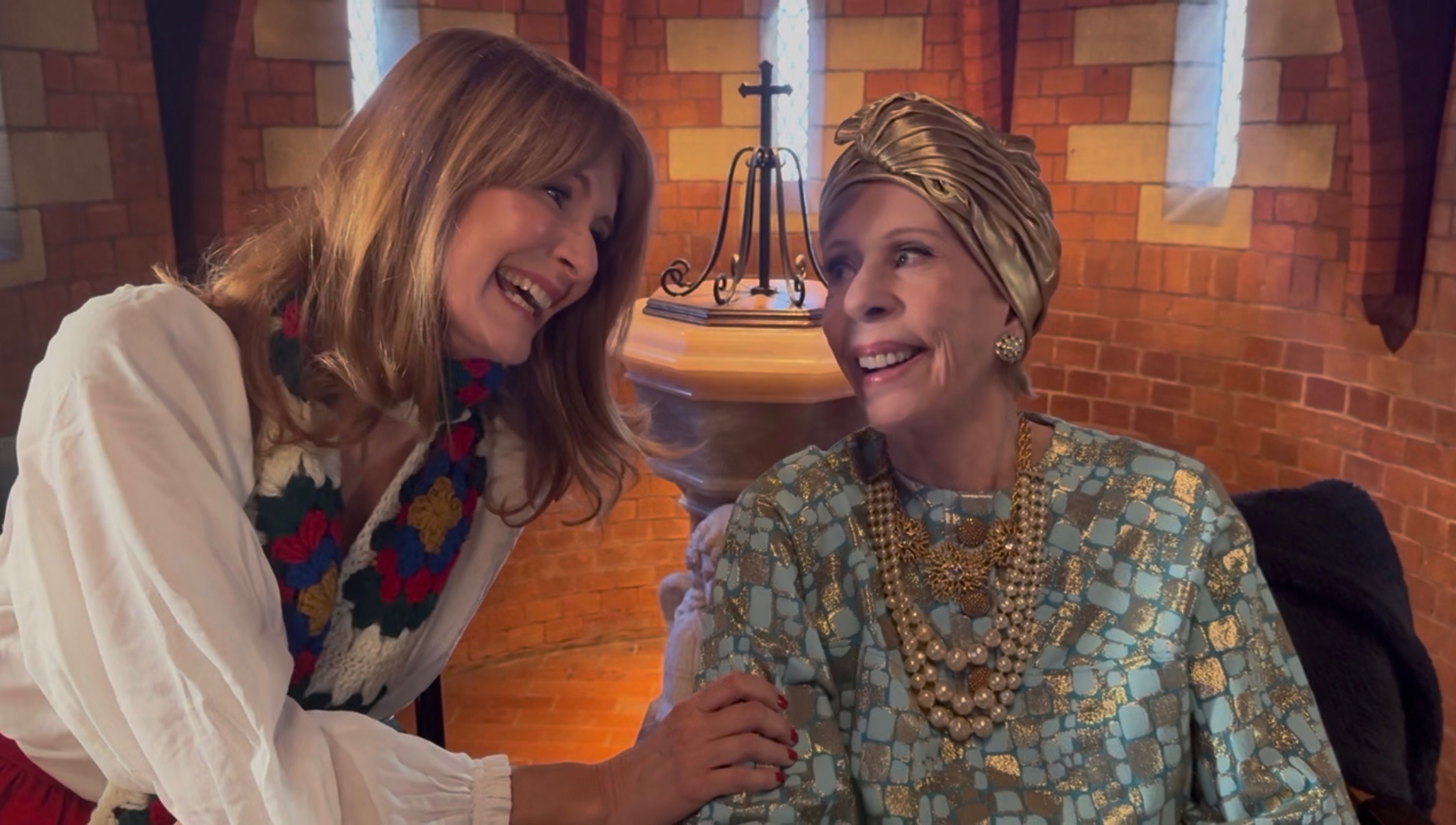
Laura Dern and Carol Burnett on the set of Palm Royale.
DERN: Well, I’ve come across someone who just got famous that year and they’re in their 20s and they think the world should bow to them. You know what I mean? It can be misused by all kinds of figures. And we know, yes, that it comes from insecurity. But I think it takes work to remain humble because people are broken. I’m so amazed by the joy that you have, but I’ve never felt any moment from you in my friendship with you or in watching you as a professional where you felt you were owed. Do you know what I mean?
BURNETT: Well, I think people are going to be what they’re going to be. In other words, one of the nicest people I ever met in my life was my movie star idol, and that was Jimmy Stewart. Everybody loved him. Of course, if you want to give somebody power, he certainly had it. But there was nobody that I ever met who was that big of a star who was so humble, and I think he would’ve been that way no matter what. Somebody who’s full of themselves, they’d probably be that way if they were a shoe salesman.
DERN: Right, exactly.
BURNETT: That’s who he was. God knows he did some wonderful work and made some fantastic movies, but there was nobody that I ever knew that was sweeter, and that’s just who he was.
DERN: My mom had that experience with Spencer Tracy.
BURNETT: Oh, wow.
DERN: And if I’m not mistaken, he was sick later in life, and she told an amazing story about someone coughing on set. One of the crew got a tickle in their throat and was coughing, and other people were angry because it could have ruined the take, and he could feel that bullying energy start. And my mom said he held the camera, he stood up from his mark, walked over to the water cooler, got a cup of water, and brought it to the crew member.
BURNETT: Oh my gosh.
DERN: And she was, I think, an 18-year-old actress or something, just starting. And she said that was one of the great gifts at the beginning of her career. Sometimes you’re just waiting for somebody else to do that job, to be a human being, but nobody else is doing it.
BURNETT: I love that.
DERN: It’s amazing, it really is.
BURNETT: Mike Nichols told a story about Elizabeth Taylor when they were doing [Who’s Afraid of] Virginia Woolf, and there’s this huge scene at the end where she’s got this long monologue and there’s a reveal of all of their secrets. It was a major, major, major monologue for her. And one of the crew members way up high on a girder or whatever had fallen asleep and was snoring. They were going to fire him, they were so angry. And Mike Nichols told us at her memorial that she said, “No, it’s okay, I can do it again.” And she went through it again and was wonderful.
DERN: Wow. I’m trying to think of that Mark Twain quote about happiness that just touched me so much I even keep it in my phone. Something like, “It is an important thing in our never-ending pursuit of happiness to stop and just be happy for a while.” I love that quote because it also makes me think, just as you said, about someone who has that hurt, that wound, how even if they were the shoe salesman, it would be the same behavior. If you’re going to choose to carry anger in your life, that anger is not going to go away.
BURNETT: Right. Carrie, my daughter, when she was ill and in the hospital for the last time, the nurse stopped me in the hall and she said, “I’ve got to talk to you about her. I walk into her room in the morning and she’s smiling.” And I said, “Carrie, how can you always be so happy?” She was dying. And she said, “Every day, I wake up and decide”—and this is a key word—”that today I’m going to love my life.”
DERN: Wow.
BURNETT: That was her mantra. “Today, I’m just going to decide to love my life.” So it’s the same idea about happiness.
DERN: I’ve got work to do in that area, Carol.
BURNETT: We all do. Maybe if we repeat it often enough, it’ll sink in.
DERN: I must say, of all the many gifts that my parents and you have influenced me with, one is the determination to forever do what you love. My parents have never had the word retirement in their language. And I know you know this story, how my mom finished a screenplay two weeks before she left us.
BURNETT: Oh my god.
DERN: And I think three days before we were in the hospital, she was trying to get a producer on the phone about this project she wanted to do and I was just like, “Mom, give yourself a break. Please, let’s just be here.”
BURNETT: But that’s what she wanted to do.
DERN: She goes, “I am enjoying. I’m going to enjoy this until I go.”
BURNETT: Wow. You were blessed to have her and she was blessed to have you.
DERN: And to have these incredible, gorgeous, deep relationships between mother and daughter, it’s an unparalleled relationship. And that’s why when we were asked by a journalist how you prepared for the complexity of the scenes that we got to do in the of Palm Royale, it’s like, “No, no, no, that’s our life story.”
BURNETT: Yeah, there wasn’t much to prepare for.
DERN: We carry it in ourselves, don’t we?
BURNETT: Exactly.
DERN: Well, I love you. What a gift.
BURNETT: Well, thank you very much. Sweetheart, I’m going to see you next week, right?
DERN: Yes, yes. Love you so much.
BURNETT: Love you. Bye-bye.
