

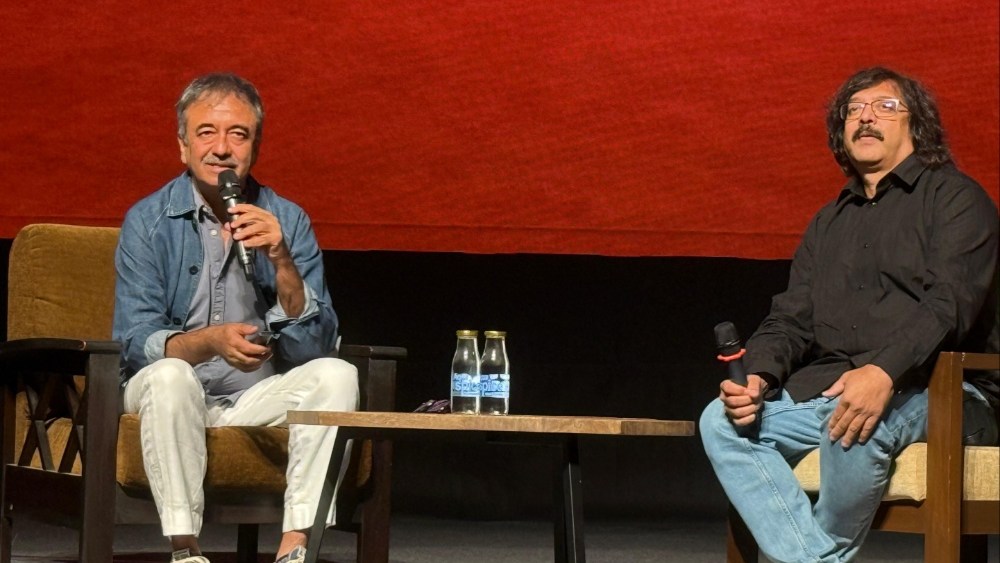
Leading Indian filmmaker Rajkumar Hirani drew a full house at the International Film Festival of India (IFFI) with a dynamic session unpacking how writing and editing shape a film’s emotional core, using examples from “3 Idiots,” “Lage Raho Munna Bhai” and his wider filmography to show how meaning, tension and character can shift entirely through the arrangement of shots, sound and structure.
Joined by longtime collaborator Abhijat Joshi, he explored the idea that writing is emotion imagined while editing is emotion experienced, arguing that conflict remains the heartbeat of cinematic storytelling.
“A good editor plays with your emotion,” he said, referencing American filmmaker D.W. Griffith. “Magic can happen while editing.”
While editing, Hirani said, “Editing can really change the meaning of a story. And how does it happen? When you write something, your unit of writing is a word, and many words make a sentence, sentences make a paragraph, a chapter, and finally a book. Similarly, the unit of editing is a shot. The shots by themselves might not contain the entire meaning, but when they’re put together with many other shots, a new meaning emerges. Now imagine being able to change the shots, flip the shots. A shot also will have sound. Take the sound from here, put it somewhere else. A film will have 10,000 shots. You have the liberty of using transitions, music, sound effects. So you can actually completely transform from what it was intended to be.”
Hirani and Joshi spoke about their process which begins with the concept that “writing is emotion imagined” while editing is “emotion experienced.” A film, they said, begins when a character “wants” something, conflict is “oxygen” while exposition must be hidden under drama and conflict.
“Conflict in life is not something which is welcome. But in cinema, without conflict, things get very boring very quickly. Conflict is the heart of cinema,” Joshi said, adding that the strongest drama arises when two valid, opposing truths collide.
Hirani urged writers to ground their stories in lived experiences. “A good writer must pick triggers from life,” he said.
