


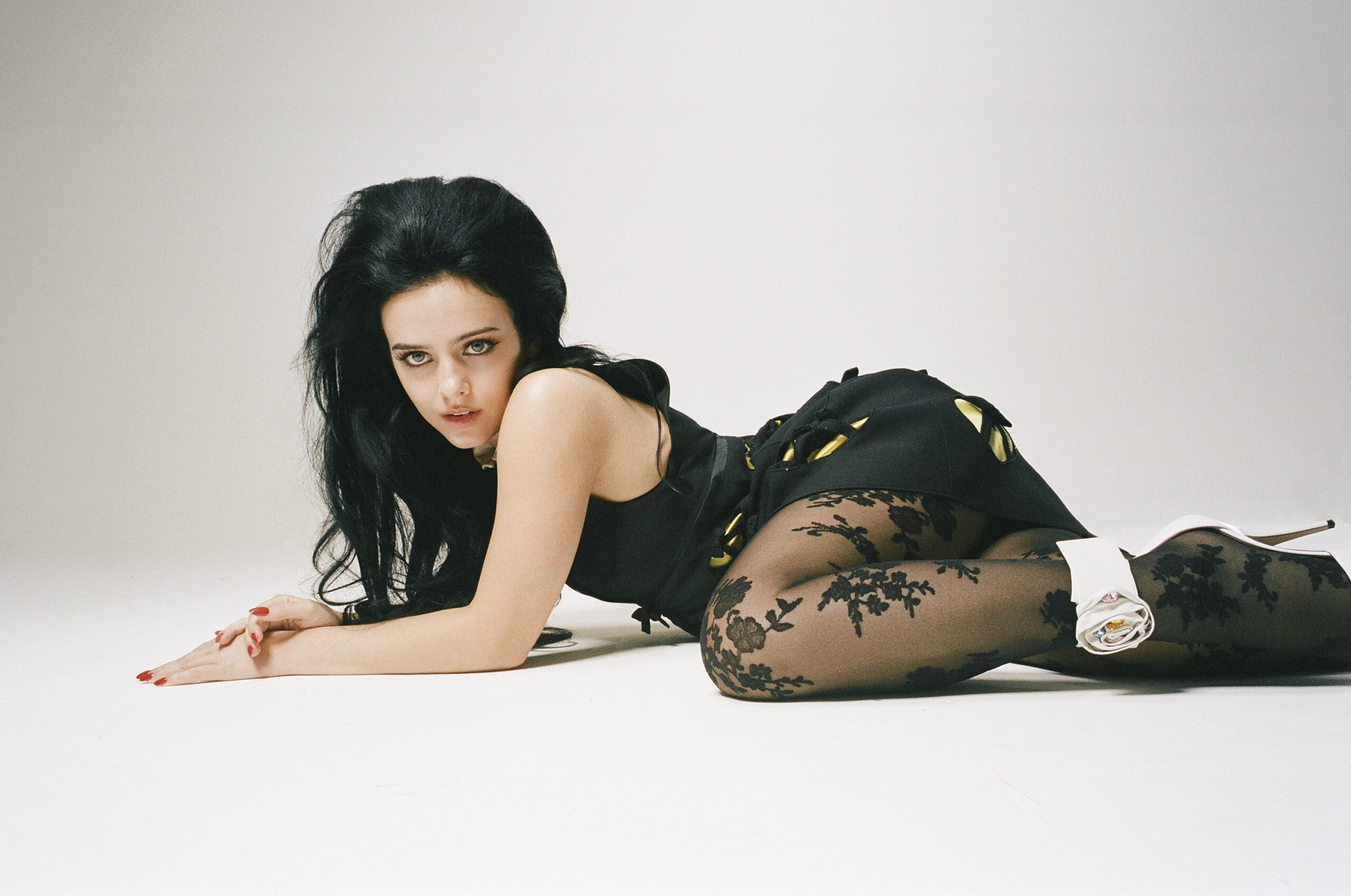
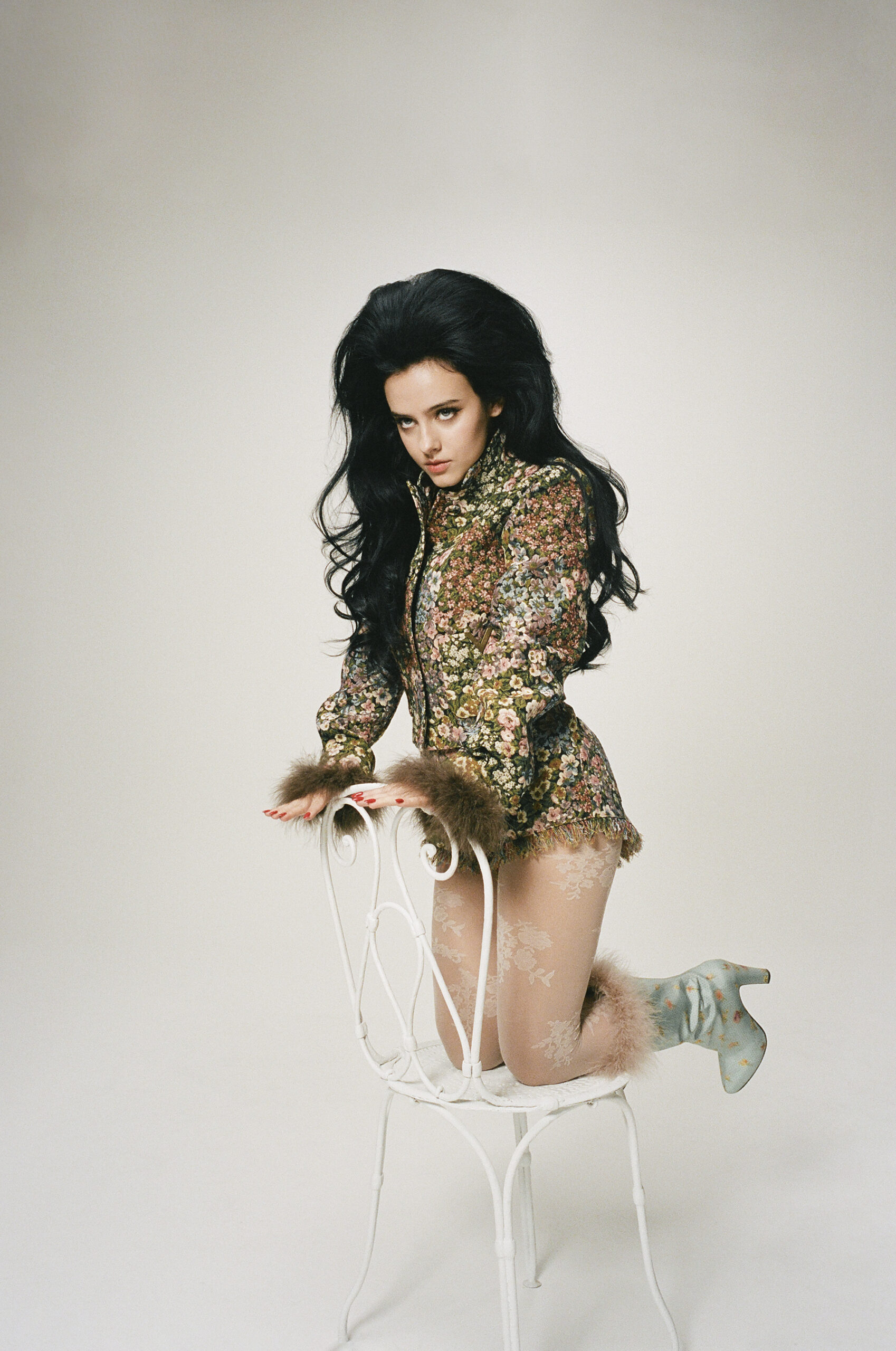
Jessie wears Dress and Tights Valentino. Shoes Valentino Garavani.
Jessie Murph’s been serving Southern swagger for years, collabing with stars like Jelly Roll and Diplo before going viral with her trap-inflected track “Blue Strips.” Fame hits fast, the haters hit faster, and there’s no playbook for coping with TikTok virality. But as the 21-year-old Alabama firecracker tells writer and podcaster Biz Sherbert, she’s keeping her head high—and her hair even higher.
———
FRIDAY 1 PM OCT. 31 , 2025 LA
JESSIE MURPH: Hey! Sorry. I’m about to grab a charger real quick. Hey mama, do you have a charger I could borrow?
SPEAKER 3: It’s in the make-up room.
MURPH: Okay, hi. Thanks for doing this.
BIZ SHERBERT: Of course. I’m such a big fan of your music. I was listening to Sex Hysteria when I was back home in South Carolina this summer.
MURPH: Dude, you’re from South Carolina? That’s so sick.
SHERBERT: Yeah, and I actually spent some time in Alabama this month.
MURPH: Oh my god. For what?
SHERBERT: I’m writing about the University of Alabama, so I spent all this time with these sorority girls.
MURPH: Bro, that is crazy. You were probably around some of my friends from home. Some of them are in the sororities there.
SHERBERT: They’re all so glamorous, which is something I wanted to talk to you about today.
MURPH: Wow. This is so fun.
SHERBERT: I know. To get us started, do you have a favorite Southern food?
MURPH: Boiled peanuts. I’ve literally spent hours online trying to find them in L.A.
SHERBERT: Did you succeed?
MURPH: Yeah, girl. I found them at Walmart. [Laughs]
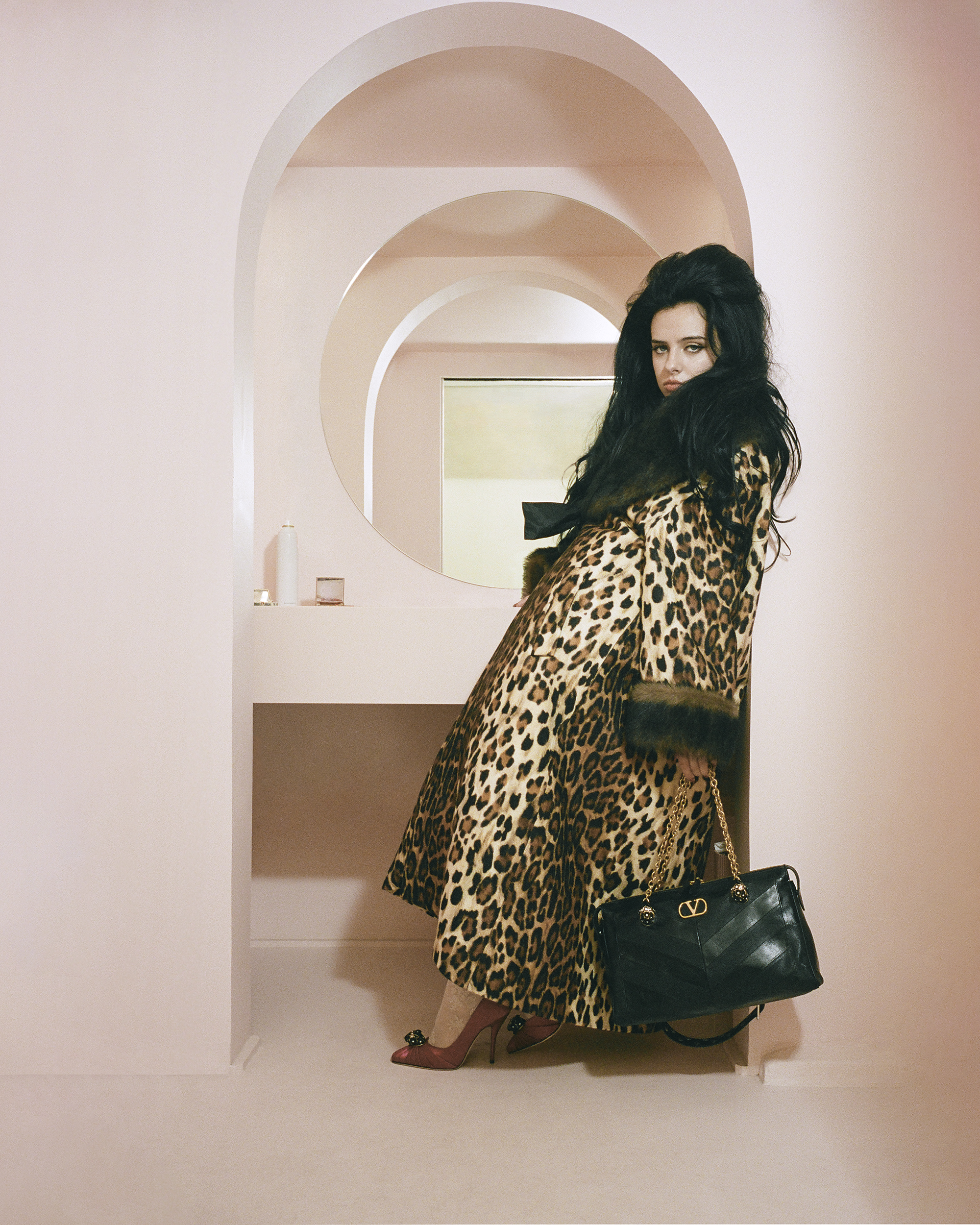
Coat and Tights Valentino. Panthea Bag and Shoes Valentino Garavani.
SHERBERT: How are they packaged? I’m thinking about how when you go to the gas station, they’re in a Styrofoam cup or something.
MURPH: They’re in a can. They’re not hot and they’re a little stiffer than normal. It’s just not the vibe.
SHERBERT: Okay, so like I said, I was at the University of Alabama this month and I was so intoxicated by how glamorous the women were. I was wondering if that Southern glamour has inspired your visual identity as an artist?
MURPH: Big hair has always been a thing in the South, more so in the past, but growing up, a lot of people would tease their hair and I always thought it was so beautiful. And you’re right, people do put a lot of effort into the way they present themselves. It’s such a fun part of the South.
SHERBERT: There’s an emphasis on having a full look, which kind of feels like a dying norm. What were you like in high school? Were you glamorous then?
MURPH: I don’t know about glamorous. [Laughs] I definitely did my makeup, but I was a pretty normal high schooler. I did cheer, so I would get pretty glammed up for that, but I also wore sweatpants a lot.
SHERBERT: Were you a flyer? I could see them being able to throw you really high.
MURPH: [Laughs] Yeah.
SHERBERT: What sort of music were you into when you were growing up?
MURPH: I always loved older stuff because my grandmother played a lot of Elton John and Skeeter Davis, and there was always country music playing too. And then in middle school I started discovering hip-hop and I fell in love with that. Oh, and Adele has always been somebody I’ve been enamored by. And Amy Winehouse and Sheryl Crow.
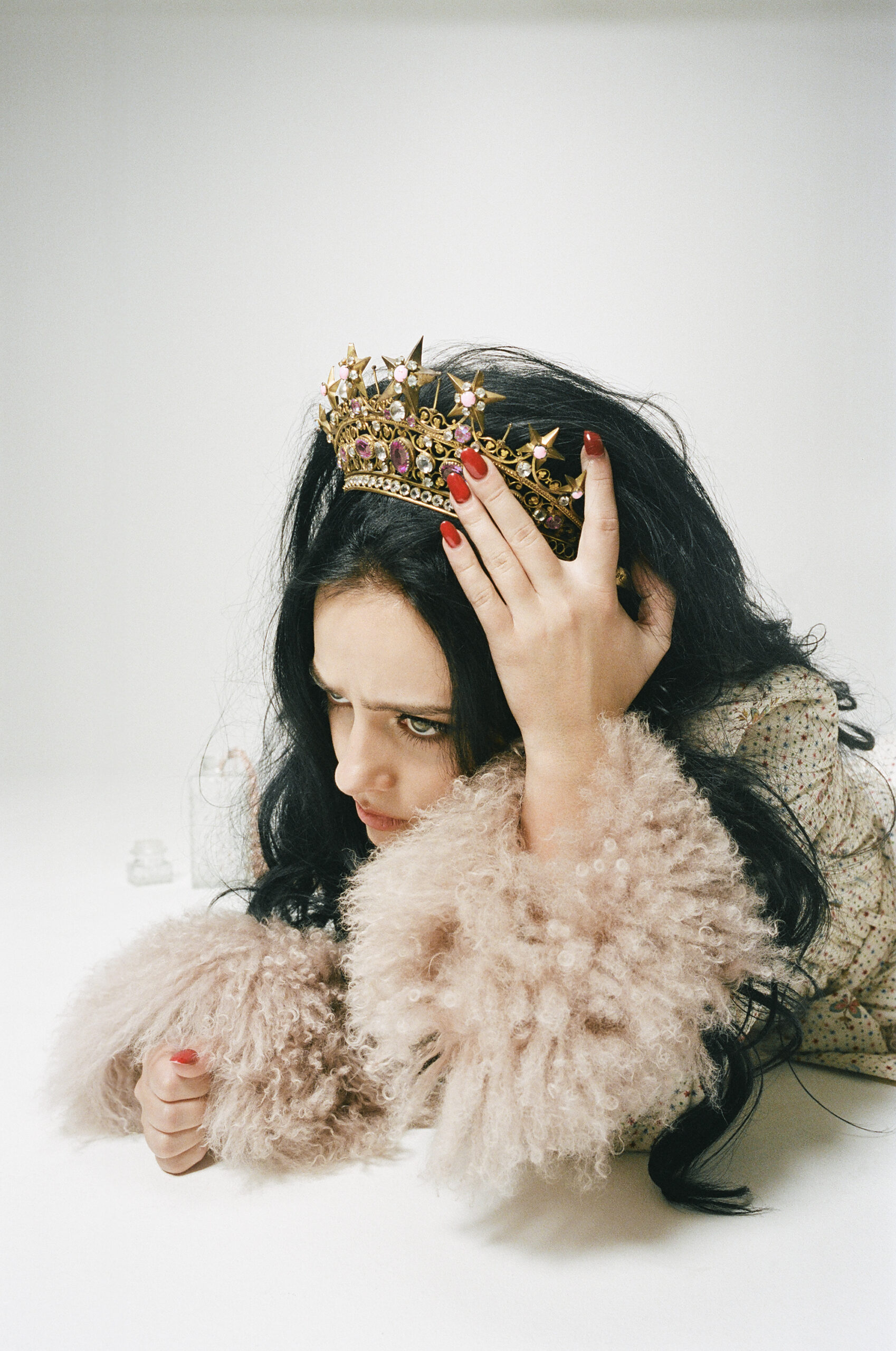
Jacket Valentino.
SHERBERT: Cool. Do you remember the first album you listened to that changed your life? For me it was Channel Orange by Frank Ocean.
MURPH: Whoa, that’s a good one. My first full album experience where I was like, “Holy shit, music is everything,” was 21 by Adele. One of my mom’s friends had an extra CD and I stole it and played it over and over and over and over.
SHERBERT: Did you grow up spending time on the internet, and do you spend time online these days?
MURPH: I was definitely on the internet. I think I posted my first video when I was 11, but I don’t remember being super on my iPod or whatever all the time. I loved figure skating when I was little. It was my pride and joy. I’ve always picked one thing and been super passionate about it. Then I transitioned into music and never stopped. I wasn’t on my phone that much. Now I’m really, really bad about being on Facebook Marketplace. [Laughs] That and Pinterest.
SHERBERT: That’s so awesome. I just moved back to New York from London, and my entire room is from Facebook Marketplace in South Carolina.
MURPH: I bet it’s fucking cute. They have the best stuff.
SHERBERT: They really do. Do you have a recent find that comes to mind?
MURPH: Dude, my entire apartment is Facebook Marketplace. I love vintage stuff. But my most recent, which people might think this is weird, is an old quilt. It’s patchwork and shit, but I washed it, so it’s fine. [Laughs]
SHERBERT: I literally have a Facebook Marketplace quilt in my room.
MURPH: Wow. Mad respect. I feel like they don’t make them as cute as they used to.
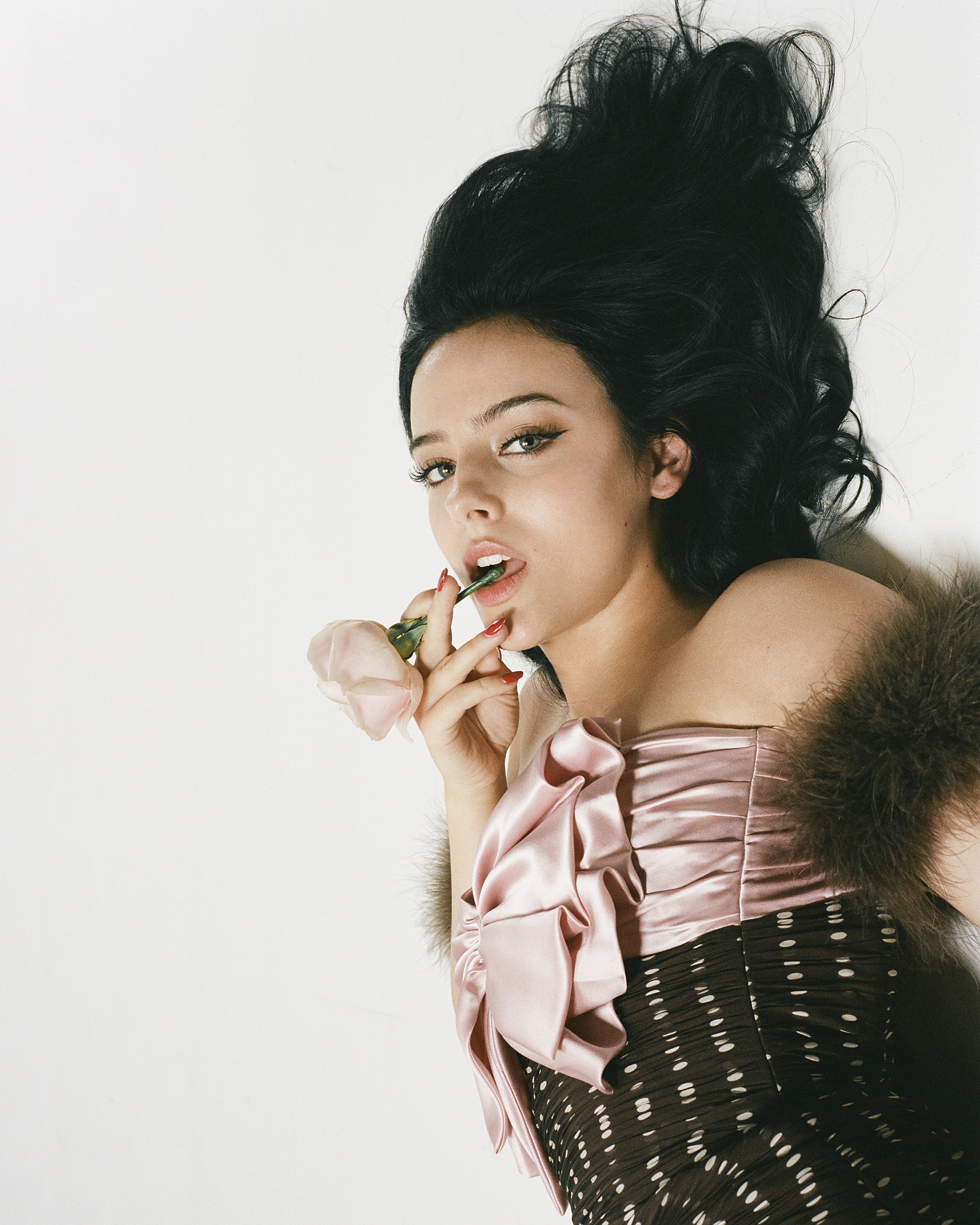
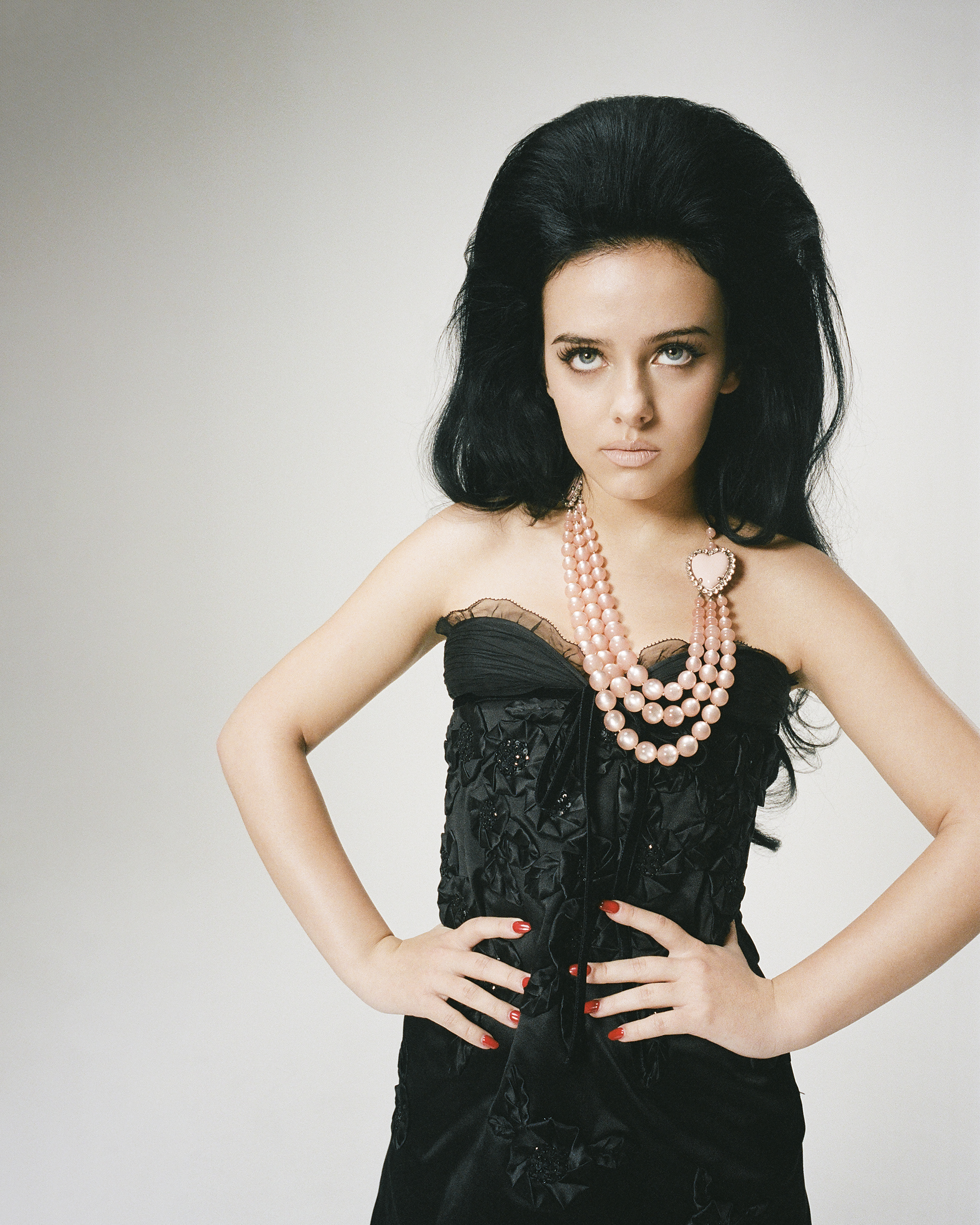
Dress Valentino.
SHERBERT: You could tell this took a long time and someone’s meemaw was making it. Okay. I want to talk a little bit about your relationship to references and imagery and your beautiful visual world. What draws you to the ’60s?
MURPH: Ever since I was a little girl, I’ve always been fascinated by the ’60s. I think a lot of it has to do with the visual aspects, especially the big hair. But also the music my grandmother and mom would play. I always felt connected to that time, lyrically and emotionally. I also fell in love with the Priscilla Presley look.
SHERBERT: Do you have a mood-board process?
MURPH: For this era, I knew I was going to do the big hair because it’s something I always wanted to do, but I had to wait for my life and the stories I was telling in the songs to match up with the aesthetic. I remember going into the studio for the first song I did for this, which was “Touch Me Like a Gangster.” I wanted to do a ’60s-influenced record, so I read a lot of books, watched a lot of movies, and searched a lot online. My creative partner is Claire [Schmitt]. We’re always sending each other shit.
SHERBERT: Cool. So obviously this year has been big for you. What’s it like to have this huge amount of attention all of a sudden? It must be crazy to hear everyone listening to “Blue Strips” or going on TikTok and it’s all over the place.
MURPH: I remember feeling a lot of gratitude in the moment, but a part of me was anxious because I realized that everyone was going to see this version of me. I have so many songs with such deep meaning and emotional depth, and I think a part of me was like, “Fuck, people are going to hear this and think this is the only thing I can do.” I had to figure out how to navigate a new level of attention and hate.
SHERBERT: What was that like? Did you have to take a moment and recalibrate with your friends and family?
MURPH: Definitely. There were a couple of days where I was not feeling very good. It didn’t agree with my spirit at first. I was like, I need to figure out how to not engage in this and not listen to everybody’s opinions, because it doesn’t fucking matter.
SHERBERT: Yeah. When I listened to Sex Hysteria I was like, “Whoa, this girl has so much range.” What has that been like as a songwriter, tapping into those different genres? How is it in the studio?

MURPH: I’ve created such a tight-knit circle of creatives that I work with, and I have my crew now, so they understand me very well. But I also think my creative process is unique. I don’t sit down and plan anything. They hand me a mic and start playing chords and I just freestyle. I’m terrible at talking about things—it’s just excruciating to me. When I first started doing sessions, they sat me down and they were like, “What are you going through?” And that’s just fucking weird. So once I discovered I could just sing it instead of having to say it, it opened so many doors for me. And I think that’s a big reason Sex Hysteria has so many intimate topics.
SHERBERT: Right. I’m also curious about your relationship to self-mythology because I think that’s really intrinsic to country music, but also to rap and hip-hop as well. How did you decide you wanted to step into that on some songs?
MURPH: I don’t think I ever thought about it. This album and any music I ever make is just me going in 100 percent. The studio is a place of release for me. It’s where I go when I have to get something off my chest. I’m never consciously thinking about anything when it comes to music.
SHERBERT: Yeah.
MURPH: But it does make for an interesting grouping of songs later, because it’s like the sequence of days I was living and what I was going through in that moment.
SHERBERT: One thing I love about your music is that it’s very beautiful and raw, but some of it’s also really funny. I’m curious about your relationship to humor and where that comes from.
MURPH: [Laughs] Thank you. I think that’s something I didn’t discover until recently. And like I said, it came from just being free on a mic. But humor has been a way for me to cope with things, because if something’s fucked up, sometimes it’s easier to just laugh about it. I’m very passionate about never censoring yourself on a song, like ever.
SHERBERT: Do you have any beauty rituals that you abide by, whether it’s when you’re on tour or at home?
MURPH: I’m big on my skincare routine. My taste in glam has changed drastically over the last month for some reason. I’m really loving being pale. I was such a big spray tan advocate for so long, and then I started embracing being pale because it was getting so fucking annoying. Now I’m just like, “Fuck it. I want to be pale this winter.”
SHERBERT: That’s awesome. I read in a past interview that sometimes you felt guarded about talking about your past or your personal life, but there’s a lot of introspection on the deluxe edition of Sex Hysteria where you talk about what it’s like becoming famous. And then on “Wildflowers & Wine,” where you talk about your mom and wanting nice things for her. Was that a conscious decision to open up a little bit more in the writing process?
MURPH: A large reason for me becoming more comfortable with that was putting certain songs like “The Man That Came Back” on Sex Hysteria. I wasn’t going to ever put it out because I was so scared, but I think me being vulnerable has inspired a lot of other people to be vulnerable. It’s been such a beautiful interaction, and it’s given me more courage to talk about real shit. Real subject matter is always going to be the most important to me.
SHERBERT: Yeah. I’m curious if you actually have a mansion in Malibu, because that is such a good line.
MURPH: [Laughs] No, but it’s something I’m going to do one day. I’m manifesting.
SHERBERT: I feel like that’s one of the most beautiful things about people in our generation: everyone has a really strong relationship to manifesting.
MURPH: It’s so real.
SHERBERT: Yeah. What are you manifesting next?
MURPH: Ooh. I don’t know if it’s a manifesting situation, but I’m really trying to put myself first and just learn how to love myself better. I spent the duration of Sex Hysteria not treating myself well at all. I was so drained and so low, and I think it’s interesting that as I’m releasing this body of work, I’m also moving forward in my own life. So it’s actually been a really therapeutic time.
SHERBERT: That’s so beautiful, and I’m really happy for you. Can you tell us anything about this upcoming record you’re working on?
MURPH: I mean, I literally just started yesterday. [Laughs] It’s going to be inspired by something in the past. I’m not sure what yet, but it’s definitely going to be glam. I am a glam girl.
SHERBERT: You are. Well, I think that’s a beautiful place for us to end. Thank you so much for taking the time to speak with me.
MURPH: Thank you, dear. I really appreciate you.
———
Hair: Danny Newsham using K18 Hair.
Makeup: Porsche Poon at Total Management.
Nails: Romane Martini at The Wall Group.
Tailor: Déborah Labartino.
Photography Assistant: Louis Headlam.
Fashion Assistant: Lisa Fulchignoni.
Onset Production: Clara Perrotte.
Post-production: Gloria Torquati.
