
Lee Einhorn remembers the day he officially met his soulmate. He’d been hired at the prominent ad agency Publicis & Hal Riney in 2003, working out of Boston, and had come to San Francisco to collaborate directly with a team there on a campaign. Lee decided to bring his dog to the office one day. The pooch then proceeded to take a shit in the elevator on the way up to a meeting. Worse, the other person in the elevator, who witnessed this impromptu canine defection, was his boss. His name was André Ricciardi. “He thought I was a loser, basically,” Lee recalls of that first impression. The two would soon become the sort of friends that felt perfectly fine calling each other “soulmates,” or, say, suggesting that one accompany the other for a dual BFF colonoscopy.
Tony Benna laughs. Then reaches outside of the frame of his Zoom screen, and places a roughly eight-inch puppet of André, the kind perfect for stop-motion animation, in the corner of the shot. He has one of Lee as well, he notes, but that one is staying in the box. The real Lee is here, after all, nestled in a digital square right next to his. André is absent. The doll will be his stand-in.
Benna met André a few years after Lee did, when the ad-agency genius known for coming up with guerilla-style “terror marketing” campaigns (see: the time Toyota stalked potential customers via personalized emails) moved from Riney to the firm Mekanism. He and André ended up working on a number of projects together, “which were all really out there. We did a stop-motion thing with Ozzy Osbourne. We did a shoot in Spain. We’d be on the road together for weeks at a time. I got to know him really well.”
Both of them were used to André pitching outrageous concepts in conversation over the years, whether it was in regards to a new client or a road trip involving some remote outback and hallucinogens. So when the director got an email from his friend in 2020 about a potential “fun” collaboration, the filmmaker jumped on a Zoom meeting with him. Lee was on the call as well.
“‘I’ve got Stage 4 cancer,’” Benna remembers. “That was how André started the conversation. I thought they were fucking with me. ‘Right, what’s the catch?’ And he’s like, there’s no catch. ‘Ok, but what’s the catch?!‘ ‘The catch is I actually have cancer.’ Then he gestured to Lee and said, ‘We want to make a comedy about it.’ That was the pitch.”
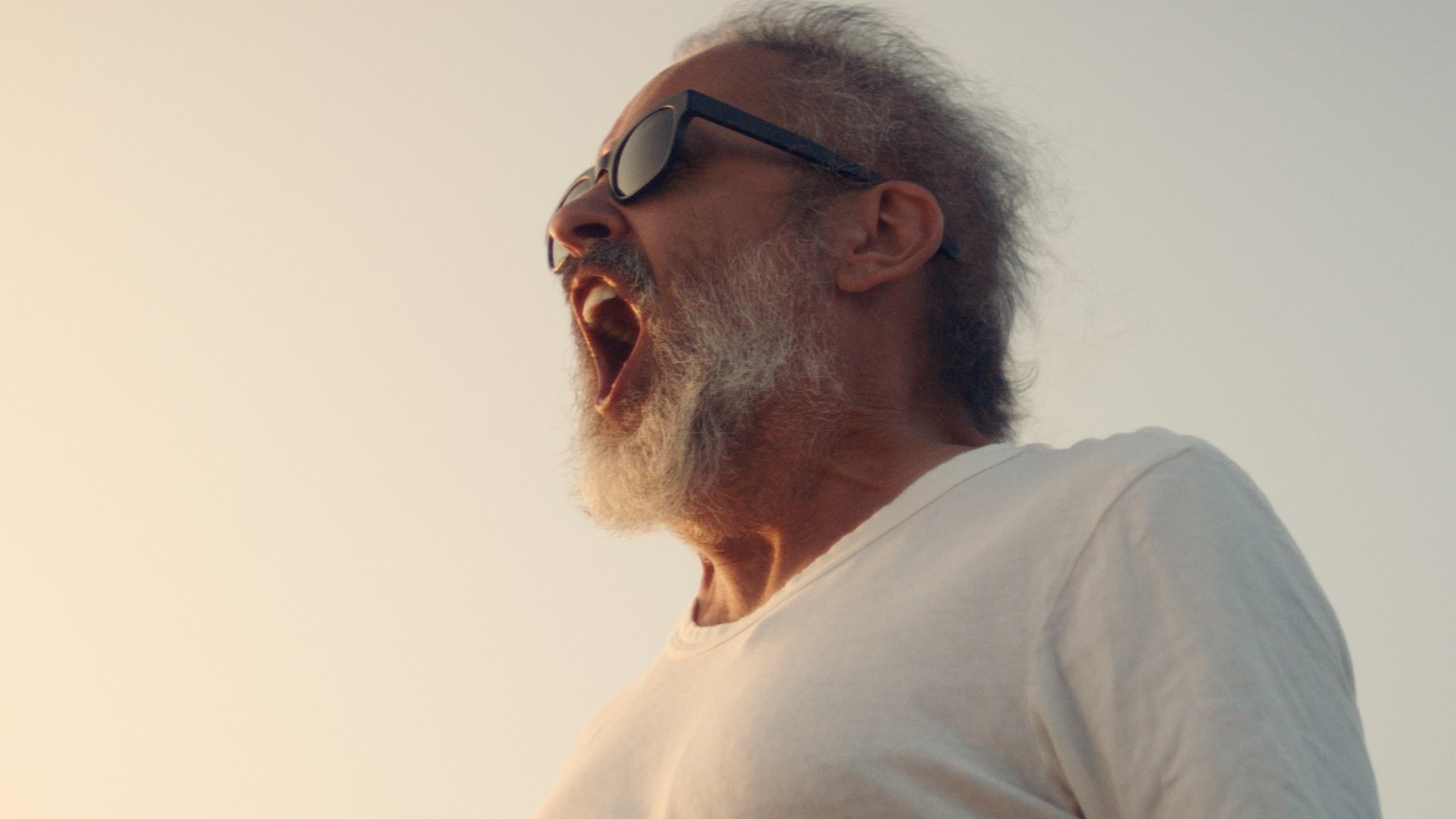
An award-winner at last year’s Sundance, André Is an Idiot documents Ricciardi’s experience dealing with this unexpected diagnosis, and the effect it has on his friends and family. We accompany him as he undergoes chemo and radioactive treatments for he continually refers to as “my ass cancer,” takes drugs in the desert, practices a “death yell” with a trained professional, and floats the idea of a possible game show titled Who Wants to Kill Me?, where contestants would compete for the chance to murder him in weird but highly entertaining ways. That aforementioned André stop-motion-animation puppet plays a big part as well. In the spirit of its subject, it’s irreverent, offbeat, occasionally poignant, and quite easily the most hilarious film you’ll ever see about someone dying from an incurable disease. (It hits theaters in a limited release this weekend.)
“He originally wanted to call it André’s Dying of Cancer Because He Is a Fucking Idiot,” Benna says. “I told him, ‘Well, it’s a little long, and there’s an expletive in it — maybe we could shorten it in a way that rolls off the tongue a bit better?’” Ricciardi was adamant that the self-criticizing word be included at the very least, because he’d had a possible opportunity to avoid this catastrophe and let it slip by. It was Lee who suggested that his friend accompany him for a “couple’s colonoscopy” when the former went to get his done. André declined. He was then diagnosed with Stage 4 colorectal cancer a year later. Had he gone with his friend, Ricciardi might have been able to catch it early and successfully treat it. Instead… well, see the film’s title.
André mentioned the idea of making something along the lines of a radical, outside-the-box movie that would be part existential comedy, part gonzo PSA to Lee first. He immediately said yes — “It was very much, whatever you want to do, André, I’m 100-percent in” — and came on as a producer, then suggested they rope Benna to direct it. The latter initially had a hard time wrapping his head around the notion. “I asked André for a week or two, you know, just to digest the fact that he had cancer,” he admits. “Because at the end of that call, I just didn’t know what to feel. I was so confused and in shock about all of it. Then I mentioned the whole let’s-make-a-film-about-it thing to my wife, and she immediately said, ‘If he’s asking you to do this very intimate project that’s probably one of the last things he’ll do while he’s alive — that’s special.’
“And she was absolutely right,” he adds. “I thought, if I just capture half the stories that André told me over the years, just so his kids had a record of them, that’d be enough. Start small and work up from there.”
André, it’s worth mentioning, had lived the sort of life that would warrant a feature-length retelling even without the impending mortality. An autodidact who exemplified the type of free-for-all bohemia that was rampant in San Francisco in the 1990s, he’d dabbled in a number of creative, off-the-wall endeavors before becoming an ad agency’s resident off-the-wall genius. Opportunities to expand his consciousness by outside means were rarely, if ever turned down. André was the type of guy who, when a Canadian bartender at his local haunt needed to keep from being deported, he instantly offered to marry her so she could get a green card. Her name was Janice, and the two even went on a revamped version of The Newlywed Game so as to convince immigration officials that this was not a sham. The couple ended up winning a honeymoon trip to the Caribbean — at which point their marriage of convenience turned into an actual romance.
(In the spirit of full disclosure: I knew both of them back in the day. Janice worked at the bar across the street from the restaurant I worked at, and André was a constant presence around the neighborhood. If you frequented the taverns and drinking establishments in the Inner Sunset district around that time, you almost assuredly encountered him on a regular basis.)
The two eventually had two daughters, Tallula and Delilah, though according to his family, André still relished in being extremely unconventional even as he after becoming a doting father. He grew his frizzy hair out in a manner that made him seem like he’d just battled an electric socket and lost (“My dad looked like he lived on street,” one of his children affectionately says in the film). When his older kid was sick, he read her Helter Skelter to soothe her. At one point, he pulls out a pair of pants from a box in his closet. These belonged to Kim Kardashian, André proudly exclaims. He bought them off of eBay in the off chance he could clone the reality-TV star-turned-mogul.
True to form, when André enlisted his two friends to capture what would be his last few years on Earth, the overall idea was: Just make it interesting. And whatever you do, don’t turn the whole thing into a boo-hoo pity party. Other than that, anything goes.
“We decided from the start that we’d let him choose what he wants to do, and we’ll just follow him,” Benna says. “It was very much: We’ll follow you wherever you want to go, André — if you want to go to Italy and look into getting a head transplant, we’ll go. If you want to go to a cryogenics place and talk about freezing yourself, we’ll bring our cameras. We went to a radon mine in Montana, where he wanted to breathe radioactive air — not because he thought it would cure him, but because he was curious about these old school techniques. We went to a crystal healing session. He talked about doing Ayahuasca again. André wanted to ingest nine grams of mushrooms.”
“He did eat nine grams of mushrooms!” Lee exclaims.
“He did eat nine grams of mushrooms, yes,” Benna confirms. “We ended up filming the most tangential shit. But we were literally were open to anything. Which, you know, is very dangerous in the world of André.”

Ricciardi, left, and Lee Einhorn (in green baseball cap), in a scene from ‘André Is an Idiot.’
Joint Venture
And then there was the issue of André’s father. Benna and Einhorn had interviewed Janice and their two children, as well as André’s older brother, for the film. When they inquired about getting his father to sit for the camera, however, André flat out said no. It turns out that the elder Ricciardi “is an extremely private person — extremely private,” and wouldn’t agree to being part of this endeavor in a million years, according to his son. Still, Benna wanted someone who could attest to what he was like as a kid — who André was “before he became André,” Benna says. (André’s mother, Einhorn adds, suffers from dementia, and thus was not an option.) A compromise was reached: They’d hire someone to play his father. [Possible spoiler ahead.]
“He originally wanted Barack Obama,” Benna says. “That was his first choice. But he thought Barack Obama was a little too young to be his father. So he was like, ‘What about Tommy Chong?’ Who, we should say, was an almost immediate yes. He’s a colorectal cancer survivor. Except, when he shows up for the shoot, Tommy has zero idea what this film is or what his role is. We keep telling him, ‘You’re supposed to be his dad.’ He’s like, ‘What? No, I have my own kids.’ I’m like, ‘We know that. You’re playing his dad.’ And he’s like, ‘But André’s not my real son.’ And I’m like, ‘We understand that, but today you’re going to pretend.’ And he’s like, “What?!’”
“We’d told Tommy, ‘You just have the two kids, André and his brother,’” Einhorn adds. “Tony asks the first question: What was André like as a kid? And Tommy goes, ‘Oh, his sisters hated him.’ It’s like, Dude, we just fucking told you that he only has one brother!”
“A production company, which will remain nameless, asked if all the weed that he and Tommy were smoking for 12 hours was fake,” Benna adds. “‘Those are stage drugs, right?’ And I was like, Oh yeah, they’re, um, definitely fake. Definitely.”
The duo kept filming even as their friend became sicker, and the results from his treatments became increasingly more grim. Shortly before the end of 2023, André exited the building. Benna recalls sitting in his editing suite one night at 4am, crying on the floor and nursing an injured hand after punching a hole in the wall. “There was a lot of personal grieving happening during post-production,” he says. “There was a lot of me yelling at André’s puppet: ‘I miss you. Why the fuck aren’t you here?’
“But the thing is, I’ve remember talking to the family after they first saw it,” Benna continues. “I was worried about their reaction, because I knew this would be hard for them. And they all said, ‘I felt like I got to hang out with him for 90 minutes again.’ Which is such a gift, you know? The question was always: Am I honoring my friend? That was the goal. Not making a movie about cancer. I didn’t want to make a movie about cancer. I wanted to make an authentic portrait of the person I knew, who was irreverent, hilarious, brilliant… and who happened to have cancer.”
“‘Just don’t make a sad cancer movie, guys’ — that was what he kept saying,” Einhorn says. “I think if he saw this, he’d be happy that we didn’t do that.” There’s a long moment of silence. “And then he would turn to the screen and yell, ‘And everyone, go get a colonoscopy! ‘Don’t be a fucking idiot!!!’”
