

No matter how often women are commanded to celebrate their bodies, we know they can be a real inconvenience for souls.
The Metropolitan Museum of Art and its new Costume Institute exhibit have an answer, or at least, an exhibit. Costume Art opens to the public on May 10 and runs through January 10, 2027. The show follows this year’s Met Gala—co-chaired by Beyoncé, Nicole Kidman, Venus Williams, and Anna Wintour, with a “Fashion is Art” dress code—which raised a record $42 million for the Costume Institute. Costume Art also inaugurates the Met’s nearly 12,000-square-foot expansion adjacent to the Great Hall, a permanent home for the Costume Institute’s annual spring shows and other exhibitions exploring the connection between fashion and art.
The exhibit might sound like a gallery show with outfits from Star Wars and Moulin Rouge, but it’s actually a jam-packed tour of the myriad ways clothes can enhance or alter the human body itself. (The museum calls this practice “examining the centrality of the dressed body.”) The show uses nearly 400 objects—half garments, half more traditional “art,” like sculpture and painting—to make the case that when we get dressed, we create a collision between our inner selves and the outer world. We get to choose, at least a little bit, what the universe can look like. And especially in this political and social moment of imminent bodily harm, this daily practice of getting dressed is both resistance and a major excuse to party.
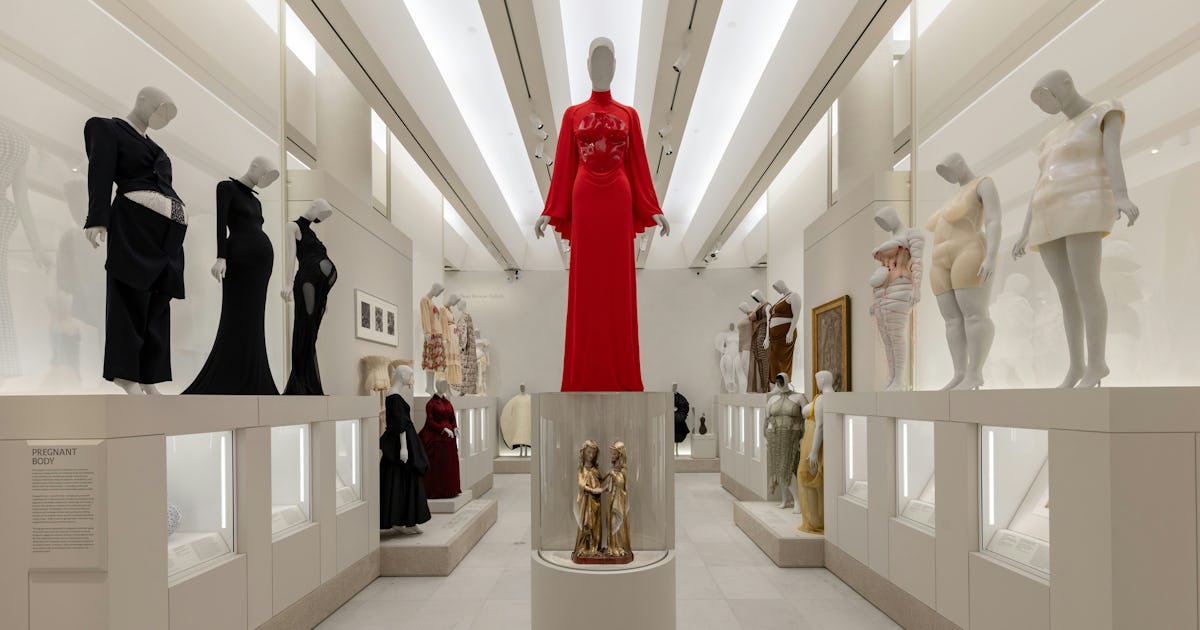
View of Naked and Nude Body gallery the Met’s new Costume Art Exhibition.
Photo © Anna – Marie Kellen / The Metropolitan Museum of Art

For the exhibit, the Costume Institute divides “the body” into 13 types, each populated with mannequins dressed in fascinating examples. “The Classical Body” juxtaposes Greek and Etruscan reliefs and statues with 1920s toga riffs from Coco Chanel and Jean Paul Gaultier, along with hand-stitched fresco effects from Maria Grazia Chiuri’s Dior era and Thom Browne’s eponymous couture line. “This is all hand-done,” Browne told press during the pre–Met Gala tour of the exhibit. “The graphic work was entirely stitched and embroidered.”
View of Classical Body gallery the Met’s new Costume Art Exhibition.
Photo © Anna-Marie Kellen / The Metropolitan Museum of Art

Each mannequin has a mirror for a face—designed by Palestinian-Canadian artist Samar Hejazi—so you can “see yourself” in the look; each dress is paired with an object, such as a 19th-century goddess statue or a column carved in 500 B.C. It gets eerie when the pairings are literal—Yves Saint Laurent and Jonathan Anderson’s takes on Van Gogh irises placed smack in front of the Dutch Impressionist’s 1889 Irises, or Adam McEwen’s faux-obituary screen print of the very much alive Nicole Kidman, displayed right next to the Jean Paul Gaultier dress Kidman wears in the fake-news layout.
View of Disabled Body gallery the Met’s new Costume Art Exhibition.
Photo © Anna – Marie Kellen / The Metropolitan Museum of Art

Naturally, there’s a lot of corsetry in this show, including historic examples from the Edwardian and Victorian eras and a drop-dead amazing peplum brocade from Versailles. These looks are smooshed against work by Michaela Stark, the Australian artist whose distorted corsets purposefully push the body into fleshy ripples and bulges, creating the type of blobby silhouette most women have been taught to fear. Seeing them alongside the typically “desired” body shapes—slim, taut, gleaming—highlighted by gowns from Alexander McQueen and Tory Burch creates a sense of both hope and exhaustion. We’re still mired in the past when it comes to the female body’s cultural worth.
Even the exhibit’s section celebrating larger sizes and shapes is titled “The Corpulent Body” because, despite reported feedback from activists living in larger bodies, the Costume Institute could not bring itself to say the word “fat.” And if the most exquisite collection of fashion history in the world can’t practice basic body neutrality, what hope do the rest of us have?
View of Corpulent Body gallery the Met’s new Costume Art Exhibition.
Photo © Anna – Marie Kellen / The Metropolitan Museum of Art

The show fares better when it frames “The Disabled Body” in terms of its possibilities, using the Irish activist and fashion consultant Sinéad Burke (who has dwarfism) as both a model and a curatorial adviser. There is an adaptive graphic look by the American sportswear phenom Willie Norris, modeled on Aariana Rose Philip, a trans model who uses a wheelchair and attended the Gala wearing Collina Strada. Seeing these looks presented not just with consent but with the willing participation of these fashion fixtures is a compelling reframing of the daily staring contest that anyone living in an “atypical” body has to navigate with the world. It’s also a reminder that every body is not just valuable but fun, if we want it to be.
View of Disabled Body gallery the Met’s new Costume Art Exhibition.
Photo © Anna – Marie Kellen / The Metropolitan Museum of Art

Another hit comes in a section called “The Aging Body,” where Batsheva Hay’s tongue-in-cheek HAG sweater lines up with oil paintings of witchy widows and goth-edged outfits with hems that drag on the floor. Perhaps once this black-on-black parade of swishy modesty read as crone-wear, but today you’re just as likely to see it on a junior at Parsons who rides her skateboard to class. Pointing out the breakdown of “age-appropriate” fashion—even as it revels in the black lace veils of a mourner or the quilted garden jackets of a retiree (rendered by Erdem in oversized quilted floral jacquard, of course)—is a considered example of how to dismantle stereotypes through clothes. It’s also a visual hoot.
View of Aging Body gallery the Met’s new Costume Art Exhibition.
Photo © Anna – Marie Kellen / The Metropolitan Museum of Art

So can the Costume Institute’s new show about bodies make us feel better about our bodies? Maybe. It can certainly make us feel better about our access to power. Even in the Ozempic age, we don’t have a choice about what kind of body we live in, and we have limited agency in how the world’s larger systems value us, as women and as humans. But deciding how to display our power—and proudly stepping out in garments that reflect our values, whether craftsmanship, nature, ingenuity, or even, if it’s your thing, just being blisteringly sexy—can be a tacit permission slip for others to do the same. Nobody’s going to tell you what to wear in the morning except you. This exhibit has myriad options. Choose wisely. Wear proudly.
(But maybe avoid the 19th-century whalebone corset. That one really hurts.)
