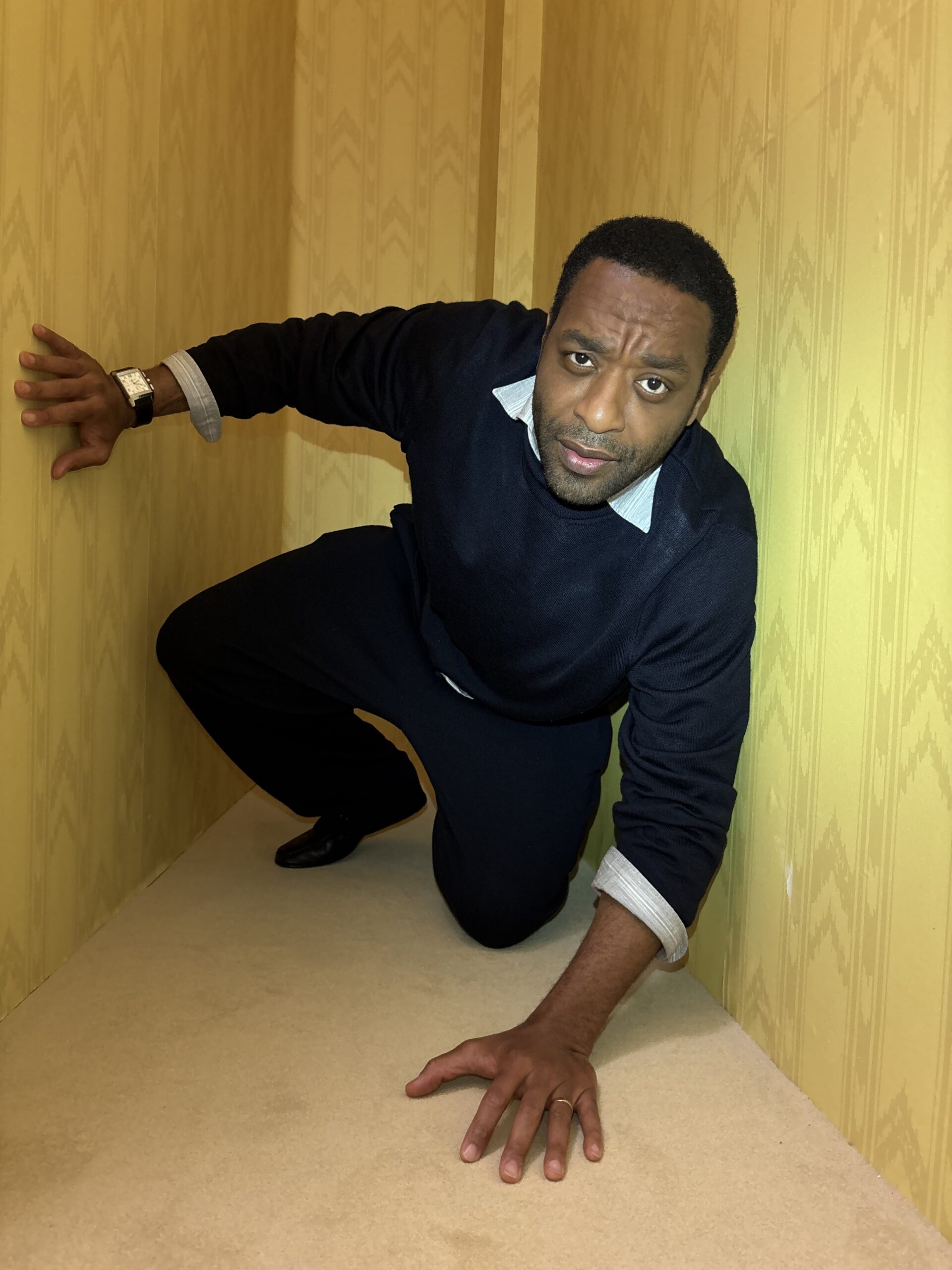



All photos courtesy of Chiwetel Ejiofor.
In Backrooms, the A24 horror phenomenon that turned a 20-year-old YouTuber’s viral web series into one of the year’s biggest films, Chiwetel Ejiofor plays Clark, a divorced furniture store owner and failed architect who stumbles through a portal into an endless maze of fluorescent-lit office hallways and can’t quite find his way out. To talk about why this movie has resonated, Ejiofor got on the phone with Mike Flanagan, the horror auteur behind The Haunting of Hill House who’s currently directing him in a new adaptation of The Exorcist. With both of them due on set in a matter of hours, they got into horror as a mirror, the end of the analog age, and what it actually means to act.
———
WEDNESDAY, APRIL 29, 9 AM, 2026, NEW YORK
———
MIKE FLANAGAN: You have a 10:30 pickup, right?
CHIWETEL EJIOFOR: I do.
FLANAGAN: Me too.
EJIOFOR: The first time I directed, it was a big moment for me when I was like, “Oh, I don’t have to go in early? I don’t have to get into makeup?”
FLANAGAN: Nobody told me that. I’m going to yell at Ilya. We do walkthroughs and shotlist reviews, so I tend to get there about 90 minutes early most days.
EJIOFOR: I would always roll up just before. I was taking advantage of it.
FLANAGAN: I’m going to try that. Well, let’s dive in. First of all, it’s such a pleasure to be able to talk to you about this incredibly unique movie that’s about to have this incredible moment. We’re talking on the morning of its opening. As the movie comes out, it’s poised to do very well and it’s already doing very well with critics. How does that feel?
EJIOFOR: You never know in the moment of making a film. It’s always a process of hopefulness. From beginning to end, it’s a challenge of maintaining an optimism about something, even though we’ve all sat on sets and felt really strongly about material, engaged in the work, and then got to the other side of the process, and for whatever reason, it hasn’t manifested in the way that we wanted in terms of how it speaks to people, to critics, or in the world. But you maintain that hope.
FLANAGAN: I never really know how to feel on opening day because on the one hand, the experience of making it was one thing, and its life beyond the release is a whole separate thing. But at the same time, I can’t help consuming as much of the reviews and the reactions in real time over that weekend as I can. It’s not healthy to live and die by it.
EJIOFOR: It’s very hard, especially now, because it’s so accessible. When I started in theater, you’d do the play, then you might walk down to the local newsstand, pick up the paper, and then you might see the first reviews, but it would take a certain amount of time. Film, years ago, was the same sort of thing. It would trickle out, but now having it right there, every opinion is so accessible.
FLANAGAN: You start hearing about the reactions days or weeks in advance of the release, but they’re embargoed. There’s this barrier between this tsunami of opinion that’s about to hit you and the anticipation and the dread that sweeps over you, which is tough. I like to be busy when something I’ve worked on releases so that I can distract myself.
EJIOFOR: Which is why I’m lucky today because we’re going—
FLANAGAN: We’re off to work, which is fantastic. We’ve been working together pretty intensely for months on this project. When I first met you on set doing The Life of Chuck together, it struck me immediately that you had a very deep love of cinema. I’m curious what relationship you had specifically with horror cinema prior to becoming aware of Kane and his work. What is horror to you as a movie fan and how has it been part of your cinematic life?
EJIOFOR: Horror is a fascinating genre. There are elements of it that I lean into, but I also have a personal metric, which is the instinct to put my hands up in front of my eyes, almost crawl into a fetal position, and be protected from what I’m about to witness. There’s something very primal about that. The Exorcist fits that to some degree. It moves into the psychological and the spiritual, but it’s in the camp of horror under the broad umbrella. But then in that broad camp were things that I also thought were phenomenal, like A Nightmare on Elm Street. I would include things like The Shining as horror, but from a different perspective. There are horror aspects, but it never provoked me to hide. What it did was open up parts of myself to myself. Some parts of your psyche are on display in a way that is deeply uncomfortable and terrifying. I don’t know whether The Silence of the Lambs is horror or not. I thought it to be when I first watched it. Its psychological nature was so exposing and Hannibal Lecter so bizarre and uncomfortable that it put me in that space that moves beyond thriller.
FLANAGAN: There’s something about Lecter specifically, because he’s not Freddy Krueger. He’s not a supernatural entity. He’s a human being who is evil, and at the same time you like watching him. The movie holds him in these incredibly uncomfortable closeups. You’re forced to be there face to face with this man, and you’re forced to also acknowledge that you’re fascinated by everything he says and by how he behaves. You mentioned earlier the reflective nature of horror and I could not agree more. What makes horror endure is that it is a mirror, and in some cases it’s a funhouse mirror. It distorts things so much that they can be fun and they can be strange, but they’re also showing us sides of ourselves that we don’t typically see, in a way that’s exaggerated so that it becomes palatable, but it’s very confrontational in that way too. That’s something very interesting to me about what you guys achieved with Backrooms because it dealt very much with the entropy of existence, and with Clark in particular, who has this idyllic life. He achieved all of the things about the normal adult suburban life that we’re told to strive for, and then all of those things distort. Were you aware of the creepy pasta and the internet viral explosion of the Backrooms, or did you encounter it for the first time in contemplation of doing the movie?
EJIOFOR: I didn’t know anything about it. I suppose I had heard of the term “liminal spaces” and understood that they were creepy. The first thing I really heard about the Backrooms was receiving the script and the information about Kane, which included links to a more extensive deep dive on liminal spaces. From the very beginning of the Kane series, I was aware that I was caught in the grip of somebody who knew how to engage and push those very specific buttons in an audience and in me. I was absolutely hooked. I couldn’t really predict where it was going to go. I knew that I was scared for all of the people involved. It looked very realistic, but it must have been computer generated, otherwise it would have cost beyond the budgets of any number of movies. So I was aware that it was also a very interesting technical achievement to be able to present it that way. It wasn’t until much later, when we were on this huge set, that I fully understood that none of it had ever been physically created, that absolutely every frame of imaging I had seen in the videos had been created by Kane on a computer. So my first instinct was that I would love to speak to this guy. Then I was told at the same time that he was 19, which, up until the moment I met Kane over Zoom, remained a remarkable fact. When I met him, it was basically the last time I really thought about that, because it was then taken over by an engagement about this material, which he had been so passionate about and so fundamental to the creation of in all of its aspects, that that became the central focus of our dynamic and our relationship.
FLANAGAN: I had a moment learning of his age as well, where my profound jealousy was finally eclipsed by the respect that grew out of really seeing the meticulous nature with which he approaches his work. What strikes me too about this particular universe is that it doesn’t feel like it goes away when the video’s over, when the movie’s over. It feels like it’s still there, and that’s insidious. A lot of that has to do with the fact that he’s never answered a lot of the questions. He doesn’t fall into the traps that a lot of studio horror falls into. The mystery is left alive. What was it like to experience that set, and how do you think that tactile analog experience makes a difference in working on a film like this as opposed to so many who would’ve stepped into a blue screen stage and done it that way?
EJIOFOR: There’s a lot of crossover between you and Kane and the way that you approach performance and world building. Even though Kane constructed the worlds in Blender, which is very technological in a literal sense, it still felt very analog, like somebody figuratively touching every brick in order to understand the world. For Kane, that feeling was really important. So then as you translate that to the cinema experience, it’s so detached if you’re just going to try and place an actor within a world with green screens, marrying things in a way that you can’t get a hold of in the same way. The best way to keep your arms around it is if it’s all one thing, if we actually build the Backrooms. That’s how you work as well, that desire to have it tactile, to have it in camera as much as humanly possible, to keep that freshness and aliveness and have the things in the spaces as present as possible. It would have been a very different experience both as an actor and for people seeing the film if it had all been built later, and you’re just reacting to tiny elements that you can see in front of you while everything else is constructed. I wouldn’t say it necessarily makes the work easier. I only mean that there’s a closer proximity to the emotions, but either way you’re still having to process. Ultimately, what was important is that it does become for Clark this questioning of his own reality. Whether we like it or not, we spend all of our days slightly looking at each other, silently communicating, “Are you seeing this too?”
FLANAGAN: Yep.
EJIOFOR: What is reality and how do we experience it together?
FLANAGAN: You’re absolutely right. I’m glad you bring up questioning reality because the feeling I get out of a movie like this is similar to the feeling I get when I really allow myself to look into physics, to look into some of the more unsettling truths and mysteries about reality and about what makes us up in time and space. Whenever I let myself drift into those corners, I get very uncomfortable because it threatens to unravel everything we think about ourselves. But the interesting thing to me about the evolution of this world that you guys have created is that the Backrooms for so long existed online as a place and as an experience, but what it never really had was a character to hold onto inside there. You really created our first explorer into this realm in Clark. I think of the Backrooms as a prism, and the person who steps inside is directly responsible in one way or another for their ultimate experience. Clark is the architect of his own fate in this movie through his curiosity, then his obsession, and then a degree of embracing what exists within there. Can you talk about the elements of the character that resonated with you approaching the project? What did you draw on to make him three-dimensional in what was, until you guys made this movie, a fully two-dimensional experience?
EJIOFOR: There’s so much in Clark and in the experience of making this that was moving and in its own way important to me, which is not necessarily what your first instinct is when you are about to read the script for Backrooms. But it was clear to me quite early as I was reading it that it was scratching at something fascinating about this idea that you’re promised a certain kind of life, and once you have ticked a certain number of boxes and gotten to a certain age where the future isn’t all laid out ahead of you, you are either going to feel a certain comfort in moving along, or you can become consumed by a whole host of regrets and disappointments that you can throw that rage out in various different directions. But more than anything, it is the question of optimism. There is a choice to be made for anybody at some point as to whether they will continue to live a life optimistically or not. Clark has decided that he’s going to go the other way, even though there is something hopeful about a furniture store where everything is on sale. Something happens to him in this moment that feels to him, as much as he could describe it, as a complete break from reality—that he must be insane, but he also recognizes that it might be the only thing that saves him from himself. What that becomes an allegory for is what I wanted to contemplate, not as a character, but as myself. The closest thing I can think of is technology in its many forms and its many ways of offering an endless solution to the problem of self. That is what continues to be the looming threat as we move into this full technological age. In some ways, we’ve only just broken the seal of the technological age. Future generations will look at this as the end of the analog age, and consider what that meant for mankind, whether it meant that they could finally cut the tether of those difficult human emotions and sink into this endless abyss of technology to soothe them, to comfort them, in the hope that the machine never stops.
FLANAGAN: You’re blowing my mind a little because a penny just dropped for me listening to you talk. Another thing that’s fascinating about that analogy is that he’s in a space without other people. He exists in this endless technological environment with facsimiles of people who aren’t threatening to him, or so he thinks. How many of us have that experience the more we get into this technological age? This is all deeply unsettling. I would love to wrap things up today with a question about acting. I’ve been lucky enough to work with you twice now. I hope to work with you many more times.
EJIOFOR: And me.
FLANAGAN: There’s an incredible piece of writing in Backrooms that stuck with me after watching it, where you explain at one point, “Imagine explaining a dog to someone who had never seen a dog,” and it’s this wonderful thought puzzle that comes out of a sentence like that. I’m wondering if you would indulge me in explaining acting to someone who has no concept of acting.
EJIOFOR: It’s about trying to feel the physical and emotional and psychological reality of an individual. From the first time that I really did that, it profoundly affected my attitude to life. It made me feel like I had an access point to so many experiences, some of which I related to in different ways and some of which were a little beyond my grasp. Some of them I was afraid to indulge. They were parts of me that I wanted to engage with more but was ashamed of. It allowed me to express myself artistically without having to expose myself in my humanity. It allowed me to do something publicly while still keeping all of these elements of myself private. The only way I can do it is to try and build the connective tissue to my own fear, which is what it all boils down to ultimately at the base of our psyche. If I can connect a character’s fear to my own fear, then I think I can play the truth of that character.
FLANAGAN: That was beautifully said, and now if it’s anything less than that in 90 minutes when we are on set together, I’m going to be very disappointed. [Laughs]
EJIOFOR: Exactly. I’ve slightly set myself up. Was that the absolute truth to yourself?
FLANAGAN: Was it your truth, or was it someone else’s truth that you’d witnessed prior? Because if it was the other one, I’m not interested.
EJIOFOR: Then we’re going another take.
FLANAGAN: That fascinates me, that you are taking your true self and pushing it through this membrane of expression. It’s almost like dreaming on purpose, but as you. As always, it is such a pleasure to talk with you. It feels particularly fun because I’ll see you in a little bit as we go try to find our truth on set. Congratulations on Backrooms. Congratulations on all of it.
EJIOFOR: Thank you, Mike.