

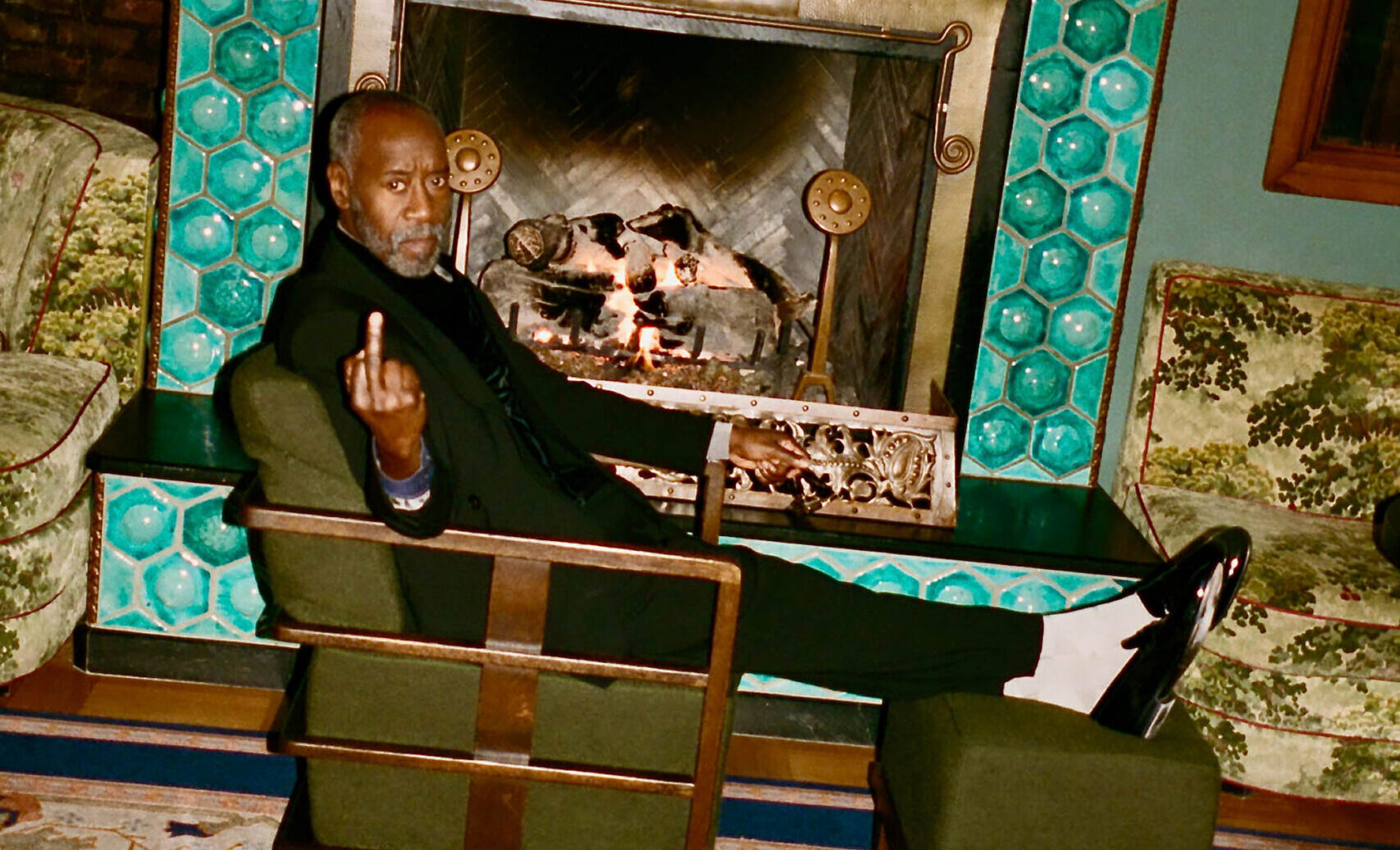
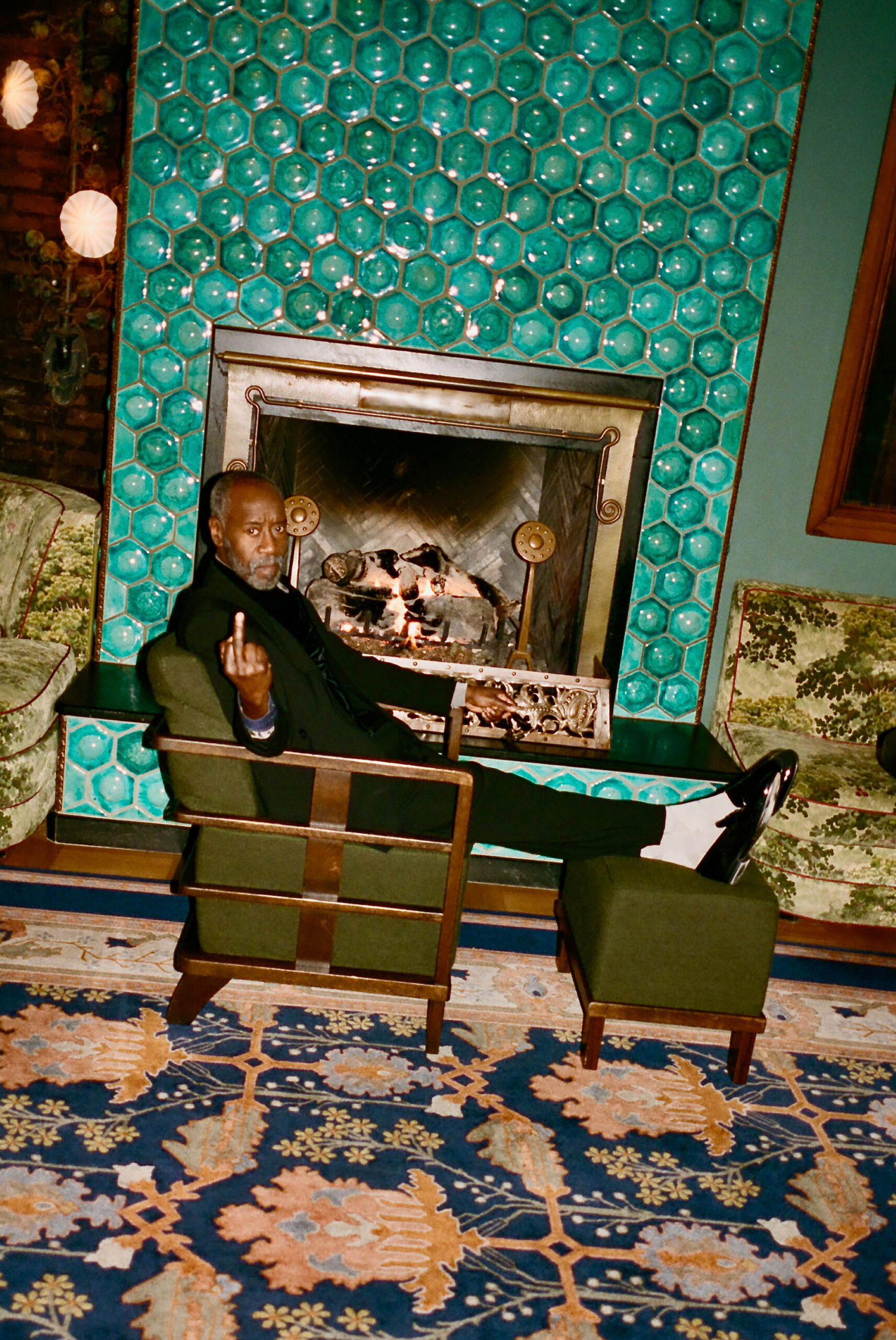
Don wears Suit and Shirt Giorgio Armani. Shoes Scarosso.
Don Cheadle has spent his career making remarkable work seem like the most ordinary thing in the world. Devil in a Blue Dress, Hotel Rwanda, the Ocean’s trilogy, Miles Ahead—shape-shifting performances across genres and registers, driven by what looks less like ego or ambition and more like genuine curiosity about what a role can offer, to himself and his audience. Now he’s back on Broadway for the first time in 25 years, starring in a revival of Proof opposite Ayo Edebiri, while being simultaneously unrecognizable under three hours of makeup in Boots Riley’s I Love Boosters. His old friend Julianne Moore [they met in 1988 when they were both dancing at the Guthrie Theater] met up with Don in New York to talk about, among other things, what it means to keep caring about the work when the world keeps giving you reasons not to.
———
TUESDAY 2 PM, MAY 5, 2026, NYC
———
JULIANNE MOORE: Oh my gosh. Hi, Don.
DON CHEADLE: What’s up, Julianne?
MOORE: Well, it’s my privilege to interview you. I was thinking about how we first met in 1988.
CHEADLE: Yes, you were in a production of Hamlet at the Guthrie Theater, and I was doing Leon & Lena (and Lenz) with JoAnne Akalaitis.
MOORE: JoAnne liked to do all those improvs and warmups. She used to make us dance, which is the thing I hate the most.
CHEADLE: Please keep going.
MOORE: She was like, “Let’s all get to know each other. Let’s dance!”
CHEADLE: Let’s just dance!
MOORE: I could have died. We were doing that kind of theater dancing, waving our arms around, and I looked over and saw you dancing right up on me, going, “Hey, how are you? What’s your name?”
CHEADLE: [Laughs] I’m sure we were right up on you. No question about that.
MOORE: And that’s how we met.
CHEADLE: That’s a great story I wish I remembered.
MOORE: You don’t remember it?
CHEADLE: I remember us doing it and I remember meeting you for sure, but it all runs together.
MOORE: I remember JoAnne telling me to take it down because I was getting too dance-y.
CHEADLE: “Julianne, I don’t know what you’re doing. Do less.” In 1988, I was two years out of CalArts. The next time we worked together was Boogie Nights.
MOORE: Do you remember the scene they cut?
CHEADLE: When you ask me what’s wrong with the radio?
MOORE: You made me laugh so hard that Paul [Thomas Anderson] started to yell at us and said, “Stop it. Get it together!”
CHEADLE: I was so disappointed that scene didn’t make it in.
MOORE: I thought it was a comic masterpiece. You’re so funny in that movie.
CHEADLE: What a great movie. There’s a scene when I’m sitting at the table. Paul came up to me and said, “Okay, what I want here is just… nothing. I don’t want anything from Buck. I just want you to be nothing.”
MOORE: Be plain.
CHEADLE: I said, “What do you mean?” He’s like, “Just be like nothing.” So we shot it and he came back over and said, “You’re kind of doing nothing. I want just nothing.” He said, “Just think about it.” So I’m sitting there thinking, “What is nothing?” And he comes over and goes, “Okay, got it.”
MOORE: Oh, that’s amazing.
CHEADLE: Right? I put this Japanese pond in my brain and just sat there.
MOORE: You look so puzzled and baffled in that scene.
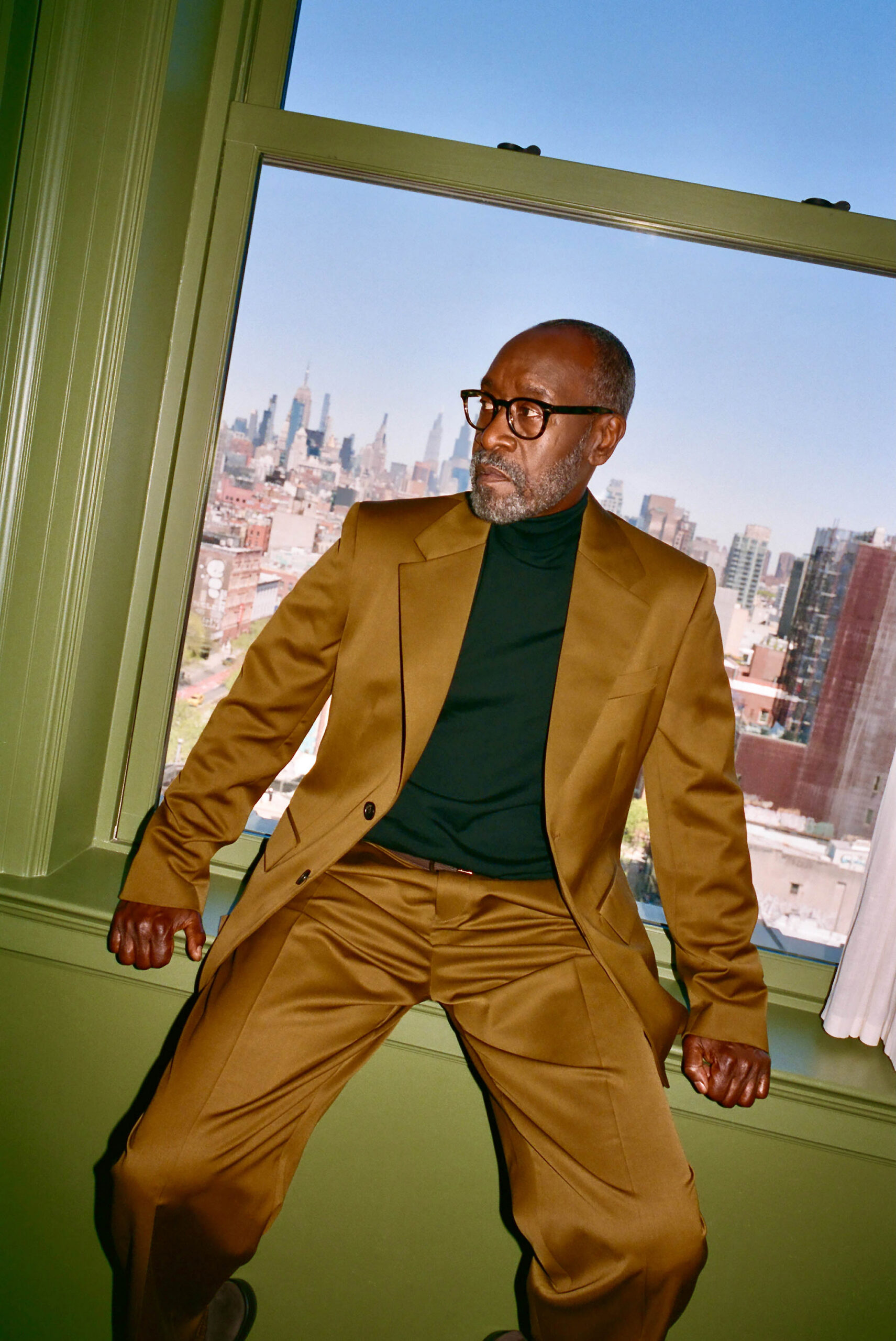
Suit, Sweater, Belt, and Shoes Ferragamo. Glasses Don’s own.
CHEADLE: That movie really holds up.
MOORE: Well, you’re a great actor. I say that as a segue into talking about Proof, which I just saw. It was such a beautiful performance, and I said this to you when I came backstage. I was like, “I’m going to be that lady who comes backstage and cries.” But I believed absolutely everything about your performance. I felt like I was watching somebody I know grapple with something real. People always talk about stakes in acting, and you guys have that in spades in that production.
CHEADLE: Thank you. A lot of the navigation in that play is the characters constantly contradicting themselves line to line, which is so great because—
MOORE: That’s what people do.
CHEADLE: That’s right. They’ll definitively make a statement and then say something completely opposite. I remember asking David [Auburn, the playwright], “Is Robert a ghost? Is he Catherine’s nightmare? Is he a part of her mental illness? Is this a hallucination?” And he was like, “Yes.”
MOORE: I saw the play so many years ago that I knew what happened, but I couldn’t remember when and how. As you guys were playing it, it was brilliantly clear what the characters meant to each other and what the dynamic was.
CHEADLE: It really is Catherine’s play—this is Ayo Edebiri’s show—but what I like about this production is that everyone’s important. All the characters are satelliting her and pushing her in all these different directions, but they’re all grappling with interdependent stakes.
MOORE: I like that in terms of a family dynamic too; a family is like a spider web, so you’re always like,“Where are my alliances? Where am I going to gain traction in a situation?”
CHEADLE: And everybody has these bombs in their pocket. I mean, both Claire and Catherine know they’re walking into scenes with nitroglycerin and they’re just kind of like,“When’s the right time to drop this on you?”
MOORE: That’s what’s beautiful about it. You see a lot of people making big mistakes, but also you don’t lose your sympathy or empathy for anyone. What made you decide to do the play?
CHEADLE: A buffet of reasons. You do it because you have the time, because it speaks to you, because you want to be around all the other people involved. It’s like, “Maybe I can do something with this, and maybe it can do something for me, and maybe I can see where we meet. In those places where we don’t meet, maybe I can pull myself up to that challenge.”
MOORE: Yeah.
CHEADLE: I’ve been playing around with the idea of coming back to the stage for a long time, but I was on a series for five years and I was doing movies. There was just no time.
MOORE: And you have kids at home.
CHEADLE: I have kids, but they’re 31 and 29 now.
MOORE: Mine are 24 and 28.
CHEADLE: Can’t use them as an excuse. They’re like, “Please leave.”
MOORE: [Laughs] That ship has sailed.
CHEADLE: But we’re both married, and all that stuff has to jive and make sense. I’ve been in L.A. so long. The last time I was onstage here was Topdog [/Underdog], and that was 25 years ago.
MOORE: I just saw I Love Boosters this weekend, which was amazing. I didn’t recognize you.
CHEADLE: Well, how could you?
MOORE: You came on screen and I was like—
CHEADLE: “Who’s that?”
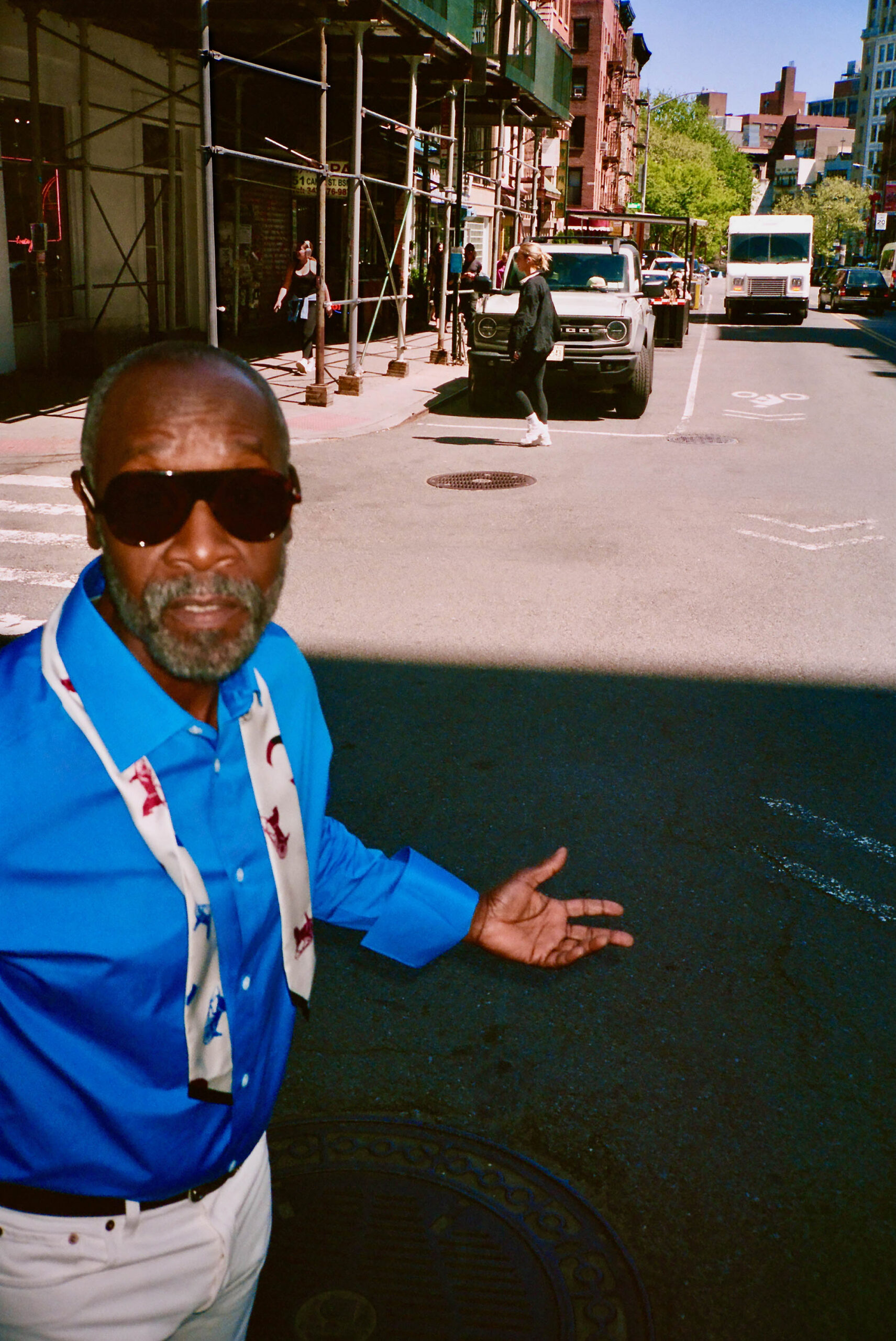
Shirt, Pants, Sunglasses, Scarf, and Belt Celine.
MOORE: But what did they do to your face?
CHEADLE: So much. It’s three hours of makeup.
MOORE: Your character runs a pyramid scheme.
CHEADLE: Yeah. Originally, I think Boots [Riley, the director] said that’s what the movie was going to be about.
MOORE: But it turned out to be a film specifically about the women, the boosters. The film asks how far you can push the human experience behaviorally without resorting to caricature or fantasy. Because in fantasy there are no rules.
CHEADLE: I went to Sweetgreen for a salad recently, and the dude making it looks at me and he’s like, “Oh, you’re an actor, right?” And I said, “Yeah.” And he goes, “I don’t think I could do that, man.” And I said, “Really?” He goes, “Yeah, you have to play crazy and you have to play murderers and all this other shit, right?” I was like, “Yeah, you play a lot of stuff.” He goes, “I don’t know how you come back.”
MOORE: “Come back.” Isn’t that interesting?
CHEADLE: I started thinking about it. We’re not insane, although we do dip our toe into insanity.
MOORE: That’s what’s so beautiful. You go really deep into an emotion, and you push it as far as you can to make it as big as you can, until you exhaust that emotion. Then you kind of revisit it. That’s the fun of it, and the relief of it, too. I find it’s very easy. I love my ordinary life, but I have all this extreme stuff in my work. I do think a lot of people feel like, “Oh yeah, it would carry me away.”
CHEADLE: If you were to ask the people around you, “Is Julianne the same when she comes back down?” they might say, “Not really. She thinks she is.” There’s a residue, that something that hangs on because your nervous system doesn’t know you didn’t mean it.
MOORE: That’s true, but sometimes when I’ve talked to acting students, I’ve said “Don’t forget you have to have your intellect.”
CHEADLE: There’s a container.
MOORE: There’s a container because you’re on a set. You have to know where that camera is. You have to know where people are walking. You have to know what the boundaries are. Your intellect is always holding you together, but you let your feelings kind of run amok. That’s the fun.
CHEADLE: It’s a skill most people aren’t using unless they’re trying to get away with something, like trying to run a con.
MOORE: What does it feel like to play someone you deeply disagree with?
CHEADLE: I’ve played characters who do things that make me say, “Don would never do that.” But one of the things we are taught is not to judge our characters and not to look at their actions in a way they wouldn’t. Most people who are doing things you and I might say are objectively bad are not walking around thinking they’re bad.
MOORE: What do you do in a scene that feels like it’s not working?
CHEADLE: Suffer. Deal with it. We’ve all been in those, and we’re going to be in more of them.
MOORE: For example, back to that scene in Boogie Nights. I felt that that scene was really working.
CHEADLE: I did too, but that movie would have been four hours long if they kept everything.
MOORE: I know. What did Steven Soderbergh teach you that you couldn’t have learned anywhere else?
CHEADLE: Watching him work so many times, he really is a “best answer wins” filmmaker.
MOORE: I hear he’s also really fast.
CHEADLE: Sometimes faster than you want. Terrifyingly fast. We’re like, “Bro, can we do that a couple more times?”
MOORE: You know who else is that way? David Cronenberg. One take and he’ll be like, “I got it.” There was a scene in Maps to the Stars where I had a monologue, a really great piece of writing by Bruce Wagner. I did it once and David was like, “Got it.” And I said, “Let me do it again, just for me.”
CHEADLE: Steven is like that. I remember being with him in Detroit during Out of Sight. We were on the freeway in a rig when the axle broke. We were sitting there at three in the morning in the snow and wind blowing, and I remember looking over at Steven. He was sitting inside on the chair with his head on his hand, just kind of blissed out. I said, “We might not get this shot.” He’s like, “Yeah.” I’m like, “How are you so chilled out right now?” He goes, “Is me getting mad going to do anything?”
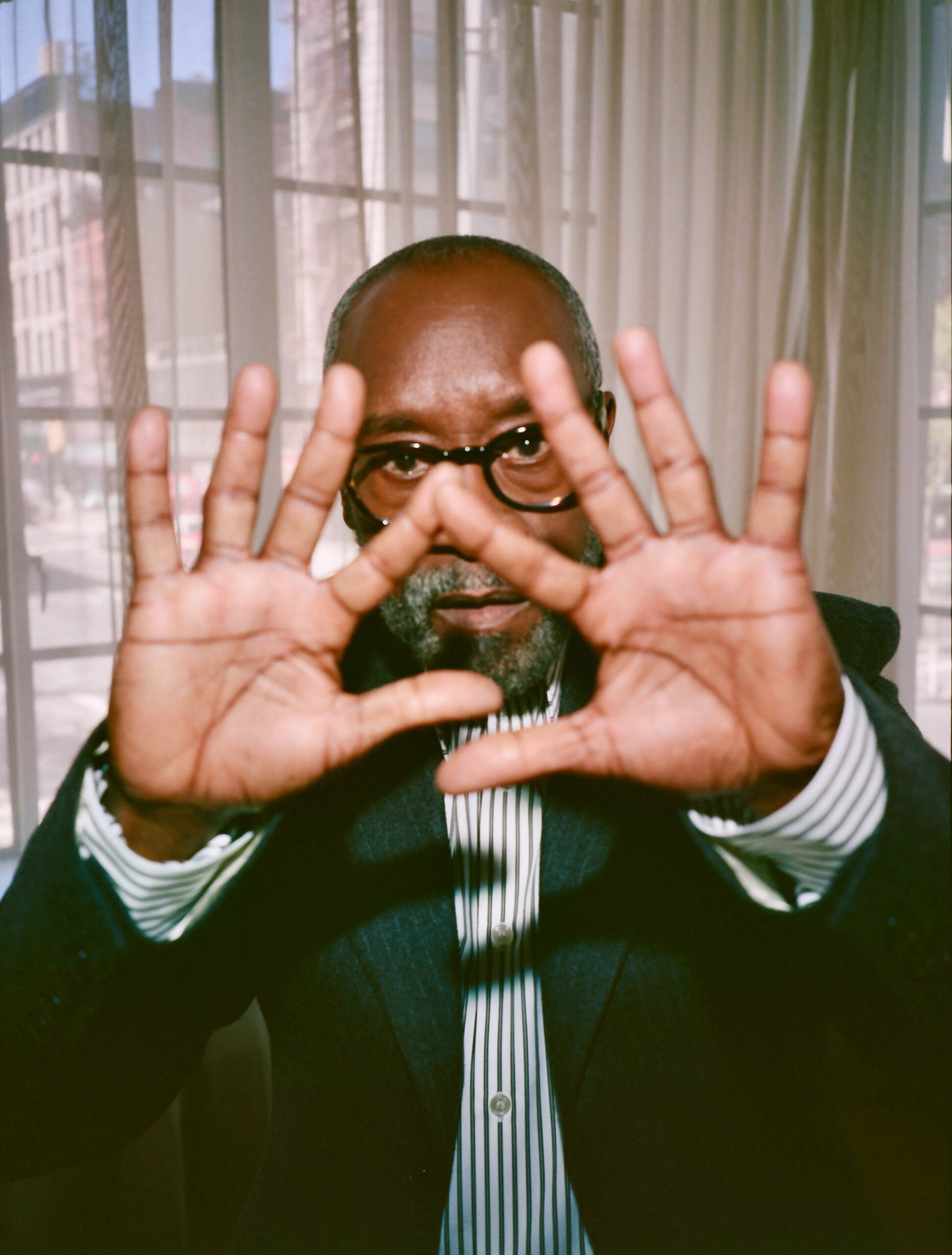
Jacket and Shirt Saint Laurent by Anthony Vaccarello. Glasses Don’s Own.
MOORE: Oh, that’s amazing.
CHEADLE: I was like, “No.” He’s like,“Yeah, so they’ll fix it when they fix it. We’ll get the shot or we won’t.”
MOORE: Do you have a favorite performance or a movie that was under-watched?
CHEADLE: Yeah, probably Talk to Me.
MOORE: Oh.
CHEADLE: You’re like, “What’s that?” [Laughs]
MOORE: I didn’t say it!
CHEADLE: It’s all good. The people at Focus used it later as a lesson for how not to release a movie because they so fucked it up trying to platform it.
MOORE: I haven’t seen it. That sucks.
CHEADLE: I think it’s a really good movie and Taraji [P. Henson] is really, really good in it. Chiwetel [Ejiofor] is really good in it. I guess it’s a cult classic. People do see it, but it’s not writ large.
MOORE: Something might come out, and at that moment it’s just like,“Eh,” but then you realize it stays in the culture. I always say that about work, about movies and books and actors. Sometimes people will say, “Oh god, where’d they go?” And I’m like, “They’ll be back.” Gifted people endure.
CHEADLE: We talk about those five stages of the actor’s career. I don’t know where George Clooney stole the five stages idea from, but I stole it from him. It starts with “Who the hell is Don Cheadle? Get me Don Cheadle. Get me a Don Cheadle type. Get me a young Don Cheadle. Who the hell is Don Cheadle?”
MOORE: Oh my god.
CHEADLE: It happens to everybody, but like you said, certain things are in the air forever. You can have a resurgence of something and people can be like, “You know what? We need him back. Where are those great-grandfather roles? Let’s get him in there.”
MOORE: What kind of relationship do your kids have to your career?
CHEADLE: They’re aware of it. I get a lot of, “Oh, this just popped up. I haven’t seen this. I’m just watching this.” They’ve been at a lot of premieres and stuff, but they got pretty over it very early. They’d be sitting on a set like, “This is what you do?You don’t need to invite me back.”
MOORE: “Only invite me back if there’s candy.” I don’t think kids have much of a relationship with what their parents do, no matter what. It wasn’t until ours went to college that they realized we worked in the entertainment business.
CHEADLE: My kids weren’t going to watch Boogie Nights.
MOORE: Mine have never seen it.
CHEADLE: You sure about that?
MOORE: [Laughs] They might someday!
CHEADLE: I bet they have.
MOORE: Maybe they didn’t want to tell me.
CHEADLE: I’m sure all their friends have seen it.
MOORE: My son has a composition degree from NYU, and he won the Elmer Bernstein Award, but at that point, he still hadn’t seen Far from Heaven. I was like, “Would you watch Far from Heaven now?”
CHEADLE: Please watch it.
MOORE: For the score? Which was Elmer Bernstein?
CHEADLE: When House of Lies came on, my kid was like, “Aren’t you naked in half that show?”
MOORE: Oh, no.
CHEADLE: “There ain’t no way I want to watch that.”
MOORE: What’s the most alive you’ve ever felt in a scene?
CHEADLE: There’s nothing like being on stage, right? There’s nothing like being in front of people, knowing anything can happen and there’s no do-overs.
MOORE: That’s so scary. Do you worry about your lines ever? I can’t believe I’m asking you that as an actor, but I’m always like, “Shit.”
CHEADLE: I forgot a line today while I was sitting at home, thinking about a scene. I was like, “What is that line?” I had to look it up. I was like,“Oh, shit,” but I know it’s in my muscles and it’s going to come.
MOORE: There’s that horrible thing that can happen on stage where your mouth gets ahead of your brain, so the words are coming out, but your brain is taking a little break.

Shirt and Scarf Bottega Veneta. Pants Celine.
CHEADLE: That’s happened.
MOORE: I hate that. Is there something you know now about this industry that you wish you’d known at 25 when we were dancing for JoAnne?
CHEADLE: What did we know?
MOORE: We knew nothing.
CHEADLE: But I think we went into rooms and talked to people when we auditioned. Now it’s a camera in the corner and you have to have the lighting, you have to have this thing behind you. You have to spend money to get told no. And no direction, no notes.
MOORE: I also wonder where you find your allies, because certainly when I was starting out, you’d audition a lot and get callbacks, and you’d be brought in for other things because the casting directors talked. They saw you for one thing and you wouldn’t get that thing, but they were like, “I’m going to bring you back for this next thing.”
CHEADLE: Because it was about relationships.
MOORE: They were fostering a relationship with you and they were fostering your talent. I appreciate it even more now, when I look back and I’m like, “Oh my god, people bothered.”
CHEADLE: Yeah.
MOORE: When did you first feel like you belonged in this industry? I don’t know that I ever felt a feeling of belonging.
CHEADLE: Correct, there you go.
MOORE: I feel like it’s a gig economy, right?
CHEADLE: Yeah. And that’s a running theme. If all the things that are lined up happen after this play, that would be the most things I’ve had lined up in a row since—
MOORE: Really?
CHEADLE: Yeah, and I’m not sure how I feel about it.
MOORE: Why do you think that’s happening?
CHEADLE: A lot of it is timing, right? It’s always feast or famine. I didn’t work for a year and a half before I did this play.
MOORE: Is everything shooting around L.A. or will you have to go far?
CHEADLE: No, everywhere. Maine, London.
MOORE: That’s what’s so hard. I had a year and a half where I was in Europe a lot, and I was like, “I want to see my family. I want to live my life.”
CHEADLE: It’s a trade-off, and in this pendulum swing of the world we’re living in, I think we can’t necessarily know what the impact of anything we do will be. You just hope you’re not putting out trash.
MOORE: Like, “How is this going to affect the world? What does it mean?”
CHEADLE: “Am I adding or detracting?” I do think what we do offers respite. There is something to eating popcorn and being entertained.
MOORE: Relief.
CHEADLE: I’m always trying to figure out a way to smuggle ideas and commentary in. What’s not political in 2026?
MOORE: I know, and I’m very challenged these days by tragedy on screen, because there’s so much happening in the world that’s so horrible and people are really, really suffering. So to be in a situation where a bunch of us are pretending to be suffering feels a little…
CHEADLE: Even if you feel like you’re telling a story about something that’s not known, that may need a light shined on it.
MOORE: It depends on how the story is told, but sometimes it can feel sodden and grief-stricken.
CHEADLE: Grief porn.
MOORE: And I’m just like, “We’re not in a place where I feel like people need to see that.”
CHEADLE: Yeah, just go on the internet and you got a whole channel to stream that for you.
MOORE: But I do think we need human stories. Proof is not exactly a happy play, but it feels cathartic and important. We can see ourselves in it, our own family relationships and our desires and challenges. I Love Boosters is also a very political movie.
CHEADLE: That hopefully allows you to genuinely engage with it.
MOORE: Yeah. You are a fucking amazing actor and a wonderful person.
CHEADLE: Thank you. Right back at you.
MOORE: I’m so happy to talk to you.
CHEADLE: Let’s do something.
MOORE: We always say that.
CHEADLE: We should find something where we’re both a little—
MOORE: “Imaginative,” shall we say?
CHEADLE: A little imaginative.
MOORE: I like it. You’re the best.
CHEADLE: Hugs. Kisses.
———
Groomer: Matiki Anoff using Danessa Myricks.
Barber: Duane Moody.
Tailor: Chelsea McCarroll at R-Zee Tailoring.
Photography Assistant: Zach Helper.
Fashion Assistants: Dan Victoria Gleason and Erik Brambila-Zavala.
Production Direction: Alexandra Weiss.
Photography Production: Georgia Ford.
Post-production: Blythe Cross.
Social Media Assistant: Alexa Spellman.
Location: Nine Orchard.
