

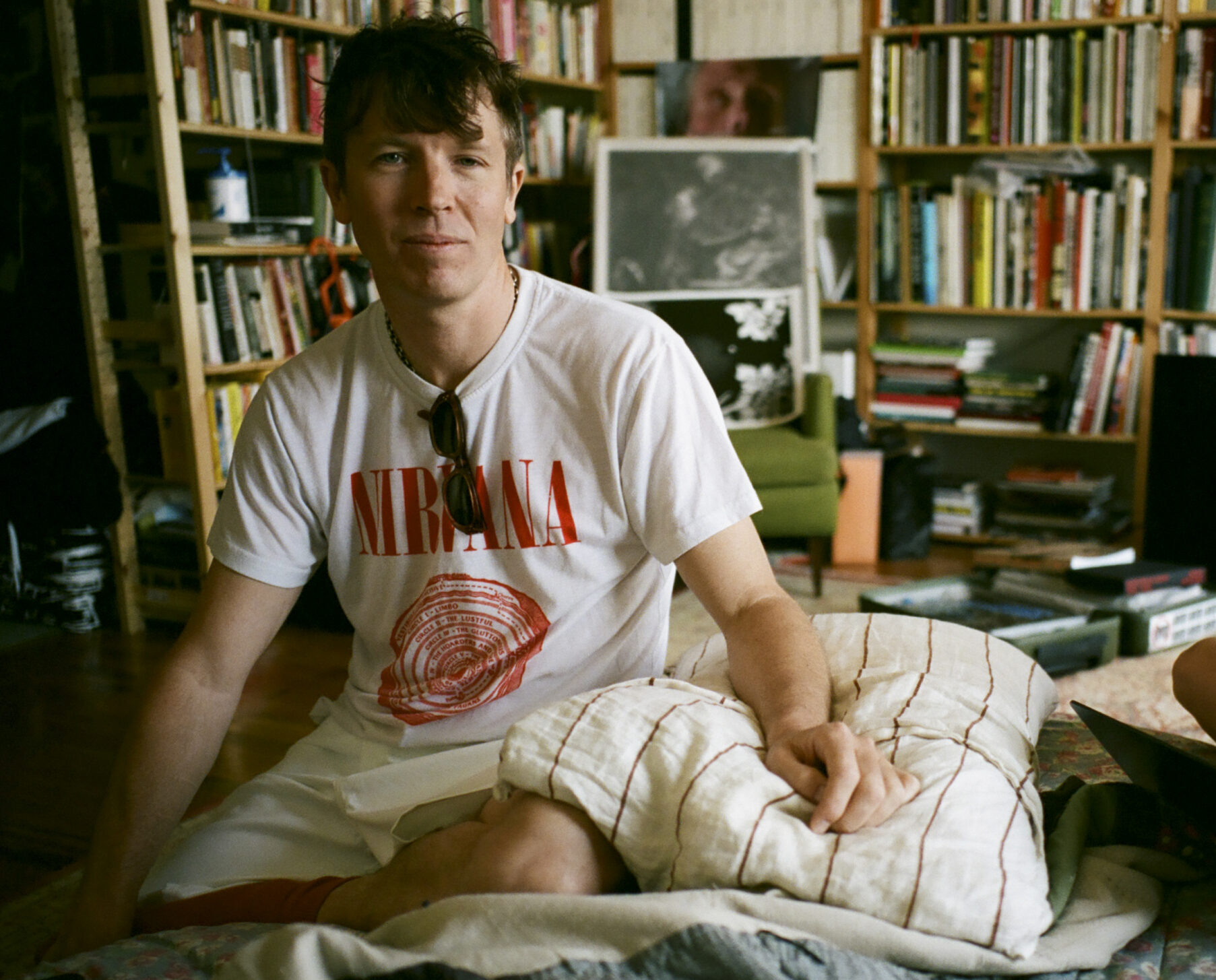

Ryan McGinley, photographed by Daniel Arnold.
Ryan McGinley has been crawling around New York City at ungodly hours. For Night Shift, his new exhibition at Jeffrey Deitch, the photographer traded his usual 1 AM bedtime for a self-imposed graveyard shift, roaming all five boroughs between nightfall and sunrise. The resulting photographs turn New York into a vast nocturnal playground where figures scale scaffolding, disappear beneath bridges, bathe in fountains, and drift through empty streets.The photographs have the same appetite for adventure that once led McGinley into artists’ homes, skate spots, and late-night hangs with New York’s misfits. Only this time, he’s chasing the city itself. To mark the exhibition, McGinley got on the phone with his friend and fellow photographer Daniel Arnold, one of the few people who understands his particular compulsions. “I’m a photo addict,” McGinley admits at one point. “Oh yeah,” Arnold replies. “I’m totally sick.” In conversation, the two revisit the many chapters of McGinley’s career and discuss the peculiar things that creep out when you stay out far past your bedtime.
FRIDAY 10 AM, JUNE 12, 2026 NEW YORK CITY
———
RYAN MCGINLEY: Here we go. Testing, one, two, three. Interview magazine, Daniel Arnold and Ryan McGinley. June–I don’t even know what date it is. The end of June?
DANIEL ARNOLD: The middle of June.
MCGINLEY: It’s Pride Month.
ARNOLD: Yeah.
MCGINLEY: How are you feeling about Pride, Daniel?
ARNOLD: So proud.

2nd Avenue, Manhattan, 2026. © Ryan McGinley. Courtesy the artist and Jeffrey Deitch, New York.
MCGINLEY: Are you proud of me?
ARNOLD: I am proud of you.
MCGINLEY: You’re my favorite ally.
ARNOLD: I feel like I crossed the ally line a bit. I shouldn’t say that in an interview.
MCGINLEY: They like that.
ARNOLD: When I was a kid, I had such powerful visions of myself as Dorothy from The Wizard of Oz, in a little gingham dress skipping down a gravel road in ruby slippers. I asked my mother for patent leather shoes and barrettes for my birthday. I stomped my feet in the Halloween costume store and insisted that I was going to be Strawberry Shortcake because I wanted to be a little girl. So, that’s who you’re dealing with. I just turned out really butch.
MCGINLEY: Well, now I know what to do for the next fashion shoot with you.
ARNOLD: So did you scout in the middle of the night, or did you just do daytime and come back?

Bayonne Bridge, Staten Island, 2026. © Ryan McGinley. Courtesy the artist and Jeffrey Deitch, New York.
MCGINLEY: Sometimes I would scout at night, but mostly daytime. Often I would scout something during the day and then when I would go back it would be a completely different color palette, different energy and very different lighting, which sometimes would throw me off. If it was like a building or an archway, the architecture was the same, but the lighting could really change dramatically.
ARNOLD: The architecture made me think of your cave books.
MCGINLEY: Thank you for noticing that. I grew up in Jersey, and my mom knew that she could get me into Catholicism through art. She showed me all those paintings, and there’s a technique called staffage, which is about the power of god and the small figure in a giant landscape. There are so many paintings like that. It even goes up until recently in the last hundred years, like the Hudson River School painters and stuff.
ARNOLD: I think it’s really instinctive too. When I first moved here, long before I knew that being a photographer was something you could do with your life, I would obsessively take pictures of the city just because I was new and overwhelmed. I was always trying to find someone alone, from a distance, swallowed by the backdrop of the city.
MCGINLEY: I love that.
ARNOLD: I have a masturbatory photo guy question. You’re such a star, and I wonder what your relationship is with Ryan getting off at Jay Street, going to the punk space. What does that early experience of being a photographer and being brought in with such open arms, what does that do to you trying to figure out projects now?

Bushwick, Brooklyn, 2026. © Ryan McGinley. Courtesy the artist and Jeffrey Deitch, New York.
MCGINLEY: I think early on there were artists that embraced me. I was just young and excited, adventurous, charismatic. There was a joyful and rebellious spirit in that space. There were artists 10 to 20 years older than me who really recognized that. I was just really curious. I wanted to be out every night and do everything. That’s why I moved to New York, to be at some alternative punk space, or be at a fancy party at somebody’s apartment overlooking Central Park, or to be at some dirty gay bar. New York’s all about the high and low. I would just throw 10 rolls of film in my pocket every night and shoot it all.
ARNOLD: Were you fearless?
MCGINLEY: I was fearless in a sense of, like, I would go into a subway tunnel with Kunle [Martins], and photograph him writing graffiti.
ARNOLD: I’m not fearless. I just look fearless.
MCGINLEY: You’re known as a New York City street photographer. But I’ve never been fearless in a way where I would approach a stranger. I’ve always brought my community into my photos rather than observing, like documentary photography. I think I was more ambitious than fearless.

Bushwick Inlet, Brooklyn, 2026. © Ryan McGinley. Courtesy the artist and Jeffrey Deitch, New York.
ARNOLD: That makes sense.
MCGINLEY: But sometimes being ambitious can be fearless. There was a lot of time spent blind approaching people that I thought were cool, like Nan Goldin or Larry Clark, or magazine people like David Armstrong and Jack Pierson. I would imagine, now being their age, that they saw something in me that they had in themselves, just like a young creative spirit and like trying to figure it out.
ARNOLD: Have you always had a really good friend group?
MCGINLEY: Definitely. I think the way that I’m approaching photography, I’m creating a community that might not even be there. When I was younger, there were no gay skaters or graffiti writers. Kunle and I basically invented that.
ARNOLD: It’s so crazy.
MCGINLEY: We put that out into the world and made it seem like that there was this flourishing community of queer graffiti writers. Now, there’s a reverberation of that. It’s a decade later and I’ll have Tyler, the Creator run up to me in LA and be like, “Yo, when I saw that shit when I was younger, that was dope. You guys were the blueprint.” Or like Kevin Abstract from Brockhampton be like, “We loved you guys.”

Ryan McGinley, photographed by Daniel Arnold.
ARNOLD: It is really insane how recent that is and what a dramatic change it is.
MCGINLEY: But so many things in culture have evolved. The things that we took for granted as younger artists are things that people have fought so hard to change, and we just kind of took it at face value. I mean, I lost my brother to AIDS, and I think about the AIDS crisis and now young gay people hardly even talk about it because everyone’s just on Truvada.
ARNOLD: I mean, the erasure or whitewashing of that whole era for anybody who wasn’t directly affected is shocking.
MCGINLEY: I had a question for you. Do you consider yourself a photojournalist? Do you think, “I’m a documentary photographer? I’m a street photographer?”
ARNOLD: I mean, it’s a smug answer if you can’t see my face, but I sometimes don’t even identify as a photographer. The camera just feels like an arbitrary catalyst of what makes my life interesting. It doesn’t matter that it’s on the street. It just happens to be that I live in a place where every time you go outside something interesting happens. I’d just as happily take a picture in my apartment or in Milwaukee, or across the world. I’ve said it before, but the street is on the way, everywhere you go. So if you’re a junkie, you always take pictures of it.
MCGINLEY: Are you a photo junkie?
ARNOLD: Oh, yeah. I’m totally sick.

Deliteria, Manhattan, 2026. © Ryan McGinley. Courtesy the artist and Jeffrey Deitch, New York.
MCGINLEY: Is that why we’re friends?
ARNOLD: I think so. There’s a lot of people like that. I remember seeing Jason Nocito’s work early on. It caught my eye. I was like, “Oh my God, this guy is sick like me.”
MCGINLEY: Yeah. I classify myself as a photo addict.
ARNOLD: It’s a total addict thing.
MCGINLEY: That’s probably why we’re friends, and why we gravitate towards each other. Real recognizes real.
ARNOLD: I have a cultural shift question. Maybe it’s just the nature of what you were shooting and how you were shooting it, but I feel like so much of your early work was of people in your neighborhood.
MCGINLEY: Yeah.
ARNOLD: There was this frank intimacy with people you see on the street. The pictures in this round are so anonymous. Even if you zoom way in, you don’t know who anybody is. Is that because you’re working in the middle of the night and it’s run and gun? Or has Instagram made everybody so image conscious that they want to hide? Is it people?

Ryan McGinley, photographed by Daniel Arnold.
MCGINLEY: I think that if you look at my work, especially during the decade of road trips, there’s a lot of anonymity. In the beginning I was trying to cultivate a community. I shot 5,000 Polaroids of people that came over to my apartment. I was trying to paint a picture of a new kind of queerness, and I was really discovering my sexuality. I had just come out very early on. And then over the course of a decade or two, I really wanted to take photos where people can make up their own stories. Like you can create your own narrative from looking at one of these photographs, and you’re not really focusing on the person. It’s almost like you can insert yourself into the figure because you’re not studying their face. It’s almost like life drawing. When I grew up before I studied photography, I’ve always been an artist and even as a young boy, my mom would bring me to life drawing class and it was just so anonymous. I always try to bring that into it, almost like the wooden figure that you would have on your desktop of the body to study just the muscles. When I started studying photography, I think the person who probably influenced me the most was [Jacques-Henri] Lartigue — and I know I’ll never say it right in the French way.
ARNOLD: Yeah, like “Lartigue.”
MCGINLEY: Yeah. His motion studies, that was it for me. When I saw the way that he had people jumping off of steps, or being playful, or like running through water, or rolling down hills, I don’t know, I gravitated so much to it. Whatever he did in the ’40s or ’50s was all about him studying motion. That had a huge impact on me.

Crown Heights, Brooklyn, 2026. © Ryan McGinley. Courtesy the artist and Jeffrey Deitch, New York.
ARNOLD: It’s very interesting to think about you generationally. I feel like you’re almost a standalone model. Like you kind of minted a generation. There’s this Ryan McGinley umbrella from which emerged so many strains of the vision you introduced. I remember when it was happening, when I was some lonely dork watching from afar as you changed the way everything looked for a minute. Then all these people took your thing and made their own version of it. It’s really interesting to think of it now, and what happens to that in the long term. Like, now you’re part of the generation where nobody even knows that you originated that work.
MCGINLEY: I think the greatest joy as an artist is influence.
ARNOLD: Really?
MCGINLEY: Yeah.
ARNOLD: You never had any tension around that?
MCGINLEY: No.
ARNOLD: That’s amazing. You’re so generous.

Ryan McGinley, photographed by Daniel Arnold.
MCGINLEY: It feels organic. Maybe it’s because I grew up in a family of eight siblings and two parents, so there was such an ‘each one, teach one’ feeling.
ARNOLD: Totally.
MCGINLEY: Also, it doesn’t matter if you’re assisting me or modeling for me, everyone who’s modeling for me is an artist. We’re all learning together, and everyone’s wearing so many hats, and I’m bringing this world together. We learn by doing. After doing that for two decades and having so many great people come into my orbit, and also be part of their orbit, for me it’s really a two-way street. Just because somebody might be older or younger, I may be learning more from them than they’re learning from me.
ARNOLD: Totally. I feel like that ends up being a hallmark of any strong, progressive creative institution. Way back when I was writing for The Fader, as a scrappy 20-something know-nothing writer about music, everybody in that place was treated as an artist. There was this sort of non-hierarchical collective experiment. Now, again with this Knicks moment, I feel so romantic about New York.
MCGINLEY: Yeah. I think about this project as New York post-pandemic, which was very short for me. Basically when May 2020 hit and George Floyd was murdered, we were out with thousands of people. I probably participated in or documented a thousand protests over the course of three years, and was on the beat, in the streets.

DSNY, Brooklyn, 2026. © Ryan McGinley. Courtesy the artist and Jeffrey Deitch, New York.
ARNOLD: Totally. I was with you. Climbing fences, sitting in garbage cans.
MCGINLEY: Yes. Climbing every street light, standing on top of mailboxes, climbing the scaffolding to the third tier to get a long shot of a group of a few hundred people, and then being in parts of neighborhoods I’d never been in before. That was an amazing way to see the city, and also really inspiring for this project.
ARNOLD: Yeah, I’m sure. Dude, how about Qween Jean [the costume designer] with the Tony?
MCGINLEY: I know.
ARNOLD: I haven’t heard it articulated, but there’s such lightning bolt legacy of that moment, where suddenly there was this huge undeniable star at the front of the line clacking that fan saying, “Fire, fire, gentrifier!” It’s so cool to see her emerge on a big stage.
MCGINLEY: I know, I know. It was amazing. I follow CNN on social media and just see her pop up on the CNN page and say–
ARNOLD: That’s giving me goosebumps.

South Bronx, 2026. © Ryan McGinley. Courtesy the artist and Jeffrey Deitch, New York.
MCGINLEY: She’s the first transgender woman to win a Tony. I’m so proud of her.
ARNOLD: She’s such pure energy. It’s just so cool to see how it’s all sort of moving into the world.
MCGINLEY: Yeah.
ARNOLD: Also, huge fucking respect to you for being our age and going out in the middle of the night. When you were thinking about Jay Street 20 years ago, did you have that feeling? Naked in the middle of the night, of that sort of dangerous excitement? Or do you have a different relationship with the city in the middle of the night now?
MCGINLEY: It’s different because I’m not involved with nightlife, I’m not partying, but I still have a completely rebellious spirit. If you were to give me a set of rules right now, I would figure out how to break them immediately. That has always been my spirit.
ARNOLD: What’s the last rule you broke?
MCGINLEY: I’d rather not say.
ARNOLD: Nice.

Williamsburg Bridge, Brooklyn, 2026. © Ryan McGinley. Courtesy the artist and Jeffrey Deitch, New York.
MCGINLEY: But I always want to fly as close to the sun as possible.
ARNOLD: Even in the middle of the night?
MCGINLEY: Even in the middle of the night. It was hard to do this project. I haven’t stayed up till 5:00 AM in a minute. I usually go to bed at like 1:00 AM. I’m still a creature of the night. Regardless of where I am, I like staying up late and I’ve always been like that, but not until 5:00 AM. I don’t want to hear the birds chirping in the morning, because that feels like cokehead energy.
ARNOLD: Totally. Such funny nostalgia. I forgot that that even happened. When it happens now, I’m like, “Oh yeah, that old life. The birds are waking up.”
MCGINLEY: Yeah. But over the course of a year I photographed like 60 nights for this project, so I was putting my head on my pillow when the sun was rising and the birds were chirping. And I think as an artist I felt out of my comfort zone, which felt like I was doing something good.
ARNOLD: Totally agree.
MCGINLEY: Anyway. Thank you for doing this.
ARNOLD: That was fun. Did I do anything embarrassing?

