

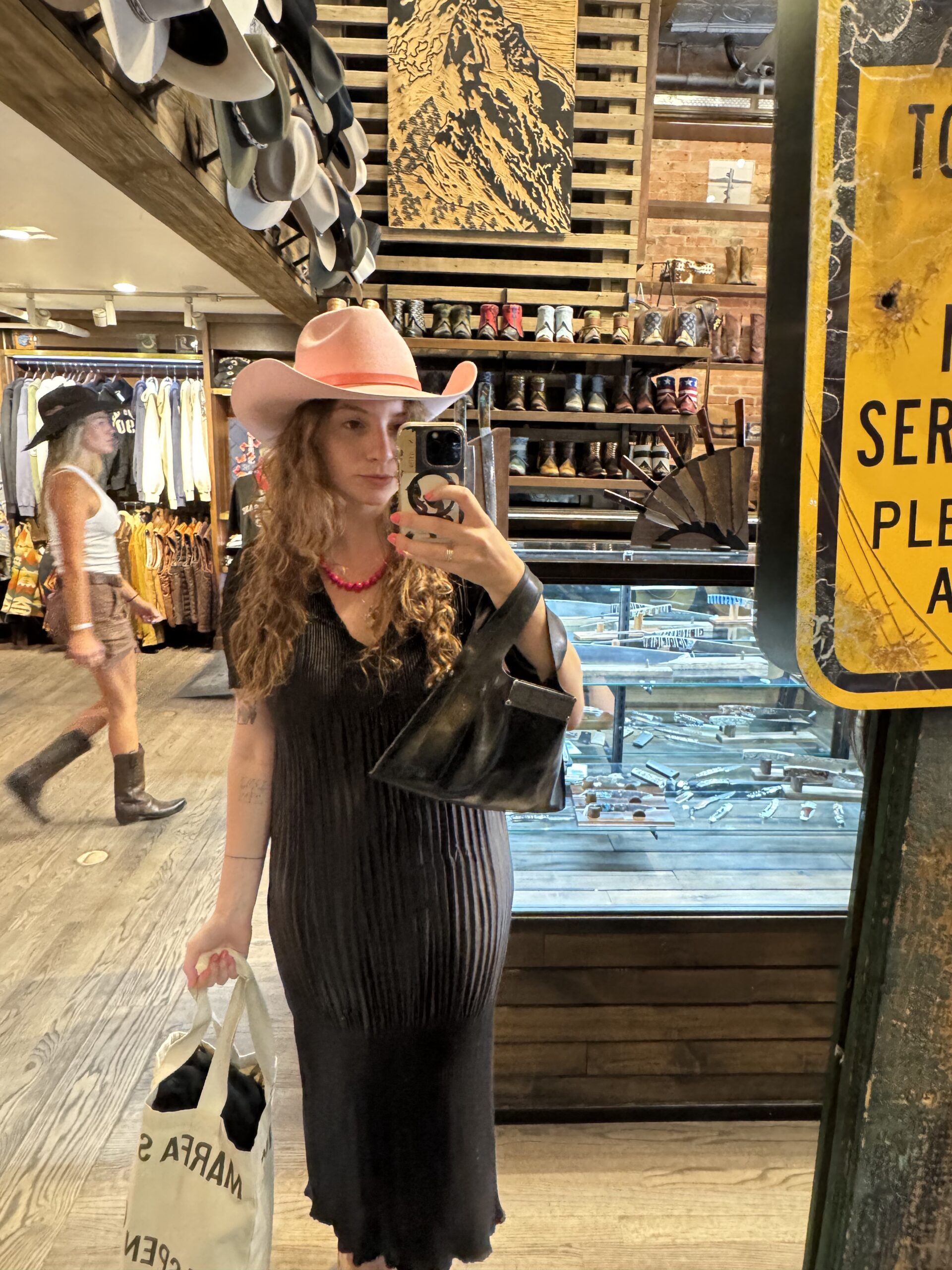

All photos courtesy of Greta Rainbow.
The last week of July, international art world figures populated the landscape of Aspen, Colorado for Figures in a Landscape, the second iteration of AIR, Aspen Art Museum’s festival of contemporary art, performance, and ideas. Also in attendance: doublings, ghosts (including Andy Warhol’s), gay guys, clowns, and caterpillars.
Founded by artists in 1979, back when Aspenites leaned more hippie ski bum than “owner of multiple vacation homes,” the museum is a non-collecting institution. A visionary curatorial team led by Nicola Lees, Daniel Merritt, and Vic Brooks wasted no time finding shiny, surprising artists working in unwieldy mediums, on things that decay or otherwise won’t stand the test of time, yet are critical for right now. They’ve convinced their coterie of donors to spend money on that which cannot be owned or captured completely.
It’s a certain kind of person who brings their Dior Saddle Bag to a performance art piece at a solid waste center, and these dueling currents of stylish disaffection and philanthropic virtue coursed through four packed days of activities. There will always be the corner of Germans smoking cigarettes—alarming the forest-fire-aware Aspen Institute staff—but on the whole, this is an earnest affair. How else to be when Barack Obama is mentioned in at least three different remarks to enthusiastic snaps? Everyone likes the Obamas.
I mean, the gap is closing between those who bought Michelle’s personal style-focused coffee table tome and those who might buy a Reagan Bush ’84 trucker hat from Kemo Sabe. It is fun to try on luxury puffers and marvel at the other world of the wealthy, but there’s politics beneath the surface of taste. After his reading in a chapel dappled with golden light, poet-novelist Kaveh Akbar tells me, “The future that I want to live in has art, and it has people gathering for art, and it has people gathering for extraordinary, transcendent performances, and it has a free Palestine, and it has a time when every sentient being is free from suffering.” Every sentient being—I guess that includes the billionaires as much as the bugs.
———
MONDAY 11:20 AM DOWNTOWN ASPEN, COLORADO

I stop at the antique store Johnnie Mae Alderfer has owned for 40 years. I ask her what’s changed about Aspen. “There’s a difference between millionaires and billionaires,” she says. “We used to have millionaires. Now we have billionaires. So that’s different.” I explain that I’m here to see art, and she tells me she served Andy Warhol once at the Hickory House, which was the worst job she ever had. She remembers him being perfectly nice.

In Warhol’s diaries, I learn that he bought forty acres “out near Aspen” around 1977. He mostly came in the winter to ski Buttermilk and host New Year’s parties.
In 1981: “We called up Jack [Nicholson] and he said he’d meet us in Aspen so we drove all the way to Aspen and it was just so beautiful and a toy town. We went to this restaurant where Jack met us with Lou Adler, and Jack was just adorable. God, he just was adorable. The waitresses were adorable, everybody was adorable.” I wonder if one of the adorable waitresses was Johnnie at the Hickory House.

———
6:20 PM ROSE RANCH, SNOWMASS, COLORADO


Spilling from shuttle buses and a singular Tesla, attendees of AIR’s welcome party are greeted by donkeys and their handlers. A jazzy rendition of MGMT’s “Electric Feel” blooms from a great white wedding tent. Buttery chardonnay flows. The donor class mingles with the artists they are benefiting. It’s a transaction that is referenced for the rest of the week in pleas and half-jokes, immodest proposals for patronage. Why doesn’t Jamie Tisch just pay Alex Tatarsky’s rent?

A crowd gathers around Matthew Barney’s ZONE DEFENSE: Old Snowmass Parallax, a sculptural remnant of a performance commissioned for AIR last year. Apparently, hunters, huskies, and retired football players slung guns, ran laps, and beat drums. It doesn’t quite translate, this ghost of the action. Between its beams, I spy Goldie Hawn and Kurt Russell, who own the 70-acre Home Run Ranch next door. Barney weaves between clusters of friends and fans, stopping to let us pet his dog, Clover, a black-and-white fluff not much smaller than the donkeys.

Tracing a circle in a carriage pulled by horses Dilly and Dally, conversation drifts to Yellowstone, as it must when you put a bunch of New York culture vultures temporarily out to pasture in a trapezoid-shaped state. I recommend Landman, Taylor Sheridan’s more recent mythologization of the West and man’s search for anti-woke meaning, which becomes meta when I spy actor-artist Bobbi Salvör Menuez in attendance. They play the sports medicine roommate of cheerleader Ainsley, tasked with explaining non-binarism to Paramount+ subscribers across the United States.

For our supper, we give thanks to Bank of America. Thank you Prada. There is a birthday. Artist Adrián Villar Rojas got legally married this morning, because that was what his schedule allowed for. Life gallops on.
———
TUESDAY 8:40 AM JULY 28, 2026 ASPEN MOUNTAIN

A mountaintop morning concert from Los Thuthanaka is one of the best things that’s ever happened to me. “They’re what I listen to on my way to work,” Daniel Merritt says of the duo described by critics as “ceremonial, but swaggy.” Chuquimamani-Condori and Joshua Chuquimia Crampton’s newest EP, Waq’a, tells the story of the birth of the sun as it’s taught in the Great Pakajaqui Nation around the Andes in South America. They don’t seem to be saying anything to us; they seem to be addressing the sky.
———
11:14 AM ASPEN ART MUSEUM

Aspen Art Museum CEO and artistic director Nicola Lees says that, this year, AIR moves “from the stage, to the cave, and back again.” Inside the museum, the newly opened Adrián Villar Rojas exhibition First Gods, Lost Animals covers the dark and jagged mysteries of the natural world and humans’ anxious attempts to understand them.


Meanwhile, Arch Connelly’s collages and sculptures in his first and posthumous institutional survey, Straighten Your Wig and Pray, shower us in glitter and pearls, the most synthetic of splendors.


———
4:31 PM MOLLIE HOTEL

My newly acquired, admittedly stolen party trick is to ask people to guess the average sale price of a single-family home in Aspen. They usually say somewhere between $1 million and $4 million; the answer is $17.3. In the rooftop hot tub of the MOLLIE hotel, the hum of construction surrounds me. I remember my first East Coast summer, when I thought cicadas were distant chainsaws. I decide to become a stoner again.

———
7:50 PM T-LAZY-7 RANCH, ROARING FORK VALLEY, COLORADO

There is a long line for the buffet in the high alpine meadow, and Hans Ulrich Obrist cuts me at the front. That’s okay, Hans Ulrich Obrist.
Warhol after a trip to Aspen in 1983: “I didn’t have one drink the whole time I was away. And I didn’t gain weight, either. I just got weighed and I’m 126 still.”

I’m noticing familiar faces at every stop. “It’s like summer camp,” psychoanalyst, poet, and trained clown Nuar Alsadir tells me. “I was meeting Kaveh [Akbar] for breakfast, and Miranda [July] and Jonah [Primiano] happened to be there at the same cafe, and they came and joined us. We just dove right in. Great conversation, totally generative. You can not know someone, and then connect with them, and something about this environment gives you permission to make that connection into something that feels permanent. As an adult, that’s rare. Nothing is being asked of me, I’m not here to gain anything, and nothing I do here is being turned into capital.”

At summer day camp as a child (I was not cut out for sleepaway), I remember observing the counselors, picking up on the strange behavior that I now know was flirtation. There are lots of artist-couples here. Lucy Raven and Matthew Barney are one of them. Tonight, he’s supporting her as the new iteration of her film Murderers Bar is shown on a monumental, curved screen with live musical accompaniment composed by Deantoni Parks.

It is pale twilight when the show begins, and the sky darkens as a dam is detonated on screen, water and mud flowing forcefully to fill up the dried Klamath River in Northern California. The energy appears to be spilling from the mountains. It’s pitch black by the time the camera darts in and out of the rushing current like a Coho salmon. Coho salmon are so ugly. I love them.
———
WEDNESDAY 9:25 AM JULY 29, 2026 PITKIN COUNTY SOLID WASTE CENTER

Originally, Ivan Cheng was supposed to stage 16, his “live situation for the camera,” on a country club golf course, he tells me. Instead, we are in folding chairs at a landfill. We twist our bodies to watch him leap over dirt piles, IRL and mediated through a screen projecting live on-the-ground and drone footage of his actions.

Cheng becomes just the right amount of out of breath so as to remain audible as he utters an entrancing script on artistry. “Authenticity is about throwing away all unnecessary things,” Cheng recites. A dumpster truck rolls by in the near distance. “Stop collecting. Stop disposing. Stop living. They’re all the same!”

He asks for two strong people to pick him up and bring him to the lap of museum board member Marcy Edelstein, where he rests his head like a baby before leaping up into song, now a dumpster-diving nymph, or a seductress of scrap metal.

Cheng tells me he was trying to “deliver a low-level spectacle and provide enough of a constant sense of image in a frame.” He feels aware that he is comparatively younger and less established than some of the other talent, meant to provide “something exciting from Europe.” For Marcy, it was exciting indeed.
———
12:05 PM ASPEN INSTITUTE

One of the first things Morgan Bassichis does when they visit a new place is go to the public library. It’s where “people are stewarding memory and making space to be in intergenerational conversation,” Bassichis tells me. At Pitkin County Library, they finished their 2026 AIR commission, Ghosted Live on Stage, an outstanding performance lecture split between entertaining and intellectually illuminating. Coming off the success of Can I Be Frank?, Bassichis teases next year’s probable work in which they are “in concert with” Amy Winehouse. Making art with a dead artist means “confronting one’s own ego and motives,” Bassichis says. “A tribute is too pure. Something’s amiss because we’re not acknowledging our own ambition, and the brutality of the fact that they don’t get to be here and we do.”
Stuart Comer, curator of media and performance art at MoMA, told Bassichis moments ago that legendary choreographer Simone Forti had died. And I tell Bassichis about the recent death of Betye Saar. “When you start to pay attention to artistic lineage and memory, you start to realize so many people are doing what I’m doing, which is basically keeping somebody’s memory fed,” Bassichis tells me. “That’s a beautiful way to move through the world: noticing who people are honoring and how.”
———
1:47 PM

Ever since I was a little girl I’ve wanted to go inside one of Buckminster Fuller’s early geodesic domes.

———
2:16 PM

There’s a slight stampede at the doors for Miranda July. All the divorced and divorce-curious white women of Aspen who saw their perimenopausal symptoms in the protagonist of All Fours are here. And so am I. But I love Miranda July from #twee Tumblr. Some acolytes get to participate in a seemingly impromptu sculpture based on July’s discomfort around seeing herself tagged in photos after participating in this kind of thing. She tries to wrest some control—now we’re okay to take pictures. I’m delighted to note that Miranda July and I have the same heels from Paloma Wool.
July is in conversation with Okwui Okpokwasili, a performance artist and one-half of Sweat Variant, along with her creative partner and spouse Peter Born. If there was supposed to be a structure, it’s not clear, but I don’t mind their ramblings on smelling their pussies (which is actually a conversation about shame), July’s ecstatic dancing on Instagram (a way for her to still be in the world while writing a novel for four years), and going up to strangers at a party to ask if they want to try her perfume (she’s developing a tonka-bean-forward scent with Marissa Zappas).

She took a bath with someone last night, July says, someone who hasn’t read All Fours, and their conversation turned to shitting and pissing in a sexual context. She realized she’s never had the level of physical intimacy of the boys in Call Me By Your Name, the original André Aciman book, when one massaged the other’s abdomen while he defecated. And what a profound absence is that?
I don’t think it’s meant to be provocative for provocation’s sake, though a donor behind me whispers, amazed, “She’s saying things no one else says.” When Okpokwasili declares that “People have trouble with cunt,” an older man in my row says, “I don’t.”
———
6:38 PM THE BEAR DEN, DOWNTOWN ASPEN

I get a normal burger and a normal dirty martini with Meka Boyle so we can feel normal. We have become expert audience members and we eavesdrop on the conversation at the table over—something about being afraid of Zohran Mamdani and “Israel’s side.” Groups of twins keep passing by, women wearing the same Zadig & Voltaire top with the same Farm Rio pants. The table keeps recognizing everyone on the sidewalk. I don’t know how they tell each other apart.
Warhol in Vail: “Betty Ford doesn’t look as good as she did in the photos after her facelift, she just looks sort of the same.”
Matthew Barney and Lucy Raven stroll past holding hands. They look happy and no one recognizes them.
———
8:11 PM ASPEN ART MUSEUM

At this point, the cozy anti-capitalist summer camp fantasy has been ruptured as attendees of the third Aspen Art Fair arrive via jets from Texas (the newly appointed director also heads Dallas Art Fair). Consultants and collectors scurry in overeager.
Concurrently, the museum hosts their benefit auction ArtCrush, featuring works by several past, present, and future participants in AIR, including Anne Imhof and Camille Henrot. A sleeping lady catches my eye, and happens to be a 1954 Warhol drawing.
———
8:43 PM

Lyle Ashton Harris’s multi-media performance On Oracle, with writer-activist Darnell L. Moore and artist-researcher Raymond Pinto, is a punishing watch. Part splashy career survey (Hauser & Wirth mentioned; Aperture Foundation mentioned), part elegy for a friend he lost less than a month ago. It feels too raw. But I like the smell of the incense wafting through the Aspen air after the rain and the white lightning strikes. Nature shows all of us up.


–––
THURSDAY 9:12 AM JULY 30, 2026 ASPEN CHAPEL

Kaveh Akbar and Paige Lewis left their “menagerie” of animals at home in Iowa to be here. They’ve got two dogs, two cats, and 38 monarch butterfly caterpillars Lewis found as eggs the size of a comma on a page, nestled in the milkweed she planted in their yard. “I bring them inside and I raise them because, in the wild, monarchs have, like, a 2% survival rate,” she tells me. “And they have a 100% survival rate with Paige Lewis,” Akbar chimes in, turning to tell her, “You look so pretty right now, the way that the wind is, and the light behind you.”
In the chapel, Lewis and Akbar each read several poems, including “The Moon” by Palestinian poet Mosab Abu Toha, a snapshot of the airstrikes in Gaza. Afterward, Akbar feels “pulverized,” distraught that he allowed the audience to “just vent some neoliberal anxieties because now they’ve heard someone say a thing that makes them feel like they’ve been exempted from the harm described therein, because they’ve listened to me talk about it. And I’m not exempt. Everything that I read was indicting me.”

“I’m experiencing many things at once. I’m experiencing pleasure at the verdure. I’m experiencing being deeply in love with my spouse in a new space. I’m experiencing getting to be moved by art,” Akbar says. “But because I am the Iranian in the room, I’m the Muslim in the room, whatever the fuck—no one else is going to say it if I’m not.” He concludes that, on the whole, he’s having a nice time.
———
9:49 AM

It is hard to say who is the bigger celebrity this morning: Swedish composer Kali Malone, drone-metal legend and Sunn O))) guitarist Stephen O’Malley, or the newly-restored pipe organ in the Aspen Chapel. Together, they open something up inside the space of tonal repetition.

I feel the emotions of everything I have consumed, and they start to leak out a little before that softness is replaced with rage at the blue light of the iPhone of the woman next to me Googling “aspen mountain stargazing august gondola” and “aspen equestrian estates.” The light in here is supposed to be yellow.
———
1:05 PM ASPEN INSTITUTE

Keynote speaker Julie Dash hopes no one will ask her if she’s seen Christopher Nolan’s Odyssey yet because she hasn’t had the time. “The only thing I’ve seen in the theaters is Minions & Monsters with my grandson,” she tells me. Yes, it was pretty good.
This is the first day of the festival that the trailblazing director of Daughters of the Dust didn’t bring her laptop. She’s in post-production on a new film. She’s fielding press requests for her Wanda Sykes special for Netflix that just received three Emmy noms. “So, you’re working,” I remark. “Always,” she says. Her Daughters of the Dust collaborators are too—Arthur Jafa was the cinematographer, and Kerry James Marshall the production designer.
———
7:00 PM WHEELER OPERA HOUSE


French artist Camille Henrot reimagines Commedia dell’arte inside 101 Vulture Street, a New York City apartment building crawling with artists, like caterpillar Dagmara (Bobbi Salvör Menuez), who spreads their legs in pilates “as wide as the wealth gap” while dodging their landlord. It’s a whimsical set, swooping and drooping in Henrot’s style, and I, for one, chuckled at the 6-7 joke. Originally commissioned by Performa, I think Christina Catherine Martinez belongs on this classic red-curtained stage.
———
10:00 PM W HOTEL

There is a strict noise ordinance and the rooftop for the artist party must be vacated promptly. The Commedia cast had been at a collector’s house, which was apparently light on sustenance, so they arrive wanting. I observe a potential patronage opportunity play out between Pat Wang Maugüé, Isa Spector, and Gabrielle Richardson. It’s time for me to go. “I feel like we just live in Aspen now,” Naomi Fry says. Henrot’s satire about paying rent made me homesick.
Warhol, finally: “Never took a bath the whole time in Aspen, never changed clothes. Just lived like a pig. That’s a good story, isn’t it?”
