

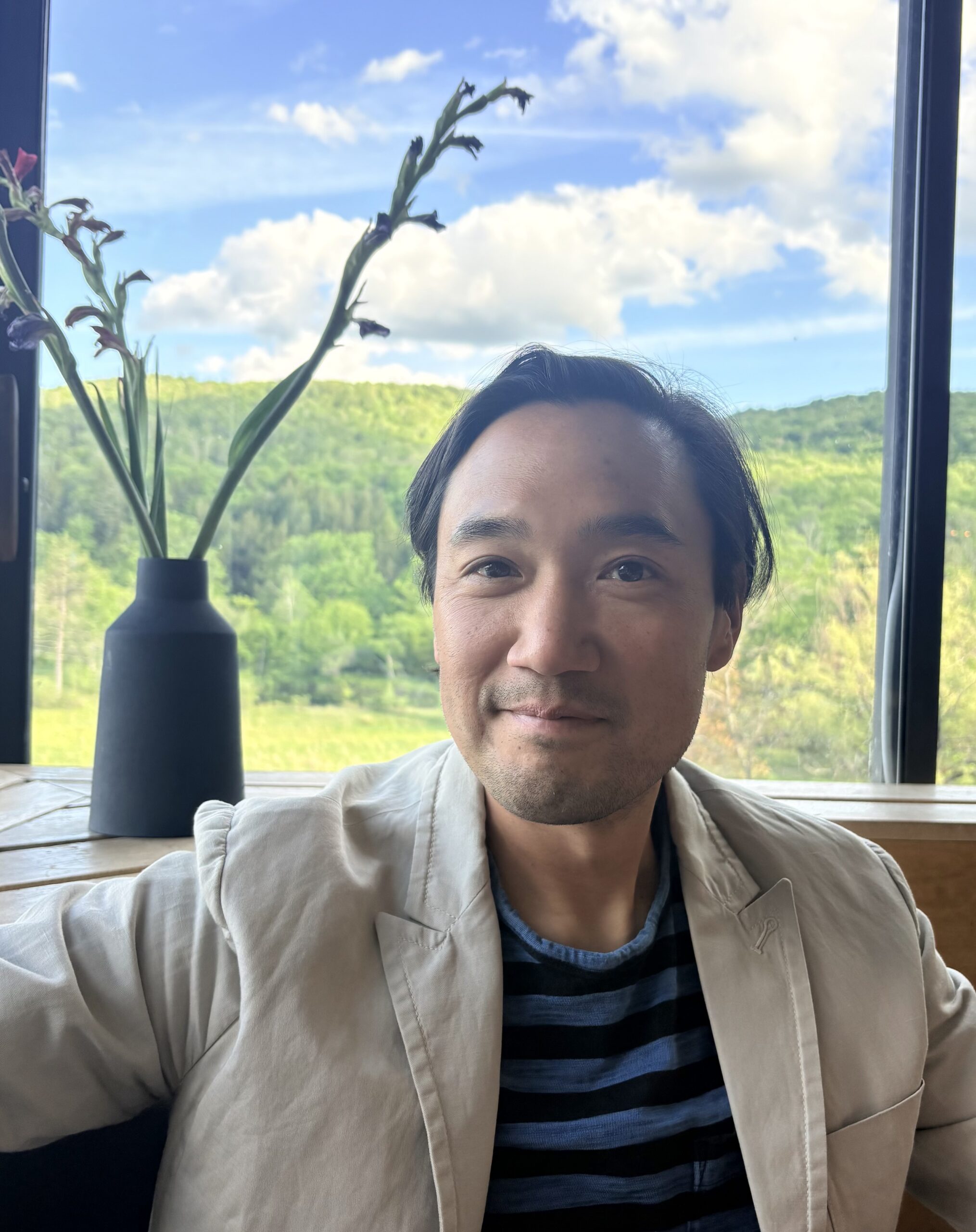

Photo courtesy of Paul Yoon.
You wouldn’t guess from meeting Paul Yoon just how sick he is of people. I got to know him on the tennis courts last summer at the Bread Loaf Writers’ Conference, where he was the affable sort of opponent who always gives you the benefit of the doubt and loves to shoot the breeze between points. But if you’ve read his work, you know he’s no stranger to the violent side of the human heart. In addition to three collections of stories, he’s the author of two previous novels, Snow Hunters and Run Me to Earth, both of which describe the impact of war in the kind of clean, austere prose that traces the negative space around his characters’ interior lives rather than plumbing their depths. The same turns out to be true of his new novel, Etna—which he read from that week at Bread Loaf—with the important distinction that the interior life in question belongs not to a human, but to a dog.
The book follows Etna in the aftermath of his service as a combat dog in a devastating war, as he makes his way across a ruined landscape toward an idyll of home that may no longer exist. Etna’s journey is a thrilling, consuming adventure, one that makes you ashamed to be human but also asks you to share in Etna’s faith that, in the ruins humans have made of life on earth, some fragment of goodness has survived, and that it’s worth pursuing. When we spoke last month, Yoon was navigating the frenzy of pre-publication from his publisher’s offices in Manhattan. In addition to Etna, which came out on August 4, we talked about animal psychics, historical fiction, his real-life dog Oscar, and the legacy of war in his own life.
MONDAY 4 PM JULY 13, 2026 NEW YORK CITY
———
CHRIS KNAPP: Let me make sure this is rolling. Okay, we’re good to go. Sorry, I was asking you how you’re doing and how excited you must be about your book coming out.
PAUL YOON: I’m so excited. I’m in the Scribner offices right now signing copies for a bunch of amazing independent bookstores. Personally, it’s weird. I’ve been doing this for a long time, but still not really used to it. My books have never gotten this much pre-publication attention before. So I’m really grateful for it.
KNAPP: Is your hand all cramped up from signing all those books?
YOON: I would say it’s like being a boxer, but my wife would be like, “Please,” because she actually boxes.
KNAPP: Wait, are you a lefty?
YOON: Yes, except I play tennis right-handed.
KNAPP: So the book’s coming out in August.
YOON: The book’s coming out in August, which, as we speak, is maybe three weeks out, which is insane. It’s very much in line with things I’ve been working on for a long time in terms of themes, but it’s also, for obvious reasons, a major departure. It’s a little scary, but I’m going in with a lot of love and excitement.
KNAPP: I still remember listening to you read at Bread Loaf last year. You gave a jokey preamble that you were going to read something from the point of view of a dog, which made it sound like it was going to be something more satirical. Then you read, and the entire crowd was rapt. It was just breathtaking, but very, very serious. We spoke about it afterwards, but I didn’t get a full answer from you. How did this project start? When did you know you were writing a book from the point of view of a dog?
YOON: I think, like all my projects, it was not just one thing. It was a few things. The obvious one and the fastest answer would be I fell in love with a dog. I have a dog who’s 12 years old now. His name is Oscar. My first dog ever, I never had a dog growing up. I know a lot of people who have animals, and they talk to their dogs. I’ll wake up, and I’ll hear my wife, Laura [van den Berg], talking, and I’ll think she’s on the phone or something. And then I realize she’s just talking to Oscar. But I never talked to him out loud, and I still don’t. Other than basic commands, it’s this silent communication, almost like telepathy or something like that, or imagined telepathy. I spent a lot of time thinking about what his voice would sound like. At the same time, over the past few years as we experience the world, read about the world, open up the newsfeed and all that, there’s been a feeling like I’m exhausted by humanity. Exhausted by humans. I say this a little bit jokingly, but I think I just needed a break from humans.
KNAPP: Yes.
YOON: We’re the main characters of our stories, but I just thought in my exhaustion, what would happen if I pushed humans to the side of the stage? I started imagining my dog’s voice again, and I started writing what would turn out to be the first pages.
KNAPP: As I read the book, I thought about other books that have been written from the point of view of animals. I was thinking about my father-in-law. He got his first dog in his late 60s. I remember visiting him, and he’s looking at his dog whose name is Moustache.
YOON: Moustache.
KNAPP: And he’s looking at him very intently. I’ve never really thought of my father-in-law as an especially deep or inner-directed person, but he looks up at me and says, “It’s just impossible not to imagine what they’re thinking.”
YOON: Wow.
KNAPP: He said, “I just sit around imagining what he’s thinking all the time.” I was thinking about this a lot reading Etna. It does push humans to the side of the stage in the way you described. But also, it’s a book about a state of affairs that humans have inflicted on the whole planet. You’ve built this character who’s apprehending that human world through animal consciousness, and I’m just curious how you approached that. Because it’s not only building a character, it’s building an entire way of seeing the world.
YOON: Yeah. And part of it was, in the best way I could: no judgment. This animal is on this planet that humans have destroyed. So he needs to just survive. Part of the engine was just having Etna be a lens through which we can see the havoc, the wreckage, the disasters.
But Etna isn’t always thinking about the human thing: the human pain, the human loss, the environmental destruction. It was like, how do I balance that in a book? How do I create a voice and a character where he is dog-but-not-dog? And what I mean by that is to have a voice where it’s just believable that you’re in a dog’s point of view, but also create sentences, and paragraphs, and language that become a bridge for the reader to be able to experience this world too.
KNAPP: Both dog and not.
YOON: I’ve been interested, as a writer, in what do we hold that’s private, that’s just for us? What are the mysteries? What do readers have access to, and what’s withheld? I like it when I’m reading a book and I’m like, “You know what? I feel like there are times when I don’t actually have access to this character,” where this character is actually having a private moment that is just about them, and they don’t need to explain their reasonings, or motivations, or their actions. That feels more true to life to me. I personally believe dogs have superpowers and have deep mysteries that we won’t have access to or we don’t even know how to begin to comprehend. A small example is, Oscar always knows 20 minutes before Laura gets home. He can just sense her presence 20 minutes out. So there’s this section in the book where Etna is recovering from a fight with other dogs, and his mind begins to float from there to other places. Until he’s listening in on a conversation that technically it’s impossible for him to be listening in on.
KNAPP: Through the window, you mean?
YOON: Through the window. I was just thinking, “Oh, what if Oscar can sense Laura because he can move his mind so far away that he can actually sense her?” And I know that’s not true, but there’s also a part of me that’s like, “Well, I don’t know if that’s not true.”
KNAPP: A really interesting thing about the book is the way that, like you said, the both-dog-and-not aspect operates. You’ve got this medium, which is consciousness rendered in language, but then you have all of these dog things that humans don’t have access to. You render this nonverbal experience of instinct in language in a way that feels really immediate. Sensory detail is another one. How did you think about that, about how to take those things that are really hard for us as humans to get our brains around and translate them to the human medium of language?
YOON: Obviously, smell is going to be the predominant sense, which is not our go-to when we’re writing human characters. I was like, “I’ve got to pivot and shift gears and make sure that scent is the primary mode in which we build this world.” But it was also the fact of being lower to the ground. I had to build a world where I was a lot lower to the ground, seeing things from there. He’s always going to be at shin height.
So those were the two guiding lights to push the story forward and begin building the world and navigating it. That and just certain rules that I decided to keep to, like all animals can communicate with each other.
KNAPP: How did those rules emerge? As a reader, you pick it up as you go. Like, “Okay, so all animals can communicate in this telepathic way?”
YOON: It was just a matter of him being alone for most of the journey, and I wanted him to have times where he’s interacting with these other animals who survived. I wanted to make sure that they were all in communication with each other and surviving or grieving together momentarily, and having these connections. It pushes humans further aside if the animals are in silent communication. With the exception of Soojin, who actually can telepathically communicate with dogs, which came from real life where we’ve encountered many people who are dog psychics.
KNAPP: I’ve never encountered a dog psychic.
YOON: We had a dog psychic when Oscar was three years old. They were on the phone, and the psychic was like, “Tell me all about Oscar.” It’s possible the seed of this book started there too. She wrote in Oscar’s voice. She sent a monologue in Oscar’s voice after this long phone call. I remember reading this thing, and first of all, it’s hilarious and I love it. But there’s this moment where she’s like, “I love sleeping in my parent’s bed.” This is an apartment in Cambridge many years ago. “But there’s this thing at the foot of the bed that makes me a little nervous because I did a very bad thing on it. And I try to stay away from it from now on.” And we didn’t tell the psychic about any of this, but there was a bench at the foot of the bed, and I think a noise startled him in the middle of the night one night, and he jumped on it, and it slid, and he fell off of it.
KNAPP: Wild.
YOON: It was such a wild thing for the psychic to bring up. And I think it’s haunted me for a long time.
KNAPP: I’m thinking about the setting of the book in the sense that it’s this completely decimated landscape, the entire country is in ruins. It’s interesting that we feel a lot of grief about that from Etna, but surprisingly little anger. Was that something that you thought about?
YOON: Maybe that’s what I meant about no judgment. There’s this moment where he’s hanging out with an older dog, who says, “I don’t know if there’s a place for us anymore after this in this world.” And Etna’s response is, “There’s no other place. This is the only world we have, and we live in it, and we move through it, and we survive or we don’t survive.” I wanted that kind of mentality as an engine for him, where, yeah, there’s a lot of loss and grief, but is he angry about it?
It’s almost like it’s beside the point whether he’s angry about it or not. His point of view is he just wants to go back to a memory. He wants to go back to a geographic location. There’s a moment where he gets angry a little bit with the dog psychic, Soojin, at the end where he growls at her. And that was intentional. That was the only moment I wanted him to show that emotion.
KNAPP: It’s a really arresting moment for exactly that reason. So the book takes place in what seems to be a fictional country. But it’s a world that resembles ours, and there are place names that correspond to the real world. How did you think about overlaying this world that you’re creating on our recognizable world?
YOON: For the most part, I have been writing historical fiction all my life. A lot of that involved heavy research and reflection about accuracy and what fiction writers can get away with in pursuit of a truth that’s more faithful to story than to historical fact. I’ve been writing about war for 20-plus years, never having expected that I would be. It’s just that we seem to always be at war. I thought, if this is my preoccupation, if this is the thing that I’m always going to tackle, what would happen if I did it from a different angle? If I created a landscape that felt both possibly historic, but also futuristic, would that lend itself to a universality or something where people from many backgrounds connect with it?
KNAPP: What is it about you, as a writer and as a person, that has drawn you to that subject?
YOON: I think it’s because I grew up feeling really alone, because I never knew a lot of my family members. A lot of them were affected by the Korean War. They either didn’t survive the war, or they ended up staying in the north and were stuck there. Looking back, I felt like an outsider less because of my skin color. It was more that everyone seemed to have family that they could visit or knew a lot about, and I just knew nothing. Growing up, when the stories that you hear around the dinner table are war stories, it stays with you.
KNAPP: Is it something that you feel anger about?
YOON: No, but I think I feel sad about it. Well, I don’t know if that’s the right word. I feel great loss. Not being able to know family members, never having met them, it just feels like a kind of erasure. I’ve been wrestling with that in my fiction for the past few decades. I guess Etna gave me a chance to keep wrestling with it, but in a new way.
