

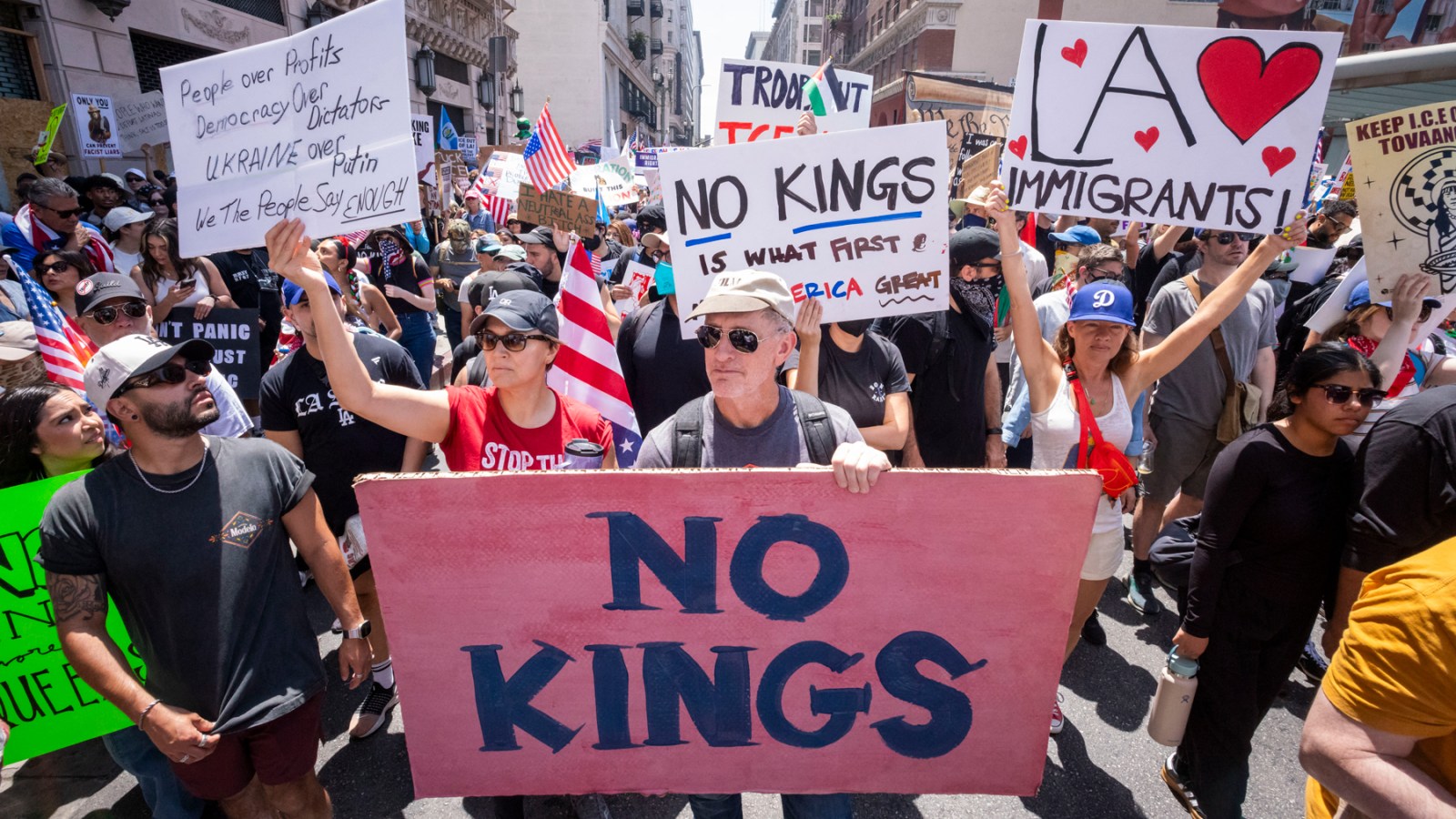
By and large, when my parents go to a protest, I don’t worry about them. Over the past few years, they’ve attended several of the large No Kings demonstrations in Fresno, California. They took me to my first protest there as well, in 2003, to demonstrate against the Iraq War. I remember chanting “No Blood for Oil” and getting honked at by chuds in lifted trucks. The cops, even back then, looked more bored than anything else. In most mid-size American cities, this is how the majority of protests go: They’re permitted, well-attended, and celebratory; comfortable spaces for mainstream liberals to express their frustrations with their government. People write letters to their congressman, set up phone banks, vote in primaries, donate to nonprofits, and maybe walk in the street a few times a year toting a homemade cardboard sign, all to feel like they’re participating in the political process.
There are other types of protest, which can often be spontaneous, combustible, and raw. These are the ones you see on the news. There are the ones that flood into freeways and shut down cities. There are also the ones where people get hurt, where the First Amendment runs up against a wall of plastic shields and steel batons and tear gas, where buildings get torched and cars smashed. The people who end up at the more chaotic protests, often, are from different demographics than the first: younger, angrier, more willing to put their bodies on the line, to feel like they’re fighting for something rather than just making their voices heard.
The truth is that, in America, there is room for many types of protest. We need spaces in which vast swathes of our society can feel like they’re contributing to a movement where they are seen and heard. And in some cases, we need the other kinds too: the five day work week, civil rights, and LGBT rights were hard-fought movements that combined peaceful protest, civil disobedience and other more direct action. Orderly, quiet disagreement often does not move the status quo.
But here’s what you have to understand: In Donald Trump’s America, all types of protest are unacceptable. And if he gets his way, everyone involved in either of them could face the same fate. Trump is currently at war with the left. Antifa, communists, radical leftist agitators — call them what you will, he’s coming for them. But he’s also making plans to come for the center: attacking nonprofit groups, suing the press, and making every effort to criminalize the kind of peaceful resistance and political engagement that is a cornerstone of our democracy.
We’ve already seen how this starts. Earlier this week, I wrote about Autumn Hill, a defendant in the Prairieland ICE shooting case, who was convicted of providing support to terrorists and sentenced to 50 years in prison for merely participating in a protest where a police officer was shot. (Other defendants in the case were sentenced to decades in jail for tangential crimes, like moving a box of zines and other documents the FBI deemed to be evidence.) Autumn Hill was an easy target: She is a trans woman, a quirky nerd who was part of a politically wacky scene of leftists and anarchists, our generation’s free-love hippies. She worked piecemeal as a package handler for UPS. She had little political or economic capital to cement her place in society. And the protest she went to was not, ultimately, peaceful.
There are other examples as well. Take Fergie Chambers, a media-conglomorate scion and long-time activist who is, at best, a problematic figure. He is currently awaiting extradition to the U.S. after being arrested in Spain on money laundering charges that stem from donations he made to charities in Gaza. Chambers, of course, has money, but he has also lived a chaotic, hypocritical, fragmented life on the margins of society. Like Autumn and her co-defendants, he is an easy target.
The Trump administration is hunting these activists on purpose. This is how political repression works. The government picks off the most vulnerable, the most extreme, the misfits and oddballs that they can ostracize through slanted narratives. They take individuals who may or may not be guilty of minor crimes and throw them away for life. The point, always, is precedent. If you can go away for 50 years for attending a protest that the government deemed a “riot,” or if someone you know commits a more serious crime, then there is ready pretext to give any defendant any sentence they please. The government is finding out what works. And we can already see it expanding.
On Thursday, the New York Times released a shocking report that detailed the Trump administration’s efforts to investigate, infiltrate, and break up both major political groups like labor unions and neighborhood-level mutual aid groups during the ICE protests in Minnesota earlier this year. The Times reporting showed that Trump’s Department of Homeland Security used administrative subpoenas to dredge up three years worth of financial data from the nonprofit group Sunrise Movement and a labor union, the Communication Workers of America, and pulled lists of wire transfers over the same time period for the Service Employees International Union, claiming that such actions were part of an investigation into “domestic terrorist fundraising.” The government made the case that a grand conspiracy of NGOs, nonprofit groups, and political organizations had participated in impeding the efforts of federal immigration officers during Operation Metro Surge this winter in Minneapolis.
The SEIU are hardly “far-left” political organizations. The Sunrise Movement has a reputation for puckish, disruptive social media stunts and some legitimate organizing, but they’re hardly a gang of black-bloc anti-fascists. The individuals who were actually arrested in Minneapolis — 15 people who the government claims were at the center of this grand web — were street-level activists. On the surface, some of them bore resemblances to the Prairieland defendants — some of them, to be sure, were involved in the more dedicated anti-fascist and left-wing organizing scenes. But unlike Prairieland, the actual crimes the Minneapolis defendants are accused of are far from terrorism: They allegedly blocked off some streets to keep ICE officers out, and used rudimentary shields during shoving matches with police. The most violent charge leveled against them was “assault of a federal officer,” something that protesters have been charged with in the past if they so much as breathed in the direction of a cop.
It’s tempting for someone who views themselves as a political moderate to look at these cases and think that the repression at work there will never touch them. They may have attended a protest, sure, but they’ve never used a shield. They’ve never touched a cop, put up a barricade, or lit a firework. But that’s missing the point of what the Trump administration is doing.
Over the next several months, or whenever the next flashpoint in American policy appears, we’ll see even more vague charges for activists who dare to take to the streets. We’ll see more nonprofit groups audited or investigated. In Georgia, several years ago, state prosecutors charged members of a community bail fund — meant to provide funds for arrested protesters to get out on bail — with racketeering, attempting to destroy the legal, above-board networks that support people exercising their First Amendment rights.
Resistance, the government wants to say, is not just futile but dangerous. And these charges won’t just apply to the far left. For moderates, the protest permits will stop coming. The cardboard signs will come down. The Trump administration has been making the case that any level of dissent can be construed as dangerous, and has used precedent set in one case to further persecute the next activists step out of line. We don’t have to agree with all of a protester’s goals or all of their methods to recognize that the disproportionate sentences they may face are part of a deliberate machine that will target us next. Eventually, if the Trump Administration has its way, the entire political left will be driven under ground or snuffed out. If America’s political center doesn’t raise its voice and push back against that now, it may not get another chance.
