

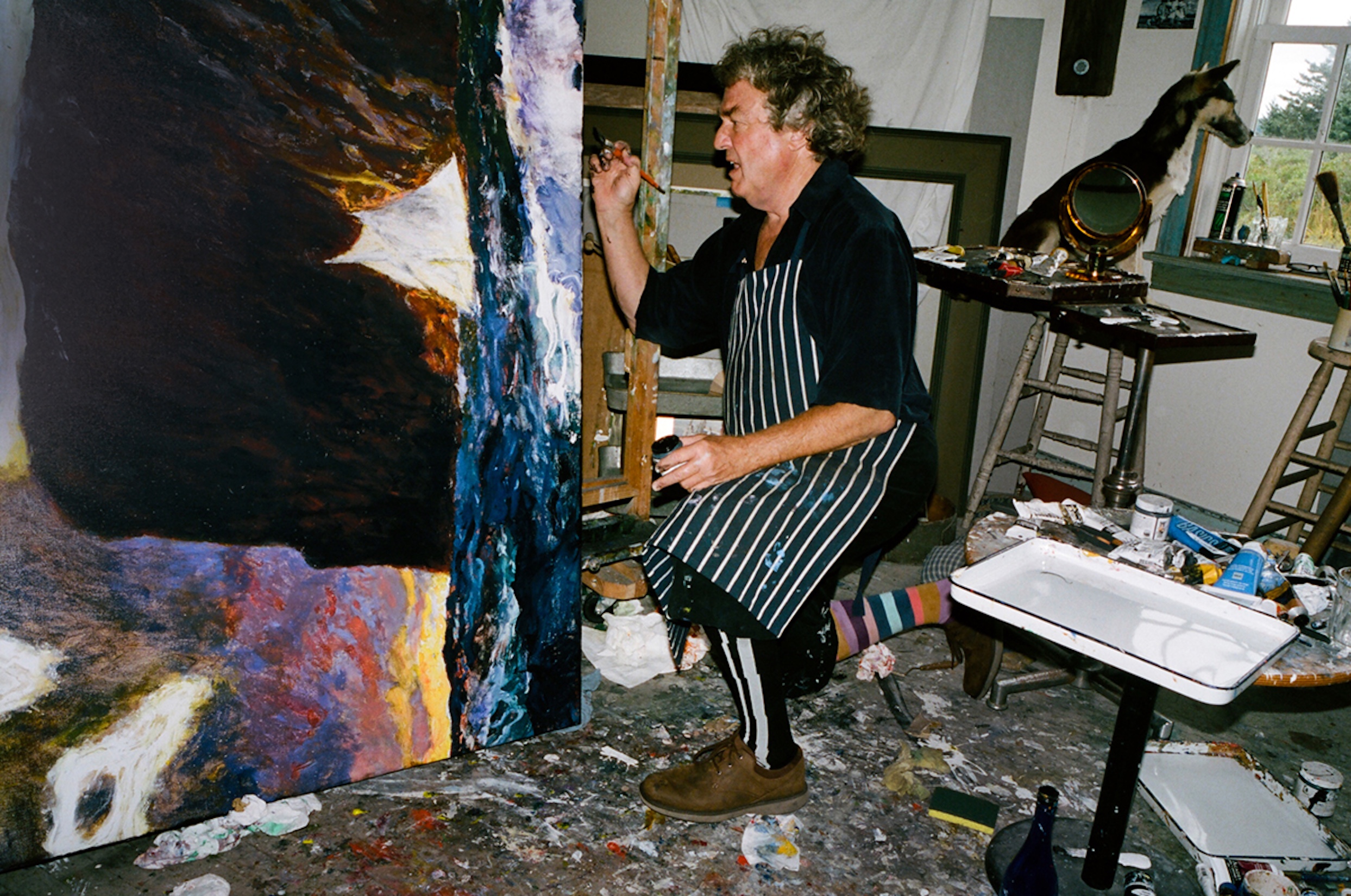

Jamie Wyeth by Daniel Arnold.
Lifelong New Englanders like myself know this is a place that, even on a clear day, can feel foggy. It’s weatherworn and made hearty by brutal, isolating winters, and its people can be just as unyielding. Few artists understand this like the Wyeths, arguably one of America’s greatest art dynasties. Their work evokes a sometimes eerie, even morose quality that makes it all the more hauntingly beautiful, just like New England itself. From Andrew’s “The Witching Hour” to his son Jamie’s series of paintings depicting seagulls as the seven deadly sins, the Wyeths’ knack for accurately portraying the spookier soul of the region is unmatched and fully on display in the upcoming exhibition of Andrew’s watercolors at the Cleveland Museum of Art, Spectacular Freedom: Andrew Wyeth and the Modern American Watercolor
“There is a sort of authenticity to the work that draws the viewer in,” says Britany Salsbury, the Curator of Prints and Drawings at the CMA. “Throughout the watercolors in the show, which are all from the 1930s through the 1960s, we can see Wyeth developing into having the incredibly distinctive, idiosyncratic, surprising, and sometimes even unsettling perspective that makes him the kind of artist who has a true legacy today.”
On display will be nearly 75 works, most of which have never been seen by the public. The exhibit also positions Wyeth within the larger history of American watercolor. “Watercolor gave him a source of endless experimentation, but also a way to place himself in conversation with some of the artists he admired the most, and to be part of a really meaningful conversation about watercolor’s place in American art,” says Salsbury. “His watercolors show him as a wonderfully experimental and complex artist, and one about whom there is still so much to learn.”
To mark the occasion, I called up Jamie Wyeth. We talked about his father’s watercolors, the macabre beauty of New England, and of course, Andy Warhol.
———
JAMIE WYETH: Now, I remember Interview from Andy. He would always carry a bunch of Interviews under his arm and give them out to people and whatnot. And you know Andy was a huge fan of my father’s, of course. When they met it was wonderful, Andy kept saying “The two Andys! I can’t believe it!” He was a very sweet person.
CAROLINE REILLY: Wow, I didn’t realize he had met your father.
WYETH: Oh yeah, he was a huge admirer. And in a funny sense, their work is not that dissimilar. People ask me all the time what it was like, but for me, he was the first serious painter I’d ever met other than my father, simple as that.
REILLY: To the untrained eye, Warhol’s work and your father’s feels very disparate, but I understand what you mean. There are throughlines.
WYETH: It’s about taking everyday objects and zeroing in on them—a can, a building. There are more similarities than dissimilarities.
REILLY: And that ability to turn something everyday into something beautiful really is a big part of this upcoming show.

A 1976 portrait of Jamie Wyeth by Andy Warhol at Wyeth’s home in Wilmington, Delaware, photographed by Daniel Arnold

Andrew Wyeth (1917–2009) Untitled, 1953. Watercolor on paper; 50.5 x 35.6 cm. Wyeth Foundation for American Art Collection, M0408. © 2026 Wyeth Foundation for American Art / Artists Rights Society (ARS), New York.
WYETH: This Cleveland show, I think it should be interesting. It’s a side of Andrew Wyeth that is not really known, it makes it unique. Most people are aware of the tempuras from “Christina’s World” on down, very tight and hyperrealistic. And here, you have this wildly unbridled exuberance in his early watercolors and brilliant colors.
REILLY: Do you remember seeing him working with watercolors when you were growing up?
WYETH: Oh, constantly, and it was the antithesis of everyone’s perception of Andrew Wyeth. I mean, he would throw paint around, spill things purposely, knock them over. And I think that came from working with watercolors when he was in his 20s and so forth. It was kind of a reaction, not against his father, but I think—he was sort of the student under his father, and his father worked in oil. So, he discovered watercolor and the freedom of it. He would sit and do four or five watercolors of the same subject and throw away the ones he didn’t feel.
REILLY: It’s interesting that you say it was a reaction to his father’s work. The watercolors really are such a departure from N.C. Wyeth’s paintings.
WYETH: Totally, and one medium which he completely reinvented, which I think is fascinating, is what he called dry brush—the medium was watercolor, but he worked it almost like a tempura. He’d start with washes and then small brushwork; there’s one in the exhibit called Monologue which is a dry brush watercolor. And nobody’s ever picked up on it. The precedent, he would always tell me, was Albrecht Dürer, a Flemish painter who was really the first to use watercolors in that sort of method. Dürer was working in a period where everybody was depicting a crucifix or religious things, and he does a clump of grass. Then there’s one called Young Hare, and it was a breakthrough because nobody had ever done something that simple.

Andrew Wyeth (1917–2009) Wind Northwest—First Version, 1966. Watercolor on paper; 71.1 x 48.3 cm. Wyeth Foundation for American Art Collection, P1331. © 2026 Wyeth Foundation for American Art / Artists Rights Society (ARS), New York.

Andrew Wyeth (1917–2009) Untitled, 1962. Watercolor on paper; 54 x 75.6 cm. Wyeth Foundation for American Art Collection, M0261. © 2026 Wyeth Foundation for American Art / Artists Rights Society (ARS), New York.
REILLY: When I saw the pieces in this show, I was so taken by how precise they are. It’s not how I typically imagine watercolors are used.
WYETH: It completely defies everything. Look at his dry brush [paintings.] He did a portrait of me, for instance, at eight years old called “Far Away,” which is just me sitting with a coonskin cap and grass around me. And it’s incredibly painted, it’s one of his iconic paintings.
REILLY: I think it’s also the mood these paintings have. I mean, you live in New England and so you know so much of the coastal art is these scenic waterscapes, and they’re all sunny and cheerful. But your father’s work, and your work too, I’ve always loved because it really has that spooky feel that is true to the region.
WYETH: I think that’s the element that appeals to me. I mean, living on Monhegan[, an island off the coast of Maine], it’s very peculiar and sort of a world unto itself, and that hasn’t changed. Some of the art that has been produced, I mean—I admire Rockwell Kent and all the things he did at Monhegan are so strange. He really caught the primal mood of it out there.
REILLY: I had a colleague about a year ago who wasn’t from here, and she went to the Cape in the summer and she was, well, I’ll just say she was snobby. And she asked me, she was like, “Did you know it’s kind of eerie? New England can be kind of morbid,” like it was a bad thing.
WYETH: Isn’t that great? I mean, a perfect case for it is, of course, Stephen King. I did a painting that was a dream I had, a recurring dream. I dreamed I went out to the headlands on Monhegan on one really blowy day, and I looked down and there were two figures in the surf, and as I got near, I realized it was my father and grandfather. So I became totally obsessed with this and eventually put Winslow Homer in one of the versions. The first big version was bought by Stephen King to give to his wife Tabitha for her birthday, and he said, “You’re the strangest painter I know.”

Andrew Wyeth (1917–2009) Black Hunter, 1938. Egg tempera on panel; 81.3 x 101.3 cm. Wyeth Foundation for American Art Collection, P0004. © 2026 Wyeth Foundation for American Art / Artists Rights Society (ARS), New York.

Andrew Wyeth (1917–2009) Burial at Archies, 1934. Oil on canvas; 80 x 100.3 cm. Wyeth Foundation for American Art Collection, Oil13. © 2026 Wyeth Foundation for American Art / Artists Rights Society (ARS), New York.
REILLY: Oh my god, I love that. There’s a new show that everyone loves, Widow’s Bay, and it’s set on a remote New England island and it’s kind of campy horror. She says one of her inspirations was Stephen King, and there’s a joke where a reporter sees one of the hauntings and tells the mayor essentially, “nice try but you’re not Salem.” But Salem isn’t the only spooky place here.
WYETH: Exactly, Maine, it has this strange quality in it; sort of foreboding, and long winters, and huge storms, and so forth. It’s not very inviting to people.
REILLY: There’s a great joke on the show where there’s all these hauntings happening and the mayor calls and asks the sheriff to set up a perimeter, and the sheriff is like, “The island has a perimeter. It’s an island.”
WYETH: How fabulous. It sounds like Monhegan.
REILLY: [New England] has a nice vetting process in that way. In summer, everyone descends on this area. I’m looking out at a row of cars parked on our street with people going to the beach. And as soon as it gets cold, it gets quiet, and I love that. I think that’s something that’s always connected me with your work and your father’s work.
WYETH: You can see it creeping in towards the later work in this exhibition; the color starts disappearing, the darkness starts coming in. That’s when he really got to the bottom of what he wanted to do.

Andrew Wyeth (1917 – 2009) Lobster #4, 1940. Watercolor on paper; 54.6 x 74.63 cm. Wyeth Foundation for American Art Collection, M1035. © 2026 Wyeth Foundation for American Art / Artists Rights Society (ARS), New York.

Andrew Wyeth (1917 – 2009) Storm Clouds, 1938. Watercolor on paper; 45.7 x 55.9 cm. Wyeth Foundation for American Art Collection, 0113. © 2026 Wyeth Foundation for American Art / Artists Rights Society (ARS), New York.
REILLY: I have “The Witching Hour” up in my office and I love it because it’s so eerie.
WYETH: I mean, even “Christina’s World” is a very strange painting. It’s very odd, and the appeal that it has has mystified me because it’s not your usual pretty New England Scene. It’s a hell of a lot more than that.
REILLY: I have a print of “Day Dream” up in my room and I grew up with a lot of nude artwork in the house, Matisse and whatnot. I love his rendition of a nude because it has that same sort of placid feel.
WYETH: That just sold recently at auction for $24 million.
REILLY: Well, I got mine on Etsy.
WYETH: [Laughs] Incredible.
