

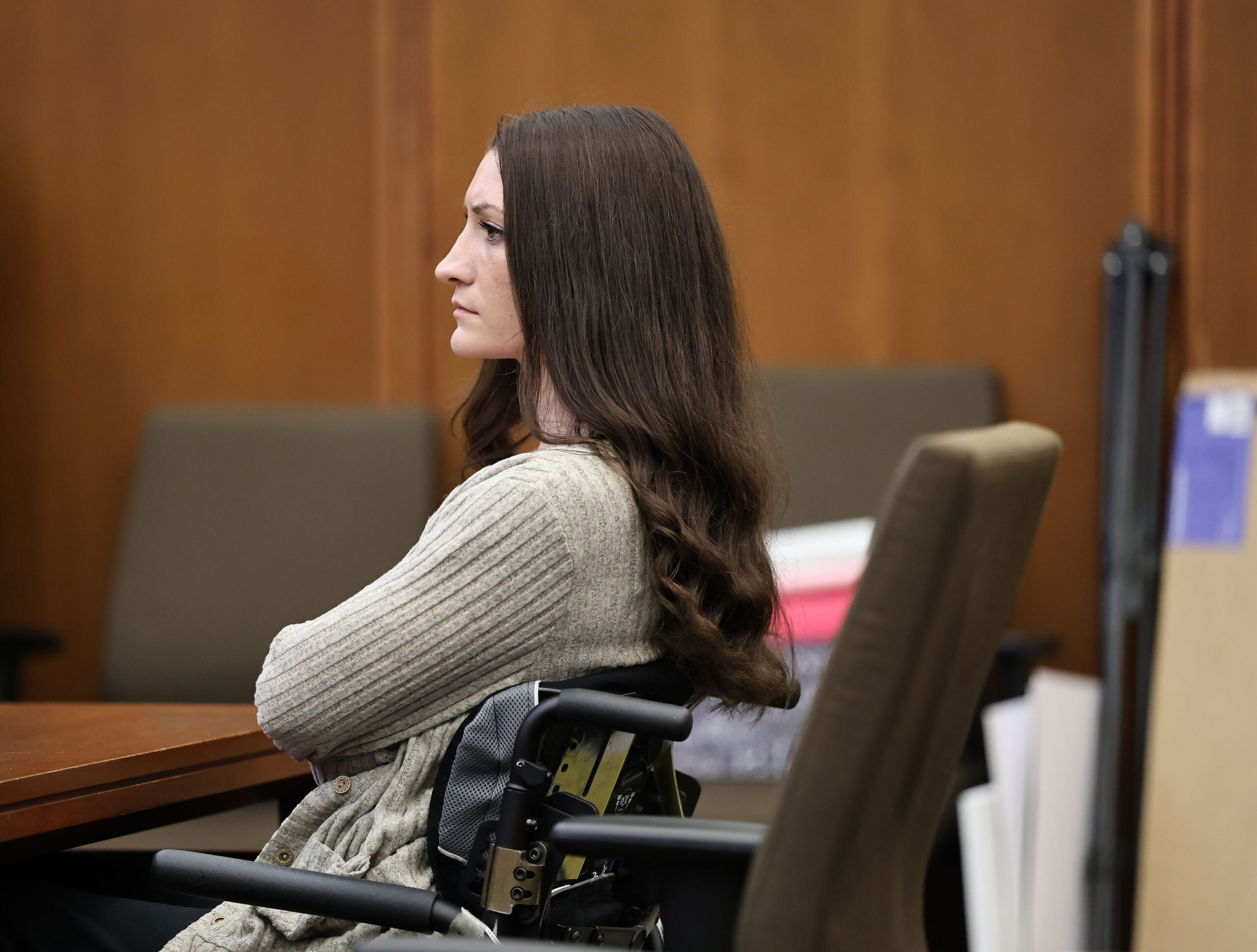

© Greg Derr – USA TODAY NETWORK via Reuters
After nearly 40 years working as a prosecutor and legal commentator, Nancy Grace can usually call a verdict, but something about the Lindsay Clancy trial has her stumped. Now, Grace has no doubt in her mind that Lindsay Clancy was responsible for the murders of her three innocent children back in January 2023. In fact, she rejects any and all theories stating otherwise. The question, however, lies in whether or not Clancy’s postpartum psychosis defense is true and enough to sway a jury, and that’s something the Crime Stories host can’t quite answer.
But she isn’t the only one searching for answers in this tragedy. Like most of America, Jeremy O. Harris has fallen down a deep, dark rabbit hole over this case and is itching to talk about it. As a child, Harris spent evenings glued to the TV watching Grace break down high-profile criminal cases on Court TV with his family, so it was only fitting that he be the one to speak to her about the trial currently gripping this nation. On Monday, just days before a verdict will be given, the pair sat down to talk about TikTok sleuthing, Patrick Clancy conspiracy theories, and why Nancy Grace will stop at nothing to get to the truth. — ARY RUSSELL
MONDAY 11:30 AM AUGUST 24, 2026 ATLANTA
———
JEREMY O. HARRIS: Hi, how are you?
NANCY GRACE: Hello. How are you? Thank you for inviting me.
HARRIS: You have no idea how much it’s meant to me to be watching people come back to talking about you on a regular basis, because I grew up in a Court TV household. There are certain phrases of yours that are just imprinted in my head forever, and certain cases I followed completely with you.
GRACE: Well, thank you.
HARRIS: I’ll never forget that “the devil is dancing tonight” after Casey Anthony’s trial.
GRACE: [Laughs] Yes, I remember that really well. That seemed to stick. It was completely off the cuff. I remember sitting outside the courthouse. It was getting dark. I recall the interviewer giving me a hard time, but the person who was guilty was Tot Mom Casey Anthony. Although the jury certainly did not agree with me, that’s for sure.
HARRIS: Wow. It’s really wild. We’re in a moment right now where there’s another case that has taken over the nation. I have become completely swept up in everything Lindsay Clancy, which is a very different case, but also involves, sadly, the death of three beautiful, innocent children. I wonder if we can go down a spiral a bit about Lindsay Clancy.
GRACE: I don’t know about a spiral, but I will be happy to analyze the evidence as I see it. Her three children were found dead in her basement. There is evidence that one of the children ran trying to save their own life. They were reportedly strangled face down. The last face they would’ve seen, according to the prosecution, is their own mom’s face. Now, an interesting comparison between the Clancy case and the Tot Mom Casey Anthony case, is that in the Clancy case where her three children are strangled dead with their mother’s workout exercise bands, Clancy admits she did it. That is the meaning behind NGBRI, Not Guilty by Reason of Insanity. In order to plead that, you must state that, yes, I did it, but I was insane at the time. You don’t plead insanity for something you say you didn’t do. Tot Mom Casey Anthony, to this day, contrary to overwhelming evidence, insists she did not murder her child Caylee.
HARRIS: Yes.
GRACE: Of course, there’s so many stories coming from Tot Mom Casey Anthony. I’m sure you remember Zenaida Gonzalez, the pretend nanny that she blamed for Caylee’s disappearance. No such person existed. So everything was a lie.
HARRIS: So one of the things that’s very compelling to a lot of women, especially online, are the inconsistencies in what the prosecution has presented to the world. Is there a world where they could also think that it could possibly be a third person, but in order to avoid having the messiness of pointing a finger at someone else, [Kevin] Reddington isn’t bringing that up?
GRACE: Okay, are you serious?
HARRIS: The person that people online think would’ve done it is Patrick.
GRACE: Okay.
HARRIS: And even without Patrick having an actual hand in this crime, the evidence is showing at least a husband that was so uninvolved in the life of his wife and his children that there could be some “involuntary manslaughter failure to act” case about him as well. So women are responding very viscerally to their discomfort with both his testimony and his behavior in and around his children’s deaths.
GRACE: Well, what I’ve learned from the murder of my fiancé is that people respond differently to the death of a loved one. I can’t even imagine the death of your children. But I would like to clarify the evidence.
HARRIS: That’s perfect. Thank you.
GRACE: People confuse DNA evidence with fingerprint evidence. At the beginning, it was stated that no recoverable fingerprints were found. Lindsay Clancy’s fingerprints were not on the exercise bands. Think about it. If you were strangling someone with exercise bands, think of a rubber band, and you’re pulling on it, you’re smearing your own fingerprints. But her DNA was in fact found on the exercise bands, and agreed to that in court. Fingerprints are very fragile. You typically need a smooth surface and the right kind of contact. These elastic or rubber exercise bands are stretchy, they’re textured. Now, a knife that is gripped hard and covered in blood very often will leave a smear, not a fingerprint ridge pattern. But it’s totally irrelevant, because Clancy admits she killed her children. I would also like to point out, as much as people want to hate Patrick Clancy under the belief he was having an affair or that he was a neglectful father, all of that may be true or false. I don’t know, and I don’t care. I care about who murdered the children. Yes, it’s fun to go down a rabbit hole pretending a third party did it. That’s not what the evidence shows. Some of her first words when she came to, she wrote, “Do I have a lawyer?” So that indicates knowledge of guilt. I didn’t ask you at the beginning of this interview, “Do I have a lawyer?” Because I don’t think I’ve committed a crime. Now, whether court watchers like it or not, let me give you the law. The law is, one may immediately regret the deed. That does not negate intent at the time of the incident.
HARRIS: Yep.
GRACE: The law can presume you intend the natural consequences of your act. For instance, if I take a gun—let’s go with a Glock, just for the fun of it. I hold it to your head and pull the trigger. I can’t then say, “Oh, my stars, Mr. Police Officer, I was just trying to scare him. It was a joke.” So with her strangling the children with exercise bands, the law presumes she meant to kill them. The only issue is, was she in a psychotic break? The state is arguing that she waited for her husband to leave intentionally, then herded the children into the basement, and one by one strangled them dead. Then made an unsuccessful attempt at suicide. It’s going to be difficult for the defense to claim psychotic break if she had the wherewithal to plan it. If a not guilty comes down, it will be jury nullification, like in OJ Simpson. Of course he did it, but the jury hated the cops so much, right or wrong, they went, “To hay with it. He’s walking.” That could happen here.
HARRIS: This is the most sobering breakdown of what paths to justice exist in this case, or don’t exist. One of the things that has made a lot of women feel the most crazy online is the sense that there’s a stone to unturn to help this woman who a lot of people see themselves in. “Maybe I can be the one that finds that stone.”
GRACE: I agree with you. There were times when I had gotten the twins home from neonatal intensive care. After their birth, Lucy and I almost died. And one would wake up at 12:30, one at 1:30, one at 2:30, one at 4:30. I ended up having to cut my maternity leave short and go back to work really quickly. I was so sleep-deprived I could hardly think. I believe a lot of women put themselves in her shoes and their hearts break for her. She was trying to get help. She was given a horrible cocktail of 13 drugs—anxiety, antipsychotic, antipsychotic, sleep, mood stabilizer, antidepressant. Does it break my heart? Yes. But I must follow the law. I can’t call this verdict because I feel so badly for what Lindsay Clancy was going through. Yet I know the law about intent. Very often I feel that I can call the verdict. Can’t do it.
HARRIS: I write theater and film. There’s something to the way in which Kevin Reddington has been such a convincing performer. And the prosecutors have been so bad at performing whatever they’re supposed to perform. They’ve been hostile to so many witnesses, even their own. That must prejudice a jury in some way towards Lindsay and Reddington, no?
GRACE: You’re right. Lawyers can rub the jury the wrong way when you’re hostile to even your own witnesses. I would hate to put my own witness up, and then declare them a hostile witness, and cross-examine them. I remember Johnnie Cochran was my co-anchor on Cochran & Grace at Court TV.
HARRIS: Wow.
GRACE: Johnnie would come in the studio. I would’ve been slaving away, preparing all day. Johnnie was like, “What’s the show about?” But he would still be incredible.
HARRIS: Oh, my gosh.
GRACE: He knew more in his little finger than most lawyers know their whole legal career. He would wing it and be so convincing. He just had the “it” thing. God rest his soul. I disagree with everything he ever said, but he had the “it” thing, and everybody wanted to be his friend. I learned a lot from watching him. When you have lawyers that alienate jurors, that’s the death knell to your case.
HARRIS: You know what’s funny is that, when I was little, Johnnie Cochran had such an effect on me that I told everyone I wanted to be a lawyer, not realizing I just wanted to be a showman. But I really was dead set on being a lawyer because of how much verve and swag he had.
GRACE: He totally had the swagger, and it worked on juries. It worked on judges. It was amazing to watch it.
HARRIS: Many people grew up with the ID Channel and Court TV, and have brought all of that onto a social media site like TikTok, and are blowing up cases like this, cases like Nolan Wells. What do you think about this technological social media moment we’re having as it relates to these major cases that are taking over the media right now?
GRACE: It’s amazing. During our program, I often engage in live chat and it matters, because they mirror the jury. They’re looking at evidence. A lot of them are suspicious of the husband. There’s no evidence against Patrick Clancy, just know that, but I think that is born from empathy for Lindsay Clancy’s plight. They feel horribly about what she was going through, her desperate attempt to get help, and it ended in her children’s death. They’re looking for reasons that it’s not her to exonerate her.
HARRIS: I saw a woman do a recreation.
GRACE: Oh, I’ve seen the recreations. I remember when Gabby Petito was missing, we had been covering it so much. There was a citizen sleuth out there called Red, Blue, and Bethune. They were out in the middle of nowhere and dispersed camping. They are out in the wilderness and they see a vehicle and they go, “Oh, my stars, that’s Gabby Petito’s Ford Transit.”
HARRIS: That’s insane.
GRACE: How did they know that? Because of social media. And if it had not been for them, her body would likely never have been found, and the Petito family would have no peace. Not that they’re ever going to have peace because their daughter was murdered, but they would never know what happened to her. So I welcome alternate theories and pointing out facts that other people may have missed. But I would also like to point out Cain and Abel. I mean, that goes back to Genesis, and we’re still talking about it right now. There is a fascination with homicide of all sorts, because when you look at Lindsay Clancy and Patrick Clancy, you think, “Picture perfect,” right? No. And it’s like the mind is tricking the eye.
HARRIS: One of the things that’s been really amazing about watching your new rise on social media has been how much of it is aligned with this case about Nolan Wells, which I wanted to hit on just for a brief moment. As someone who is a Black American from the South, who was that one Black boy at a school full of white boys, the thing my mom always said to me was, like, “Be careful at these parties and on these trips.” So many commentators who aren’t Black had ignored this case and wanted to sweep it under the rug, and you have been like, “No, let’s put a light on this.” I know that a lot of people in the Black community have really appreciated that.
GRACE: Well, when I prosecuted nearly all of my victims that I represented, largely women and children, were minorities. My juries were largely minorities, and I find it disturbing that their voice is not heard. So these crime victims’ families are facing horrific suffering. You don’t even know what to do with the grief. It sits in the room like a monster, like a person breathing on your back. I know, and it still creeps up, even to this day, my fiance’s murder. Then they have to deal with the fact that seemingly nobody cares. I want to do what I can do in this life to help crime victims of all sorts and their families. Nolan Wells is one of them. I don’t know what happened yet. I know everyone’s looking at the acquaintances on the boat, on the Triton. But if I can get evidence that Nolan was alive and well on Horn Island at five or six o’clock after that boat left, I’m leaving them and I’m moving on to who was left on that island. And I will find them.
HARRIS: I think that’s a beautiful place to end off, Nancy. Thank you.
GRACE: I feel like we just got started. Thank you for inviting me.
