

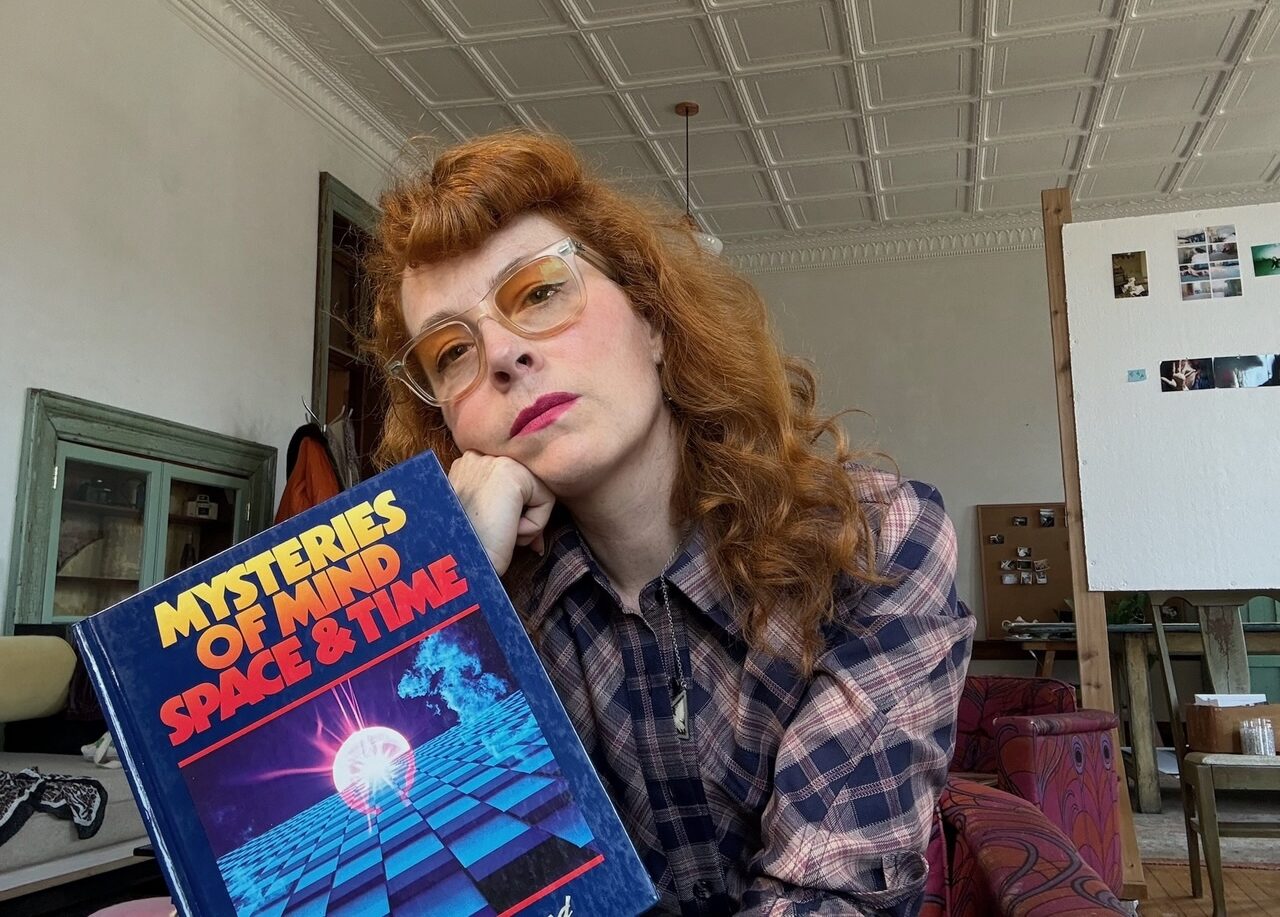

All photos courtesy of Melissa Auf Der Maur.
Melissa Auf der Maur is the first to tell you she’s a very good, very normal, and very polite girl—not exactly what you’d expect from the bassist of one of the most influential rock groups in history. But for the past two years, the Hole musician has been digging up her wilder past, first with Even the Good Girls Will Cry: A ’90s Rock Memoir, and now the upcoming museum exhibition, Melissa Auf der Maur: My ’90s Rock Photographs at the Art Gallery of Ontario, and its accompanying 240-page monograph. The book, featuring over 200 images from her extensive archive, is an intimate portrait of womanhood, friendship, art, and the decadence of the ’90s rock-and-roll lifestyle. In less than 24 hours, Auf der Maur and longtime friend Shirley Manson will reunite at the first-ever Daisy Chain Fields Music Festival organized by Olivia Rodrigo, an event they both agree is necessary now more than ever. But before the two rock legends meet again on the festival grounds, the pair called each other up to chat about Courtney Love, demon visitations, and whether or not everything was actually better in the ’90s.
FRIDAY 2:15 PM AUGUST 28, 2026 TORONTO
———
MELISSA AUF DER MAUR: I don’t know if you can see me, Shirley, but I am in a breastfeeding pod in an airport because I went to the members’ lounge and it was so loud. I had to do a long survey about when I last breastfed.
SHIRLEY MANSON: You’re masquerading as a milk feeder.
AUF DER MAUR: I honestly haven’t seen many people use these, so I felt like it’s not totally dishonest of me to use it.
MANSON: Always breaking rules.
AUF DER MAUR: Exactly. But the reason I’m here is I’m getting on a plane to come see you at Daisy Chain [Fields Music Festival]. I’m in Toronto, having just spent two weeks installing a museum exhibit, and I’m going to get to see you play tomorrow. This is so fantastic.
MANSON: I’m really looking forward to speaking to you in person when you present your photography book at LACMA later on this year. But I just have so many questions and I just want to get into it right away.
AUF DER MAUR: I was going to interview you about what Garbage is doing, but we can do that after.
MANSON: No, you’re not doing that because I’m doing you, bitch. I want to say congratulations, first and foremost, for you’ve had an extraordinary year. You’ve released an incredible memoir and a beautiful coffee table book in one year.
AUF DER MAUR: I don’t have a manager, and I don’t know if people are supposed to do two books back-to-back six months apart. A manager would’ve not gotten it to happen nor recommended it.
MANSON: I don’t know what I was expecting, but it’s absolutely gorgeous and I highly recommend anybody reading this article to pick it up.
AUF DER MAUR: I wonder if you were expecting like, “Oh, she’s on the side as a fine art photographer taking pictures of flowers or still life.”
MANSON: I guess I thought it would be, and I don’t want you to take this the wrong way, but less focused. I know that you’re a very broad-minded person, and I thought it would be across all the realms of interest that I know that you hold in your heart. This is very specific.
AUF DER MAUR: Yeah, it’s not a product of a publisher who just said, “Hey, make a coffee table book.” This is two years in the making with archivists, photo historians, art historians, and spending two years with 15,000 negatives that had to be reduced to 200. And so, for me, who is a very expansive dreamer, to be able to write my memoir, I needed to create a limitation of time and space, and the same went with my photos. I changed my photography practice to become a documentarian and not a fine art photographer because my subject changed, my life changed.
I had always assumed that photography was going to be my way into the world and that music would be this hobby on the side. It’s a known thing that when Courtney [Love] asked me to join Hole, I said, “No, I’m studying photography and I’m going to go do my master’s.” That was my solid excuse, and then she convinced me otherwise. My main connective tissue to the girl back home that would protect me from becoming completely devoured by the decadent rock world and expansive global travel confusion public stage was my camera.
MANSON: Wow. What a magnificent monologue.
AUF DER MAUR: I’ve also been on a speaking tour. [Laughs]
MANSON: There’s a photograph on page 155 of you and Courtney on your way to the MTV Awards which is where we met in the flesh. You’re in the back of a limo, and you’re seated beside Courtney and Frances [Bean Cobain], her child is in your arms. This is an extraordinary photograph.
AUF DER MAUR: In one decadent space, it’s that term, “it takes a village,” the raising of a child and Frances being the daughter of a widowed single mother in a rock band and the bass player taking her role as a co-rearer. It was a really serious role I had, it looks like I’m breastfeeding her in that picture actually.
MANSON: It almost looks like a religious painting.

AUF DER MAUR: I see what you mean, yes. It is like the handmaiden who takes care of the queen’s child. It’s actually quite symbolic of our relationship, of the warrior deity who had nowhere to go in the wake of the suicide, but back on stage. I mentioned earlier, I said no originally to joining the band. But then when I said yes, it was because I recognized that I had a duty for women across the ages and the future that it was going to make for women, hence Daisy Chain Festival this weekend.
What we did as a duo for ourselves, but also for the cultural history books of women in rock and in history, I have really come to terms with. But it took me 25 years, a memoir, and looking through these photos of understanding the yin and yang of the feminine order and how proud I am that through aligning myself with a woman like Courtney, who was so misunderstood that I personally watched being burned at the stake. I’m like, “I know who that woman is. She was misunderstood, and I am going to reframe this because it deserves reframing.”
MANSON: Well, you know I am a huge fan of Courtney. I watched her be demonized myself because I was around in that period, and the way that she was treated was abysmal, but that’s a conversation for a whole other time. What I’ve always found fascinating about you is that you could always hang with the dudes, but you are very much a woman’s woman. How did you find space for yourself around someone as large in energy as Courtney? Did you feel that you had to shrink yourself or were you just born a generous, powerful person?
AUF DER MAUR: What’s interesting is last night at the public library in a tiny town in Ontario, Canada, the woman who interviewed me was a singer in a rock band in the ’90s in Canada and she took this moment introducing me to tell the audience, “When Melissa joined Hole, no one in our local scene was surprised. Melissa seemed to have an otherworldly energy around her. There was something from another time or another place. When she joined Hole,” this woman said, “Well, of course she did because she’s strong enough to do that.” Did I have to eat shit sometimes and deal with things I didn’t want to do? Patty and I used to always say, “We’re just waiting for Courtney.” Our role wasn’t a drummer, wasn’t a bass player, it was just waiting for Courtney.
MANSON: Professional waiter. That’s all musicians are, no? So, where does the title come from, Even the Good Girls Will Cry?
AUF DER MAUR: The title of the book was delivered to me by a demon when I was 19 in a life-changing—I won’t even call it a dream—visitation that changed the way I perceived the world. It was almost like a warning from another time and place, and this demon woke me up with a whisper, “Even the good girls will cry,” and it burned through me. It wasn’t until I had written my memoir and I had a totally different, terrible title—
MANSON: Give us the terrible title.
AUF DER MAUR: Raging With Our Hearts on Our Sleeves.
MANSON: Oh, dear. Not your finest moment.
AUF DER MAUR: There was one year of my life, and I am totally not bipolar, I have no manic depression—
MANSON: You’re the norm, Melissa.
AUF DER MAUR: I’m a very normal, good girl, very polite. [Laughs]
MANSON: I love this.
AUF DER MAUR: And in one year at the age of 19, I had this insane thing happen where these dreams just kept freaking me out and changing the way I saw the world, told me to play music, sent a demon to whisper in my ear, and all of a sudden, I’m 52 years old finishing my book, and I dare to write down that terrifying dream of the night the demon came. I fucking write it out, I’m like, “Oh my god, the demon gave me the title.”
MANSON: You really are an incredible writer, I was very struck by how candid this book is.
AUF DER MAUR: Oh, thank you.
MANSON: One of the favorite chapters for me is right in the middle of it, you talk about the dying journey of your beloved father.
AUF DER MAUR: Yes.
MANSON: I was very moved by the quote that you include from Courtney’s letter to your father promising to look after you for as long as she lives and it’s exquisite. But what I found really fascinating is how you felt your grief empowered you.
AUF DER MAUR: I can tell you that there’re two parts of grief. Grief is a beast of no particular shape, timeline, and form. It does its wild thing in every person. So, my journey with losing my father at such a young age and in such a dark way during a time where I was surrounded by drug addicts is that from A to Z. When I tell the reader in the book that the day after my father died, I woke up and said, “This death is a gift.” Maybe it’s survival mechanisms, maybe it’s Joan Didion, The Year of Magical Thinking, my magical mind at that moment said, “This is the greatest gift of your life.” This shadow of my father is both glorious and difficult. He was also an alcoholic and had a darkness.
MANSON: All the contradictions of people.
AUF DER MAUR: So, there was something in the loss of my father that activated this choosing of myself for the first time. In saying goodbye to him, I let him go. But then I suffered for decades. I wrote this book for my daughter and for all the young girls in the world, but I wrote it to heal from my father’s death that I never unpacked. The editor I hired to help me was both a literary editor and a grief specialist. I hired them not just for my father’s death, but for our generation and the end of the world as we know it. I’m not saying it’s all hell on earth now and doomsday in the future, but we lost.
MANSON: I’ll say that.
AUF DER MAUR: The way that you speak up for the injustices in our world is what I admire the most about you, you warrior Celtic maniac. You are sharing the glory and the hell all in a seamless voice in your public world.
MANSON: I really appreciate you seeing me, it’s very consoling. When you leave Hole, Courtney sends you a letter and you print it in its entirety in the book and then make no comment about it. You let the letter speak for itself. I was just curious if you had anything to say about that now. Did it hurt you? Did it inspire you?
AUF DER MAUR: Very good question because in the arc of this book, the reader will see that I have painted a very clear picture of this difficult, glorious, contradicting, powerful woman. I don’t candy-coat her, but I also shine great light.
MANSON: You absolutely do.
AUF DER MAUR: By the time we get to the end of the book, my decision to reproduce her two very lengthy, powerful letters in full was for two reasons. One, I wanted her to speak for herself. When I found them going through my archives, they were fading and I had not read them since 1999.
MANSON: Did you remember that they existed?
AUF DER MAUR: I totally remember they existed. I fucking didn’t rip them up because I’m too polite, but I did not like them. At the time, I thought, “She’s two-faced, this is all about her.” And then I sat there in my 50s and I read this woman’s two letters and I humbly understood she knew something about me that I did not. That is also why I wanted to share them. She taught me later in life about my blind spots then, and that’s how brilliant she is.

MANSON: Let’s talk about the incredible collection of you and Dave Grohl’s love-
AUF DER MAUR: Oh my god, that’s enough. [Laughs] You know what’s amazing? I’ve been on a book tour for nine months, do you know that he never comes up? I don’t know if it’s because it’s the wake of his out-of-wedlock child, but strangely he has not come up.
MANSON: Wow.
AUF DER MAUR: It’s a pretty glorious love story. I shared it not because I want to highlight the Foo Fighters, but because we had a true, big love. It totally was all wrapped up in the wake of my father’s death, and the decision to leave Hole, and to take Billy up on the offer of joining my favorite bands. For the bass player in Hole and the drummer of Nirvana to fall in love in 1999 to 2001 at the turn of the millennium, it was pretty saga-like.
MANSON: Y2K, baby. It’s like Marianne [Ihlen] and Leonard [Cohen].
AUF DER MAUR: As a Montrealer, I’ll take the poet position in this one.
MANSON: This is an extraordinary portrait of two rock stars in the ’90s, a very specific decade. The ’90s were so fucking incredible in many ways, just as you point out, a bridge between analog and digital. We really did see history shift, and it’s all cataloged for the first time.
AUF DER MAUR: One of my biggest declarations to my daughter and her teenage friends is that love was better in the ’90s because, if we were lucky, you’d have a fax machine. Otherwise, you’re totally reliant on getting across the planet to be with the person you love or talking on the phone from time to time.
MANSON: There was also the mail.
AUF DER MAUR: I cheated and used faxes.
MANSON: You totally cheated, you fucking cheat bitch. [Laughs]
AUF DER MAUR: In my case, we were literally on tour. He’d be on one continent, I’d be on the other, and we’d be in a hotel for one night, and we’d only have one night to get the letter to each other.
MANSON: That’s hot. But were the ’90s really as great as we all think they were?
AUF DER MAUR: Oh, no. I love the fact that I can be on these book tours and romanticize love, and music, and art, and counterculture–
MANSON: But there was ghastly sexism and lad culture.
AUF DER MAUR: This is the one area where I say, “However, this illusion of the ‘woman decade’ of Oprah, Sex in the City, and supermodels—are you fucking kidding?” Look how they treated Courtney. It took me 20 years to even wake up to the level of sexism that you and I lived within.
MANSON: Exactly.
AUF DER MAUR: People treated Hole so differently because she was pointing the finger at all the injustice everywhere all the time. Look at “Asking For It.” Look at the lyrics of her fucking songs.
MANSON: But you have a child now who is growing up in this culture, far removed from the culture we grew up in. As a mom, what’s your overview for her?
AUF DER MAUR: One of the reasons why I’m bringing her to Daisy Chain is to see you, and Olivia [Rodrigo], and Die Spitz, and to see that there are women in 2026 needing to raise funds to protect our bodies. What the fuck is happening? 30 years ago, I was photographing the Tibetan Freedom Concert for Spin magazine.
MANSON: I was there, baby.
AUF DER MAUR: There we were, privileged ’90s, just fighting for an ancient civilization. We are literally going to be, this weekend, gathering to protect the rights of women’s bodies 30 years later.
MANSON: Okay, you’re giving me goosebumps.
AUF DER MAUR: So, I have a double-edged thing that I’ve been raising my daughter with. She has access to all of the most inspiring women on the planet Earth. I’ve brought her to see you, Billie Eilish, Olivia Rodrigo, and I say to my daughter, “River, you are so lucky to have all of these women singing for you, showing you that you can express yourself, hearing the depth of a woman’s quest of finding herself.” But between the rapists in the White House, the algorithms of Sephora, and the predatory fashion that’s turning little girls into the equivalent of strippers, I have no idea what’s happened. We have not made progress globally, and this is why we probably—
MANSON: Continue to reel.
AUF DER MAUR: My daughter unfortunately hears both sides. She hears her mother say, “You’re the luckiest girl in the world because we get to listen to this music, but never ever take your safety and body for granted.”
MANSON: I love you, Melissa. You’re doing god’s work. And on that bombshell, I have to bid you adieu because I have to go to rehearsal and you’ve got a flight to catch.
AUF DER MAUR: I do. I’m getting out of my breastfeeding pod right now. Big hug.
