

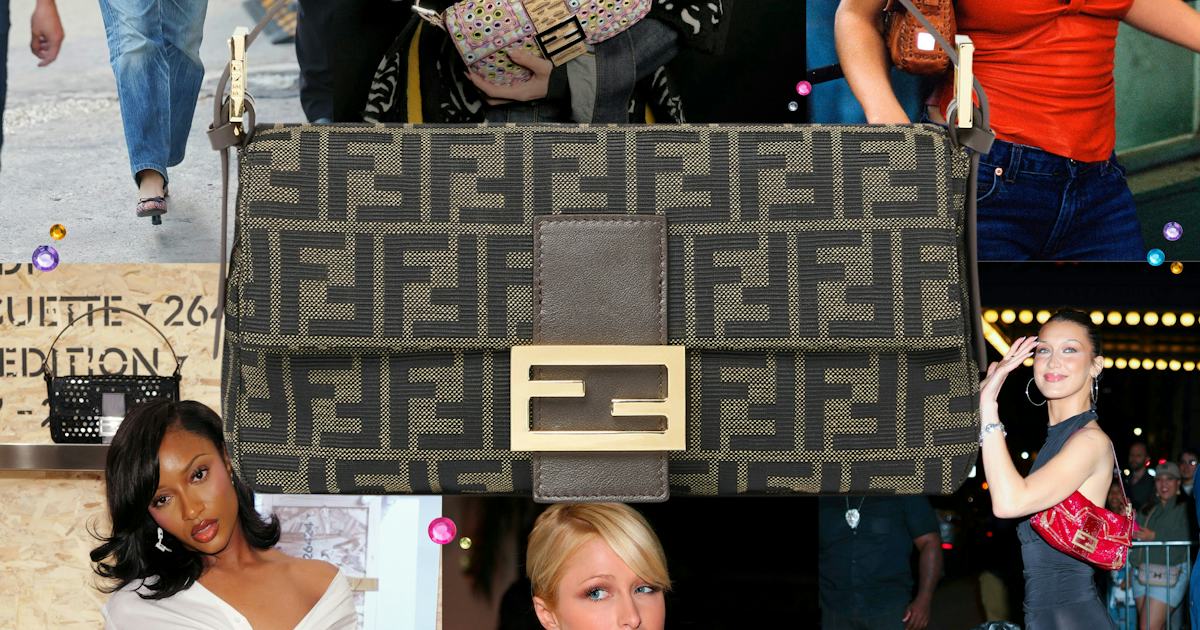
The term “It bag” is tossed around casually these days, but only a few accessories truly deserve that title. At the top of the list is the Fendi Baguette. It has been spotted on the arms of celebrities as different as Rihanna and Jacob Elordi; in movies such as 13 Going on 30; and in TV shows including Sex and the City and Emily in Paris. In February, Fendi’s new chief creative officer, Maria Grazia Chiuri, put her own twist on the bag—think sequins, mirrored embroidery, and calf hair—in her debut collection, cementing the Baguette’s place in the brand’s new era. But how, exactly, did it reach icon status?
The Baguette was designed in the 1990s by Silvia Venturini Fendi, the granddaughter of the company’s founders, who was then the brand’s creative director of accessories and menswear. At the time, minimalist bags such as the nylon Prada backpack reigned supreme, and Venturini Fendi was asked to design a similarly functional tote. Her response was to go in the complete opposite aesthetic direction. She debuted her creation, which came in black and brown with gold and red straps, in 1997. There was some practicality to it: Like the French bread from which it takes its name, the bag was meant to be tucked nonchalantly under the arm, leaving a person’s hands totally free.
It wasn’t an immediate hit. In December 1997, Fendi hosted a sample sale, inviting fashion insiders to buy Baguettes for as little as $50, and soon after they were hanging on the arms of many powerful fashion editors. Still, the average buyer needed another push; enter Carrie Bradshaw.
Sex and the City is now known for its fashion, but when the show first aired, in 1998, costume designer Patricia Field struggled to persuade brands to lend her clothes. Fendi stepped up. In season 3, episode 17, Carrie finds herself face-to-face with a mugger while shopping in SoHo. “Give me your bag,” the man says. “It’s a Baguette,” Carrie corrects him. The line became iconic, placing the purse at the center of pop culture.

In the early 2010s, the Baguette briefly fell out of favor as large, boho-inspired totes gained popularity. Then, around 2019, Fendi started releasing new, daring iterations of the original. The timing was perfect. A year later, the Covid lockdown had a new generation bingeing SATC and discovering Carrie’s signature accessory.
Today pretty much every A-lister has been spotted with a Baguette. Its biggest champion might be Rihanna, who, along with Sarah Jessica Parker, designed Baguettes to be auctioned off for charity in 2015. (Rihanna’s version was black mink and had a mini sibling in silver bead embroidery attached.)
The Baguette has come full circle: Chiuri worked in the Fendi accessories department in the 1990s, when the original models were created. Her new takes join the more than 1,000 unique versions already on the market. That breadth is a big part of the Baguette’s appeal: There is truly a style for everyone.
Lead image, clockwise from left: PG/Bauer-Griffin/GC Images; Swan Gallet/WWD via Getty Images; Chronicle; Aeon/GC Images; Frazer Harrison/Getty Images; Craig Barritt/Getty Images for Fendi. Center: Courtesy of Fendi.
