

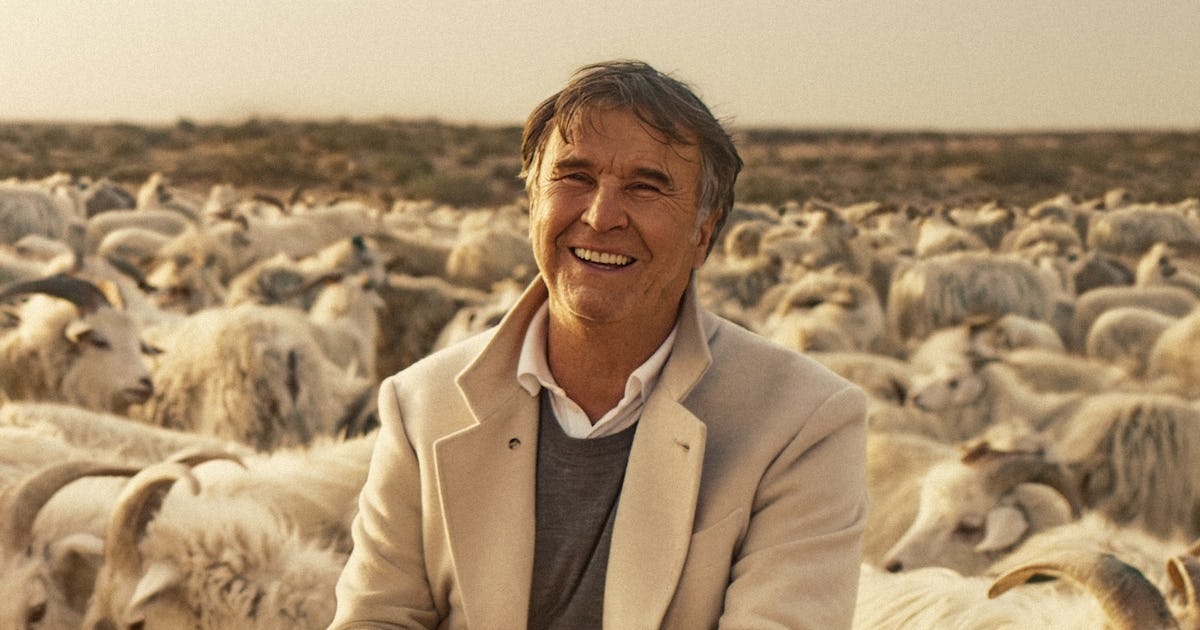
There comes a time in every great designer’s career when they receive a cinematic portrait—a polished origin story rendered for the screen. These films tend to fall into two familiar styles: the scripted biopic, à la Coco Before Chanel, or the documentary, built from fly-on-the-wall observation, archival material, and interviews, as seen in Valentino: The Last Emperor. Even when designers enlist leading auteurs—from Martin Scorsese’s portrait of Giorgio Armani to Sofia Coppola’s recent study of Marc Jacobs—the genre has largely remained rooted in retrospective storytelling. But for Brunello Cucinelli, a conventional approach wouldn’t suffice. To tell his life story, he turned to Giuseppe Tornatore, the Academy Award–winning director of Cinema Paradiso, who created an ambitious, experimental work that blurs the line between documentary and dramatization.
On Monday, April 14, guests including Naomi Watts, Oscar Isaac, Katie Holmes, Joshua Jackson, and Martha Stewart, gathered at Lincoln Center for a black-tie gala screening of the film, Brunello: The Gracious Visionary ahead of its U.S. release this July. Following opening remarks from Cucinelli himself—delivered in his native Italian so he could “speak from the heart”—the lights dimmed, transporting the audience to the vineyards surrounding Solomeo, the medieval hamlet in the hills of Umbria that serves as both home and headquarters for the king of cashmere.
Carolina Cucinelli, Brunello Cucinelli, Naomi Watts, Federica Benda, Camilla Cucinelli, Riccardo Stefanelli and Oscar Isaac attend the gala screening of Brunello: The Gracious Visionary at David Koch Theatre at Lincoln Center.
Dia Dipasupil/Getty Images Entertainment/Getty Images

Joshua Jackson and Katie Holmes.
Lexie Moreland/WWD/Getty Images

Brunello Cucinelli Turns His Life Into Pure Cinema
A quick succession of interviews with family members, friends, longtime employees, and clients like Oprah and Patrick Dempsey, along with local clergymen, set the tone for Cucinelli’s mythmaking, outlining his impact far beyond the fashion world. At the heart of the whole endeavor is Cucinelli’s emphasis on the immortality of the soul and his broader vision of “humanistic capitalism,” defined by above-market wages, welcoming work environments, and a commitment to putting people first. It’s a philosophy that led him to dedicate 20% of the house’s profits to charitable causes and has guided his decades of lovingly restoring Solomeo into not just a company town but a cultural center with a world-class theater, park, and his latest project, a library with half a million books, open to anyone who visits.
The story unfolds in picturesque scenes with Cucinelli tracing the chapters of his life, serving as a narrator, character, and observer of his own tale—almost untethered from time. It begins in the countryside of Perugia where we see Cucinelli as he is today, walking alongside his childhood self who runs among chickens and ducks, and scoffs at the stink of the cowshed over which their home was built. His family of tenant farmers work diligently, pushing wheelbarrows and carrying milk churns. Breaking the fourth wall, the 72-year-old designer addresses viewers directly, welcoming them into the remote farmstead without electricity or indoor plumbing. The location is no movie magic—it’s the very house where he lived with his parents, two brothers, and eight other family members until the age of 14; he bought the property while filming for full verisimilitude.

Cucinelli has covered some of the same personal history in his 2018 memoir-cum-philosophical treatise The Dream of Solomeo: My Life and the Idea of Humanistic Capitalism, but describes a need to immortalize it in another medium. “I have always believed that every story has more than one life,” he says. “With film, I could show—not only tell—the dignity of work, the beauty of our land, the rhythm of life in Solomeo. There are emotions that cannot be written, only felt through an image or a gesture.” Indeed, audiences watch as his aesthetics and ethics take shape during his youth: his father teaching him to plow in a straight line with a pair of cows, the furrows kept precise as much for beauty as for function, and the family brushing angora rabbits with quiet care. A pair of loathsome green corduroy pants his mother gave him as a teenager would lead him to ban the color from all of his collections to this very day. (His design team instead refers to shades of sage, and “American khaki,” but never green.)
A particularly formative episode comes after the family’s move in the late 1960s to the industrial outskirts of Perugia. There, Cucinelli’s father takes a job at a cement factory and is seen struggling with the strain of daily humiliations. The moment leaves a lasting impression on the young Cucinelli and shapes a lasting affinity for Italian neorealist film and its humanist lens. “I have always felt close to directors who tell human stories with delicacy and respect,” he says. “Federico Fellini, for his dreamlike poetry, and Vittorio De Sica, for his deep humanity, have touched me profoundly. Their films remind us that even the simplest lives contain extraordinary dignity.” It was that same sensibility that drew him to Tornatore, whose stories are often rooted in working-class Sicily. “His relationship with his native land reminded me of my own bond with Solomeo,” Cucinelli says. “We both believe that beauty and memory can guide human actions.”
Actor Saul Nanni plays a young Brunello Cucinelli in Brunello: The Gracious Visionary.
Photo by Stefano Schirato courtesy of Brunello Cucinelli

Cucinelli is played at different ages by three actors: first-time performers Francesco Cannevale and Francesco Ferroni, both from Umbria, and Saul Nanni. The shifting cast allows the film to settle into a more selective, idealised register of memory, rendering episodes as cinematic set pieces, including Cucinelli’s reprobate youth as a teenage cardsharp and a courtship vignette in which he appears as a kind of romantic hero, riding a motorcycle behind a bus carrying his future wife, Federica Benda (Emma Fatone), his luscious locks blowing in the wind. The effect is a form of self-mythologization, in which biography is reordered as emotional resonance rather than chronology. “Life itself is not linear,” Cucinelli says. “I think Maestro Tornatore wanted the film to reflect this. The documentary elements ground the story in reality, in testimony, in lived experience. The more narrative moments allow space for imagination, for poetry. Together, they create something closer to memory itself—where fact and feeling coexist.”
Following the screening, guests tucked into a dinner of rigatoni alla pomodoro—Cucinelli’s favorite—as conversation turned to the designer’s final message in the film. While he knows his legacy will forever be tied to the cashmere empire he built, what he ultimately hopes will be inscribed on his tombstone is simple: that he was a good man. A notable ambition at a time when goodness—especially among the billionaire class—can feel in short supply.
