



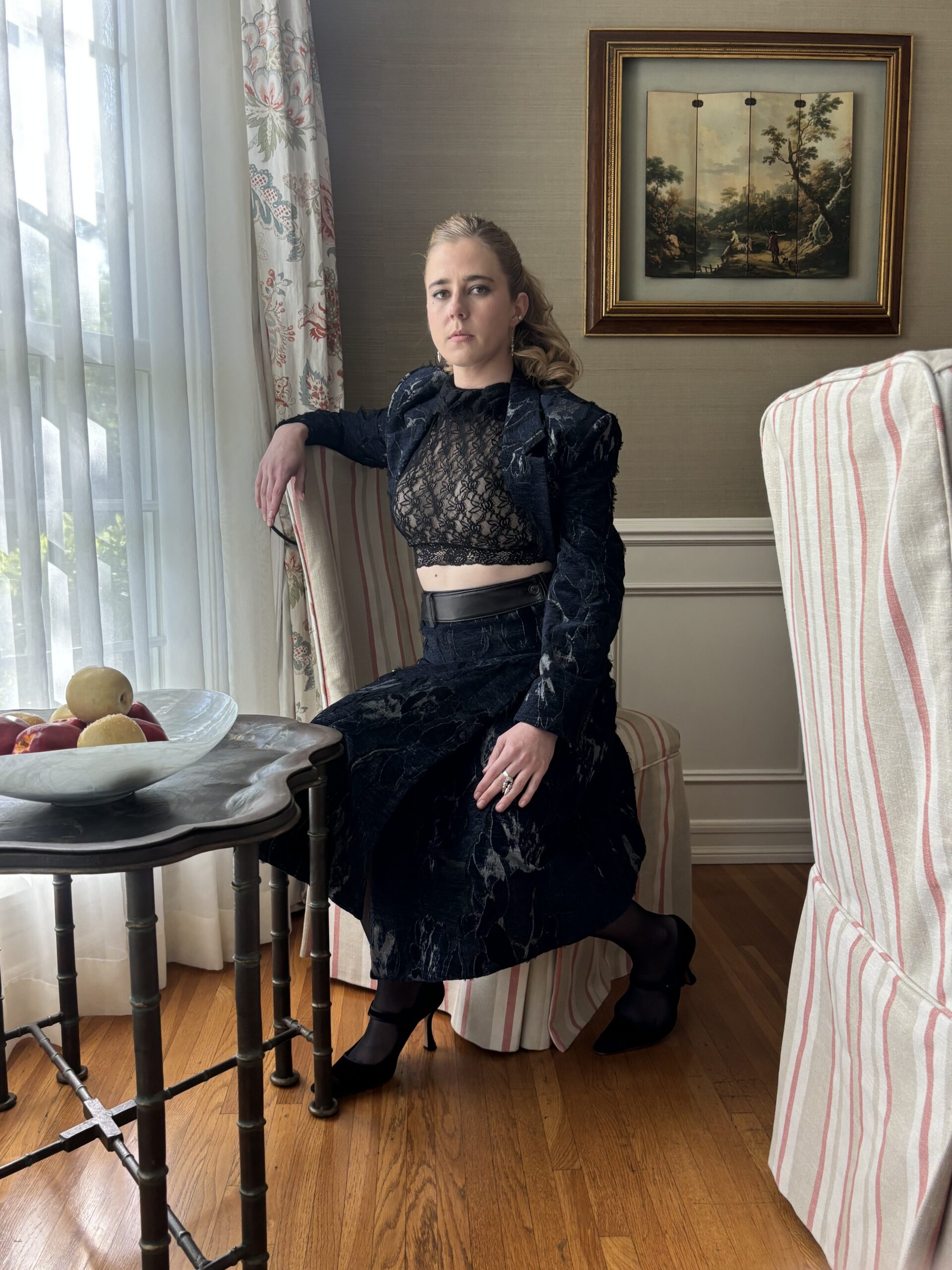
Taylor Dearden photographed by Myles Pettengill.
Despite being the daughter of a world-famous actor, Taylor Dearden‘s talent more than speaks for itself. The second season of the hit HBO medical drama The Pitt took her character Dr. Mel on a wild ride from depositions to a surprisingly fierce rendition of “You Oughta Know” at a karaoke bar. The LA–born and raised star’s singular performance has garnered her enormous praise from fans and fellow thespians alike, like the Gilded Age‘s Carrie Coon. The pair hopped on a call earlier this month to talk about growing up around fame, improv comedy, getting the Broadway bug, and not being recognized by fans.
———
CARRIE COON: Oh, it’s recording. Good morning. Where are you?
TAYLOR DEARDEN: Good morning. I’m at home in LA.
COON: Looks nice. People make fun of me when I’m in LA because every time I walk out of a hotel, I’m like, “It’s such a beautiful day!” And they’re like, “Yeah. It’s California.”
DEARDEN: Yeah.
COON: I was reading up on you and your interviews lately so as not to be terribly repetitive. I hate that. I’ve done press for stuff and I know it can get a little repetitive. Especially when you’re on a big, fat hit show and people want to know the same things about it. But I’m interested, Taylor, in growing up in LA. It’s so far from me. I grew up in the Midwest, and I had no inclination to go to LA. I mean, I was doing theater in Wisconsin. I had no designs to go anywhere. So, what’s the best thing about growing up in LA? And then, what’s a terrible thing about growing up in LA?
DEARDEN: I think the people who are actually from LA are really easy. Transplants seem to give us a bad name and a bad reputation.
COON: That’s funny.
DEARDEN: Because the reputation of being very fake and caring about status and stuff is not really how any of us were raised. But we were also raised with celebrity and the industry not being a big deal either, which is really cool. In high school, there were a bunch of kids of celebrities and they were all pretty much left alone. So I think, especially with the show doing so well, it’s weird for me to now have people reacting [to me]. It’s like, oh my god, this is different from what I grew up with.
COON: Right. Even watching your parents, nobody was bothering your parents or friends. Yeah, I’ve heard you say that you’re not getting as recognized as your co-stars, which I also experience in my life. My camera department doesn’t recognize me at the wrap party, so I understand that energy. But how has it been on the receiving end? Are you being more mindful about how you’re speaking in public now?
DEARDEN: I should, I definitely should.
COON: I remember not realizing that myself and getting burned a couple of times. When you’ve been gossiping for two hours at dinner and then you realize the person sitting next to you knows who you are. Careful.
DEARDEN: Yeah, it’s wild. For me, I’ve learned that if my hair is down, no one knows who I am. But if it’s back—
COON: That’s it. Is it something you hope goes away?
DEARDEN: Oh, yeah. That’s one of the things I love so much about theater is how you’ll do a show and then there’s a line of people who want to see you. Then, if you pass them the next day, they’ll just keep walking.
COON: Yeah, that’s so true. I had another question about growing up there, but these are all just my own personal interests. I have four siblings and you’re an only child. What do you think the best part of being an only child is?
DEARDEN: We know how to be alone. There’s a bunch of friends of mine that, as soon as they’re alone, they have to call a bunch of people. I want company, but I don’t need it. And also, it’s self-sufficient. You have to learn to calm yourself, to hype yourself up. You have to learn to do everything on your own at an early age. So you find who you’re going to be as an independent person a little bit quicker.

COON: You’ve experienced this sudden, wild success with this show. How do you feel about moving through your 30s and heading toward 40? Do you have feelings about that when you think about the future?
DEARDEN: Yeah, I think it seems more clear what I don’t need than what I do. I’m like, “I’m already in PJs. I’m good. I’m out.” It’s being fine with that choice and not feeling like you have to do something. But I know it’s been tough for a lot of my friends. They feel like they should be a lot further along. It’s a tough thing. You end up thinking it’s just you, but everyone our age is going through the same thing. I would definitely consider myself more of an anomaly.
COON: I know you’ve done a lot of improv and improv is all, “Yes, and.” I was wondering, are you good at letting go of your mistakes? And did your training in improv have anything to do with that?
DEARDEN: I think so. If I’m not sure what someone wants and they’re not being clear, they’re not speaking my language, that will mess with me for a long time. But mistakes, I feel like with improv you’re like, “Oh, that didn’t fly. All right, next.” And it’s really nice to feel easy about it.
COON: That’s a really healthy attitude. I think it’s hard for a lot of young actors in particular to be able to move past something like that, especially when it happens at work. I think that’s a hallmark of youth on a set is, like, [learning] the set’s not going to stop just because you’re feeling insecure. You have to keep moving forward.
DEARDEN: I had a very strange high school experience where it was, like, a phenomenal theater program, but all of our teachers were horrible bullies. We learned so much, but we are so affected by it. But, in a way, it’s like, “Oh, I’ve heard so much worse from my high school teachers.” So, whatever.
COON: Water off a duck’s back. Go ahead, try to hurt me.
DEARDEN: It’s weirdly worked in my favor.
COON: I’m in the middle of shooting Gilded Age and I have no idea what episode I’m on. We’re block shooting, so I’ll shoot from three [different] episodes a day. I’m not tracking the story anymore because I can’t keep up with the schedule. So, for me, the idea that we would shoot in order feels like the gold standard. What is the thing that I’m not thinking of that makes it hard?
DEARDEN: I think it’s mainly [hard for] guest stars. We shoot in order as opposed to shooting all of one trauma scene in one batch, so [guest stars] have to come every single day. Usually, you get one day, you let it all go, you scream. You’ll lose your voice the next day, fine, because you’re done. But [on The Pitt], you can’t. Getting there four hours early to put on this uncomfortable prosthetic to then be strapped to the gurney, it makes me so appreciative of what they do because they’re all so in it and ready for it. I don’t know if I’d be that good of a sport.

COON: I neglected to mention, but my mother was an emergency room nurse my whole life. She worked up in Cleveland at night. She really loves the show, as well. I appreciate the fact that shift is out in the world in a way that feels very real to her. I remember her talking about…well, butt stuff was always a feature. [Laughs] The first topic of conversation would always be butt stuff, but also the pressures they were under bureaucratically. The harder stuff, you keep at bay. I know you’ve had experiences of people saying they can talk about their lives now in a way that they haven’t with their families before. So, I just wanted to say that about my mommy.
Growing up in LA, do you feel like you’re surrounded by young people that have that purity of passion about the industry? Is that something you feel like you have?
DEARDEN: I went to USC, and the film school is so hard. It’s impossible to get into and it really winnowed down people who were hobbyists to people who this is their life. So the people around me, they’re not necessarily from LA, but they’re all here now. It was USC that connected us. I love school. I miss school.
COON: Yeah, I hear you. I love school too. I loved everything about it. I would love to go back. I got the ding-dang kids though. Talking to young artists makes me feel hopeful, and I get particularly moved when I see a young actor step into an opportunity and really nail it. I could start crying right now. I guess I still feel new to the industry in some ways because I came to TV and film quite late, and yet I also understand that I’m a veteran on some level too. I just get all weepy about the kids. I know you’re 33, but I think of you all as kids.
DEARDEN: That’s fine. I’m okay with that.
COON: And that’s one of the things that’s so thrilling about your show is to see the number of young actors who stepped into this opportunity in such a beautiful and accomplished way.
I also heard about you referencing your kinesiologist. I’m really interested in body work. I’m the person on set who always has a gadget, like, “Oh, you need to release that muscle.” So, I’m curious what the kinesiologist is doing for you?
DEARDEN: I have Ehlers-Danlos, which is a hypermobility disorder. So, on set, we don’t have chairs. We have a family room we’re allowed to go to sometimes, but it’s seven and a half hours of standing.
COON: Wow. You might as well be a waitress.
DEARDEN: He’s like a chiropractor kinesiologist and there’s no cracking, ever. It’s about finding the line of muscle or nerve. So, if my shoulder hurts, it’s because of my right hip. It’s bizarre and so necessary and I wish I had more time to go to him. In the first season, we did one leg on the gurney CPR and I started walking and my hips were completely crooked. I remember walking and he goes, “Don’t tell me, one leg on the bed CPR?” And I was like, “Yes.”
COON: Oh, that’s great to have someone that intuitive on your team like that. That’s good stuff. Is there anything that you haven’t had the chance to say about The Pitt or about yourself? Is there anything that you feel like people aren’t asking you? Is there something you feel a burning desire to share?
DEARDEN: Well, I don’t know… I love theater. I miss theater so much.
COON: So, you want to get back to it?
DEARDEN: I want it so bad.
COON: Well, now you’re doing The Pitt, so they’ll let you do Broadway.
DEARDEN: I read what you said about that and it’s so accurate, of just like—
COON: It’s true. It’s because you can’t mix art and commerce. Inevitably, that’s what’s going to happen. The dollar signs matter, and now you can do it. What are you going to do when somebody says to you, “Taylor, what do you want to do on Broadway?” What’s your answer going to be?
DEARDEN: Oh, I don’t know. I love so many different things. I’ve always wanted to find something new and workshop it at The Guthrie or Steppenwolf.
COON: Right. Something that hasn’t been written yet.
DEARDEN: Yeah.
COON: I know what you mean. That’s always my answer too. It’s like, I don’t know, maybe it hasn’t been written.
DEARDEN: Exactly.
COON: I love working on new plays. I love a workshop. It’s because we like school, Taylor.
DEARDEN: Yeah, that’s it.
COON: It’s nerdy stuff.
DEARDEN: It is.
COON: But it is the best. I just finished my run of Bug and, oh, it was so satisfying to tell a story in order every night. And like you say, get another crack at it. Whatever percentage you’re in one night, you get to try again the next day. It’s just really satisfying, and not forever.
DEARDEN: And I love that you can have the best performance of your life or the worst performance of your life, and then it disappears. It’s gone. And you’ll find new things every time, just discovering what it could be at every variation.
COON: It’s a specific rhythm of living too, isn’t it? Like what’s required of you when you’re doing a play, being present. The focus and the cost of it, but also what it gives back to you. You’re in the club, too, when you’re doing Broadway because everyone’s going to the same little restaurants and stuff. It feels like such a team. There’s so much solidarity in it. The thing I love most about Gilded Age is that everybody’s a theater person. Everybody understands the ensemble ethic. And you guys are very much an ensemble on that show, there’s no way to do that without that commitment to each other, right?
DEARDEN: Yeah. I think part of improv, too, is understanding when something’s not your scene and just finding the supportive role for the story and for the other actors. We’re really good at going, “What do you need? Is there anything to do for you in this [scene]? It’s your coverage. Let me know.” You have to, you’re an ensemble. You have to have that element.
COON: Yeah, it makes everything better. Lifts all boats, as they say. And that is such a theater lesson because when you’re on stage, there’s no hiding. Your body always signifies in space, so you have to get very economical about the way you’re using it so the focus is going to the right place. Is there anything you want to ask me? You don’t have to, no pressure. I’m just a middle-aged lady with two kids.

DEARDEN: Yeah, I was going to say, what does it feel like for you to do theater versus film and TV? The excitement of theater, there’s a certain gut feeling for me. Sometimes I can get that with film and TV, but it’s not the whole play length.
COON: Yeah, that’s absolutely right. I think it is really the satisfaction of living through the story every night and what is gained by getting to do the moment before and the moment after, instead of having someone knock on your door to come out at 3:00 in the morning so you can cry for three hours. It’s just not as satisfying as telling a whole story in one fell swoop. Doing it with the same people every night, and the audience also being a character in that story. There’s nothing better than doing it with an audience and you don’t have that in TV and film. There’s no applause. Mandy Patinkin used to say that at Homeland. My husband [Tracy Letts] was on Homeland with him. He’s like, “And then you do the scene and there’s no applause. Nobody cares. It’s just like being at a bank.”
I do love the physical rigor of theater, too. No one’s going to come in and do your stunt for you. You’re doing all the yelling and crying and jumping and rolling and slapping. It asks so much of our bodies. I think so often in TV and film, women’s roles in particular don’t ask that broadness from us. It’s much more limited. But I feel like The Pitt is such a physical show.
DEARDEN: Definitely. I think, especially with all the medical scenes, it is almost like a dance. It feels so collaborative and does feel more theater-y and dance-like because it’s supposed to look messy. So, you actually have to really choreograph it to look messy.
COON: Right. It can’t be too neat.
DEARDEN: Yeah.
COON: What a wonderful challenge. Well, it’s just a thrilling opportunity. When we finished season one, Tracy and I both turned to each other and acknowledged what a vivid, specific performance you’re giving as Mel, and I think that’s a hallmark of a very good actor. We’re so happy and thrilled for you and can’t wait to see what you do next. What an exciting time in your life. I just think it’s so moving, and congratulations.
DEARDEN: Thank you.
COON: I’m so flattered you asked me to speak to you today.
DEARDEN: Thanks for doing this.
COON: My pleasure, absolutely. I hope we get to work together. Maybe I’ll do it, come in and be some screaming lady on The Pitt.
DEARDEN: Just find a way to save your voice.
Styling: Amanda Lim
Hair: Kiley Fitz
Makeup: Katrina Klein
