

Maria Grazia Chiuri’s Fendi couture debut was a double feature: a time capsule of the Roman house’s fur-forward past and a glimpse of its lighter future. She brought the presentation home to the Eternal City, choosing as her venue Galleria Nazionale d’Arte Moderna e Contemporanea, GMAC for short, Rome’s answer to MoMA. Before the show, guests including Sarah Jessica Parker and Monica Bellucci explored After Steps Through Work. Fendi / Karl Lagerfeld 1985, a restaging of one of the first fashion exhibitions mounted in a major art museum. The show traces Lagerfeld’s first two decades at Fendi through sketches, toiles, pattern boards pinned with tiny fur fragments arranged into intricate geometric designs, and finished coats, offering a window into the artistry of Lagerfeld’s furs, which ultimately led Fendi to launch haute couture—or, more precisely, haute fourrure—in 2015.
Chiuri’s designs are always deeply connected to art, and here she looked to the Vienna Secession, the early 20th-century movement that sought to dissolve the boundaries between fine and applied arts. She also drew inspiration from Histoire d’Eau, a Jacques de Bascher-directed short commissioned by Lagerfeld to introduce Fendi’s first ready-to-wear collection for spring 1977. A playful riff on the 1975 erotic drama Histoire d’O—and now widely considered the first fashion film—it follows model Susy Dyson as she frolics in fountains around Rome. For those watching the livestream, Chiuri offered a contemporary counterpart: Love Monster, an original short by Italian actor and filmmaker Valeria Golino featuring a Fendi-clad couple (Leila George and Pietro Castellitto) gazing longingly at each other in front of a Cy Twombly painting in GMAC and making out in the surrounding Villa Borghese gardens.


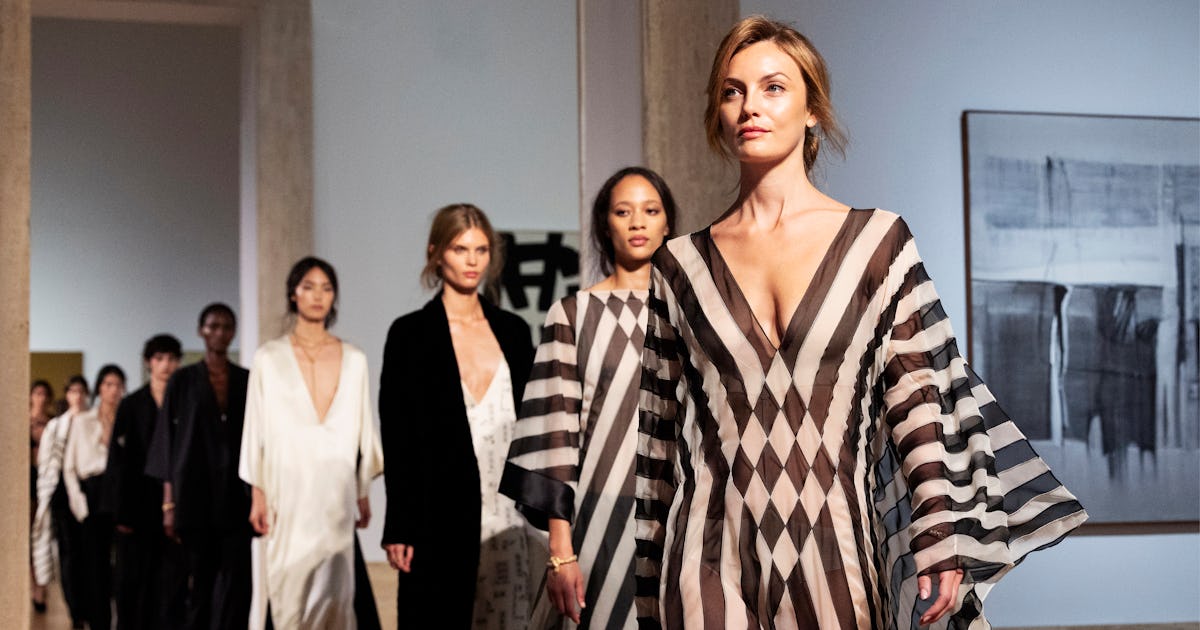
At the museum, the striped chiffon caftan styled with delicate fur-trimmed heels seen in the film was the first look to hit the runway. Inspired by a reform dress created to free women from corsets by Emilie Flöge, the Austrian designer and Vienna Secession associate whose legacy is often reduced to her role as Gustav Klimt’s muse, Chiuri’s version felt like a century-old idea renewed. It glided sensually over the body, setting the tone for a collection of grain de poudre kimono tailoring and fluid velvet gowns that seemed determined to strip couture of its traditional architecture. Fur, as in the fall ready-to-wear collection, was entirely upcycled, appearing mostly as trims and featherlight outerwear, including a striped coat held together by strips of tulle. As a coda to a Paris couture week where designers often competed through excess, Chiuri’s easy elegance was a reminder that haute couture actually means “high craft,” not spectacle.


