

Nearly 2,800 years ago, the ancient Greek poet Homer composed The Odyssey, the epic tale of King Odysseus’s harrowing journey home to Ithaca after the fall of Troy. Now, Christopher Nolan charts his own course with an expansive, spectacular vision, shot entirely with IMAX cameras.
“We were authoring our own mythology,” says costume designer Ellen Mirojnick, who earned her first Oscar nomination for Nolan’s 2023 historical drama, Oppenheimer. “I believe, as Chris does, mythology is not meant to be ‘translated.’ You reinterpret it.”
To design more than 5,300 costumes—from battle-worn armor to commanding royal finery to draped robes of mythological figures—Mirojnick looked to Mycenaean Greece and late Bronze Age Mediterranean cultures as a foundation. She built her own anthropological costume course, studying millennia-old frescoes, ancient weaving techniques, seafaring traditions, and mythological iconography.
“But this wasn’t a historical world. It was a timeless one, and that was what was most important to tell,” says Mirojnick. “I like to use the word timeless as opposed to modern.” The result is a mythical but grounded ancient world that resonates with contemporary sensibilities.
Anne Hathaway’s Strategist Queen, Penelope
With Odysseus (Matt Damon) absent for two decades, suitors descend on the palace demanding Queen Penelope (Anne Hathaway) choose a new husband—and hand one a claim to the throne. She keeps them waiting with a clever ruse—weaving a burial shroud for her late father-in-law by day and secretly unraveling it each night—all in majestic red and blue jewel-toned gowns whose delicate pleating, exquisite draping, and diaphanous layers jump off the IMAX screen.
Anne Hathaway and Tom Holland in The Odyssey
Photo courtesy Universal

“What we found cinematically with her is that the richer the color, the more powerful and strategic she was. She was a powerful strategist in a queen-like way,” says Mirojnick, explaining that Penelope’s lush jewel tones also telegraph her steadfast belief in Odysseus’s return.

“Blue and red are also the colors of the house and kingdom of Ithaca,” she continues. “We wanted to make sure that she did not look like she was mourning her husband. She was always viewed as the queen.”
Charlize Theron’s Resourceful Calypso
A shipwrecked Odysseus spends seven years on the mystical island of Ogygia with Calypso (Charlize Theron), the water nymph historically portrayed as a seductress, a one-note villain, or a lonely, tragic figure.
“We didn’t want to go in that direction. Chris was very, very, very, very clear that he didn’t want to go in that direction—with all of the women characters,” says Mirojnick. “The most important thing about these women [in the movie] is that they had purpose.”
Calypso’s weather- and water-worn dress, made from natural fibers with raw edges and freeform draping and knotting, extends the film’s naturalism. “It had to be a raw something that was woven, found, or washed up that she could just put on, rip, and tie—that’s all it was,” says Mirojnick. “Our fitting took 20 minutes.”
To design her fishnet outer-dress layer, Mirojnick considered how Calypso would sustain herself—and Odysseus—on the remote island.
“She actually could go out into the sea and catch fish with the netted apron—which she did,” says Mirojnick. “But we practiced it, and [Theron] knows how to fish. So it was really easy.”
Zendaya’s Down-to-Earth Goddess, Athena
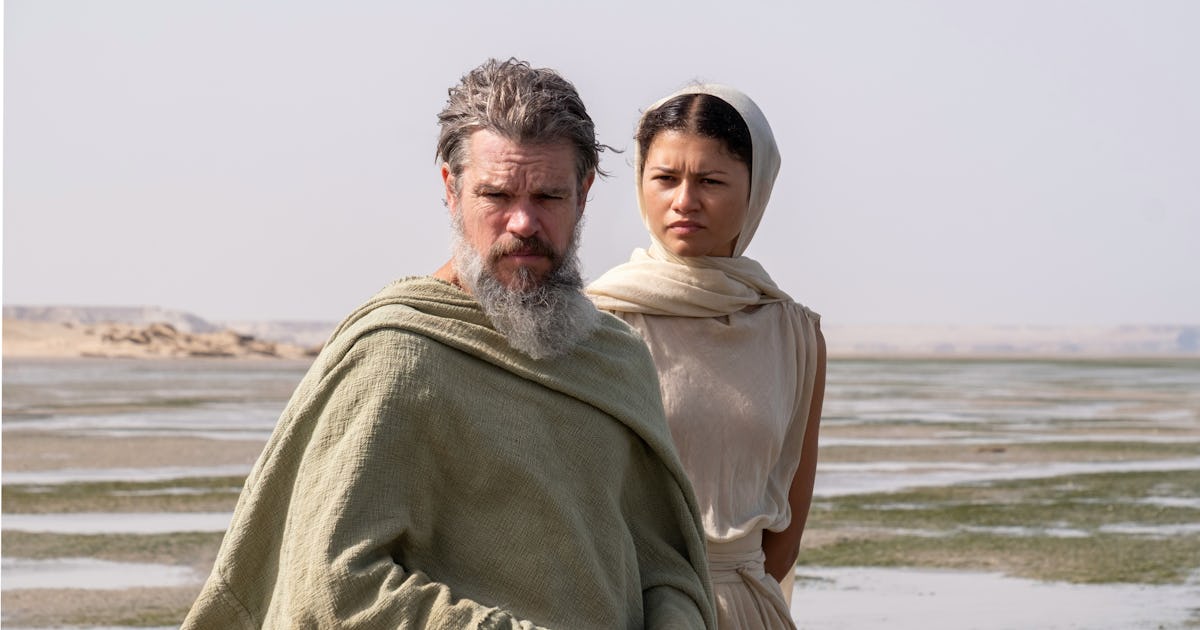
As Odysseus faces the wrath of Poseidon on his voyage home, Athena (Zendaya), the goddess of wisdom and strategic warfare, offers guidance in his darkest moments. In the production notes, Zendaya explains she connected with the “emotional component” and humanity to shape her portrayal of the god. Mirojnick also focused on realism in Athena’s hooded, artfully draped white linen robe, using materials available in ancient times.
Matt Damon and Zendaya on set
Photo courtesy Universal

“Athena was as real as one could get while still expressing her magic,” says Mirojnick. “The linen made her feel 100% as if she was a real person. The draping was quite easy. Everything needed to feel real, as if she was a human soul.”
Robert Pattinson’s Peacocking Villain, Antinous
As Penelope’s suitors circle the palace, Antinous (Robert Pattinson) emerges as the sneering main antagonist—and the film’s great violator of xenia, Zeus’s sacred law of hospitality, which dictates that every stranger be welcomed with food and shelter because any one of them could be a god in disguise. Antinous flouts it brazenly: bullying the servants and less fortunate, spying on the queen, and plotting against Telemachus. His silver-plated, ornamented courtly finery reflects his vanity and entitlement—and his preference to have others do his dirty work.
Robert Pattinson in The Odyssey
Photo courtesy Universal

“He’s the peacock,” says Mirojnick. “Working with Rob is such a great treat because he will go everywhere and anywhere.”
Pattinson—who seems to be having the time of his life on the Odyssey press tour—gleefully told Today that he pitched wearing “cheetah underpants” to Nolan because “Antinous is that kind of guy.”

“I put [the cheetah fur] on his collar,” says Mirojnick, also pointing to Antinous’s over-the-knee Greek—not Roman—sandals and the abbreviated kilt-like overskirt that confidently reveals a flash of thigh. “His skirt was very, very special and actually the shortest of everybody’s skirts.”
Lupita Nyong’o’s Sculptural Helen of Troy
Bearing the emotional scars of the Trojan War and, in Nolan’s interpretation, physical ones, too, Helen (Lupita Nyong’o, in a dual role also as Clytemnestra) reigns as Queen of Sparta alongside King Menelaus (Jon Bernthal). Draped in glittering royal finery, they host Odysseus’s son, Telemachus (Tom Holland), who arrives in search of his father.
Dressing the face that launched a thousand ships presented an initial challenge: Helen had to feel enigmatic, almost otherworldly, yet fit the film’s grounded vision. “We really had to get down to the realism of that queen,” says Mirojnick. Then Nyong’o recommended her friend, artist and fashion designer Misha Japanwala, known for sculptural body casts that celebrate all shapes—who created a bronze, asymmetrical neck and shoulder plate.
“To me, it looked like a broken statue,” says Mirojnick, who transformed the collar piece into a capelet atop a ruched and draped luminescent gown.
Sadly, the sculptural look is mostly obscured by the banquet table in the finished film. But Helen’s final gleaming gold look—a choker, also by Japanwala, and a chainmail-like caftan-gown—provides a striking bookend, as she bids farewell to Telemachus and sends her wistful regards to Penelope. Mirojnick found the intricately patterned metal-woven fabric in Spain, but hesitated to ask Nyong’o to wear it.
“We said, ‘We don’t know if you want to do this.’ The dress is 30 pounds, but she was such a great trooper,” says Mirojnick. “She said, ‘I’ve worn more pounds of Chanel pearls. I think I could do that.’”
Matt Damon’s Battle-Worn Odysseus
While Antinous reveals his dubious intentions through his lavish court attire, Odysseus wears his sense of purpose on streamlined armor that bears the marks of 20 years of warfare, inclement weather, and arduous travel.
“There was a simpleness, a strength, a vulnerability, and a love to his silhouette,” says Mirojnick. “There was every single emotion you can imagine.”
Matt Damon in The Odyssey
Photo courtesy Universal

In her research, Mirojnick discovered the “really simple” armor of the period, then studied how to distress the materials to depict Odysseus’s punishing journey—both the physical and emotional toll.
“Often in movies, bronze is gold and gleaming,” Mirojnick says in the film’s production notes. “Real bronze is dark, heavy, oxidized, dented, alive with its own history. We wanted armor that looked like it had been made by someone, struck by someone, worn by someone that had absorbed weather and violence and the body underneath it.”

“The simplicity of the shapes was so important to be able to show a collapse, an exhaustion,” she says. “Everything was based on the rawness, the brutality, the love, and the humanity of that story.”
The Laestrygonians’s Symbolic Armor
At one point on their journey, Odysseus and his army encounter an island of man-eating giants—the Laestrygonians—towering above the trees and clad in silver armor.
Damon as Odysseus as he and his men encounter the Laestrygonians
Photo courtesy Universal

“There are certain qualities in the power of dress that became very inspiring in terms of how materials can hold movement, gravity and command without feeling overly decorative,” Mirojnick says of dressing the massive men.
“The Laestrygonian research explored mammoth scale and the unsettling effect of unexpected size. The child Laestrygonian was based on quilted Himalayan dress, designed to keep the child warm and protected while sharing the armor-plated vocabulary of his larger adult counterparts,” she adds.
“The adult Laestrygonians were conceived as though they were made entirely of metal: impenetrable figures moving with inhuman strength and brute force. Their helmet shapes grew out of research into smaller creatures of the sea and forest, then were enlarged to a hulking scale. This created an uncanny tension between the familiarity of the forms and the enormous scale of the creatures.”
