

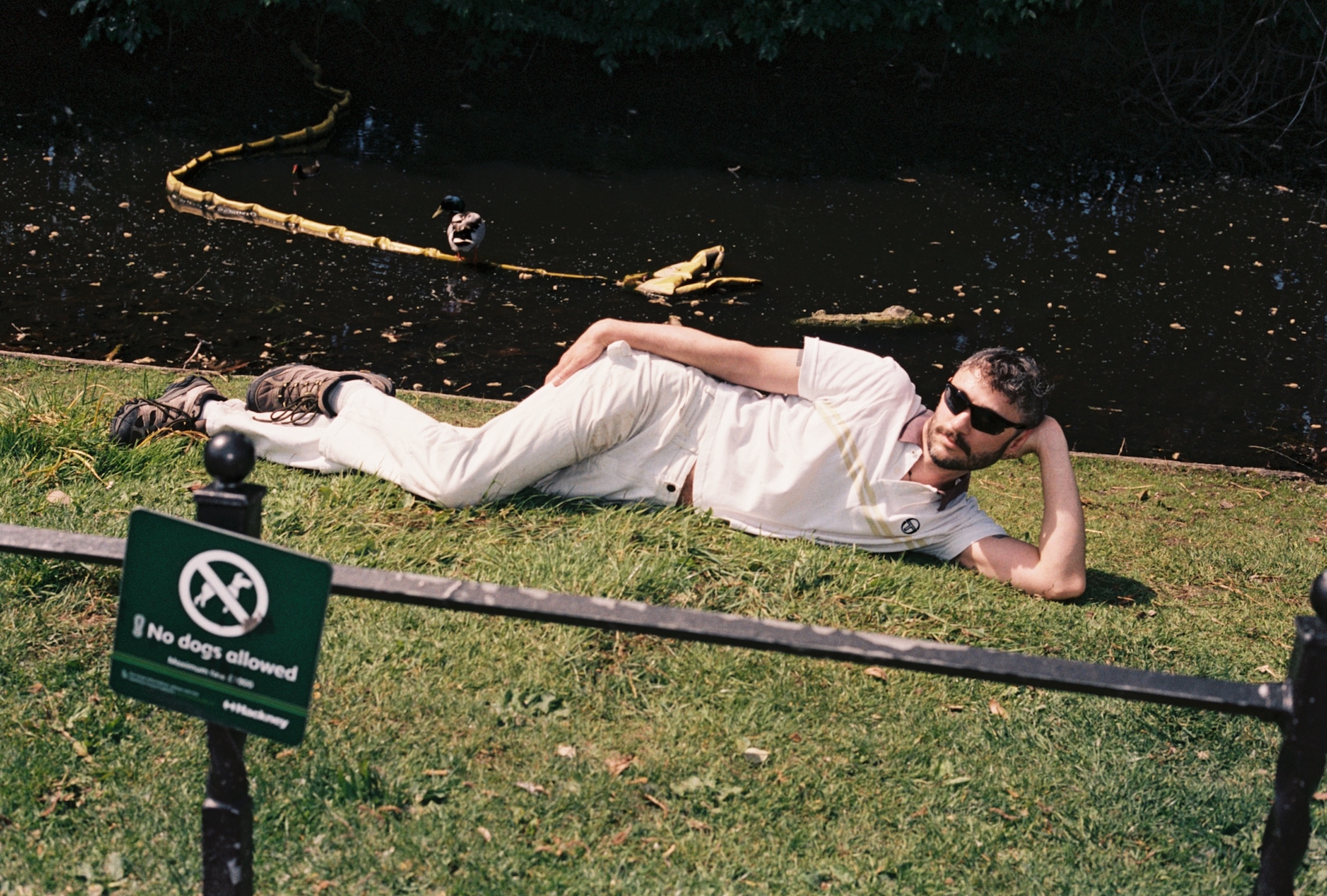

All photos courtesy of Francesco Nazardo.
What happens if the last man on earth is an advertising copywriter? Steven Phillips-Horst‘s The Last Mad Man imagines the collapse of civilization as one long client brief. It’s an apt premise for the writer and podcaster, who’s spent years skewering the absurdities of branding, media, and modern life. As he prepares to bring his satirical one-man show to this year’s Edinburgh Fringe Festival, he called up his old friend Kate Berlant to discuss British food’s undeserved reputation, theater as an inherently embarrassing medium, and the nightmarish ubiquity of direct-to-consumer chili crisp fonts.
FRIDAY 6 PM JULY 10, 2026 LONDON
———
KATE BERLANT: I’ll start with a classic. Where are you?
STEVEN PHILLIPS: I’m in a theater space in London.
BERLANT: I heard that was rough.
PHILLIPS: It’s a little rough. It’s in Canary Wharf. I don’t know how familiar you are with it. It’s kind of the Long Island City of London. It’s a lot of office buildings and it has this very early ’80s World’s Fair, “We built the city of tomorrow, but no one’s here” kind of energy. There’s a monorail, but no one’s walking around.
BERLANT: But you have a Costa on every corner.
PHILLIPS: There’s not even a Costa. I walked like 11 minutes to get to the Tesco.
BERLANT: Oh, gosh.
PHILLIPS: It’s brutal. Then, I’m in this theater group that reuses a disused office to give creatives a space to play, but I can hear other people doing their movement exercises in the adjoining rooms.
BERLANT: You said office. I’m thinking about the insistence to still use the folding chair as a stand-in for a couch, to allow the audience to use their imagination and go, “No, I know it looks like an office folding chair, but actually the two of them together are a loveseat.” Just invest in the loveseat. Go get the couch.
PHILLIPS: But are there any circumstances in which asking the audience to go there with you, and their imagination doesn’t suggest a lack of budget? Is there a moment when it actually creates magic where it’s more than the sum of its parts?
BERLANT: Yes.
PHILLIPS: When I did this production of this one-man show, there was a moment when I used a briefcase as a stand-in for a laptop.
BERLANT: That’s fun. I like that.
PHILLIPS: Is it? I’m looking back on that being like, “Was that mortifying?”
BERLANT: No, I think that’s smart. Oh my god, I’m so excited for this show. I have not seen it yet, because I typically don’t do the homework. I texted you frantically like, “Do you want this?!”
PHILLIPS: Did you admit that?
BERLANT: Yeah. I’m excited because, to those who don’t know, Steven is one of the last intellectuals we have left on earth.
PHILLIPS: That’s the concept of the show.
BERLANT: That’s what you truly are. I mean, I could direct them to so much of your work. You wrote a piece on Quibi that rocked my world.
PHILLIPS: Thank you for elevating that piece. I like to think that I hastened their inevitable downfall with that obscure piece I wrote.

BERLANT: I also want the reader to know you coined the term “Dimes Square.”
PHILLIPS: Thank you for putting that out there. It’s not something that I obviously like, but I will tell anyone who wants to know that I coined that term. Something I want to ask you—because this play has polemical ideas behind it. It’s about ecological collapse, advertising, identity, and branding. When I’m writing plays, I’m comfortable being a critic and being a bitch.
BERLANT: Oh, god.
PHILLIPS: And the readers should know that your one-woman show, Kate, is massively inspiring to me as an up-and-coming one-woman performer. You turned your strengths into this storyline that was incredibly dense with comedy, but also quite emotional.
BERLANT: Thank you, Steven.
PHILLIPS: It was really inspiring. When you were writing that, were you like, “I’m having to really twist what I actually think is comfortable for me into something else?” Or were you just like, “Well, this sounds like what I would do in standup, and not like a play at all”?
BERLANT: There were so many things that I wrote for that show where I was like, “I’ll improve this later,” or there were stand-ins. Then, you end up doing this show 150 times and it’s just like, “Well, it’s locked in.” We can never escape our language, nor should we really try to.
PHILLIPS: My first iteration of this thing I wrote was more of a collection of my ideas and my polemic essay-ish writing. It’s almost like a collection of skits, and it’s been really quite difficult. I’ve been working with a dramaturg, which is not something I would like.
BERLANT: They still make those?
PHILLIPS: Honey, only in the UK.
BERLANT: Wow.
PHILLIPS: Only in London, which has a thriving theater scene. You know, people actually go to the theater here? It’s obscene.
BERLANT: I’ve seen so few plays in my life.
PHILLIPS: There is literally a thriving, healthy theater scene here. It’s not just incredibly snooty people and/or tourists who are coming to see $300 shows. Your average gay guy in London is seeing a play every week.
BERLANT: I mean, we’re Americans. America’s inherently an anti-intellectual society.
PHILLIPS: Yeah and, honey, it was like that long before Trump. We were founded by sex-negative Puritans who were so terrified of the body, and not in a fun Catholic repressed way. But anyway, my dramaturg is also directing the show now. Lovely fellow.
BERLANT: What’s his name? Let’s give him a shout-out.
PHILLIPS: Amitai Landau-Pope. Also, a double-barrel last name like me, so we really get along.
BERLANT: Oh, any relation?

PHILLIPS: To the pope? He’s actually Jewish, so maybe. We went to see a production of Dangerous Liaisons at the National Theater in London recently.
BERLANT: Fun.
PHILLIPS: We left halfway through.
BERLANT: You have to leave. That actually just reminded me of one of my core memories. My parents took me to New York when I was 12, and we went to see Rent on Broadway and we walked out halfway through.
PHILLIPS: No way.
BERLANT: My dad was like, “I just can’t do it anymore.” I can see it, the backs of people’s shadowy heads as things are happening on the stage, and inching up from our surely pretty good seats. I just remember the exit and then later finding out somehow that was quite scandalous. I mean, I was raised by art snobs, but I actually now think that we really should have stayed. Leaving in the middle is unacceptable, I’d argue.
PHILLIPS: Jacqueline [Novak] has this horror story from when she was first doing the Fringe Festival and people were walking out in the middle of her set, but the exit was next to the stage and they had to cross the stage.
BERLANT: Oh my god. So this is your second Fringe?
PHILLIPS: I did Fringe last year with this show at a very small venue. I started really buckling down and working on this show and now we’re going to be at Assembly, which is one of the big four.
BERLANT: That’s where I did CommuniKate in 2017.
PHILLIPS: No way.
BERLANT: I had a blast. What’s your Edinburgh experience? Mine was so monk-like. I just would go home and drink tea every night.
PHILLIPS: You weren’t going to the Pleasance Bar area, hanging out with the other comedians and talking shop?
BERLANT: A little bit. That’s where I met you. You do form those lifelong, important friendships.
PHILLIPS: Last year I made the weird decision to move to Edinburgh while also doing the British show there, so I’ve been living in Edinburgh for the past year.
BERLANT: I’m going to congratulate you on breaking free.
PHILLIPS: I had to. I’m so old. I’m almost 40 and I didn’t want to get to my 20th anniversary in New York. That felt crazy to me.
BERLANT: Wow. Oh, god. So wait. Are you eating? Because I couldn’t get anything there.
PHILLIPS: I will push back on the notion that Britain doesn’t have good food. That is a stereotype that needs to be buried.
BERLANT: Edinburgh?
PHILLIPS: Listen, Edinburgh is a very adorable, posh, little gentrified city. We have lots of natural wine. I mean, 2017 was a long time ago. That’s, like, before the anchovy revolution.
BERLANT: You are completely correct. I’ve completely dated myself. I’m truly fucked.
PHILLIPS: We have so many restaurants that have the direct-to-consumer chili crisp font. You know what I’m talking about? That font is everywhere, honey.
BERLANT: Okay. I’m coming back. PHILLIPS: You come back to fucking Fringe, you would be a rock star. It would be crazy. The whole city will be shitting, vibrating. It would be wild.
BERLANT: Wait. I want to talk about your show. So for a layman, you are rebranding, as you said, dealing with ecological collapse and the reality of the world that we’re entering.
PHILLIPS: Yeah. It’s a surrealist romp that many have called a razor-sharp satire, but it’s essentially what happens if the last man on earth is an advertising copywriter.
BERLANT: Fuck yeah.
PHILLIPS: The premise is the world has ended, we’re in this post-apocalyptic, dystopian moment. And there’s one guy left and, in his craziness and struggle to make sense of it all, he decides he’s going to rebrand the apocalypse.
BERLANT: Oh, that’s beautiful.
PHILLIPS: In this process, as he struggles for inspiration, he starts to go back and look at branding projects that he worked on when Earth was still spinning. Then, some of those projects had a hand in the kind of consumers that may have led to ecological collapse. So it brings up questions of guilt, responsibility, identity, and advertising—how we kind of create our identities and the effect that has on the world.
BERLANT: This is beautiful and so perfect for you. Are we going to see some familiar brands in your show?
PHILLIPS: That’s been another challenge—how do you make something that works on both sides of the pond? It’s not chock-full of either American or British references. You try to find stuff that speaks in a language everyone relates to, but doesn’t necessarily draw upon references that only certain people will get.
BERLANT: Of course. So the world of fonts and the subtextual characters emerge and are circulated.
PHILLIPS: There is definitely font humor in this show, because that’s global. You travel a lot for work, surely you’ve noticed the increasing sameness of our cities?
BERLANT: It’s real. Everywhere you go, it’s the same. There’s this funny sense of safety in it. Like you’re trying to find a coffee shop, and then you see those colors.
PHILLIPS: The fake chalkboard?
BERLANT: Yes, you see that. I mean, we still are in the world of the succulent and the cloth tapestry.
PHILLIPS: The woven baskets. I mean, it’s funny when you see a place that is so clearly really cheap, really slapdash. They threw the succulents up yesterday and you see how pandering it is. Every piece of the experience is like a facsimile of some idea of Los Angeles five years ago, but you’re like, “I’m buying into it.”
BERLANT: “It’s working.” So, how has your relationship with your director been?
PHILLIPS: Well, I’m very intimidated by theater as a medium because it’s so high level. I’m quite embarrassed and humiliated by it. Not just because it’s embarrassing to perform, but the form itself is so cheesy. You’re asking the audience to do so much suspension of disbelief. So the way I’ve counteracted that is by making fun of it, and there are a lot of meta elements to my show. To me, theater is always a man walking on stage and opening a newspaper. It’s always that.
BERLANT: It’s always an actor entering the stage through a door, like, “Honey, I’m home.”
PHILLIPS: It’s always that. It’s like you’re announcing everything. Everyone’s also saying their exposition to each other like, “But it’s been three weeks since you got out of the hospital!”
BERLANT: Yeah.
PHILLIPS: So the only way I’ve been able to deal with that is to make fun of it and heighten it in the show, but maybe that’s also a very immature reaction.
BERLANT: I think that’s kind of the only way in. That’s the only way that you can actually revel in the magic of theater. To acknowledge not only the artifice, but the embarrassing tropes and the inherent humiliation of participating in theater.
PHILLIPS: Right. Because it’s just so different from television and film. Those really are magic. Those are transportive. Theater has these moments that can be really magical, but then you’re always taken right back down to earth.
BERLANT: Totally. I just saw Death of a Salesman on Broadway.
PHILLIPS: Oh my god. Did you love it?
BERLANT: Yes. The entire experience for me was colored by how maybe every 22 minutes a phone would go off in some way. Nathan Lane is there and he’s doing this gripping monologue, but the whole time I can’t breathe because I’m waiting for the phone to interrupt it.
PHILLIPS: Right.
BERLANT: Is he just hearing the phone? I had this profound experience 15 minutes in. I go, “I’m Linda Loman.” I turned to my partner and said, “This is the monologue I just gave about the Bowery. They know me at the Bowery. Goddammit.” This is the traveling salesman. The archetypal desperation, humiliation. It was so referential for my show because the show is about an ad guy. To me, Linda Loman is the downtrodden American.
PHILLIPS: So you were experiencing performer sympathy? Or anxiety?
BERLANT: I mean, I don’t want to exaggerate. It wasn’t like it was constant, but if there’s more than one phone, we’re so fucked as a society. It’s just like, “How is this possible? We’ve all spent 14 million to be here, to be seated with Laurie—”
PHILLIPS: Roughly 14 million to see Laurie Metcalf. Parting with that much money isn’t sacred enough to you that you’re going to turn your phone off.
BERLANT: I know. But there are these moments before the play starts and the actors are there, kind of shadowy. The play hasn’t started yet, but they’re sitting there. That’s also such an embarrassing thing in theater. Watching Laurie Metcalf sit there in the darkness, moving her foot and shifting in her seat, you’re like, “Is that the play?”
PHILLIPS: Right.
BERLANT: Someone said this, but the pleasure of theater is the pleasure of being able to stare at people, and that’s the truth. You can just stare at people and wonder and you don’t have to avert your gaze. There’s so much feeling in it. Even if the material’s not good.
PHILLIPS: Yes. I mean, you did such a good job of hiding that in your show and your production of Kate. All of this extra architecture that you create before you start, really playing with the audience’s expectations about when theater begins.
BERLANT: Oh, god bless you.
PHILLIPS: There’s a relief, as the audience, to constantly know that you’re one step ahead of them. I think that’s the biggest fear as an audience member, that you’re going to get ahead of the performers.
BERLANT: Absolutely. That’s very kind, but I will say that you truly are one of the funniest, smartest people. It’s really the truth. I would feel so thrilled to just sit right there to read your mind and whatever it is that you’re making in this moment, because I think few people really can see the moment that we’re in as clearly as you.
PHILLIPS: Wow. Thank you so much, Kate. It’s been a pleasure.
BERLANT: I really can’t wait to see the show.
