

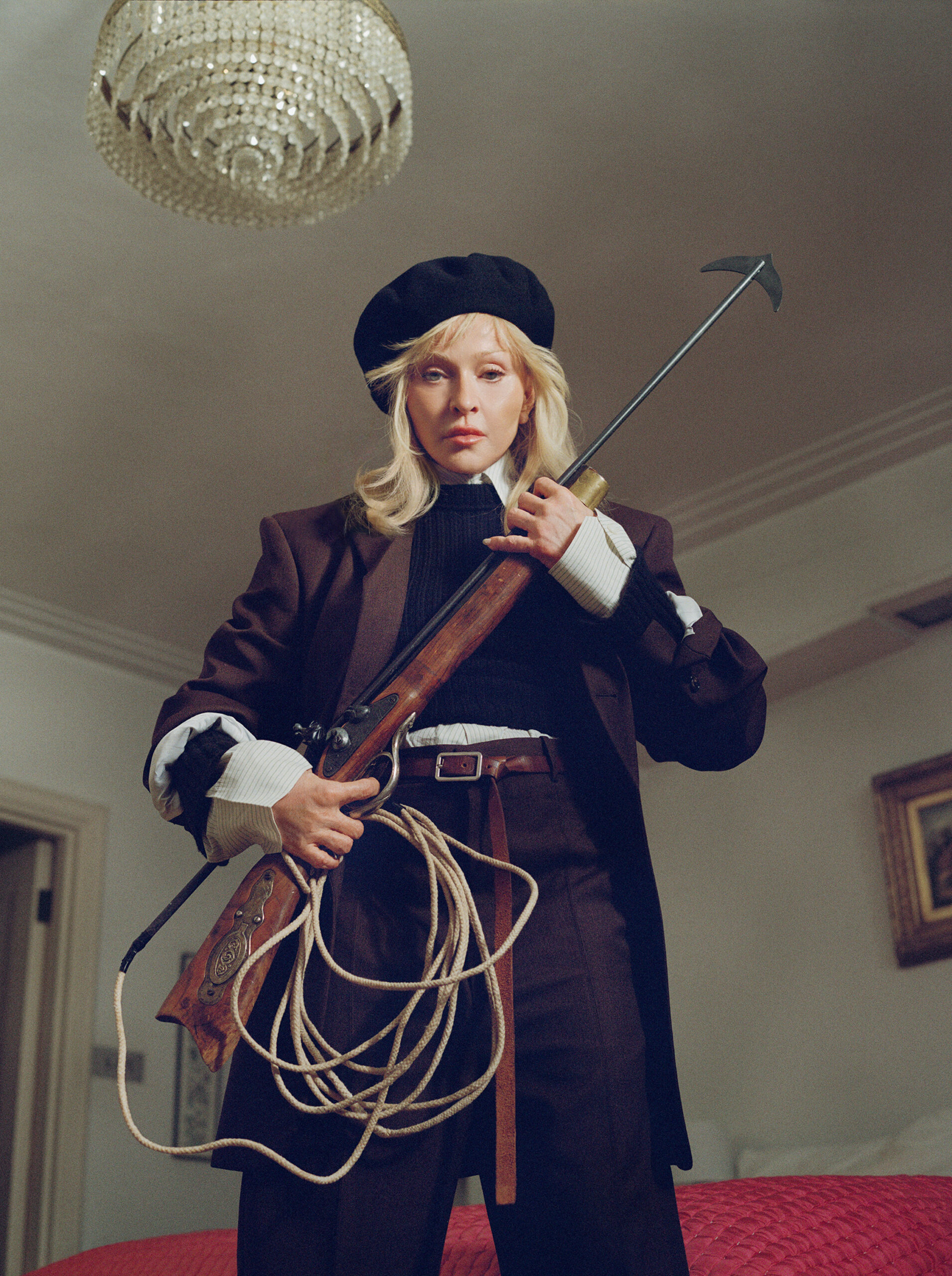

In honor of Madonna’s 68th birthday, Interview unearthed from our archives every single moment we’ve ever spent with the music icon. Below, find the Queen of Pop in her own words, from 1985 to today.
———
DECEMBER 1985

Madonna photographed by Herb Ritts for Interview.
MADONNA: I’m not as true to myself as I always proclaimed that I had been. I realize now, after eating this Fig Newton and reading this package, I realize there’s animal fat in this and I’m no longer a vegetarian. I want everybody to known how fallible I am.
HARRY DEAN STANTON: You’re not perfect.
MADONNA: No, I’m not Jamie Lee Curtis.
STANTON: Madonna, to start at the very beginning, what’s your earliest memory?
MADONNA: I think my earliest memories go back to about four or five years old, and they’re memories of my beautiful mother. They’re really great memories. When I was four years old or younger, I remember not being able to go to sleep at night, so I would walk into my parents’ bedroom and push the door open. They were both asleep in bed and I think I must have done this a lot, gone in there, because they sort of sat up in bed and said, “Oh no, not again,” and I said, “Can I get in bed between you?” I always went to sleep right away when I slept with them. I felt really lonely and forlorn, even though my brothers and sisters were in my room with me. I wanted to sleep with my parents.
STANTON: The bosses.
MADONNA: Yeah, I wanted to sleep with the A-Team. I remember, because my mother had a really beautiful red nightgown, silky red. My father was against me getting into bed with them, and my mother was for it, I remember that. So I got into bed between them, and I remember getting into bed and rubbing against her nightgown and going to sleep—just like that. To me that was heaven, to sleep in between my parents.
STANTON: And your next memory?
MADONNA: My second wasn’t so pleasant. It was me sitting in the driveway of my house and another little girl, who must have been about two years old—I was about four–had just learned to walk, and she walked into the yard and picked a dandelion up out of the ground. I hate dandelions more than anything, and I had been told I couldn’t leave the front yard so I was kind of mad. I was sitting on the cement of the driveway and this little girl came waddling up to me with her diapers on, and with little innocent eyes, she looked up at me and handed me the dandelion and I pushed her down. I was so mad because I was being punished and my first instinct was to lash out at someone who was more helpless than I. I saw in her innocent eyes the chance to get back at some authority.
STANTON: Why do you hate dandelions?
MADONNA: Because they’re weeds that run rampant. I like things that are cultivated. So that was my first memory of being mean to someone.
STANTON: Do you remember when this hatred of dandelions started?
MADONNA: I think it was from when my father made us go out in the yard and pick all the dandelions, like they were varmints. So those are my earliest memories—nice and naughty.
STANTON: Talk about your view of the world as a child.
MADONNA: When I was a child I always thought that the world was mine, that it was a stomping ground for me, full of opportunities. I always had the attitude that I was going to go out into the world and do all the things I wanted to do, whatever that was.
STANTON: I read that you liked the song, “These boots are made for walking—I’m gonna walk all over you.”
MADONNA: That attitude wasn’t it—not like I’m going to go in and terrorize anybody or walk all over anyone or conquer—but just that I was going to get out there and take a bite of the big forest. And I think I did that. And now that I’m a woman, I’m still doing that. But as big as I am and as much as I know, I still have that same wide-eyed feeling that there’s still a forest for me to go out in—
STANTON: You’re still a virgin.
MADONNA: [Laughs] Yeah.
STANTON: What’s the angriest that you’ve ever been?
MADONNA: The angriest time in my life—I’d have to say that was in my teen years. Like from when I was in junior high till I graduated from high school. Actually I sort of mellowed out toward my last year because I finally figured out what I was going to do with my weird old self. It was a combination of feelings. When you’re growing up, whether it’s the neighborhood you live in, or school, or church, or whatever, your family—and I had a really big one—there’s a lot of pressure to fit into the group.
STANTON: Peer pressure.
MADONNA: Your peers aren’t pressuring you, you just want to identify with somebody as you’re growing away from being a child. You’re starting to think differently, and you want to be independent, but before you reach that independence you really need to attach yourself to someone. In my school, there were the hippies—the more free group, the guys who had long hair and took a lot of jewelry and shop classes, and smoked a lot of pot during lunch hour. I didn’t identify with them because I thought they were extremely lazy. Then, there was the jock group, and they were drunk on beer every day. I was a cheerleader for a little while, but I couldn’t get into it anymore. It wasn’t that I wasn’t interested in sports, it’s that I couldn’t agree with the sensibilities of the cheerleaders and the athletes. They were only interested in one thing—sports and drinking girls. Oops, Freudian slip. Well, that’s basically what they did—drank girls and went out with beers [Laughs]. See, I had this idea that everybody went to school with blinders on their eyes in junior high and high school, and it really pissed me off. For some reason, don’t ask me how because my parents weren’t worldly and I didn’t know many people who were, I was just sure everybody was missing something. I couldn’t identify with anyone, so I just wandered around aimlessly. As far as friendships go, I sort of hung around on the outside of things and befriended who other people thought were the class nerds. Those were my best friends, I think, the guys who were really studious, like physics majors.
STANTON: Did you have a best friend?
MADONNA: Yeah, there was one girl. We were pretty good friends and I think we laughed at the world together for awhile, but we grew apart. We did a really funny thing once. We thought we were better than anybody else, and our main point of interest was boys, obviously, and we decided that we were going to dress up as ten-cent floozies.
STANTON: And that’s where it all started.
MADONNA: I remember one summer I went away and hung out with my uncles. They were very young, a couple years older than my brother, and I thought they were the coolest people in the world. They had a rock band. I’d visit my grandmother up north in Bay City, Michigan. She wasn’t an extreme disciplinarian like my parents, so I loved going there. We could have twelve desserts at grandma’s, and stay out past 10:00, and go out with beers, and drink boys. But I remember, that summer, I was watching my uncles’ rock ’n’ roll band—wearing tight jeans for the first time in my life. I smoked a cigarette, not too successfully, I started plucking my eyebrows and I started feeling like, “Yeah, this is it, I’m cool.” I remember I got back and my stepmother told me I looked like a floozy and I was really smashed.
STANTON: This was before you had taken any dance or music or anything?
MADONNA: I was studying dance in high school, but this was before I was really committing myself to it every day. At that time, I was going to dance classes, but they were fun. It was really a release for me, just so I wouldn’t beat up my brothers and sisters. I knew that I was really good at it. They were jazz classes, so they weren’t as strict as, say, a ballet class. I’m talking like eighth grade; the summer between eighth and ninth grade I went to my grandmother’s house and did all this. So then, I came back and after that summer I felt like I had really grown up—only to find out that I was a floozy [Laughs]. Then it was a private joke between my girlfriend and me, that we were floozies, because she used to get it from her mother all the time too. If we did one little thing, like wear a little lip gloss or try to wear opaque pantyhose, not nylon stockings that you could see through, not sheer, just tights.
STANTON: So somewhere you did like the floozy look.
MADONNA: Only because we knew our parents didn’t like it. We thought it was fun. We got dressed to the nines. We got bras and stuffed them so our breasts were over-large and wore really tight sweaters—we were sweater-girl floozies. We wore tons of lipstick and really badly applied makeup and huge beauty marks and did our hair up like Tammy Wynette. She’s got the pictures actually, I don’t, of us laying in the bed. We both took turns, lounging on the bed with our hands behind our heads. We took pictures of each other and we developed them and these were our ten-cent floozy pictures. We were going to keep them so we could look back at them and laugh, because we knew how ridiculous it was.
STANTON: Do you still have them?
MADONNA: I don’t, but when I went home last spring I saw that girl and she showed them to me and it made me laugh hysterically.
STANTON: Maybe you could get them back and we could use them.
MADONNA: No way. I’ve had enough blasphemous photographs. Everybody knows I’m a bad girl.
STANTON: In one of your interviews you said you’re basically a very sweet person, a very good person—a very healthy person and you like your body.
MADONNA: I am. I know that I’ve incited a lot of bad feeling with the Moral Majority or Parents and Children. There’s this big scandal about banning music with sexually explicit lyrics, but I think ultimately children, more than anybody, sense the realness of somebody and the goodness of somebody. I don’t think they would have attached themselves to a person or believed in them or looked up to them if there wasn’t some innate goodness or sweetness to them. You let go of that trust and innocence and that intuitive psychic ability to see that in people as you grow older. I think it’s these kids’ parents who don’t understand it and they’re fearful of it.
STANTON: Do you think it will have a positive effect on all these little girls, the “want to be’s’’?
MADONNA: I do, because I have a positive attitude about life, and I think they see that. What they see more than anything is that I was a little girl from Michigan and I had a dream, and I worked really hard, and my dream came true. I believed in myself and now especially, more than ever, children really need to have those kind of people to look up to, people with positive life messages. People who believe in dreams and magic and things that are happy. Everything is so real and grim. Children in school today are thinking about their life being over soon because of nuclear holocaust or… All I’m trying to say is that it just seems that more and more negative things are happening around the world; whether it’s incurable diseases, or famine, or the threat of the atomic bomb. What kind of thing is it for children to grow up with that fear? I think it’s really important for them to have an image or something to inspire them and take them out of that. Not so they don’t even think about it, but to realize that there are also some positive things going on. It’s not just “What’s there to look forward to in life?”
STANTON: And you want that to come through in your singing, your music, that feeling that you have integrity and you’ re not a fake and you’re good and you tell the truth.
MADONNA: Harry Dean, those are your words. I don’t claim to be an intellectual or esoteric songwriter and I think my message is very simple, positive and full of life.
STANTON: You have a great attitude.
MADONNA: I laugh at myself, I don’t take myself completely seriously. I think that’s another quality that people have to hold on to, you have to laugh, especially at yourself. I do in most of the things I do, and most of the videos that I make, and my performances. Even in my concerts, there were so many moments when I just stood still and laughed at myself. It was like I start mocking the image that the public has of me. For instance, I ended a show with “Material Girl” and throughout the song I went up to all the guys in my band; they’re giving me pearls and diamonds and fake money and I’m stuffing it down my shirt, and I’m going crazy with it. At the end, I say to the audience, “Do you think I’m a material girl?” and they all say “Yeah!” Then I say, “I’m not” and start taking all of it off and throwing it into the audience. It’s like a joke, that’s the point. It was fun, and the audience loved it.
STANTON: That’s the truly moral thing too.
MADONNA: If you can’t make jokes about yourself, you’re not going to be happy. You’ ll be the saddest person that ever lived—you are!
STANTON: I also think the dancing you did gave you tremendous discipline.
MADONNA: Exactly. That was the first thing—the devotion to that, and realizing that I could go from being unmolded clay, and over time and with a lot of work and with people helping me, I could turn myself into something else. Before I started feeling devoted to dancing, I didn’t really like myself very much. I didn’t think I was beautiful or talented. I spent a lot of time loathing myself, and not feeling like I fit in my school and hating the authority of my parents, like every adolescent does. I really had a lot of self-hatred. When I started having a dream, and working toward that goal, having a sense of discipline, I started to really like myself for the first time. Then that just carried over into everything. That isn’t to say that even now, as I approach acting a lot more seriously in my life, that I feel like, “Wow, I could work really hard and just get there.” I’m full of the same fears now, and awkwardness about not knowing that much about it, as I was when I first started dancing.
STANTON: About acting?
MADONNA: Definitely. Once I felt really confident about my dancing, I went into music. I started writing lots of songs. But to get out in front of lots of people and actually do the songs and sing in front of a microphone and project, I encountered all those same fears all over again. I feel like my life is cycles, one cycle after the next, and I keep learning more and more. Every time I get to another place and I’m learning more about something, I’m exactly the same as I was way back when I was just starting to dance. My knees are trembling and I want to learn, I’m afraid, but I’m also excited. I’m just like an open book. I want to get everything into my head that I can, then get it out. I’m completely uninhibited on a stage with 30,000 people in the audience, and say things, and dance and sing, because I feel confident about it because I know what I’m doing.
STANTON: Then once you know a script and know a role and know your lines, then—
MADONNA: Then I feel very confident. Being a dancer certainly helped me learn how to play instruments, and understand musicality and rhythm and coordination, things like that. When you’re playing the drums, it’s all about being coordinated, you know?
STANTON: This friend of mine told me that men see women from the outside in—in other words they’ve got to look great and have a great body, and then after you pass all those tests they’ll talk to you. A woman looks at the inside of a man first. They look in his eyes or at his attitude—from the inside out, is that true?
MADONNA: I’m sure there are exceptions on both sides, but generally I would agree with that.
STANTON: You know who said that?
MADONNA: Who?
STANTON: Sean, your husband.
MADONNA: Isn’t he the smartest!
STANTON: Madonna, what kind of classical music do you like?
MADONNA: My favorite-favorite-favorite music to listen to is Baroque, that would be Vivaldi and Bach and Pachelbel and Handel’s Water Music.
STANTON: Beethoven?
MADONNA: He’s heavier than the people I mentioned. I don’t listen to Beethoven enough to make a judgment whether I like him or not. When I was studying ballet, I listened to classical music all the time because that’s what you listen to when you take class. And I got really interested in it, but just lately I started listening to it all again and I really miss it. That has a lot to do with living in an apartment that doesn’t have a stereo system, believe it or not, but I’m going to be moving soon and I’ll have that. The other day, my husband was playing Brahms and I never really listened to him that much and I loved it—it was a concerto. I love Mozart and Chopin only in that they had some real sweet feminine quality about a lot of their music.
STANTON: What about reading—what authors do you like?
MADONNA: Books are my next favorite thing, after kissing my husband. I love to gobble up books. You want to know who I gobble up?
STANTON: Like boys and beer?
MADONNA: I don’t drink books, I gobble books. I gobble books and I read my husband, okay? So, my favorite poet is Rainer Maria Rilke, he’s a German poet and he’s great. I love James Agee. One of my all-time, all-time, all-time favorite poets is Charles Bukowski, I think he’s the coolest guy in the world. He lives in San Pedro, and some day I’m going to go up there and knock on his door and say, “Charles, get out of that house and let’s have a talk. Charles, can we talk?” He’s totally awesome.
STANTON: What’s so awesome about him?
MADONNA: He’s really funny and raunchy. I love him because he’s always cutting himself down, but he’s totally for real. I have a lot of favorite poets, but I can’t think of them right now. Aside from biographies about people I’ve admired in my life, I love the classics. I love James Joyce and Henry James and F. Scott Fitzgerald and Hemingway and J.D. Salinger and D.H. Lawrence and Thomas Mann and, what’s that guy’s name—shit—oh! Balzac and Guy de Maupassant. I love Françoise Sagan and Marguerite Duras. I love a lot of French writers. As far as new people who I read, I love V.S. Naipaul, Milan Kundera. And Lawrence Durrell, I love his books. But more recently, I went through my Jack Kerouac phase, and Kurt Vonnegut. I’m reading three books now, one is Françoise Sagan, the other is Milan Kundera and oh—I love Alice Walker. I love to read, and I can’t wait to move into my house so I can have a room full of books on the walls.
STANTON: And you never went to college—otherwise you never would have had time to read all those books.
MADONNA: Actually, I went to University of Michigan for a year, but I was in the performing arts school and I studied dance, music theory, and art history. I took a Shakespearian course, so I read a lot of Shakespeare, but that was it. But man, I love to read.
STANTON: What about paintings?
MADONNA: I wish I knew a lot more about painting than I do, but I have a few favorite old guys and new guys. I loved this French painter called Corot. He was right before the Impressionists got big, before Monet’s time. And I like Picasso, certain periods, but I’m not really into Modernism or Cubism or Post-Modernism. Of the young artists now, I think Jean-Michel Basquiat is a great painter, I love this guy named James Brown. I think those two are really funny in their work. I really like Francesco Clemente, his paintings are very romantic and rich—oh, and I love Keith Haring. I think a lot of painters look down on him because he sort of capitalized on his paintings in a way that people might promote their pop records, but I think he’s very talented. I like humor in paintings, I really do.
STANTON: What singers and instrumentalists do you like in contemporary music?
MADONNA: Let’s talk about singers. I love Ella Fitzgerald more than anything. She has the coolest voice in the world. The way Ella sings scat is unbelievable. As far as old singers go, I love Sarah Vaughan and old Sinatra and old Sam Cooke. Most of my leanings toward favorite singers, from when I was really young, are soul singers, you know, R & B, Black, then up till now, gee whiz.
STANTON: Do you remember Big Joe Williams?
MADONNA: Yeah, he’s great, and B.B. King. He’s got a great voice and he writes great songs. He’s a great guitar player. It’s funny, I don’t have a lot of favorite modern people. Tom Waits, he’s a great singer and songwriter and he’s got lots of humor, I like him a lot. I want to meet him some day.
STANTON: Do you know his wife, Kathleen?
MADONNA: Well, she must be cool. He would only marry cool people. Now, I love Chaka Khan and Aretha Franklin. I think Prince has a really good voice and I think he’s a really good songwriter too, and a great musician, but he definitely needs to get a sense of humor. When I was growing up I used to really like Joni Mitchell a lot. The Court and Spark album was my bible for a whole year. I knew every word of every song on that album.
STANTON: So her style influenced you a lot?
MADONNA: I don’t know, it’s hard to say. I never could bridge the gap between what records I loved to listen to when I was growing up and what influenced me. I’m sure each record I heard influenced me in some way, just like every person you ever meet influences you. I think Don Henley is really great, he’s got a really good voice. Chrissie Hynde, from The Pretenders, was a great inspiration to me because she was very popular at the time and she’d just come out. I love Rickie Lee Jones too. Of contemporary women singers, I’d say those two are my favorites. They have great voices and they’re gutsy, and they’re great musicians too. And Debbie Harry, who I really admired. I was just starting to write music when she was very popular. She and Chrissie Hynde were big inspirations to me because they were women and they were in charge of what they were doing. They were obviously writing their own lyrics and they had, to me, very strong images and that gave me courage.
STANTON: Deborah Harry’s one of my favorites too.
MADONNA: Debbie Harry, if you’re reading this, hello, I’ve always wanted to meet you. And Harry Dean wants to go out with you.
STANTON: And I think you’re the most beautiful woman in the world. Madonna, what inspires you in your music?
MADONNA: Gee willikers—I think the things that inspire me to make music are the things that arouse my curiosity and make me happy in life, whether that be romantic love, the love I feel for my husband, for instance, or the love I feel for my friends.
STANTON: Have you felt differently since you’ve been in love with Sean?
MADONNA: Totally. I feel calmer now than I ever have before. What that means is that I can really concentrate on the important things. It’s funny, now that I’m in love, all the songs I write I feel like I do it all for him. I do it for myself, but I do it for him. I’m writing the lyrics or doing the music, or something that’s creative, I think, “Would he like it?” I do. So, love inspires me, and Sean inspires me, and a great book will inspire me, or a great movie, like A Place In The Sun starring Montgomery Clift. Everything inspires me—old men walking down the street, a janitor who I meet. You know what I like to do? When I go to parties, I talk to the butlers and janitors and stuff. They inspire me. I think they’re the funniest. An expression in someone’s eye, walking down the street can inspire me. Children inspire me.
STANTON: What about children…
MADONNA: I would love to have a child. Then, after I have a child, I would decide whether I’d love to have another child. When I see couples and they’ve just had a baby and it’s newborn and fresh and smelling good, and it’s completely pure and perfect and all that, I really want to have that for my own. I want it. And I really want to watch somebody grow, and have a personal effect on their life from the very beginning.
STANTON: When?
MADONNA: I’ll tell you, I want to have a kid before I’m 80.
STANTON: You’ve told me that before you were successful you would walk down the street and look everybody in the eye, and since you’ve gotten all this media attention, it’s different.
MADONNA: I used to be just a brazen, outgoing, crazy lass, and I went out of my way to get attention from people. I would wear one orange sock and one purple one. I went out of my way to make statements with my clothing and obviously I got looks from people. I enjoyed, then, getting looks from people, and people thought I was strange or interesting looking. I brazenly looked people in the eye when I walked down the streets in New York. I loved getting dressed up and going out on the street and walking around. I didn’t have money to take cabs then, so I took subway trains a lot and I loved seeing the visual effect I had on people, and now I can’t really enjoy that privilege anymore because I already have all the attention. I feel like when I walk down the street, people don’t see me as an interesting person, they see me as Madonna, a person they know and read about every day. Looking into their eyes invites trouble, so now when I walk down the street, I look down at the ground and that’s sad for me. I’ve sort of gone from being an extrovert to being an introvert, publicly, which I never thought I could be. But it’s the only way I can be safe and not elicit a lot of unwanted response.
STANTON: What about the press?
MADONNA: Unwanted response—let’s just sort of catapult ourselves right into the press. I can talk about the press and I’m probably not going to be saying anything a lot of celebrities or people who are public figures haven’t already said before. Look at Jackie Onassis, she had to go to court to get this guy to stay away from her, but I have to say that since my tour I haven’t had a moment’s peace from the press.
STANTON: They abuse their privilege.
MADONNA: The thing that annoys me more than anything about paparazzi is that they really feel that they have put you where you are. They really think that because you’re a celebrity, you owe them all the pictures they can get. I think it’s completely unfair. I think it’s one thing to want to be there at social functions, like premieres and parties and gala events, to want to be there to chronicle those events. I know people are interested in reading about that, but I don’t want to get my picture taken every time I walk out of Jane Fonda, and I do. It’s not even the taking of the pictures that bothers me, it’s the element of surprise I always encounter every time they jump out of the bushes or jump from behind a corner. It’s like a teeny heart attack every time it happens. Every time I go running in Central Park around the reservoir, and they’re waiting. I’m gliding along listening to music and all of a sudden they jump from behind a tree. They’re always scaring me, so I have to deal with that constant fear. And every time they jump out to take a picture, the way they take them—it’s like they’re raping me. I feel like they just might as well have taken a gun out and shot me, because it takes me at least an hour to come down from that shock every time that happens. It’s a very traumatizing situation for me.
STANTON: It also isn’t right to have six helicopters hovering over a marriage ceremony.
MADONNA: No, but as we were saying before, America is a really life-negative society. People want to know all the underneath stuff—all the inside stuff, your dirty laundry. Which isn’t to say all the stuff the press has been getting on me is negative or dirty or whatever, but there’s always a hope, for them, that they’ll uncover something really scandalous. So paparazzi hover above you like helicopters; they’re vultures. If they truly understood what they’re trying to capture in a photograph, they wouldn’t want to do it. I want to be able to go through the day—go to my exercise classes, get married—without the whole world watching. I’ve given enough to the public through my music and videos and one movie that I’ve done, and I plan to keep on giving it. I don’t see why they have to keep on trying to take more from me. That’s all I have to say about it.
STANTON: Madonna, the press has written that your rise has been like a meteor and that you’re going to burn out, and they quote you as saying in 20 years you’ll be a great actress.
MADONNA: Ultimately, people want to see other people fail—another part of the life-negative society we live in.
STANTON: It’s not all life-negative is it?
MADONNA: No, because if it were, people like you and I wouldn’t be here. If there weren’t people who had a great attitude about it, great books and great paintings and movies wouldn’t be made. There’s always going to be the adversary, the antagonist, the good and the bad, the yin and the yang, and so maybe the negative exists so we can see the positive. In the very beginning, I was hurt by it, the things people wrote about me, saying that I was going to fall, go away as quickly as I came. It’s like junior high magnified a thousand times, you just can’t pay attention to it. Ultimately, anybody who sits around predicting the failure of anyone else is fearing his own failure. Why waste your time? Why not think about the good side of everything? Or—even if someone isn’t famous after three years—the good things they contributed to the world. It’s really funny. Twenty years ago, people were movie stars, musicians, and public figures—but there was a lot more mystery about them. Now, not only do they tell all about anyone’s life, anyone’s past, to find all the dirty laundry—including the number of abortion someone’s had—but they also make sure that everybody knows, twelve-year-old kids included, how much money an actor makes, how much a movie grossed, how much a TV show grossed, the ratings. It explains everything down to the scientific thing—it takes all the magic out of Hollywood, and it’s really upsetting to me.
STANTON: Making a business out of everything, cold hard cash—
MADONNA: Yeah, and as far as acting goes, I’m not sure it will take me 20 years to be a great actress. I think what I said was that I hope to be acting 20 years from now, when I know I won’t be making pop videos for MTV anymore. I ultimately think my career as an actress will outlive all my other careers.
STANTON: A friend of mine told me in your backstage preparation for your Live Aid performance that you looked like a warrior—making sure everything was right—and then when you came on, you came on like a warrior.
MADONNA: That’s a great compliment, that’s what I feel like when I go on.
STANTON: The emphasis has been on your visual image, your physicality, your image as a sex symbol. Actually, you had two hits out before anybody really knew what you looked like, right?
MADONNA: I was successful in the clubs and no one knew what I looked like. I was considered a “disco artist,” and then when I had my first nationwide hit, “Holiday,” people still didn’t know what I looked like—because I still didn’t have a video. It wasn’t until I made a video to “Borderline,” which was my third single release off my first album, that people actually put a face to a song. I do think it’s kind of ironic.
STANTON: And frustrating too. There’s been more emphasis on your looks and your image as a sex symbol than there has been on your tremendous talent as a singer, a musician, as a record co-producer and video producer. You also have a lot to do with directing your own videos, right?
MADONNA: But I always collaborate with people. I don’t think my success would be sustained as it is now if my career were only based on my physical appearance. It just shows that looks mean a lot and image means a lot. But you have to back it up. People didn’t really have any preconceived notions of me until they started seeing my image—my face, the way I moved, putting the voice with the face.
STANTON: The song “Holiday” was a big hit on Black as well as white stations.
MADONNA: My first two hits were hits only on Black stations, and it wasn’t until “Borderline,” which was my third release, and that’s also the first video I had on MTV, that they crossed over to the white pop stations. People didn’t know what I looked like before that and I was only played on Black stations, but I still considered that I was very successful.
STANTON: How close are your demos to the finished song?
MADONNA: It depends. On my first album, the demos we made were not as close simply because I didn’t have as much direct involvement with the production of my album. I didn’t know if I knew enough to speak out. It wasn’t until my first album was three-quarters of the way done that I realized, hey! I know a lot more about this than I’m allowing myself to speak out about. So I started going backward and stripping the songs down and making them more sparse. Until then, they’d been layered with a lot of stuff. Then, when we got into the second album, I had a lot more confidence in myself and I had a lot more to do with the way it came out sound wise. I really worked side by side with Nile Rodgers. When I brought the demo tapes in, all we needed to do was transfer it into a bigger sound, so they were much closer to the original demos. Nile was very open with me, he gave me the feeling we really were collaborating and I felt free to say what I wanted. He really liked the demos and wanted to preserve the quality that was on them. That’s why the second album was closer to the sound of the demos.
STANTON: Why wasn’t “‘Into the Groove,” which is from Desperately Seeking Susan, on your second album?
MADONNA: For a simple reason: My second album was already released when the movie was being filmed. The director, Susan Seidelman, said to me she was shooting a sequence in the movie where we needed a song that had a really good dance beat. She asked if we could just bring in the tape of the song that Steven Bray and I wrote. I said okay, and I brought in this tape we had been working on. Actually, I wanted to test it out on all the extras who were dancing to it, to see if it was a good song. I had no intention of using it in the movie. So I brought it in and we played it, and we had to do take after take and pretty soon everyone was starting to like the song and they were saying, “What’s this song, and where’s it coming from?” I said, “It’s just a song,” and as the film got nearer to the end and they were doing the final cuts, Susan called me up and said, “Look…” Originally, I think they were going to use all old songs that were already recorded in the soundtrack. I didn’t go into this film thinking I’m going to get a hit song out of this, or an MTV video. No way! I think everybody wanted to turn the other cheek to that song and not bring it in because nobody wanted to make it that kind of a movie. So it was getting closer and closer and Susan Seidelman said to me, “We’re trying to find another song for that scene and we just think yours really works—it’s a great song, the producers loved it, Orion loved it, everybody loved it.” I said, “Okay, fine.” They synched the song to that sequence in the movie and showed it to me. I thought it was great and it didn’t interfere with my character or what I was doing acting-wise, and we ended up using the original 8-track demo Steven and I had made. We never went into the recording studio and made a record out of it.
STANTON: You’re one of a handful of musicians—and I’m including Michael Jackson, the Beatles, Elvis—who have had to compete with themselves on the charts—to get another hit you would have to knock yourself off.
MADONNA: Gee, I can’t complain, the more the merrier. I like the fact that all my songs are doing well, who wouldn’t?
STANTON: I was personally impressed with your choice of music at the reception, after your wedding, when everyone was having dinner and dancing. The songs were a lot of older ones, from the ’40s or ’5os—
MADONNA: We went all the way back to the ’30s—big-band era stuff. Honestly, I didn’t do it on my own. I had the help of Michael Ochs, who has an incredible archive of music, and I knew he could assist me in finding all the possible tapes. I wanted it to be really romantic. We had old Bing Crosby and Ella Fitzgerald, Cole Porter and Sarah Vaughan. It was really like the roots of rock ‘n’ roll all the way back up ’til now.
STANTON: I’m going to segue into censorship here. What’s the deal on censorship in your music?
MADONNA: I’ll hip you to it, Harry Dean. Basically, a bunch of moralists have gotten together and decided that the majority of the lyrics and the images that a lot of pop artists are projecting are injurious to the minds of their children and they’re having a bad effect on them. I would say that what they’re doing is taking a lot of people and lumping them together when they point the finger at them. For me, whether my lyrics are worthy of censorship or not has nothing to do with it, it has more to do with my image. The thing is, they’re going to try to find a word in every song to hang on to. Most of the lyrics in my songs have double entendres or lots of different meanings, so if you’re thinking in a purely sexual way—I’m not using any offensive words or profanity at all. I’m not naming anything. You can take the meaning of the songs a lot of different ways. I think they’re really referring back to my song “Like a Virgin,” but since it’s not on the charts anymore they can’t complain about it. “Dress You Up in My Love” means you’re just going to completely cover somebody up in love—it’s a love song. It’s very innocent. I think all of my songs have an element of desire or flirtation. It’s never, “Come on baby, let’s get down to it—let’s get in the bed and go right through it.” It’s not like that!
STANTON: I think people always associate sexuality with something dirty.
MADONNA: What they’re complaining about is their eight-to-fourteen-year-old children who are being exposed to all these things at a very young age because they watch MTV all day and buy records. I’m definitely against violence in videos, and I think a lot of groups rely on a few thematic schemes in their videos to make it interesting. You see a girl walking in a miniskirt, or a guy driving fast in a car and crashing it, or things that are exploding, but I don’t think that the MTV videos have any more violence than things people see all day long. So if you don’t want your child exposed to violence, you shouldn’t let them watch TV at all. I don’t think the moralists are even listening to the things I’m saying in my songs, they’re just thinking about my image. I had a scandal with Playboy. They just expect everything that comes out of my mouth to be prurient and off-color. Prurience is in the eye of the beholder, let’s face it. I’m going to quote a little bit out of the I Ching regarding that subject: “So, too, music has power to ease tension within the heart and to loosen the grip of obscure emotions. The enthusiasm of the heart expresses itself involuntarily in a burst of song, in dance and rhythmic movement of the body. From immemorial times the inspiring effect of the invisible sound that moves all hearts and draws them together has mystified mankind. Rulers have made use of this natural taste for music. Music was looked upon as something serious and holy, designed to purify the feelings of men, it fell to music glorify the virtue of heroes and thus to construct a bridge to the world of the unseen.” So that sort of nips those moralists in the bud, wouldn’t you say, Harry Dean?
STANTON: To a large degree, yeah. Let’s talk about the Playboy spread.
MADONNA: When they were taken seven or eight years ago, they weren’t meant for publication in any magazine. They were done by these guys who took pictures of nudes for exhibits and showings and stuff. At the time, I wasn’t a known person and it didn’t really occur to me that I was setting myself up for scandal for years to come. And the thing is, for years, when I first moved to New York, I modeled for a lot of art schools for the drawing and painting classes and the nude is an essential part of study for a person in beginning study; they have to draw the anatomy of the the human body. I was a dancer at the time. I was in really good shape and I was slightly underweight so you could see my muscle definition and my skeleton. I was one of their favorite models because I was easy to draw. So, I sort of made the rounds. I got paid very well for that, versus having to work eight hours in a restaurant. I could work in a school for three hours, and take dance classes all day, then do my show at night, if I was performing. I’d be making money and not working that many hours. So, when I did this a lot of people wanted me to start modeling privately for them. They had little get-togethers on the weekends, say three people in the class, and they’d ask me to model for them. The smaller the class the better. I could hang out a lot more and work a lot less. So I got to know these people in a friendly kind of way. They became like surrogate mothers and fathers for me, they took care of me. Then, what would happen is, they’d say they knew a great photographer and he’s doing an exhibit on nudes and he’d like to do some pictures. So I’d get involved with photographers that way. Then he would turn me on to somebody else, and for the photography sessions I’d be paid a lot more than drawing. I consider the nude a work of art. I don’t see pornography in Michelangelo, and I likened what I was doing to that. It was a good way to make money. As it turns out, I became very successful and famous, and America, the media, and the press, geared the way it is—
STANTON: Trying to make something smutty out of it.
MADONNA: Of course, a life-negative society. Besides, that’s sort of the course of events when anyone gets successful, to go back and try to find all the deep, dirty, dark, hidden secrets and expose them. Well, I don’t have any because I’m not ashamed of anything that I did. I would have preferred that those photos weren’t printed, because obviously the way they were promoted wasn’t very flattering to me, but when people actually saw them they thought, “What’s the big deal here?”
STANTON: Tell me your goals. What do you want to do?
MADONNA: I think in the back of my mind, no matter what I was learning to do, I’ve always had the deepest desire to pursue acting as a career. I guess I’m sort of getting to it in a roundabout way.
STANTON: What actresses influenced you most?
MADONNA: Judy Holliday and Carole Lombard because of their innocence and their sense of humor.
STANTON: What directors do you think you’d like to work with?
MADONNA: I’d love to work with Bob Fosse, Martin Scorsese, and Jamie Foley. I guess people aren’t too happy with the stuff he’s been doing lately, but I love Coppola, I think he’s great. Also, Roman Polanski, Mike Nichols. I would have loved to have made a movie with Fassbinder, he would have been great to work with—and George Stevens. They’re both not available at this time.
STANTON: You mentioned earlier that a lot of your work now is for Sean. He inspires you tremendously, you feel more together, connected, being in love, so—let’s just cut the bullshit, Madonna—did he ask you to marry him or did you ask him? How did it happen?
MADONNA: Sean asked me to marry him but he didn’t say it out loud, I read his mind. So I read his mind back to him.
STANTON: Where were you?
MADONNA: In Tennessee, at the “Something Inn.” We were out in the middle of nowhere, and 7-Eleven was the high point of interest there. It was a Sunday morning and I was jumping up and down on the bed, performing one of my morning rituals, and all of a sudden he got this look in his eye and I felt like I just knew what he was thinking, I said, “Go ahead and say it, I know what you’re thinking.” No! What I said was “Whatever you’re thinking, I’ll say yes to.” That was his chance. So he popped it.
STANTON: Did you say yes immediately?
MADONNA: Of course I did. I’m a woman of my word. Then we went to the 7-Eleven and bought a whole bunch of jawbreakers and celebrated. Sean is my hero and my best friend.
———
MAY 1989

Madonna photographed by Koto Bolofo for Interview.
BECKY JOHNSTON: Maybe we should begin this interview with a verbal shit list. What don’t you want to talk about?
MADONNA: No four-letter words.
JOHNSTON: I am assuming the ban on four-letter words includes any mention of your estranged husband…
MADONNA: Yes.
JOHNSTON: Just as a footnote, I read in the L.A. Times that you’re doing a big media blitz for the release of your new album, Like a Prayer. I’m sure you know the press will try to badger you with questions about your personal life, so how do you plan to deal with that?
MADONNA: Well, generally, I do interviews because I have something to talk about in terms of my work, and I try to keep it in that area. I mean, it’s kind of an insult that they want to know those other things. It seems the most important thing to them is to find out…[long pause] stuff I’d rather not talk about, things that don’t have anything to do with my work. And it’s nobody’s business. But people always want to know what’s not their business.
JOHNSTON: Do you care what people think about you in general?
MADONNA: Yes, I do.
JOHNSTON: Are you vulnerable to criticism, to bad press?
MADONNA: Absolutely. Definitely.
JOHNSTON: What about one of your other current projects? You’re about to star in Warren Beatty’s film Dick Tracy, playing Breathless Mahoney. What’s she like?
MADONNA: What’s she like? She’s…[long pause] I don’t know. She’s a girl. She’s scarred. She’s a seductress in a lot of pain.
JOHNSTON: Have you spent the last couple of weeks preparing for the role?
MADONNA: In terms of Breathless Mahoney, I’ve probably been preparing for that role all my life. [Laughs] But superficially, yes. I mean, I had to dye my hair, pluck my eyebrows, have lots of fittings. Stephen Sondheim is writing songs of the period for the film, so I’ve been working on them, and they’re quite difficult.
JOHNSTON: Why’s that?
MADONNA: Because Stephen Sondheim writes in a kind of chromatic wildness. They’re very difficult songs to learn. I mean, one song is written with five sharps. They’re brilliant, but really complex.
JOHNSTON: Are they mostly torch songs?
MADONNA: One is, there are three songs. One is a torch song and another one is more up-tempo. It’s kind of like “Diamonds Are a Girl’s Best Friend” or “Material Girl,” where she keeps singing about how she wants more and more. It’s about gluttony. And it’s funny, it’s ironic. And then the third song is a kind of slow, sad song. Im going to be singing it with Mandy Patinkin, who plays my accompanist at the nightclub where I work. It’s the kind of song you sing at three in the morning, when the club is empty. It’s very melancholy… just a piano and a voice. But they’re all really different for me, and so I’ve been working very hard to get them right.
JOHNSTON: Do you feel this part is more demanding than a lot of the other parts you’ve played?
MADONNA: [long pause] Yes and no. I’m different now from when I played those other parts, so everything is different for me. And I think there are a lot more subtleties to her character than it would seem on the surface. So in that respect, it’s more demanding for me.
JOHNSTON: You’ve just finished a much-talked-about commercial for Pepsi. It’s apparently the longest television commercial ever made.
MADONNA: Uh-huh. I just saw it. I love it.
JOHNSTON: Do they actually run the whole length of your song for it?
MADONNA: It’s an edited version of the song. The song on the album is five and a half minutes long. It would be great if they could run a commercial that long, but it’s too much airtime to buy.
JOHNSTON: It’s kind of a dicey proposition, doing a commercial, isn’t it?
MADONNA: I had a lot of apprehension about it at first, but we had several meetings, and in the end I got to collaborate with them; I had a lot of input, and they came up with a story that I found to be very touching. I don’t feel I was used, if that’s what you mean.
JOHNSTON: The first video off your new album uses the same song you chose to feature in the commercial, ‘‘Like a Prayer.’’ How would you compare the two treatments of the same song?
MADONNA: The treatment for the video is a lot more controversial. It’s probably going to touch a lot of nerves in a lot of people. And the treatment for the commercial is—I mean, it’s a commercial. It’s very, very sweet. It’s very sentimental.
JOHNSTON: It’s the ‘‘lite’’ version. I saw the video. It’s pretty shocking. What struck me most about it is that it’s so unlike anything you’ve done before. It’s frightening. It’s dark. It’s violent. And it’s kind of bleak, despite the religious imagery.
MADONNA: Well, originally, when I recorded the song, I would play it over and over again, trying to get a visual sense of what sort of story or fantasy it evoked in me. I kept imagining this story about a girl who was madly in love with a Black man, set in the South, with this forbidden interracial love affair. And the guy she’s in love with sings in a choir. So she’s obsessed with him and goes to church all the time. And then it turned into a bigger story, which was about racism and bigotry. I wanted to put something in about the Ku Klux Klan, use burning crosses, but then Mississippi Burning came out and I realized I was hitting the nail on the head a little too hard. Too obvious. So I thought I should take a slightly different approach. My original idea was much sadder. Kind of: this is reality, and reality sucks.
Then, Mary Lambert got involved as the director, and she came up with a story that incorporated more of the religious symbolism I originally wrote into the song. The whole album has a lot of religious imagery in it. The video still has the sadness, but it’s got a hopeful ending. I mean, I had these ideas about me running away with the Black guy and both of us getting shot in the back by the KKK. Completely insane. So Mary made it more palatable.
JOHNSTON: Still, it’s not your standard MTV fare.
MADONNA: Well, it’s about something that I think is really tragic—not just in this country, but everywhere. My only fear is that people aren’t going to get it. It’s too complicated.
JOHNSTON: Oh, I think they’ll get it all right. They might be a little outraged or offended, though. You’re not the Material Girl anymore.
MADONNA: That’s why I did it.
JOHNSTON: You just turned thirty last August. How would you say you’ve changed in the last five years?
MADONNA: I think…I don’t know…I’ve changed.
JOHNSTON: What do you think are your greatest strengths?
MADONNA: [long pause] Well, I’m disciplined. And I’m persevering. And I don’t give up very easily, and I’m reliable.
JOHNSTON: And what would you say are your biggest flaws?
MADONNA: [long pause] I’m impatient. I’m intolerant of other people’s weaknesses. And I’m really hard on myself.
JOHNSTON: When you say you’re intolerant of weaknesses, do you mean you find yourself expecting too much of other people?
MADONNA: Yeah. Yeah.
JOHNSTON: Is that because you set a standard for yourself and expect others to live up to that standard?
MADONNA: Yes. That’s true.
JOHNSTON: What was your reaction to the Madonna ‘‘wanna be’’ craze a few years back?
MADONNA: It was on my first tour that I first saw it, and I thought it was amazing, amazing that a certain way I chose to look and dress became an obsession. Certainly it was not what I set out to do. I think those things just happen by chance. I don’t think you can set out to do something like that. But I thought it was really flattering.
JOHNSTON: Aside from copying your style of dress, they looked up to you as a role model. What would you say, as a role model, your responsibility was to them?
MADONNA: That’s a tough question. Because in a way my first response is: I don’t have a responsibility to them. They decided to look up to me, or use me as a role model. My only responsibility, I think, is just to be true to myself.
JOHNSTON: But you said once before in another interview that you felt it was important for you to project a life-affirming point of view to your audience. That might be construed as a responsibility.
MADONNA: Yes. Because it’s important to me to be positive. I think there’s too much negativity in the world. And I think there aren’t a lot of things which give people relief from that negativity, something life-affirming to look to or look for. I know it sounds trite in a way, but I think it’s important.
JOHNSTON: You also said in the same interview that you didn’t like yourself very much when you were a teenager. You said, ‘‘I didn’t think I was beautiful or talented. I spent a lot of time loathing myself and not feeling I fit in, like every adolescent does. When I started dancing, having a dream and working toward that goal—having a sense of discipline—I started to like myself for the first time.’’ Would you say work is a kind of internal monitoring system for you, a way of keeping the demons of self-loathing at bay?
MADONNA: Yeah, but it has everything to do with feeling you can do something well. I mean, something to focus on takes you out of yourself—that’s natural. You don’t sit around all the time feeling you don’t fit in or wondering what you’re supposed to do with yourself for the rest of your life. And especially when you’re a teenager, it’s really important to fit in and feel there’s a reason for you to be on the earth. You start moving away from your family, feeling like you want to be somebody, do something. And when you find something that you can do, and you can do it well, it gives you a reason for living.
JOHNSTON: I guess what interested me about that quote was the revelation of self-doubt or self-loathing, and the incredible will to overcome it. You don’t seem even remotely self-destructive.
MADONNA: Yeah, well, that’s why I work so hard. I work at not being self-destructive. I think my nature is to fight back, to fight those demons that want to bring me down. I have this motor inside of me that says, “No, I will not go down.” I feel it pulling at me, and sometimes it’s stronger than at other times. But, yeah, working takes me out of that. And that’s why I work so hard, because obviously I must have a lot of demons I’m fighting.
JOHNSTON: Do you do anything else to keep yourself on an even keel? Like meditate?
MADONNA: Well, exercise is absolutely necessary for me, because I don’t dance anymore. Dancing sort of brought me out of myself. Before I started dancing, I felt really physically awkward too. Not comfortable with my body. So what it does for me is twofold: I feel I can purge bad things when I exercise, and I also feel better physically. I feel superior. I feel like a warrior.
JOHNSTON: When you’re exercising, are you aware of your thought process, or do you sort of just blank out all thought?
MADONNA: You have to concentrate on your breathing when you’re exercising. You don’t really have time to get tripped up on one thought. Everything goes through a processor and kind of gets cleaned out.
JOHNSTON: A little like praying.
MADONNA: Yeah.
JOHNSTON: Do you pray?
MADONNA: Absolutely.
JOHNSTON: As regularly as you exercise?
MADONNA: Well, I don’t pray every day at ten o’clock, but I pray a lot. It sort of happens on and off, whenever I feel like it throughout the day or week.
JOHNSTON: You were raised a strict Catholic and went to Catholic schools all through your childhood, but you obviously rebelled against your upbringing at some point in your life.
MADONNA: Yeah, I did.
JOHNSTON: At what age did you start to rebel?
MADONNA: Probably when I was about ten.
JOHNSTON: And what form did the rebellion take?
MADONNA: Well, when I was ten I started liking boys. That was the first form. I remember I wanted to chase after boys on the playground, and the nuns told me I couldn’t, that good Catholic girls didn’t chase boys. I didn’t understand what was so bad about it, so I would do it anyway. And I would get punished for it. I also remember being really annoyed that I couldn’t wear pants to school or church. My brothers could, and that seemed to me all locked up with the religion. I kept saying to my father, “But why can’t I love God the same way if I have pants on?” [Laughs] You know? And my father would always have these stock responses, like “Because I said so.”
So often I would be confused about who I was worshiping, God or my father. Then, as I got older, I hated the idea that I had to go to church all the time. We used to get up every morning at six or seven and go to church for an hour before school. It just seemed like such torture—I mean, school was punishment enough. Then I got into this whole thing with my father about: Why do I have to go to church to pray? Why can’t I take the basic principles of this religion—principles like being good and doing unto others as you would have them do unto you—and live them? Why do I have to go to confession to confess my sins? Why can’t I just tell God directly? These things didn’t make any sense to me.
JOHNSTON: Did you ever actually break away from the church?
MADONNA: Oh yeah. As soon as I left home. That was one of the great things about leaving home. I moved to New York when I was seventeen, and I had lots of terrible moments. I was afraid, I didn’t know if I’d done the right thing, I missed my family, and then I’d say, Well, at least I don’t have to go to church every Sunday. So that was one of the rewards.
JOHNSTON: What aspects of Catholicism have remained with you and shaped your worldview as an adult?
MADONNA: Well, I have a great sense of guilt and sin from Catholicism that has definitely permeated my everyday life, whether I want it to or not. And when I do something wrong, or that I think is wrong… if I don’t let someone know I’ve wronged, I’m always afraid I’m going to be punished. I don’t rest easy with myself. And that’s something you’re raised to believe as a Catholic. Everyone’s a sinner in Catholicism, and you must constantly be asking God to cleanse your soul and begging Him for forgiveness.
I don’t know if this was more my father or Catholicism, but I was also raised to believe that idle time wasn’t good. You always had to be doing something productive—either your schoolwork or prayer or housework… never sitting around and never having too much leisure time. You always had to be challenging your mind or body, and that has definitely shaped my adult life. Also, I think in Catholicism there’s a great sense of family and unity, and even though I’ve been through periods of time where I never wanted to see my family again, they’re very important to me. Families in general are important to me. I was also raised to believe that when you marry someone you marry him for life. You never give up.
JOHNSTON: You were the oldest girl in a family of eight, and spent most of your adolescence running the household and raising the other kids after your mother died. Did you resent having to do that?
MADONNA: I didn’t resent having to raise my brothers and sisters as much as I resented the fact that I didn’t have my mother. And that my ideal of my family was interrupted. My stepmother was very young, and she just wasn’t ready for a zillion kids who were extremely unwilling to accept her as an authority figure. So it was rough. We all resented it.
JOHNSTON: You were six when your mother died of cancer. You said in another interview that her death was a turning point in your life—you could either ‘‘be sad and weak and not in control, or say that it’s going to be better.’’ Was your mother a role model for you in that respect? Did she have the same kind of will and strength?
MADONNA: I think she had a lot of strength. I didn’t notice it as much when I was younger, but looking back on it… she was ill for a long time and she never allowed herself any sort of self-pity, you know. And we really tortured her when she was sick, because we wanted her to play with us. We wanted her to do things when she was tired; we picked on her all the time because we just didn’t understand. But I don’t think she ever allowed herself to wallow in the tragedy of her situation. So in that respect I think she gave me an incredible lesson.
But in reference to that quote about me not wanting to be sad or weak or not in control—that really came, I think, when my father remarried. Because for the three years before he remarried, I clung to him. It was like: OK, now you’re mine, and you’re not going anywhere. Like all young girls, I was in love with my father and I didn’t want to lose him. I lost my mother, but then I was the mother; my father was mine. Then he got taken away from me when he married my stepmother. It was then that I said, OK, I don’t need anybody. No one’s going to break my heart again. I’m not going to need anybody. I can stand on my own and be my own person and not belong to anyone.
JOHNSTON: Would you say there was a definite change in your personality at that point? Did you go from being introspective to being much more extroverted? Or vice versa?
MADONNA: Well, it was at the same time that I started to rebel against religion, to be conscious of what I consider to be the injustices of my religious upbringing. It kind of happened all at once. And yes, I think I was always very outgoing or outspoken. I think I just got even more fearless. Not afraid to say what I felt. Blunt. Lots of mouthing off. [Laughs]
JOHNSTON: Are your brothers and sisters like that too? Or are you the only loudmouth in the family?
MADONNA: Some of them are really outgoing. Some of them are very introverted. As in all big families, there’s a whole hierarchy and lots of different personalities. There are the dominant forces and the submissive ones.
JOHNSTON: Growing up, were you closer to your sisters or your brothers?
MADONNA: I didn’t feel close to anybody in my family when I was growing up. I felt like an outsider in my own house. I didn’t feel close to my older brothers; they were just typical older brothers who tortured me all the time. And I didn’t feel close to my sisters. There was a lot of competition in our family, and I was always vying for my father’s attention and all that, so I worked really hard in school. I was a straight-A student, and they all hated me for it because I did it more for the position I was going to have in my father’s eyes than for whatever I was going to learn by studying. I just tried to be the apple of my father’s eye. I think that everyone else in my family was very aware of it. And I kind of stood out from them.
Then, when I got a little older—when I was in high school and started dancing really seriously—I’d say I got closer to my brothers. There was a lot of unspoken competition with my sisters. My oldest brother opened my eyes to lots of things, and I didn’t see him as just my creepy older brother anymore. And my younger brother would come to dance classes with me.
JOHNSTON: Are you close to your father now?
MADONNA: Yes, I am.
JOHNSTON: Did you have any heroines or role models when you were a kid?
MADONNA: It’s weird, people always ask me that question and I can’t think of anybody specifically. [long pause] I think a few nuns. I thought they were pretty incredible. They seemed all-powerful and perfect. Above everything. Really disciplined. And really clean. [Laughs] For a while I was obsessed with being a nun, for those reasons. I just thought they were so superior. Then, when I realized that nuns didn’t have a sex life, I was incredibly disenchanted.
JOHNSTON: How old were you when you became aware of sex?
MADONNA: Five.
JOHNSTON: [Laugh] Really? Do you have any specific memories?
MADONNA: Well, I was always very precocious as a child, extremely flirtatious. I mean, I was just one of those little girls who crawled on everybody’s lap. I flirted with everyone—my uncles, my grandfather, my father, everybody. I was aware of my female charm. Then, probably about the same time as I began to rebel against the church and my family, my breasts started to grow. I went through puberty before most of the girls in my class.
JOHNSTON: They must have really loved you.
MADONNA: [Laughs] They hated me. So right around that time was when I really started to think about sex. About its presence, not about what I was going to do about it. The true sexual awakening, of course, happened much later. [pause] Last year.
JOHNSTON: [Laughs] What would you define as the essence of femininity?
MADONNA: The essence of femininity? To absolutely love being a woman.
JOHNSTON: It seems to me that one of the reasons you’ve had such a tremendous impact—on women, especially—is that you’re saying it’s time for women to use their sexuality as a strength and as a source of power.
MADONNA: Right.
JOHNSTON: Can you elaborate on that subject at all?
MADONNA: Well, it seems to me that one of the pitfalls of the women’s movement was that women wanted to be like men. They felt they had to dress like men and behave like men to get anywhere, to be respected or to be in control. To have power. I think that’s bullshit. I think women have always had the power; they just never knew it. And you can be just as powerful being feminine.
JOHNSTON: Would you say that women are stronger than men?
MADONNA: That’s a tough one. My first instinct is to say no. They have certain strengths, and men have certain strengths. But then I think that women are more durable. Emotionally. I mean, let’s face it, we have our period every month. [Laughs] That really makes you strong.
JOHNSTON: Is vulnerability an important quality to you? Most people equate vulnerability with femininity.
MADONNA: Yes, it’s absolutely important. And I think the most interesting men I’ve met are the ones who are in touch with their femininity. They are the strongest men.
JOHNSTON: So what would be the kind of man you dislike?
MADONNA: I dislike men who totally suppress their femininity.
JOHNSTON: Do you find that a lot of men feel threatened by you, by your self-confidence and sense of sexual challenge?
MADONNA: I think only a few men are threatened by it. I think most men are inspired by it or entertained by it. Or maybe challenged by it, but in a good way.
JOHNSTON: Isn’t it true that growing up Catholic you’re cursed with the view of women as either virgins or whores?
MADONNA: I was certainly aware of it, but I couldn’t understand why you couldn’t be both.
JOHNSTON: [Laughs] This is a quote from a Rolling Stone interview you gave: “I like to create a different character for each album I do.” What motivates you to change your image or to create a new character?
MADONNA: Well, I sort of get into certain kinds of moods. And then all the songs I write come out of that mood. I don’t say to myself, “Now I’m going to be in that mood.” It just happens.
JOHNSTON: Does the music change as a result of our changing the mood?
MADONNA: Yes, I would say that.
JOHNSTON: How? Can you give me an example?
MADONNA: Well, listen to a song like “Like a Virgin,” and then listen to “Live to Tell.” There’s a different mood in each one. They’re the same person, but it’s just my desire to focus on something different because of a mood I’m in. All the changes in my so-called image are just different facets of me. It’s a matter of what you choose to focus on and how deeply you want to go into it. It’s a matter of being specific, I guess.
JOHNSTON: Does it annoy you that the press has devoted more attention to your image than your music?
MADONNA: It used to annoy me, but now it doesn’t anymore. Because somehow I feel that, as much as people complain and moan and groan and criticize me, they’re affected by me. I’ve touched a nerve in them somehow.
JOHNSTON: In your new album, Like a Prayer, it seems to me there’s no character at play; it’s the most revealing, self-exposed thing you’ve done, and you’ve addressed very personal issues.
MADONNA: Yeah, well, that’s the kind of mood I was in. And I have to say—even though I said I didn’t want to talk about Sean—that he was extremely influential in encouraging me to reveal that side of myself.
JOHNSTON: It’s also much more experimental musically.
MADONNA: Yeah, it is. I didn’t have the censors on me in terms of emotions or music. I did take a lot more chances with this one, but obviously success gives you the confidence to do those things.
JOHNSTON: How do you develop a song?
MADONNA: All different ways. Sometimes the music is sort of there, already written by either Pat Leonard or Stephen Bray. They give it to me and it inspires or insinuates lyric or feeling. Then I write out the words in a free form, and we change the music to fit the form. Other times, I’ll start out with lyrics, or I’ll have written a poem and I’ll want to put that to music. Then I end up changing the words a little bit to make them more musical. Sometimes I’ll hear the melody in my head. I don’t write music and I don’t read music, so I’ll go to Pat Leonard, who is an extremely talented musician, and I’ll sing it to him. I’ll make him play it, making chords out of it. Then I write the words to the song.
JOHNSTON: Do you write the lyrics yourself? Or do your collaborators help?
MADONNA: I write all the lyrics myself.
JOHNSTON: Steve Bray said that one of the things that made this new album so different was the fact that you worked with live musicians in the studio.
MADONNA: Well, I’ve worked with live musicians before, but this is the first first time they were all together in one room, and we did most of the basic tracks with a band playing right there. I sang with them too, and we ended up keeping a lot of those vocals. It made it different, because obviously when the musicians are playing with you you respond differently from when the track is already done and you’re by yourself with the headphones on, overdubbing things. This approach was more integral to the music. I mean, we had every intention of going back and fixing the vocals, but then we’d listen to them and say, “Why? They’re fine.” They were a lot more emotional and spontaneous when I did them with the musicians. It’s probably because I didn’t feel the pressure of knowing that this was going to be the final vocal. So I decided not to go back and clean them up. There are weird sounds that your throat makes when you sing: Ps are popped, and Ss are hissed, things like that. Just strange sounds that come out of your throat, and I didn’t fix them. I didn’t see why I should. Because I think those sounds are emotions too.
JOHNSTON: Did you work out the idea for the album in advance, or did it slowly evolve in studio?
MADONNA: I wrote a lot of songs for the album, and then I went through a process of editing what I was going to keep or not. I feel that there is something that links all the songs together, a common theme having to do with Catholicism, family, relationships, things like that. I had written a lot of other songs, but I didn’t feel they went with the theme, so I cast them aside.
JOHNSTON: How would you say you’ve matured as an artist with this record?
MADONNA: Well, my first couple of albums I would say came from the little girl in me, who is interested only in having people like me, in being entertaining and charming and frivolous and sweet. And this new one is the adult side of me, which is concerned with being brutally honest.
JOHNSTON: Do you think acting and making music are very similar? Do they require you to use the same aspects of your personality?
MADONNA: Yeah. Definitely. I used to think they were different, because I felt with music you could be more revealing. I felt music was more of a personal statement, and acting was more about being someone else. But now I realize that acting is really about being yourself too. It’s about being true to yourself, about being honest, and so is music. In music, you can choose to be a certain kind of character, if you wish, but you use your experience to fill that character’s shoes. So I think they are very similar.
JOHNSTON: Of the films and plays you’ve done, which do you think best shows your abilities as an actress?
MADONNA: None of them. Not yet.
JOHNSTON: Why?
MADONNA: I don’t think I’ve had a great part to play yet. There have been moments in each movie where I feel I’ve really explored things or done what I set out to do, but nothing as a whole.
JOHNSTON: Is there any character you’re dying to play?
MADONNA: Yeah. Lee Miller. I think she was great. I love the idea of doing Evita, but that’s just because she’s just an incredibly complex and interesting woman. I’m not dying to do it, but it’s awfully intriguing to me.
JOHNSTON: I thought you were supposed to do Evita.
MADONNA: I was, but it didn’t work out.
JOHNSTON: What do you do to prepare yourself for a role?
MADONNA: It’s all emotional. If I’m attracted to the character, then I’m attracted to something emotionally. That’s the main thing that helps me get into it.
JOHNSTON: Do you take the character home with you every night after work?
MADONNA: No, but I’m incredibly affected by whatever role I’m playing. When I did Speed-the-Plow this summer, I felt the girl I played was extremely defeated. And I felt defeated all summer. I didn’t feel she had a lot of focus or ultimately knew what she wanted to do with herself. And I felt that she lost in the end; she didn’t have whatever tools she needed to get herself out of the situation she was in. And the effects of that really showed on me. I did some photo sessions last summer, and when I look at the pictures I see a totally different person. I didn’t feel confident. I didn’t feel my usual ballsy self. I just felt really… “defeated” is the best word to use. And that actually influenced everything I did, because it made me very sad.
I was writing my album during that time. Because of the state of mind I was in, I dealt with a lot of sadness in my life that I hadn’t dealt with in a long time, things like my mother’s death and certain relationships. I started to explore all of that every night when I would do the play. Especially for the last scene, when I had to walk onstage being really upset and frightened. I would sit in my dressing room with all the lights off, waiting for that scene, and I would force myself to think of something really painful. I did it every night, and I purged myself that way. It was like a goal I set. I would say, “Tonight I’m going to work this problem out. I need to think about this, or the possibility of this terrible thing happening.” These little psychological exercises. Facing my fears.
JOHNSTON: What was it like working with Joe Mantegna and Ron Silver? Were they very supportive?
MADONNA: Yeah. They were there for me, but they never went out of their way unless I asked for it. When I was doing the play I thought, “God, they’re not really very generous,” or, “They’re not really giving me that much.” They made me stand on my own. They treated me like an equal. They didn’t give me any training wheels.
JOHNSTON: What drew you to the play in the first place?
MADONNA: It’s weird, I have this thing about David Mamet, in spite of how chauvinistic he is. There’s a sense of rhythm and music in his language that I think is beautiful. I’d written him a fan letter when I saw House of Games. I thought it was a great movie. And then, when I was in New York doing this movie called Bloodhounds of Broadway, I was having dinner with Mike Nichols, and he told me David Mamet had written a new play. He said, “You should do it.” So I just kind of went for it.
JOHNSTON: And that was before you had even read the play?
MADONNA: Yeah. And then I read it. I don’t know, I can’t even say why. I was driven. I was blindly driven to do it.
JOHNSTON: Do you think part of that has to do with the fact that you like to challenge yourself, to try new forms?
MADONNA: Yes. But things just come up in my life and I feel like I’m supposed to do them. I’m supposed to be doing Dick Tracy right now. I was supposed to write the songs for my album. I was supposed to do that play. And if I don’t feel I’m supposed to do something, I won’t do it. I believe there are no accidents, that everything happens for a reason.
JOHNSTON: This is one Catholic girl who believes in the preordained plan.
MADONNA: Oh yeah, definitely.
JOHNSTON: Would you describe yourself a political, or politically involved at all?
MADONNA: Well, I didn’t vote, so I guess I’m not.
JOHNSTON: OK, let me rephrase the question. Are you motivated by political concerns?
MADONNA: Yeah, I am. I would say that I am subconsciously more than consciously so. I’m aware of things. And my involvement has mainly been giving money to causes that I think are worthwhile. I have the resources to help people, so I do. But in the typical way that one would describe being political, I’m not.
JOHNSTON: You said in a recent interview that you’re drawn to things that illustrate the sadness of life. Why is that?
MADONNA: I don’t know why. Because life is sad. And that’s why I try to be happy, because life is so sad. And because sadness is a teacher, and happiness is really a gift.
JOHNSTON: And how would you define love?
MADONNA: [long pause] Love is like breathing. You just have to do it.
———
JUNE 1990
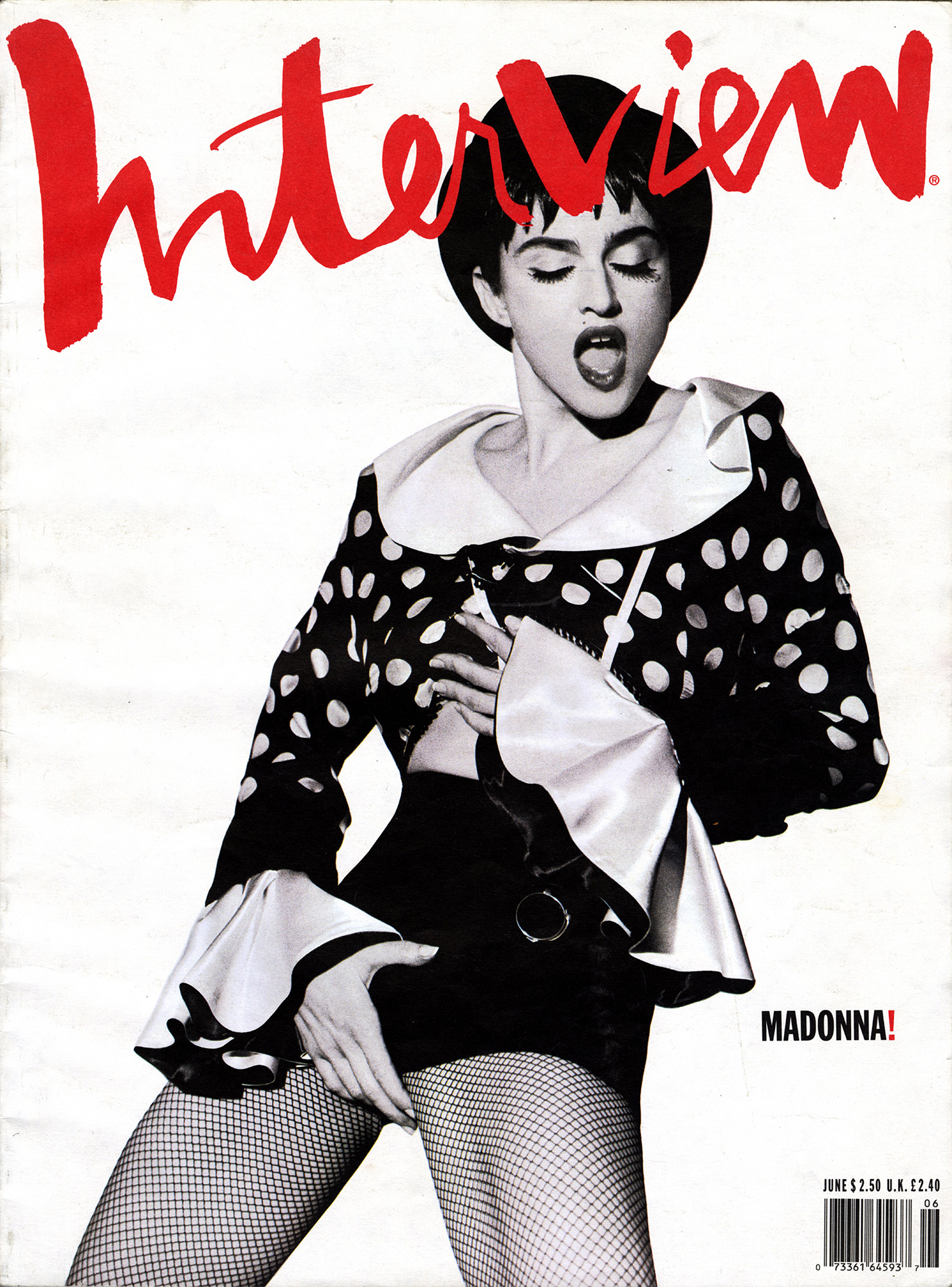
Madonna photographed by Herb Ritts for Interview.
GLENN O’BRIEN: The first time we met, I thought you were Black. You had black hair and dreadlocks and a tan.
MADONNA: I had a tan! How unusual. Oh, I think I had been to the Bahamas with Jellybean [Benitez]. That was the second tan in my whole life. Yeah, I came to your house for Thanksgiving dinner with Jean-Michel [Basquiat]…
O’BRIEN: To my dumpy apartment.
MADONNA: I can assure you that my apartment was dumpier. Anyway, I remember being hungry, but you guys just wanted to roll joints. I met your wife at Thanksgiving dinner. We’re always eating together. So let’s talk about your marriage.
O’BRIEN: No, let’s talk about your show.
MADONNA: Let’s not. Today was a horrible day. That was the worst rehearsal.
O’BRIEN: Well, I liked it, but I haven’t seen it when you thought it was good. I loved the number where you’re lying on the piano singing a torch song.
MADONNA: You saw only one segment of the show. I’ve created five different worlds, and the set is all based on hydraulics. One is going down and another is coming up. The world changes completely. I think of it more as a musical than as a rock concert. There is a straightforward Metropolis section, like my “Express Yourself” video—that set with all the gears and machinery; it’s very hard and metallic. That’s the heavy-duty dance music. Then the set changes and it’s like a church. We call it the temple ruins. It’s all these columns, trays of votive candles, a cross. I do “Like a Virgin” on a bed, but we changed the arrangement so it sounds Indian. Then I’m being punished for masturbating on this bed, which is, as you know, what happens. Then we do the more serious, religious-type material—“Like a Prayer,” “Papa Don’t Preach”… Then it changes to what you saw, this Art Deco ’50s-musical set. That’s when we do three songs from Dick Tracy, and then after that we do what I call the camp section. Then it gets really serious again and we go into our Clockwork Orange cabaret set.
O’BRIEN: What’s that?
MADONNA: It’s a very sparse set with a backdrop of an orgy—naked people. The paintings are like Tamara de Lempicka—Cubist-like nudes—no pornography, no genitals. You just see people having fun.
O’BRIEN: How long have you been working on this? It’s so elaborate.
MADONNA: Since September. Designing the stage, hiring people, firing people, hiring more people, designing the costumes with Gaultier, going over the music, changing the arrangements, picking the talent.
O’BRIEN: It’s a big operation.
MADONNA: There are seven dancers, two singers, eight musicians, me, about a zillion tech guys just to take care of the musicians, and then all the crew guys underneath the stage working everything. There are a lot of people. Probably seventy-five to a hundred. And a lot of trucks.
O’BRIEN: I heard you fired yourself today.
MADONNA: Yeah. It’s a running joke. I fire someone every day, every time something goes wrong. I fire Lenny every day. He’s the guy who opens the trap doors, and he’s always doing it at the wrong time and almost killing me.
O’BRIEN: I was sitting near your dancers; they were really funny. They were talking to your piano player, who had on a new suit. The pants were short, and one of the dancers said, “Your shoes should give a party so your pants can drop on down.”
MADONNA: The dancers are really funny. They keep me going. They’re real pranksters.
O’BRIEN: I love it when they become mermen. You seem to have a thing for merpersons.
MADONNA: Mermen, yeah. I like to switch everything around. People like mermaids; I like mermen. I like the idea of men with tails on. I like the idea of men being the objects of desire, the sirens that entrap women, instead of the other way around. Some people would say that I hate men and that I like to do things to take power away from them, but you don’t have to get that analytical.
O’BRIEN: I don’t think putting men in flimsy, marabou-trimmed negligees is taking power away from them.
MADONNA: I think it’s funny. Anyway, it’s just a takeoff. Do you think it’s offensive?
O’BRIEN: Not at all.
MADONNA: Well, a lot of people would. You’re a really evolved guy. I can assure you that people in Michigan are going to throw tomatoes at me or something because I have guys in fish tails and negligees. But I like wearing men’s suits, and I grab my crotch a lot.
O’BRIEN: But can you even tell if the audience is offended?
MADONNA: No. I just know from feedback afterward. But when I did the MTV Awards and I was smoking, I could hear people booing. I’m sure I offend people when I grab my crotch, but I really don’t care. That’s bound to happen. And I know I offend people with my videos. But I don’t hear it. I just get feedback later.
O’BRIEN: Do you ever get critical mail?
MADONNA: No. People that don’t like me aren’t going to take the time to write to me.
O’BRIEN: Really? I get mail about things I’ve written. Of course, those letters are usually from guys in jail.
MADONNA: I get letters from guys in jail all the time too, but they just want to have a date with me. Most people that don’t like me are people that are fanatically religious.
O’BRIEN: Have you ever been censored?
MADONNA: I get censored all the time. You wouldn’t believe the stuff that I’d like to do that never gets done.
O’BRIEN: But you’ve never had a video rejected.
MADONNA: No, but there was the whole Pepsi thing. They wouldn’t play my commercial because I wouldn’t take my “Like a Prayer” video off the air.
O’BRIEN: Is that why you’re drinking a Diet Coke right now?
MADONNA: I just like it. I thought MTV might not play my “Vogue” video. You can see my breasts through my dress.
O’BRIEN: Is that really a first? I mean, there are an awful lot of erect nipples under spandex on MTV as it is. I guess as long as you can’t see the dark aureole, or whatever it’s called, that’s OK.
MADONNA: I don’t know. I thought it might get censored.
O’BRIEN: You could put little animated black bars over your nipples, sort of like digital pasties.
MADONNA: Well, every time I do a video they say they’re not going to show it. When I did “Oh, Father,” they said, “We’re not going to show the scene with the lips sewn up.” And I said, “Fuck you.” And then they showed it. In “Express Yourself,” they weren’t going to show me with a chain around my neck. I don’t get their rules. I don’t know what they find offensive. Then I don’t know what’s going to happen with the video of songs I wrote for the Dick Tracy sound track. I had to change lyrics in the songs because the sound track is part of a Disney movie. I had to change things that had anything to do with sodomy, intercourse, or masturbation.
O’BRIEN: Is the movie sexy?
MADONNA: Yeah, but in a really ’50s way. It’s a really clean movie. People kiss, but they don’t have sex or go to the bathroom.
O’BRIEN: So tell us about Breathless Mahoney, your character in Dick Tracy. Do you play yourself?
MADONNA: Glenn! Do I play myself?! No! Am I a cartoon character?!
O’BRIEN: I don’t know anything about Dick Tracy.
MADONNA: No one can ever just play themselves in a movie. That’s ridiculous. Obviously there can be a lot of things in the character that are like you, but you’ve got to be a little bit inventive or imaginative. I mean, there are certain things in the character that I can relate to, but I’m not playing myself, for god’s sake!
O’BRIEN: I’m glad we cleared that up.
MADONNA: Breathless is the queen of the one-liners. She’s always cracking wise. I’m not always that way.
O’BRIEN: Beatty doesn’t have that jaw, does he?
MADONNA: He’s got the jaw he was born with. It’s a pretty nice one.
O’BRIEN: All I remember about Dick Tracy was that he had that right-angle jaw.
MADONNA: Well, Warren didn’t have any prosthetics. Me and Warren and Glenne Headly didn’t have prosthetics. Everybody else did—all the bad people and some of the good people.
O’BRIEN: On the record you play in your show, is Warren singing with you?
MADONNA: Yeah.
O’BRIEN: He’s surprisingly good. How come he never sang before?
MADONNA: Nobody ever asked him. I think he doesn’t think of himself as very musical. But he’s a very good piano player. He wanted to be a concert pianist when he was little.
O’BRIEN: You’re always playing pretty lovable characters. Would you ever want to play a villain?
MADONNA: Yeah, but I’ve never been offered one. It would also be nice to play some unsympathetic characters. God knows, I have my bad side.
O’BRIEN: How about playing a mom?
MADONNA: Oh, yeah, sure. I’m down for that.
O’BRIEN: Are you down for being a mom in real life?
MADONNA: I knew that was the next question.
O’BRIEN: I wasn’t planning it; it just popped into my head.
MADONNA: Yeah. I am. I don’t know when, but I’m down.
O’BRIEN: Who are your heroes?
MADONNA: Mother Theresa. Isn’t Gorbachev a hero?
O’BRIEN: I’d say so.
MADONNA: What about [former President Václav] Havel, from Czechoslovakia? He’s a hero.
O’BRIEN: He’s also totally into Frank Zappa and Captain Beefheart. I think he’s put Zappa on the Czech payroll as some kind of cultural consultant.
MADONNA: That’s heroic. But it’s hard to think of heroes, because not a lot of people take risks these days. I’ll probably get in trouble for saying this, but I think those guys in Public Enemy are heroes. They’re not afraid to say things.
O’BRIEN: I think that’s the case with the better rap artists in general. I think they are just about the only people who are really contributing anything on a cultural level these days.
MADONNA: Do you think Spike Lee is a hero?
O’BRIEN: Yeah, I do.
MADONNA: Me too.
O’BRIEN: Do you think how can I push things to the limit?
MADONNA: I’m sort of naturally a pain in the ass. I naturally like to do things that rub people the wrong way. No, that’s wrong. Let me rephrase that. I just like being controversial, I guess. Even that doesn’t sound right. But somehow it happens that way. It’s more like,f “Hey, well, you know how they always say things are this way? Well, they’re not! Or they don’t have to be.”
O’BRIEN: Do you write songs that way?
MADONNA: I’m starting to. Especially on my last album. And when you hear the Dick Tracy sound track, then you’ll know.
O’BRIEN: Is it political?
MADONNA: Yeah. I think my “Express Yourself” video is political too. It depends on what you mean by political. When I think of controversy, I never really think people are going to be half as shocked as they are at what I do. I really couldn’t believe how out of control the whole Pepsi thing got.
O’BRIEN: Maybe that’s just the nature of bureaucracy. They’re a huge multinational corporation with many thousands of stockholders, and you’re an entrepreneur with no stockholders. I was having breakfast this morning next to this record-company goon who was explaining to a management goon about the alternative charts and alternative radio and alternative acts. I thought it was funny that he said Lou Reed and Elvis Costello were alternative acts. I was wondering just where they draw the line. What do you think is alternative music?
MADONNA: I guess it’s music that’s not popular. I mean, alternative to what? I guess it’s supposed to be music that makes you think, as an alternative to music that doesn’t.
O’BRIEN: So what makes Elvis Costello considered alternative?
MADONNA: The fact that he’s not popular.
O’BRIEN: He isn’t?
MADONNA: He’s popular in colleges, in a cult way. He’s not popular like Milli Vanilli, right?
O’BRIEN: I guess. I’m not really sure who Milli Vanilli are.
MADONNA: You lie, Glenn! You know who they are!
O’BRIEN: I saw them on MTV once.
MADONNA: Don’t tell me that crap. Look, you know who they are.
O’BRIEN: They have a lot of hair, right?
MADONNA: Do you think I’m going to fall for that? I didn’t say you had to like them, but you know who they are. Now, they are alternative music.
O’BRIEN: Were you ever alternative? Were you ever on the college-radio chart?
MADONNA: I don’t think so. If there’s an underground disco chart, I’ve been on it.
O’BRIEN: OK, what else should we talk about?
MADONNA: Oh, please! You’re the interviewer!
O’BRIEN: People always talk about what they want to talk about anyway. Come on, help me out.
MADONNA: Help you out! Gimme a break! I’ve been working all day, honey.
O’BRIEN: Listen, it’s after midnight New York time.
MADONNA: I’ve been working all day. I’ve been working all week.
O’BRIEN: Why don’t you just tell me some good lies that can be picked up by the tabloids. Tell me about your lesbian affairs.
MADONNA: That’s old tabloid news.
O’BRIEN: It started with the nuns, right?
MADONNA: No way am I saying that. The lesbian stuff is old. I’ll have to lie about something else.
O’BRIEN: How about art? There’s a lot on your art collection in the Vanity Fair article about you. When did you start collecting art?
MADONNA: As soon as I had the bread.
O’BRIEN: What’s the first thing you bought?
MADONNA: A Robert Smithson painting.
O’BRIEN: Really?
MADONNA: You probably don’t even know who that is.
O’BRIEN: Are you kidding? I just didn’t know he did paintings.
MADONNA: The one I have is a beautiful, sort of abstract painting. But you can make out the figure of an angel in it. So I call it my guardian angel. It’s hanging over my bed in New York.
O’BRIEN: Do you believe in guardian angels?
MADONNA: I believe that someone is protecting me. Otherwise, I’d be dead. Otherwise, that guy tonight would have gotten out of his car and beaten the shit out of me. Believe me, it would have happened if I weren’t protected because I can’t resist mouthing off to people when they curse at me. One time a guy did that to me and I said, “Fuck you, motherfucker!” I wasn’t in my car; I was standing on the curb giving directions to my girlfriend. And this guy got out of his car. It was in the Valley. It always happens in the Valley. This big guy got out of his car and walked over to me, and I was thinking, “Oh, my god, he’s going to beat the shit out of me.” I was cowering. And I turned into a person I’ve never been in my life. I said, “I am so sorry! I am truly sorry!” So, I do think someone is protecting me. I don’t know if it’s an angel. It could be the Devil. He could have his own hidden agenda.
O’BRIEN: Do you believe in psychics?
MADONNA: Yeah. I believe that there are real ones and there are fake ones.
O’BRIEN: Do you have any psychic power?
MADONNA: Yeah, I do. I think most sensitive people do. I think a lot of innate psychic power has to do with just being really observant.
O’BRIEN: How does your psychic power show up?
MADONNA: In dreams. Or in knowing when people are going to call, or what people are going to say, or what they are going to do next.
O’BRIEN: Did you ever dream about being an entertainer when you were a kid?
MADONNA: No, I just had dreams about being murdered all the time. The only remotely entertainment-oriented dream I ever had was one where I dreamed I kissed Robert Redford. I was in the sixth grade. And it has not come true.
O’BRIEN: Have you met him?
MADONNA: No. I don’t really want to kiss him. It was weird. I don’t think I ever really had any fixation on him. But the dream was so vivid. I was really turned on.
O’BRIEN: So what sign are you?
MADONNA: Guess. It’s so obvious.
O’BRIEN: Uh. Uh. Uh.
MADONNA: What do I do for a living?
O’BRIEN: Uh, you sing and dance. You entertain people. OK, let’s see…Leo.
MADONNA: Yes. That’s right. Should I guess what sign you are?
O’BRIEN: Yeah. It’s fairly obvious.
MADONNA: Are you a Virgo?
O’BRIEN: No.
MADONNA: It’s obvious?
O’BRIEN: Well, it’s not that hard. Think about when we first met.
MADONNA: I thought you didn’t like me.
O’BRIEN: That happens all the time. I’m awful.
MADONNA: Let’s see. What’s an awful sign? Scorpio?
O’BRIEN: Stop! I’m a Pisces. You were close with Virgo. That’s my opposite sign.
MADONNA: I don’t know that much about Pisces. I’ve never really known any Pisces. What are their characteristics?
O’BRIEN: A lot of writers are Pisces.
MADONNA: Do you have nice feet?
O’BRIEN: No, I have big feet.
MADONNA: Don’t Pisces have nice feet?
O’BRIEN: No, they have influential feet.
MADONNA: Do they have foot fetishes?
O’BRIEN: Some do, I’ve heard. I am attracted by a nice pair of feet.
MADONNA: You know how you have a body spot that’s sensitive or powerful? There’s one for each sign. Mine is my back. I have a great back. It’s beautiful. I can say that.
O’BRIEN: Has there been any astrological pattern to your love life? Do you tend to fall for one certain sign?
MADONNA: Fire signs. I married a Leo. A lot of people in my family are Leos. My mother had a lot of us in the same month. She kept getting pregnant at the same time every year. I had my chart done once. I remember only two things from it. One was that I should eat more cooked vegetables. The other was that I was going to meet an older man who was going to be a great influence on me. And then I met Warren Beatty.
O’BRIEN: Has he been a great influence on you?
MADONNA: Yes. But I haven’t been eating many cooked vegetables. I do eat a lot of raw vegetables. How come you use two tape recorders? Are you superstitious?
O’BRIEN: No, I’m really bad at doing interviews. I recently interviewed someone for an hour and a half and the tape recorder was on “play,” not “record.”
MADONNA: He must have been a loser. Who was this person?
O’BRIEN: He’s a professor of popular culture at Notre Dame University.
MADONNA: Snoresville.
O’BRIEN: Not at all. It was very interesting to hear someone speak in complete paragraphs.
MADONNA: I’m not doing that?
O’BRIEN: No, you’re not.
MADONNA: I am so. For instance, the way I’m talking now, I’m just going to keep going on and on in a never-ending sentence and keep going on and on and then put a period on the end of it. Is that a paragraph?
O’BRIEN: No. You have to speak in complete blocks of thought.
MADONNA: I don’t know too many people like that. Warren Beatty is like that. He’s very intellectual.
O’BRIEN: Articulate?
MADONNA: Extremely. He doesn’t talk a lot, but when he does it comes out in paragraphs.
O’BRIEN: Is he a scholar?
MADONNA: I’d say that. He’s a scholar of humanity.
O’BRIEN: And you?
MADONNA: Am I a scholar? No. I’m not a scholar, I’m a sponge. I just soak things up.
O’BRIEN: You just study the videotapes of your rehearsals.
MADONNA: That’s so fucking funny! No, I don’t just study my videotapes. Yeah, yeah. That’s all I study.
O’BRIEN: I know you have a hard job.
MADONNA: I read. I’ll tell you one thing I don’t do: I don’t watch TV.
O’BRIEN: Really?
MADONNA: Never. And I have four televisions. I used to read a lot more than I do now, I’m sorry to say. I just don’t have time. There, I’ve said it again.
O’BRIEN: Well, what do you do on the plane?
MADONNA: I read magazines. I love reading magazines. It’s my vice. Junk. Not like the Enquirer…
O’BRIEN: Woman’s Day?
MADONNA: Vogue. Tatler. Details. Spy. The usual. I like Vanity Fair. It’s high-gloss gossip.
O’BRIEN: Don’t you think it’s a little negative?
MADONNA: I guess.
O’BRIEN: Usually Vanity Fair just likes English people or aristocratic felons.
MADONNA: They weren’t mean to me.
O’BRIEN: No, but you’re one of the exceptions.
MADONNA: Maybe because everyone shits on me so much they felt sorry for me.
O’BRIEN: Everybody shits on you so much? Give me a break!
MADONNA: Come on, I get a lot of bad press.
O’BRIEN: You get so much good press.
MADONNA: Yeah, but I get a lot of bad press too. I get ripped to shreds. I’ve got everybody waiting to tear me down.
O’BRIEN: Who gives you bad press? What’s the worst thing anybody ever wrote about you?
MADONNA: You know, I’m a good-for-nothing, no-talent has-been, and they can’t wait until I drop dead.
O’BRIEN: That sounds like the alternative press.
MADONNA: Oh, they hate me. People who listen to Elvis Costello hate me.
O’BRIEN: But do they write lies about you?
MADONNA: Every magazine in the world writes lies about me.
O’BRIEN: What are the biggest lies that have been written about you?
MADONNA: It’s not the big lies, it’s the little tidbits. I read about people that I’m dating that I’ve never met.
O’BRIEN: You should provide your own lies. Maybe there’s something you’d like to tell our readers.
MADONNA: Well, I am really obese right now.
O’BRIEN: Really. How much do you weigh?
MADONNA: I weigh more than Roseanne Barr. Hey, you know what? Vince Paterson, who is choreographing the show now—his mother called him from Florida and said, “Vince, is everything all right?” Vince said, “Yeah, what are you talking about?” She said, “Well, I know you’re working for Madonna now. Is she OK?” He said, “Yeah, she is fine. Why? What’s wrong?” She said, “Well, I just read that she gained fifty pounds and she’s having a really hard time working it off. She can’t do the dance steps…” It’s the silliest stuff. I must have been pregnant three hundred times in the last five years. I was dating Rob Lowe.
O’BRIEN: I was too. Are you the jealous type?
MADONNA: Are you?
O’BRIEN: No.
MADONNA: If your ex-girlfriend was dating someone, you wouldn’t be jealous?
O’BRIEN: I don’t think so.
MADONNA: Lie! Yes, you would! Everybody is.
O’BRIEN: Are you jealous of all your exes if they’re dating somebody?
MADONNA: I have a little twinge of jealousy behind my knee. I secretly want to kill them. You get really territorial over people you spent years of your life with. You don’t want anybody else to have them.
O’BRIEN: Going how far back?
MADONNA: Going as far back as I can remember. I mean, the idea that the first guy I ever slept with, my lover when I was fifteen, is married and has kids really breaks me up. I wonder if he still loves me. He probably does.
O’BRIEN: Maybe you just want to keep them all.
MADONNA: That would be nice.
O’BRIEN: I always used to think that would be ideal.
MADONNA: Do you think anybody would stand for that shit?
O’BRIEN: No, of course not.
MADONNA: But in an ideal world, where you were president, you could make it work that way.
O’BRIEN: I think Donald Trump is campaigning to be president now, carrying on—
MADONNA: With Marla? But he can’t be president if he’s had sex. That’s the rule.
O’BRIEN: No, no. It’s all cyclical. He wants to be like Kennedy, and he has to prove that he’s a womanizer.
MADONNA: It’s not cool to be like Kennedy anymore. Look at Gary Hart.
O’BRIEN: No, Gary Hart just didn’t have it. He didn’t have that aura of power.
MADONNA: You mean Donald Trump is powerful? He’s a wimp. Oh, don’t print that. I want tickets to the next Tyson fight.
O’BRIEN: I do think it’s all cyclical. You go through periods where the country wants a real solid family man, and then you go through periods where the country wants—
MADONNA: A guy with a dick?
O’BRIEN: A potentate. And then he probably gets assassinated.
MADONNA: Ow! But Donald Trump? Isn’t there anyone else? Couldn’t we get someone more handsome?
O’BRIEN: Have you ever considered running for public office?
MADONNA: I think I’ve had a fantasy about it. I’d have to hone up on a few factual things if I did that. Maybe I’m too self-centered.
O’BRIEN: But there hasn’t been a woman yet.
MADONNA: Give it time. Kim Basinger could become the mayor of that town she bought in Georgia.
O’BRIEN: That could be a conflict of interest.
MADONNA: That’s true.
O’BRIEN: But you don’t have any ambitions like that.
MADONNA: I make jokes sometimes that I’m going to run for president someday.
O’BRIEN: I think that’s a good idea. In fact, I think I thought of that.
MADONNA: That you would run for president?
O’BRIEN: No, that you would. Didn’t I write that once? Didn’t I write Madonna for president once? It sure rings a bell. I think it was my idea. You just have to wait till you’re thirty-five.
MADONNA: What are you writing down?
O’BRIEN: That line that one of your dancers said: “Your shoes should throw a party so your pants can drop on down.”
MADONNA: Is that your head, or did your neck just throw up? Do you want to know my measurements or anything?
O’BRIEN: Yeah. What are they? What size hat do you wear?
MADONNA: I don’t know.
O’BRIEN: OK, what about your other measurements?
MADONNA: Thirty-three, twenty-four, thirty-four.
O’BRIEN: Really?
MADONNA: Pretty good, huh?
O’BRIEN: I guess so. I always thought that ideally there was supposed to be ten inches’ difference.
MADONNA: Thirty-four when I’m having my period.
O’BRIEN: Do you find that all the women you work with have their periods at the same time?
MADONNA: That always happens. It pisses me off.
O’BRIEN: Why?
MADONNA: Because we’re all on the rag at the same time.
O’BRIEN: It’s a tribal thing.
MADONNA: What happens is that it screws things up. If you haven’t been with that group of people for a while, and all of a sudden you’re with them, you start your period earlier. It totally fucks up your cycle.
O’BRIEN: When you yelled at that guy in the car tonight, I think he didn’t recognize you. You seem to be able not to be recognized.
MADONNA: I got recognized about twenty times on the way over there. People just wave.
O’BRIEN: So what’s that like?
MADONNA: It’s good and bad. It means you’ve made it.
O’BRIEN: You must like it. Otherwise you’d wear a hat in the car, right?
MADONNA: Right. Sometimes it bugs me when I’m in a bad mood and I’m thinking and I’m driving my car and I look over and there’s a car full of guys and they start following me wherever I go. That’s a pain in the ass. But I could think of worse things that could happen to me. [Madonna pulls out a large bag of candy.] Do you want a piece of candy?
O’BRIEN: No, thanks.
MADONNA: I love candy, as you can see. I’m a sugar junkie. It’s because I was deprived of love as a child.
O’BRIEN: But you have a big family. Don’t they love you?
MADONNA: Yeah, I’m just kidding. I wasn’t deprived. But I wasn’t allowed to eat candy. That’s really the reason. I’ve been gorging ever since I moved out of the house.
O’BRIEN: Your brother paints Madonnas, right?
MADONNA: He paints religious figures. Religion’s been a major influence in our life.
O’BRIEN: Did you have a super-religious upbringing, or just the average Catholic home?
MADONNA: Super. I wasn’t allowed to wear tampons until I married. My stepmother said it was like intercourse. I wasn’t allowed to wear pants for a really long time.
O’BRIEN: What about your brothers?
MADONNA: You know how religion is. Guys get to do everything. They get to be altar boys. They get to stay out late. Take their shirts off in the summer. They get to pee standing up. They get to fuck a lot of girls and not worry about getting pregnant. Although that doesn’t have anything to do with being religious.
O’BRIEN: Did you ever go through an atheist period?
MADONNA: No.
O’BRIEN: You just went from Catholic to pagan.
MADONNA: Do you think I’m a pagan? That means I worship false gods.
O’BRIEN: What gods are false?
MADONNA: That’s the definition of a pagan.
O’BRIEN: That’s the Catholic definition of a pagan. I mean, I believe in the main god, the big one, and I believe in Jesus, but I believe in all the other ones too.
MADONNA: I guess I am a pagan in the eyes of Catholicism.
O’BRIEN: Do people ever ask you out on dates?
MADONNA: All the time. You bet!
O’BRIEN: Besides prisoners from jail. Do you like it?
MADONNA: Sure. It’s flattering.
O’BRIEN: What’s a good pickup line?
MADONNA: “Haven’t I seen you somewhere before?”
O’BRIEN: Does that work?
MADONNA: It depends on what they look like. But I really don’t remember anyone giving me a pickup line. Usually only jerks have pickup lines.
O’BRIEN: In your Vanity Fair article you called Oliver Stone and Andrew Lloyd Webber “fabulous misogynists.” What’s a fabulous misogynist?
MADONNA: I just like putting a nice word with a bad word. It means they’re grand in their misogyny. It’s like calling someone a charming creep.
O’BRIEN: Are there a lot of misogynists in—
MADONNA: In Hollywood? They’re everywhere, babe.
O’BRIEN: Is it as bad as it ever was? No improvement?
MADONNA: It doesn’t seem like it. It seems racism is as bad as it ever was, misogyny is as bad as it ever was, homophobia is as bad as it ever was. You know.
O’BRIEN: You’ve been in business ten years. I’ve been in business twenty years. I think some things have gotten better.
MADONNA: You have a different perspective than I have. You’re older. Like about a couple hundred years.
O’BRIEN: Yeah? I’m not as old as your boyfriend.
MADONNA: No comment.
———
JUNE 1993

Madonna photographed by Herb Ritts for Interview.
MADONNA: Hello?
MIKE MYERS: Is this Madonna?
MADONNA: Well, unfortunately, yes. [Laughs]
MYERS: How’s it goin’?
MADONNA: I’m OK. I’m getting my nails done.
MYERS: Which nails?
MADONNA: My toenails. Have you ever gotten a pedicure?
MYERS: Yes, I have.
MADONNA: Isn’t it wonderful?
MYERS: It’s heavenly. Sort of takes you back to having monkeys pick out your lice. Isn’t that a charming thing to say?
MADONNA: Where are you calling me from?
MYERS: I’m calling you from Los Angeleeze.
MADONNA: Oh, you’re in the same city I’m in. Do you live here?
MYERS: No. Robin [Ruzan] and I have rented a little house here while we’re doing Wayne’s World 2.
MADONNA: Are you nervous about getting married to Robin [this May]?
MYERS: We’ve been together for five years, so I’m not—
MADONNA: That nervous.
MYERS: No.
MADONNA: I think that everyone should get married at least once, so you can see what a silly, outdated institution it is. [Both laugh]
MYERS: Well, thank you, Mrs. Sunshine!
MADONNA: Now, what about her name?
MYERS: Her name? Robin?
MADONNA: I know. Don’t you think she should change it?
MYERS: То “Вatman”?
MADONNA: No! [exasperated]
MYERS: Yikes!
MADONNA: I’ve just always had a problem with the name Robin. Go figure. I’ll just call her Mrs. Myers.
MYERS: I’d be honored if you call her Mrs. Myers. Now, I’m supposed to be interviewing you.
MADONNA: I know, but I just have to ask you some questions, ’cause I haven’t seen you in so long.
MYERS: OK. Ask away.
MADONNA: When’s your new movie coming out?
MYERS: August. It’s called So, I Married an Axe Murderer.
MADONNA: I know what it’s called—I wanted to be in it!
MYERS: Did you?
MADONNA: Yeah, but my agents thought it would be bad for my reputation. I read the script. It’s cute.
MYERS: Оh, good.
MADONNA: Well, I’ll shell out the seven dollars for it.
MYERS: Seven-fifty, more like! Probably eight.
MADONNA: I hardly ever pay to see a movie. I just go and grovel to, like, the manager and say, “Please don’t make me wait in line, people are staring at me,” and then they let me in.
MYERS: I don’t have those problems, but—
MADONNA: You have others. We all have problems, Mike.
MYERS: Oh, you gotta second? My life sucks. Help me, man, I’m sick! [Pretends to cry]
MADONNA: We’re all sick, baby. That’s why we’re we in this business. It’s a prerequisite
MYERS: Well, the only way that I can think to interview you is to do, like, a college-newspaper interview.
MADONNA: So you ask me what my favorite color is and stuff?
MYERS: All those things, yeah. What’s your favorite toy?
MADONNA: My favorite toy? I don’t have toys.
MYERS: You don’t have Legos?
MADONNA: My favorite toy is my answering machine.
MYERS: All right, that’s a good answer
MADONNA: That’s the only thing I play with. Well, that’s not the only thing, but this is an interview. OK—next!
MYERS: What’s your favorite candy?
MADONNA: Charms Blow Pops, because they’re hard on the outside and soft on the inside. [Giggles] You can suck them or crunch them. And there’s always a surprise inside.
MYERS: [Deep voice] Paging Dr. Freud!
MADONNA: [Laughs]
MYERS: Freud was just taken out on a stretcher right now. OK. What’s your favorite dog?
MADONNA: It’s a close race between a pit bull and Johnny Depp.
MYERS: Oh-ho! Saucer of milk, table two! Meow! Bing, bing, bing!
MADONNA: Do I sound bitter?
MYERS: Nah. How about going out with Johnny Depp?
MADONNA: My name is too long for a tattoo. We could never go out.
MYERS: Ahhh. [Slyly] You know, they’re recording this.
MADONNA: Is someone listening to our conversation?
MYERS: No. Nobody’s listening to it right now, but—
MADONNA: They will listen to it. That’s the story of my life.
MYERS: It’s a little frightening.
MADONNA: That’s all right, I haven’t said anything incriminating. But I intend to!
MYERS: What’s your most embarrassing moment?
MADONNA: Right now.
MYERS: What’s your favorite picture in Sex?
MADONNA: In my book?
MYERS: Yes
MADONNA: Or in your book?
MYERS: No, I haven’t brought out my sex book yet.
MADONNA: I don’t have any favorite pictures because it happened so long ago. I’m over it. I’m on to the next thing.
MYERS: I liked the book, by the way.
MADONNA: Did you? You weren’t full of rage like the rest of the United States? [Laughs] Didn’t you think it was funny? Nobody got the funniness.
MYERS: Um, I thought it was very entertaining.
MADONNA: Excellent.
MYERS: I have a question! You know, I do a character called Dieter—
MADONNA: You do?
MYERS: Yes.
MADONNA: Well, I didn’t copy you.
MYERS: Oh, man—like, I’m calling you right now and accusing you of plagiarism? [Laughs]
MADONNA: Well, everybody else does. Some woman is threatening a lawsuit because she claims she had a book called Sex, and I apparently ruined her literary career.
MYERS: Oh, dear.
MADONNA: Oh, Dieter! How many times have you been sued?
MYERS: I’ve never been sued.
MADONNA: Just wait. One more year of being rich and famous and the lawsuits will just start rollin’ in like clockwork.
MYERS: I remember when I was sitting there with you and Roseanne, and you guys were sharing war stories. I thought, “Oh, I’d quit.” But here I am, on the job. Who do you relate to more: Barbie or Midge?
MADONNA: Who’s Midge?
MYERS: Midge was Barbie’s friend.
MADONNA: I don’t relate to either of them; I don’t relate to dolls.
MYERS: I’ll strike it from the record. Betty or Wilma?
MADONNA: Neither. I don’t watch TV. I wasn’t allowed to as a child. My father thought it was going to rot our brains. He forced us to read instead, and I’m glad he did. There aren’t that many people in this town who know who Balzac and Steinbeck are.
MYERS: OK. Which of them do you relate to more?
MADONNA: Steinbeck.
MYERS: Good, we’re making progress! You grew up in Detroit?
MADONNA: I haven’t grown up yet.
MYERS: Could you…just shut up?
MADONNA: Could I just shut up and let you answer the questions?
MYERS: Shut up, shut up and answer the questions! The Detroit Red Wings are playing the Toronto Maple Leafs in the playoffs right now. Who do you want to win?
MADONNA: I don’t really care.
MYERS: [Hushed] Thank you, Dr. No!
MADONNA: Would you ask me some questions that have a resonance to my life? This interview is mostly about what you’re interested in: toys and hockey.
MYERS: Is it more about me than it is about you?
MADONNA: Yes, but don’t you realize that all interviews are?
MYERS: More about the interviewer than the interviewee?
MADONNA: Absolutely. And all reviews are more about the writer than what they’re reviewing. They’re Rorschach tests.
MYERS: Yes, this is true. Do you believe in psychics?
MADONNA: Sometimes I believe them and sometimes I don’t, depending on how well their eyebrows are plucked.
MYERS: Have you ever contacted the spirit world?
MADONNA: Probably a couple of times when I played Ouija board. I tried to contact John Kennedy. I said, “Show me a sign,” and then the girl I was playing with, like, her mascara started running, so I was sure he was in the room with me.
MYERS: Why do I feel like I’m interviewing Sophie Tucker?
MADONNA: Because I don’t shut up?
MYERS: No, that wasn’t a slight. You’re telling very funny jokes of a political-cum-bawdy nature.
MADONNA: Is that a sexual innuendo?
MYERS: No, it was pseudointellectual discourse.
MADONNA: Oh. I can’t relate to those. Do you ever think we’ll do more than a skit together?
MYERS: Yes. It’s my goal for us to work together.
MADONNA: ‘Cause I have this idea that we should do a remake of Some Like It Hot, only with you and Garth playing the Tony Curtis/Jack Lemmon parts. Sharon Stone should play the Marilyn Monroe part and I’m gonna play the bandleader. Only I want to change it slightly. I’m going to fire the Marilyn Monroe character for being unprofessional, and then we’ll see what develops from there!
MYERS: That is one of my favorite movies. Marilyn was brilliant. She was really overweight, but really, really sexy!
MADONNA: That’s right, baby! So think about it.
MYERS: [Phony agent voice] “I’ll have my people call your people.”
MADONNA: Our agents will have lunch. Now, what street do you live on?
MYERS: Um, is this gonna be in the thing?
MADONNA: Oh, god! Who cares what street you live on is all I have to say! There’s this fun thing to do when you want to stay in a hotel under another name. You take your middle name and the street that you live on and that’s your name. So, what would your name be?
MYERS: My name would be John Mulholland.
MADONNA: [Laughs] Sounds like a movie star name
MYERS: A porno star name.
MADONNA: What’s the difference?
MYERS: We’re all porno actors, in our own way.
MADONNA: We’re all prostitutes, in our own way.
MYERS: [Slightly pretentious accent] Listen, according to Jean-Luc Godard, in his movie Two or Three Things I Know About Her, “We’re all just prostitutes, ourselves.” So what’s your pseudonym?
MADONNA: Mine is Louise Sunset Boulevard—don’t you think that’s pretty? It sounds like a movie star’s name too.
MYERS: We live really close—you should come by for sugar sometime.
MADONNA: I’d love to.
MYERS: Do you want to come over today?
MADONNA: I’m getting my nails done. Maybe I’ll drive down. Could I bring my girlfriend Ingrid?
MYERS: Ingrid can absolutely come. We’ll have coffee.
MADONNA: We’ll tawk. What color’s the house?
MYERS: It’s, um…
MADONNA: Oh, you don’t want to say that in the interview. I don’t worry about anything I’ve said.
MYERS: I’m always afraid. But you’re hugey-huge. [He tells her his exact address.]
MADONNA: All right, so now I know where to go if I don’t like this interview.
MYERS: I never interviewed anybody before.
———
MARCH 2001
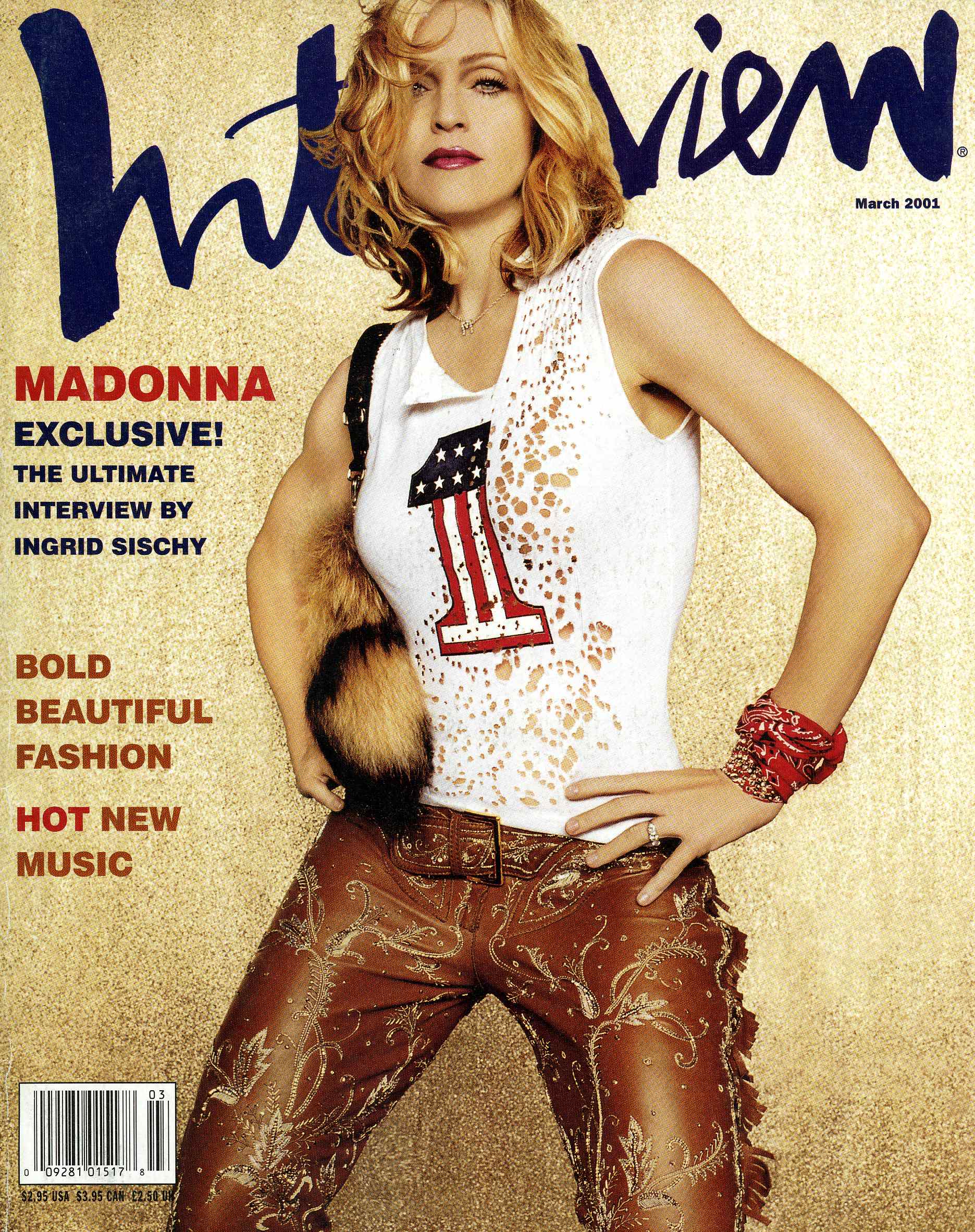
Madonna photographed by Jean-Baptiste Mondino for Interview.
INGRIS SISCHY: [The telephone rings.] Hello?
MADONNA: Hi, Ingrid. How are you?
SISCHY: Good. How are you?
MADONNA: Fine, thank you. Long time no talk.
SISCHY: I know. But before we say anything, I have to ask you something. Are you connected to the phone, or is it loose?
MADONNA: Am I connected to the phone?
SISCHY: In other words does it have a wire that goes into the wall?
MADONNA: Oh yeah, yeah. I can’t stand cordless phones. Too much static.
SISCHY: Thank the lord. Because they don’t always work with recording devices, which is what we’re using here. Anyway, Madonna, I’ve been loving Music. Congratulations on its success these last few months. And congratulations on everything else.
MADONNA: Oh, thank you.
SISCHY: So let’s get right to it. There are a number of songs on Music that I want to talk to you about. There’s “What It Feels Like for a Girl.” Can we start there?
MADONNA: Sure. I’m actually trying to sort out what I’m going to do for the video for that song, because it’s going to be my next single. My husband’s directing the video, which I’m very excited about.
SISCHY: This will be the first time Guy [Ritchie] is directing you, right?
MADONNA: Yes, it’s the first time we’ve worked together. The true test. [Laughs] I think it’s so ironic that it’s for “What It Feels Like for a Girl,” because he’s such a guy.
SISCHY: I know. I’m thinking that too.
MADONNA: He’s such a macho man and his movies are so testosterone-driven, but I asked him a long time ago which song on the album he responded to the most, and that’s the one.
SISCHY: Isn’t that interesting? It’s a song that is like a big hand that comes out and grabs you. What was going on in your life when you wrote it?
MADONNA: I wrote it kind of halfway through the album, when I was pregnant and hiding it from the world. It was a really tumultuous period in my life. I was not in a terribly stable relationship at that point, and part of the reason was because we both lived in different countries.
SISCHY: You in American, Guy in Britain.
MADONNA: It was an, “OK, I don’t want to move to England,” “Well, I don’t want to move to America” type of thing. Of course, being the girl, [Laughs] I made the first compromise. It’s that extra thing that women have. I don’t think that we’re better than men, but I believe there’s an extra accommodating chromosome that we have. I picked up my life and my daughter and everything, and I rented a house in London, and moved there and decided, “OK, well, I’ll just make my record here.” And that’s really when our relationship started to work. But it was a huge sacrifice for me, and I know he was nervous and scared about the fact that he was going to be a father. So, my life was just a roller coaster at that point. I remember going to work every day with a big coat on because I was hiding the fact that I was pregnant. I would think, “God [sighs], if people only knew.” So that’s what that song came out of: You’re pregnant, your hormones are raging, and you can’t tell anyone.
SISCHY: That’s the second time you weren’t able to tell anyone, isn’t it? When you were pregnant with Lourdes [now age four], it was during the filming of Evita, and that had to be kept under cover like a state secret too.
MADONNA: I know. It was like, “Why does this keep happening to me? Why do I have to keep hiding my pregnancies from everyone?” But, in fact, with my son [Rocco], it was for a number of reasons. Anyway, I just lived in limbo from every angle you could imagine, and I think that is also part of where that song came from, a big part of it. Then the other thing was–it’s probably the more obvious thing–that you go through life, I mean our generation certainly has been encouraged to grab life by the balls, be super independent, get a great education, follow our dreams, kick ass, all that stuff, and I feel like I woke up one day holding the golden ring and realized that smart, sassy girls who accomplish a lot and have their own cash and are independent are really frightening to men. I felt like, “Why didn’t somebody tell me? Why didn’t somebody warn me?” And that’s also what that song is about–swallowing that bitter pill.
SISCHY: It’s all right there in the lyrics—”Do you know what it feels like / for a girl? / Do you know what it feels like in / this world / for a girl? / Strong inside but you don’t know it / Good little girls they never show it / When you open up your mouth to speak / Could you be a little weak?”
MADONNA: Exactly. So, it was a combination of that, and also just feeling incredibly vulnerable that inspired the song.
SISCHY: Did you know you had something when you wrote it?
MADONNA: I just knew that I had something true.
SISCHY: So, the search is to find the true stuff?
MADONNA: Yes, the search is to find the true stuff, but also to find how to put it, because a lot of times when you find the true stuff it’s not very attractive. It doesn’t come out in a very digestible way. And if you’re trying to illuminate people, or inspire people, or wake people up to something, you know–and, believe me, I’ve learned this from other things I’ve done–you’re not going to get very far if you attack people or rub their noses in it. Anyway—
SISCHY: You know, the last time that we really had a chance to talk to each other [for a story in Vanity Fair] we were talking about having kids, and you said when you met the right person you wanted to have another kid. And get married again. And now it’s all happened. Between all the pieces that we’ve done on you in Interview over the years, and that feature, I feel like I sort of meet up with you at every chapter in your life.
MADONNA: Oh, yes. Well, a lot has happened since the last time I spoke to you, for both of us.
SISCHY: That’s right.
MADONNA: But it only took me 40 years to find my soul mate. [Laughs]
SISCHY: Did you know that this was happening when the relationship was beginning?
MADONNA: No. Not in the beginning. I knew he was a formidable human being, and a great talent with a brilliant mind, and all that stuff. But I just felt like there were too many problems. So I thought, “Well, great–I’ve just found a great friend.”
SISCHY: Then what?
MADONNA: It took a long time for me to see beyond that–and I think probably that’s why it’s worked. Because I didn’t have the usual distractions of idealistic romance and lustful longings. I’m not saying I wasn’t attracted to him, but you know, you go through all these things in your head. You go, “OK, first of all, let’s just talk about how geographically incompatible we are.”
SISCHY: It sounds like, in this case, it was a good thing.
MADONNA: It takes so long to really get to know somebody, and we had a very protracted courtship. For one year, our relationship was mostly writing to each other.
SISCHY: How great.
MADONNA: Yes, it was great. It was frustrating at the time though. I wanted to rip his head off sometimes. [Both laugh] But in retrospect, it’s a great way to get to know someone, without being distracted by how gorgeous they are or something else, because you forgive people a lot when you’re distracted by those things that aren’t as important as the other things.
SISCHY: I’m thinking that writing has had such a huge role in your life, hasn’t it? From when you were a teenager in Michigan reading Sylvia Plath and Anne Sexton in your room, right up until now.
MADONNA: Oh, yes. You have to be able to write before you can come into my room. [Laughs] I mean write me a good letter or fuck off.
SISCHY: Well, you know it’s interesting, because when I started to see the visuals that were produced for the packaging of Music [with photos by Jean-Baptiste Mondino], and then the videos, it got me thinking about you and writing, and also about you in the larger context. You once told me that when you were younger you had a romance about cowboy poet types. But, in fact, all that has evolved–you’ve married a Scotsman, and become your own cowboy poet. [Madonna bursts out laughing]
MADONNA: Yes. Totally.
SISCHY: Instead of this myth of the American West being embodied in a guy, you did it.
MADONNA: Right. I produced it myself. I just love the whole iconography of the West–the kind of sturdy earthiness of it, the earthy, rural poet. But it’s got to have an edge to it too. I think there’s something really folky about a lot of the stuff that I wrote. It’s really simple and lyrical, but then you combine it with modern technology and—
SISCHY: —you’ve got new frontiers. That’s what I’m talking about. When I see the West in an image, I always think of those photographers who went west to capture—
MADONNA: Who, people like Richard Avedon?
SISCHY: Well, I mean much earlier. Photographers like Timothy O’Sullivan, Carleton Watkins, and all those guys who wanted to capture what it stood for symbolically. You know, the sense of frontiers and wide-open space, and where America was emotionally at that point in the 19th century.
MADONNA: Yes, to me, that is the cornerstone of America.
SISCHY: Completely. And that is the history that I tuned in to when I first saw the videos and images for Music, and above all when I heard the music itself. It seems to me that the whole thing is a purely American object. It’s interesting that that’s what you did as you were falling for someone who isn’t American, and beginning to spend a lot of time outside of this country.
MADONNA: Yes, it’s strange.
SISCHY: Is it?
MADONNA: I know. Everyone thinks and writes that I’ve become a complete Anglophile. They say I’ve got no interest in America. But that’s so not true. In fact, sometimes you have to go away from something to really appreciate and see it. But no one’s ever mentioned what you’re talking about, funnily enough. It’s true, though. and how about the fact that almost everyone I worked with on the album was European. I mean there’s Mondino, who created the artwork, and there’s Mirwais [Ahmadzai] and William Orbit, [who co-produced most of the songs with Madonna], who are also Europeans.
SISCHY: But even that makes it very American.
MADONNA: It’s funny. I certainly have gone through periods of thinking, “Oh god, you know, I can’t deal with America.”
SISCHY: Well, on that subject, it’s like I don’t even need to ask the question, but I want to hear your answer.
MADONNA: To what?
SISCHY: Well, it’s obvious to me why Scotland—
MADONNA: —why did I get married there?
SISCHY: Remember, I grew up there and went to school there. I love to give Scotland a plug any time I can. [Both laugh]
MADONNA: Well, first of all, Scotland is dripping in atmosphere. It is so beautiful. And we wanted to find a place that was really hard to get to, because when people have to work to get somewhere, you know they really want to be there. It helped to sort of create an environment that was cut off from the world. You know, ultimately, I’m a romantic. And my husband and I are both obsessed with history, and we wanted to go to a place that had history. He has really helped me to appreciate the rawness and the roughness of nature. You can’t really get away from it when you go up that far north in Scotland. Really, our choice was a result of a combination of things. His family is Scottish, on his father’s side of the family, so he got to wear his family kilt, which was nice.
SISCHY: Isn’t it the most beautiful thing up there?
MADONNA: [Sighs] Please. I can’t tell you how glad I was that we made that choice. It was truly a magical religious experience—the whole week. It was very personal and very intimate.
SISCHY: It sounds like the people who you really love were there.
MADONNA: Oh, yeah. We could both really look around the room and feel that everybody was rooting for us and supporting us.
SISCHY: Nice.
MADONNA: It was. We get letters, Guy and I both get e-mails from our friends saying, “Thanks, now you’ve ruined everything for me.” [Both laugh] But you know, it was like people got to the end of the week and it was like summer camp, no one wanted to leave, no one wanted to leave each other. There was so much love, that was the thing, and we couldn’t have found a better place to do it, in this old castle in the middle of the countryside in Scotland. The Scots are great. And, by the way, nobody grassed on us, nobody; everyone looked after us. Everybody was just so trustworthy. It was like family, instantly.
SISCHY: Now, listen, one time when you have time, which doesn’t sound like the immediate future, you will be crazy about Sir Walter Scott.
MADONNA: Sir Walter Scott?
SISCHY: Have you read him?
MADONNA: I’ve certainly heard of him, but I haven’t read him.
SISCHY: Ivanhoe—it’s the most romantic book.
MADONNA: What period of time did he write?
SISCHY: Early 19th century. [He lived from 1771 to 1832.]
MADONNA: OK, I’m writing this down. Is it kind of historical?
SISCHY: It’s totally historical.
MADONNA: Oh, good, we like that.
SISCHY: Now, onward. A little birdie told me that you’re going out on tour? [Madonna’s last official tour was The Girlie Show in 1993]
MADONNA: Well, yeah, that’s the plan.
SISCHY: When?
MADONNA: This summer. I’m finally gonna fucking drag my ass in to a rehearsal studio, yeah.
SISCHY: [Laughs] I couldn’t be there on the night of the New York City listening party for Music that you did [with a Cyber Roundup Installation by Dolce & Gabbana] at Roseland last November, but a bunch of people from the magazine were there, and so were various friends, and everyone raved about it. It feels like when you hit the stage, you were back home.
MADONNA: Yes. It felt fantastic. And so did the show in London, which was even better in my opinion. You know when you have those moments.
SISCHY: Yup.
MADONNA: Oh, that’s why I do what I do, oh, right. The writing is a big part of it, but the performing is equally as big, and I haven’t done that for a really long time. Obviously, it’s the thing that made me go, “OK, I’ve got to do this, I’ve got to do this in a bigger way and for a longer period of time, with more music and stuff.” We’ll see what happens. I’m incredibly nervous about it, because—
SISCHY: —I don’t blame you.
MADONNA: You know, I never want to repeat myself. I don’t see the point of doing a show unless you offer something that is going to mind-boggle the senses. It’s not enough to get on stage and sing a song. It’s all about theater and drama and surprise and suspense. So I’m looking forward to it, but I’m also nervous about it. I’m always saying, “Can I do it? Can I do it?” It’s a massive undertaking, and now I have two kids.
SISCHY: Right.
MADONNA: No rest for the weary. [Laughs]
SISCHY: And a marriage.
MADONNA: Oh my god, please, yeah. [Both laugh]
SISCHY: So can you be specific about the plan?
MADONNA: Well, it’s on for the summer. Basically, I’m supposed to start rehearsing in April and I’m going to go out on tour from June through September.
SISCHY: America or the world?
MADONNA: America and Europe. Maybe Asia, we’ll see.
SISCHY: I’m not saying this to in any way sound fawning—
MADONNA: [Laughs] —not being a smoke blower.
SISCHY: It feels as though this is a great moment for you to do this.
MADONNA: It does feel right. It’s like when I got married. Certain things happen, and there isn’t a doubt in your mind. You know there’s going to be challenges, you know that it’s going to be a rocky road and all those things, but you also know in every cell of your body that it’s the right thing to do, so you just do it.
SISCHY: Here’s the opposite of being allowed to trust yourself with the right thing to do—the second single from Music, the song “Don’t Tell Me.”
MADONNA: Well, the inspiration for that song came from my brother-in-law, Joe Henry, who’s married to my sister. He’s one of my all-time favorite people in the whole world, and a true poet, a singer/songwriter himself. Joe Henry wrote a version of it and sent it to me. The production of it was kind of almost like a torch song in a way, like a bluesy torch song. And I just took it and ran with it and finished writing it and then Mirwais and I changed the music. But what I loved about it—I just love the defiance of it.
SISCHY: Me too. “Don’t tell me to stop / Tell the rain not to drop / Tell the wind now to blow / Cause you said so.”
MADONNA: To me, it is a romantic song. Just, you know, rip my skin off, do not tell me who I should love, or how I should love. Don’t tell me to give up. To me, in a way, it’s like that Frank Sinatra song, “If I can make it there, I’ll make it anywhere.”
SISCHY: Was “Music” the first song that you wrote for the record?
MADONNA: Actually, the first thing I worked with Mirwais on was “Paradise (Not for Me),” the second-to-last song, the least accessible and commercial song on the record. And then we sort of worked backwards, but “Music” was probably the second song. And then that set the tone for the rest of the record, really.
SISCHY: It’s that song that you’ve got two Grammy nominations for, right? [“Music,” the single, is nominated for Record of the Year and Best Female Pop Vocal Performance; in addition Music, the album, is up for Best Pop Vocal Album.]
MADONNA: Yeah, that’s right.
SISCHY: Now, I want to ask you about Britney Spears.
MADONNA: OK.
SISCHY: The reason I’m interested is that it feels like there’s more than meets the eye here.
MADONNA: Mm-hmm.
SISCHY: I’m constantly hearing people who are saying, “Well, she’s being funny.”
MADONNA: You mean being ironic?
SISCHY: Yes.
MADONNA: Well, obviously, I’m embracing it because I know it’s going to confuse people, but the true essence of my feelings for her is that I feel really protective of her. Don’t even ask me why.
SISCHY: That was my instinct.
MADONNA: I’m not going to sit here and dissect her music.
SISCHY: Right, nor do I want you to.
MADONNA: In a way, it’s not even worth it because it’s like dissecting my daughter’s music.
SISCHY: [Laughs]
MADONNA: You know, it’s just not dissectible yet. But there’s something about her. Even though she’s terribly successful, for some reason I think of her as an underdog.
SISCHY: She is. Why? I was thinking about that the other day.
MADONNA: I know it’s that weird thing.
SISCHY: I thought, “Why am I thinking that this person—who has billions of dollars and is so successful—is an underdog?” She’s a victim of a type of snobbery is what it really is. Didn’t you start to bring her up after people made fun of her on things like awards shows?
MADONNA: Totally. It’s like when you go to a party and there’s a girl, and everyone’s avoiding her because she’s really pretty, or whatever. I always want to go over and talk to that person. She is a victim of snobbery. People are going, “Oh, she’s this,” and “Oh, she’s got fake tits and blah blah blah,” and you know as soon as I see somebody getting picked on, I just want to go and, you know, talk to them at the party. Do you know what I mean?
SISCHY: Why do you think that is?
MADONNA: I don’t know. Maybe to a certain extent I can relate to it, because I feel that I was certainly a victim of snobbery when I first started. I can’t even count the number of things that I read about myself that kept dismissing me.
SISCHY: Go on.
MADONNA: And dismissing the fact that I had talent or what I could sing or any of those things. And now, I just see everybody doing it to her, so I feel defensive of her and protective of her. It’s so easy to get up and criticize people, isn’t it?
SISCHY: It sure is.
MADONNA: It’s like blah blah blah. I say you get up and do it then. You hang your balls out there. You get up and dive off the diving board, and then let me hear what you have to say. [Wearing the Britney Spears T-shirt was] a funny thing because it’s just like everything else. When you know something’s right, you just go with it. I swear to god, from the time I put it on, ’til the day I finished my promotional tour, it was my talisman. It may sound totally perverse, but it just brought me luck.
SISCHY: Speaking of young artists, are there any newcomers to Maverick [the record label that Madonna runs with her partner and friend Guy Oseary] that you want to tell people about?
MADONNA: Hmmmm, I’m thinking of all the people who are in the studio doing stuff that you already know about. Alanis [Morissette] has got a new record coming out, and Prodigy’s got a new record coming out. And there’s a Swedish singer called Amanda. She’s very young with an incredible voice. And we’ve just started a Latin label.
SISCHY: Oh, really? I didn’t know that. That’s great.
MADONNA: Yes, we did. And we’re trying to sign a band right now called Cafe Tacuba. Have you heard of them?
SISCHY: No.
MADONNA: They’re unbelievable. They’re Mexican and, in fact, there’s loads of artists that we’re trying to sign right now. There’s really so much talent, you have no idea. And it’s not like your typical kind of Latin pop thing, but much edgier, interesting stuff, things that you wouldn’t expect, kind of like the Latin version of Air, you know that French group, Air. Stuff like that. We’ve got this great guy running the Latin label down in Miami. So we’re getting that off the ground, and I’m really excited about it.
SISCHY: It sounds it. And when are you and the other Guy going to make the video for “What it Feels Like for a Girl”?
MADONNA: We’re shooting it in three weeks.
SISCHY: And you’re going to shoot that in L.A.?
MADONNA: Yes.
SISCHY: If this mini thing works out, maybe you’ll let him direct you again.
MADONNA: Oh, hey, I think he’s a genius. I’d love to work with him. I’ll be his production assistant.
SISCHY: [Laughs] I was laughing so much at the scenes with that one guy in Snatch [Ritchie’s latest movie], the kid that they have drive the stolen car. It’s a riot.
MADONNA: How lucky am I?
SISCHY: Well, he’s pretty lucky too.
MADONNA: But it’s nice to have a mutual feeling.
SISCHY: You also have some kind of mutual experience. In some ways, you work in the same worlds.
MADONNA: Well, it’s nice to be in a relationship with somebody who’s under the same amount of pressure that I’m under.
SISCHY: I’m not sure he is, but please god he will be.
MADONNA: Well, you know there’s a lot of expectations because his first movie [Lock, Stock and Two Smoking Barrels] did so well.
SISCHY: Yes.
MADONNA: And his second movie is doing so well. I think what he’s about to do next is completely different. It’s a huge undertaking. It’s a period film and it’s not what he’s been doing. He’s a risk-taker and he’s got a hungry mind, and he’s a brilliant writer. So yeah, I’d love to work with him. We’ll see what happens. Let’s just start with a video. [Laughs]
SISCHY: So listen, I don’t need to take any more of your time. We’ve covered the waterfront.
MADONNA: Good, because I have a guitar lesson.
SISCHY: Hey, thanks. And I’m going to send you Ivanhoe. See you soon.
MADONNA: OK, great. And thank you. Bye.
———
APRIL 2008

Madonna photographed by Steven Klein for Interview.
MADONNA: Hi, Ingrid.
INGRID SISCHY: Hello, Madonna. It’s our seven-year anniversary. The last interview we did together for this magazine was in March 2001, of all things. We’ve spoken since, but our last on-the-record conversation for Interview was before the whole world changed.
MADONNA: Oh, goodness. That was ages ago. Well, I hope I’ve got something interesting to talk about since then. [Laughs]
SISCHY: Me too. [Laughs] But seriously, thank you so much for doing this. I know you’re in the middle of a lot of things.
MADONNA: You’re welcome. I hear you’re leaving the magazine.
SISCHY: I am.
MADONNA: What are you going to do? .
[The two of them chat for a while]
INGRID: I’d like to start by talking about your involvement with Malawi. The event and benefit you did with Gucci at the U.N. on February 6 was really something [raising roughly $5.5 million]. I was thinking about it while I listened to your new album [scheduled to be released on April 29, with no firm title as yet], and the urgency I heard in the record, especially the song “Four Minutes,” brought the evening back. It seemed to be a vivid example of where your head is now. The piece of the intensely powerful documentary, I Am Because We Are, that you produced and was shown that night pretty much answers all the people who say the problems with AIDS in Africa are so overwhelming that nothing can help. It’s the opposite, in fact. Every little bit helps. In the film [directed by Nathan Rissman] you say: “People always ask me why I chose Malawi. And I tell them I didn’t. It chose me.” Why did you decide to document your involvement?
MADONNA: It was that I found out about the situation there. And when I went there for the first time, I saw that I needed to document my journey. More specifically, I wanted to go on a journey with these children to find out for myself what was going to make a difference in their lives and document that. Was it just about giving them a roof over their heads? Was it just about giving them food and clothes? Was it just about giving them available and accessible RAVs [antivirals]? Was it all of those things? Or was it about dealing with what was going on inside their heads and their hearts and tapping into their own sense of empowerment and resiliency? The more I went to Malawi and observed things, the more I realized that people are layered, so solving their problems is layered. The worst thing you can do to help a person is to just throw a bunch of stuff at them and run away.
SISCHY: Right, and that’s never worked with Africa, or any place for that matter.
MADONNA: No. That doesn’t work with anybody.
SISCHY: Tell us more about the film.
MADONNA: There were so many ways it could have turned out. We shot so much footage and we had so many stories to tell. And there were so many versions of the movie before we ended up with the version we now have. Some of the earlier versions were so chilling and heartbreaking that I think people felt paralyzed after watching it, and that’s the last thing I wanted to do. The other reason I wanted to make the movie—and it’s what I said at the fundraising event [at the U.N.]—is that people have become immune to the idea of raising awareness for something and getting involved. They can make a difference but you know, people are like, “Oh, there are so many problems in the world, what could I possibly do? We’re fucked. Africa’s fucked. The environment’s fucked. Whatever.” People are bombarded with problems, and they’ve become paralyzed by them. So I wanted to offer simple solutions and to illustrate how simple things really do make a difference in a person’s life. It is easy for us to be involved with the solution.
SISCHY: The film begins with a simple thing. A woman phones you. She says something like, “You’re a person with resources. People will pay attention to you. You can help.” You then say you felt embarrassed because you didn’t know where Malawi was. And she tells you to look it up on a map and hangs up.
MADONNA: Yeah. And then I went there.
SISCHY: So that call happened before you adopted your son, David?
MADONNA: Oh, yeah. All those things happened way before that. Yeah, it was a long journey. And then after I went there, I brought eight teachers from Malawi to Los Angeles, put them through a teachers’ training course, and then brought them back to Malawi. At that point, I started to meet the children and befriend them, which is how I met my son. It was a process of many journeys. All the teachers you see teaching in the movie are teachers who went through that training. Many of them have formed a network that looks after people now. I continue to stay in touch with them and they continue to teach psychosocial support to these kids and their parents. It’s amazing the difference it’s made, not only in the children’s lives, but in the teachers’ as well.
SISCHY: For outsiders, Africa’s always seemed to be a place that’s ungraspable. I remember when my family left South Africa because of apartheid. We moved to Scotland and my mother would go to the stores and ask them to boycott South African lobsters and oranges. The point back then was to put pressure on the economy so the government would have to end apartheid. The world always said it would never happen. But it did—and the leadership and inspiration of one man, Mandela, meant that the change could occur without a bloodbath. Human beings can do so much. And yet often when the subject of AIDS and Africa comes up, that same sentiment of “it will never end” pops up. Look at the beginning of the AIDS epidemic here and what people rallying around it accomplished in a few years. You and I had a lot of friends in common, like Keith Haring, who we lost. But remember that moment, about 25 years ago, when person after person was getting sick and there was no sense of the light at the end of the tunnel. Eventually it did come, and now unfortunately, the new HIV numbers are dire again in this country, too. But the point is that action helps. Of course, the scale of what we’re talking about in Africa is very different. But ultimately the stories connect. Does it feel to you as if it’s the same disease being fought in Africa as the one that changed all of our lives here in America?
MADONNA: [Sighs] That’s an interesting question. I guess it’s all the same, because what does it mean—look at the word: “disease.” There was some kind of “disease” here. And here’s some kind of “disease” there. A big part of the AIDS pandemic in Africa is connected to poverty, because there, everything comes from poverty. It’s so eloquently illustrated in the movie by Mathews Chikaonda, the ex-minister of finance, who shows the inhumanity of man to man, what people will do to one another when they don’t have anything else—whether it’s cruelty, or not disclosing that they have a disease, or practicing witchcraft because they’ve come to the end of their rope and don’t have any other solution. There are people dropping like flies there, and they can’t explain it, so for them it must be witchcraft, because how else can you explain that everyone in your village has died? Obviously it’s because somebody put a spell on them. The thing about poverty is you connect the dots and it all leads back to that. Of course, poverty is a problem in America, too, but it’s not the same as in Africa—it’s a different kind of poverty.
SISCHY: And such a different feeling.
MADONNA: That’s the other observation made, because you could say, “Wow, things are really bad in Africa. It’s hopeless. It’s never going to change.” But you get really confused when you go there because there’s so much love and so much joy and such a sense of community—yet people are dropping like flies. And we are over here with access to every kind of medication, and an infrastructure, and people are educated, and everyone’s miserable. So you’re like, “Well, wait a minute. Who do we need to save?”
SISCHY: [Laughs]
MADONNA: It’s all rather confusing. Ultimately we’re fighting the same disease, but it’s a question of consciousness and where your head is at. And for most people around the world, our heads are up our asses.
SISCHY: At the beginning of the film there’s a moment when you say, “I ended up with much more than I bargained for—about Malawi, about myself, about humanity.” Can you elaborate?
MADONNA: Well, first of all, going there thinking I needed to save people and realizing I needed to save myself; that the world I come from is actually full of disease and full of despair and full of unhappiness. Who has it right and who has it wrong and where should I be focusing my energy? And realizing that I cannot, as a mother and as a human being, watch children dying who don’t need to die, or watch them suffering in a sort of intense way—the kinds of things that you witness in places like Malawi. But on the other hand, it’s helped me to look back at myself, at my own life, my own community, my friends, the world I live in, and see how broken we are and how we’re all in the same boat—it just looks different.
SISCHY: In the new album, with the song that says, “You’ve only got four minutes to save the world,” you have this other lyric, “Sometimes I think what I need is a you intervention.”
MADONNA: Yeah, meaning, sometimes I think you need to save me. In many ways, going to Africa and having the experiences I had gave me such an incredible outlook and such an appreciation that I didn’t have before. I kind of went through it when the whole AIDS thing first hit New York and I was watching all my friends drop like flies. Suddenly you go, “Oh, my god, life is precious and what am I complaining about? I’m alive.” But you forget. You just forget. We live very comfortable lives and, unfortunately, we have to have our noses rubbed in other people’s pain and suffering to realize how much we have and how much we have to be grateful for, and to tune into that frequency of appreciation. We have to do it on a regular basis.
SISCHY: In 1982, ’83, ’84, in America and Europe, AIDS changed all of our lives forever. We knew it. And yet it was going on everywhere else,too, of course. But many countries, even continents, were denying it. How terrible that it took so many decades for so many people to become conscious of the situation in Africa. Tell me, how did you choose the director for your film?
MADONNA: He used to be my gardener. [Laughs]
SISCHY: Really? So he knows what to do with seeds.
MADONNA: Yeah. His name is Nathan Rissman. He’s a brilliant, lovely guy—one of those guys who came into my life and did every job. He was a runner, an intern, a gardener. He took care of my kids. He did everything, and he did it with humility. And everyone just grew to love him. And then he started doing these little movies of my children and sending them to me, and making films out of photographs and just being really creative. So one day I said, “I need somebody to document this,” and then I looked at him and I said, “And I think that person is you!” And he really stepped up to the plate. Another one of his many gifts is that everyone loves him, and he’s very good at winning people’s trust. He cares deeply about everybody in the film, and he’s spent a lot of time in Malawi, literally sleeping on the floors of people’s huts and waking up with chickens on his head. He really lived it and approached it with an open heart and so much gratitude. And I think that really comes through in the movie as well-the way he films people.
SISCHY: Especially the kids.
MADONNA: Yes, and he gets their stories. People opened their hearts to him. I couldn’t have done that. I don’t have his simple approach. He did an amazing job.
SISCHY: I also love the aesthetics of it—it’s almost like William Eggleston’s photographs of the American South, in terms of the lush palette.
MADONNA: Yeah, the way he captured the exterior, with the rolling hills and the trees.
SISCHY: You can really smell Africa looking at it. And you’ve got some big shots in there too—President Clinton, Desmond Tutu.
MADONNA: Jeffrey Sachs, Paul Farmer. They’re all amazing. I’m so lucky to have them in the movie.
SISCHY: How did you do that? Did you just phone ’em up?
MADONNA: I phoned them. I wrote copious letters. I met with them. I showed them the footage.
SISCHY: You always were a letter writer.
MADONNA: Yes. Some people said “yes” more quickly than others. Some took a lot more coaхing and several dinners and—
SISCHY: Did you have to do any benefits?
MADONNA: [Laughs] No. No sexual favors either. [Both laugh] But I had to be a producer and to convince people because they are like giants to me. They’re all really busy and everybody comes to them and asks them to say something in their documentary, so why should they do it for me? But I feel very blessed that they all agreed to it. And I think they all say something important. They all have a big part of their lives invested in Africa.
SISCHY: Let’s talk about your youngest child, David. He is Malawian and—
MADONNA: Yes, and I promise you, he wouldn’t have lived if I hadn’t taken him. It’s not even a possibility.
SISCHY: Your other two children have had the opportunity to be children, and as you were making this film, I’m sure you saw so many kids who never have had that chance—in the film you talk about kids being raped, kidnapped, beaten, kids having to function as parents for their little brothers and sisters because their mothers and fathers are dead. David’s reality began so differently from that of Lourdes and Rocco [Madonna’s other children]. How does it affect them that their little brother comes from this place where kids don’t get to have a childhood?
MADONNA: I think it’s essential that they understand it and know it. The last time I went there, my daughter came with me. She spent several weeks working in the orphanages, particularly one with newborn children, and most of them were HIV-positive. She so came into her own and was so responsible and stayed for eight hours every day and worked tirelessly. I thought, “Why am I babying her so much? She’s capable of so much more.” We don’t let kids do anything. We think, “Oh, they’re kids—they can’t take care of other kids; they can’t do this; they can’t do that.” And after you go to Africa, you drop all that silliness.
SISCHY: So many kids are the parents there.
MADONNA: Absolutely. It made me see how tough and resilient kids are and how little credit we give them for that. And it made me understand the importance of my children seeing and experiencing that on a regular basis, so that they understand they breathe rarified air, and that it’s their job to share what they have with other people.
LIZ ROSENBERG [Madonna’s publicist]: [Shouting from the background] Okay, five minutes, ladies.
SISCHY: No! She’s joking.
MADONNA: [To Rosenberg] She said, “No, you’re joking.”
ROSENBERG: [From the background] No, I’m not joking.
SISCHY: No, no, we—tell her we haven’t started on the album! There’s no way!
MADONNA: [To Rosenberg] It’s okay. [To Sischy] Don’t worry, she just left.
SISCHY: There’s no way!
MADONNA: Okay.
SISCHY: To me, you have always stood for freedom: freedom of expression, freedom to do what you want, to dress the way you want, to sing what you want. The fight in Africa is less about the freedom to something and more one from something—the freedom from fear, the freedom from hunger. Has that affected your understanding of freedom?
MADONNA: [Sigh] Well, I think freedom is a funny word because when we think we’re free, we’re not really. I think freedom is quite illusory. When you’re worrying about where your next meal is going to come from, you can’t afford to think about your attachments to physicality. You can’t start thinking about your ego. You’re just like, “I need some food. And I need a roof over my head. And I’m sick and I need medicine.” When you’re in that position, you don’t have the luxury of thinking about the freedoms that we have, so that’s one kind of freedom. When you live in the world that we live in, and you have the luxuries that we have and the privileges that we have, you don’t have to worry about basic needs and you can start thinking about, What am I slave to? What am I trapped by? Am I really free? Just because I can get on a jet and fly wherever I want and I can afford this and I can afford that—is that real freedom? It’s like I said in my speech at the fundraiser, “What is being the best? What is real happiness?” When I stoр caring what people think of me, I’ll be able to say, “Well, I’ve learned to care less, but I’m not totally free of it.” That’s freedom. When I stop thinking about myself all the time and put other people before me on a regular basis, that’s real freedom. When I can love unconditionally—and I have conditions with everybody, whether it’s my husband or my children or my friends or my co-workers—then that’s real freedom. So it’s something to strive for, but I’m not free.
SISCHY: Your lack of freedom certainly doesn’t show in the new record. Let’s go back to the song “Four Minutes.” Justin Timberlake and Timbaland had something to do with it, right?
MADONNA: Yes, we worked together.
SISCHY: The song feels like a ballad for the world, with a great big marching band. It’s a giant dance song.
MADONNA: Well, it’s kind of a funny paradox. It’s like we’re saying, “We’re running out of time. People, wake up. But, if we are going to save the world, can we please have a good time while we’re doing it?”
SISCHY: [Laughs] That’s great. And the video, I understand, plays with this idea of superheroes trying to save the world. It feels like it has irony, but it’s also really serious.
MADONNA: Yeah, it’s like a march. It’s a movement, and we want to take everybody with us.
SISCHY: This song will. I love the line “the road to hell is paved with good intentions,” in the middle of it all. Did you have fun making it? It really feels like it.
MADONNA: I really enjoy writing with Justin. He’s a fun person to write with.
SISCHY: Is this the first song you did with him?
MADONNA: No. We worked on other songs first. We kind of had psychoanalytic sessions whenever we wrote songs. We’d sit down and we’d start talking about situations. And then we’d start talking about issues or problems or relationships with people. That was the only way, because you know, writing together with somebody is very intimate. So we had to find a place to start talking about something we cared about, so we could get into writing about something we cared about. And that was fun, because he’s open and he’s got talent. He’s a songwriter. I haven’t worked with a lot of songwriters where I’m instantly connected and start riffing and playing with the rhythm of words. He’s as interested in the rhythm of words as the meaning of words.
SISCHY: I love the tic-toc, tic-toc part.
MADONNA: I enjoyed that process with him.
ROSENBERG: [In the background] Next question!
SISCHY: Tell her we’ve only done one song. We gotta have four more questions.
MADONNA: [To Rosenberg] She’s only asked one question about the record. She wants to ask four more questions.
ROSENBERG: [In the background] Well, she gets one more.
MADONNA: [Sighs] She’s very mean. [Both laugh] So, go ahead, ask me another
SISCHY: Okay. Let’s go to “Give It to Me.” I picture the entire island of Ibiza dancing to that one.
MADONNA: Oh, really? Oh, good. I like the idea of everybody in Ibiza dancing to “Give It to Me.” [Laughs]
SISCHY: For me, it’s a real Madonna song.
MADONNA: It’s very anthemic. I basically wrote it so I could have a great time doing it in a stadium.
SISCHY: The words are very autobiographical. “Got no boundaries, got no limits.”
MADONNA: “If there’s excitement, put me in it.”
SISCHY: “Don’t stop me now.”
MADONNA: Yeah.
SISCHY: “If it’s against the law, arrest me.”
MADONNA: [Laughs] Yes, that’s me. It’s the provocative me. The boring, predictable me.
SISCHY: One doesn’t hear people saying “arrest me” these days, I’ve got to tell you.
MADONNA: Not in pop culture, anyway.
SISCHY: More often it’s about “Give me some money.”
MADONNA: It’s about playing it safe.
SISCHY: Speaking of playing, is that you playing the guitar?
MADONNA: I wish. No.
SISCHY: Not in any of it, because I thought in “Miles Away”—
MADONNA: On “Miles Away,” I did play the guitar, but I got double-tracked by one of Timbaland’s musicians.
SISCHY: Is “Miles Away” autobiographical?
MADONNA: Probably, in many respects, most of the songs are. But in more of an unconscious way. I don’t really think about telling personal stories when I’m writing music. It just comes. And then a lot of times, six months later, eight months later, I go, “Oh, that’s what I wrote that song about.” But that’s when I play the song for lots of people and they all go, “Oh, I can totally relate to that.” In “Miles Away” I’m tapping into the global consciousness of people who have intimacy problems.
SISCHY: There’s a real sense in this record of the joy that comes from music and from dancing. Take “Heartbeat.” The pleasure of dancing all night is all over it.
MADONNA: To a certain extent, it’s an homage to the beginning of my life as an artist. Everything always comes back to dance. And music. ‘Cause you can’t dance without music. But that is how I feel. In Africa, everybody dances and everybody plays music. There is something universal about it. There’s something freeing about it. There’s something unifying about it. When people are busy making music and dancing, they’re kind of too busy to hate and fight. Music is one of the great unifiers.
SISCHY: Have you ever reached a point where you’ve said, “Fuck it. I’m not going to make another record”?
MADONNA: Oh, I say that after every record. And then I do another one.
SISCHY: Do you feel good about this record?
MADONNA: I do, yeah.
ROSENBERG: [In the background] Ingrid.
SISCHY: Last one.
MADONNA: [To Rosenberg] She says this is the last one.
SISCHY: Last question. Back to the sense of urgency of the record. You hear it again in “Beat Goes On.”
MADONNA: [Laughs] There was a big sense of urgency. Kanye [West] only had four hours. I had to finish it before he had to catch an airplane. [Both laugh] But you know what? Right now, I’m operating in the mode of “live every day like it’s your last day.” So there’s a sense of urgency in everything I do.
———
MAY 2010

Madonna photographed by Jean-Baptiste Mondino for Interview.
GUS VAN SANT: Hey, Madonna.
MADONNA: Gus, is that you?
VAN SANT: Yes. I’m at my house in L.A., just reading the paper.
MADONNA: Are you living in L.A. now?
VAN SANT: I still live in Portland[, Oregon], but I have a place in L.A., and I’m starting to work on this film down here.
MADONNA: You’re always working on a film.
VAN SANT: Usually.
MADONNA: But that’s what you do.
VAN SANT: It’s my habit. [Laughs] I heard you’re going to Africa.
MADONNA: Yeah. I go to Malawi twice a year. It’s where two of my children were adopted from, and I have a lot of projects there that I go and check up on and children who I look after. It’s sort of a commitment that I’ve made to this country and the hundreds of thousands of children there who have been orphaned by AIDS. I made a documentary about it [I Am Because We Are], and it’s just become part of my life. I’m going to meet with Jeffrey Sachs [the economist]. I’m sure you’ve heard of him. He’s starting a global education initiative, and I’m going to be his Girl Friday, so to speak. We’re going to hold a press conference to talk about the school for girls that I’m building in Malawi. It’s kind of our way of making sure that every kid has a chance to have an education—more specifically girls, but boys as well. Girls, though, in a lot of developing countries, don’t have the opportunity to go to school, nor are they encouraged to go to school, so what we’re doing is the beginning of a dream. But I’m going to Malawi for lots of reasons.
VAN SANT: You’ve done a lot of work with Jeffrey Sachs already, haven’t you?
MADONNA: Yeah. We’ve been supporting each other for years now. I’ve worked on some Millennium Villages with him. We have two Millennium Village sites in Malawi, and they’re both doing very well. He’s an incredible human being.
VAN SANT: I’ve never met him, but I’ve heard he’s very charismatic.
MADONNA: He’s extremely charismatic. Very well-spoken and charming. He’s one of the few people I know who talks the talk and also walks the walk. He thinks very big.
VAN SANT: What’s the economic theory behind the Millennium Villages?
MADONNA: Well, his work is primarily focused on ending poverty, but you know, there are lots of ways to skin the cat. Millennium Villages are an experiment that he has tried all over the world. It costs a certain amount of money, and it takes a certain number of years for them to work, but he’s got it down almost to a science, where for $1.5 million over a five-year period, you can make a series of interconnected villages self-sustainable through education, and prepping, and diversifying their crops, and giving them agricultural tools, and medicine, and knowledge. Jeffrey has been really supportive of all the work I’ve done in Malawi. So, yeah, we’ll be drinking a gin and tonic and swatting away the mosquitoes down there. By the way, Milk was such a brilliant film. I cried and cried. I loved it.
VAN SANT: Oh, great. Thanks.
MADONNA: Did you like working with my ex-husband? [Laughs]
VAN SANT: I did. Sean [Penn] was amazing.
MADONNA: He is amazing.
VAN SANT: I haven’t really caught up with Sean since he’s been going to Haiti. I mean, it’s incredible, what he’s been doing.
MADONNA: Yup. He’s got a fire under his ass, that’s for sure. A bee in his bonnet.
VAN SANT: When I called him to see whether he would play the role in Milk, he took half a second to say yes. I guess he knew the elements were there.
MADONNA: I could see why he would be attracted to the role and be able to say yes in two seconds. Watching Milk was such a trip down memory lane for me.
VAN SANT: Yeah? Did you go to the Castro a lot?
MADONNA: I did when I was younger. But you know, what the movie triggered for me was all my early days in New York and the scene that I came up in—you know, with Andy Warhol and Keith Haring and Jean-Michel Basquiat and Kenny Scharf. It was just so alive with art and politics and this wonderful spirit. So many of those people are dead now. I think that’s one of the reasons I cried. In fact, the character that Richard E. Grant plays in the film I directed, Filth and Wisdom, is this blind professor who was based on my ballet teacher, Christopher Flynn. Growing up in Michigan, I didn’t really know what a gay man was. He was the first man—the first human being—who made me feel good about myself and special. He was the first person who told me that I was beautiful or that I had something to offer the world, and he encouraged me to believe in my dreams, to go to New York. He was such an important person in my life. He died of AIDS, but he went blind toward the end of his life. He was such a lover of art, classical music, literature, opera. You know, I grew up in the Midwest, and it was really because of him that I was exposed to so many of those things. He brought me to my first gay club—it was this club in Detroit. I always felt like I was a freak when I was growing up and that there was something wrong with me because I couldn’t fit in anywhere. But when he took me to that club, he brought me to a place where I finally felt at home. So that character in Filth and Wisdom was dedicated to him and inspired by him. I don’t know why I’m bringing all this up, but I guess it’s just coming from that world in Michigan and the trajectory of my life: after going to New York and being a dancer when the whole AIDS epidemic started and nobody knew what it was. And then suddenly, all these beautiful men around me, people who I loved so dearly, were dying—just one after the next. It was just such a crazy time. And watching the world freak out—the gay community was so ostracized. But it was also when I was beginning my career…I don’t know. Your movie really struck a chord for me and made me remember all that. It’s a time I don’t think many people have captured on film. It’s a time that people don’t talk about much. And even though there was so much death, for me, New York was so alive.
VAN SANT: It’s amazing that you had a person like that in your life who was such an influence.
MADONNA: Thank god! Otherwise, I don’t know if I would’ve gotten out of Michigan. I think it was Christopher and my Russian history teacher, Marilyn Fellows. The two of them, I think they were a conspiracy that god sent to me. The conspiracy of angels that gave me the confidence and helped me turn my lemons into lemonade, if you know what I’m saying. Because when you grow up in a really conservative place and you don’t fit in, it’s kind of hard… You can go one way or the other.
VAN SANT: I had a chance to watch Filth and Wisdom. It’s a really intimate and contained piece of work. I was really surprised by it. I didn’t know what to expect.
MADONNA: Yeah, I’m sure. I guess it is intimate. I never thought of it like that. It’s kind of a small story. But really, if you break it down, it’s about the struggle of being an artist. I feel like the three main characters in the film are basically me.
VAN SANT: Are they?
MADONNA: Or aspects of me, yeah. I was fortunate enough to meet Eugene [Hiitz], the Ukrainian who plays the lead. When I started writing Filth and Wisdom, I didn’t know him, and the character he eventually played was going to be a struggling actor who was cross-dressing to make ends meet. But then, when I met Eugene after I saw him in another film, I found out he was in a band, Gogol Bordello. Then I started stalking him. [Laughs] I was like, “Oh god, he’s amazing. I’m going to make the character a struggling musician instead.” I thought it would be more interesting.
VAN SANT: What film did you see him in?
MADONNA: I saw him in a film that Liev Schreiber directed called Everything Is Illuminated [based on the novel by Jonathan Safran Foer]. Eugene was my favorite thing in the movie, and I became kind of obsessed with him. I wrote a part for him in my script for my new movie, in the part of a security guard who is a Russian immigrant living in Brooklyn and working in Manhattan. Eugene inspired the part—in fact, the character’s name is Evgeni.
VAN SANT: Is that script W.E.?
MADONNA: Yeah, the movie everyone thinks I’m making that’s supposed to be a musical about the Duke and Duchess of Windsor. I don’t know why that got in the newspapers. The Duke and Duchess of Windsor are in the movie, but it’s not going to be about them. It’s really about this other woman’s journey, and the duchess is kind of her spiritual guide.
VAN SANT: So it’s set during which period?
MADONNA: It’s set mostly in pre-World War II England—like, 1936 to 1937—and then in New York in 1998. It goes back and forth in time. I use the Sotheby’s auction in 1998 of the Duke and Duchess of Windsor’s estate as a device to flash backward from.
VAN SANT: Oh, fantastic.
MADONNA: Fantastic and complicated. [Laughs] I didn’t realize it when we were writing the script, but once I started casting and planning and working with my production designer, I went, “Oh, fuck. I wrote a script about a bunch of rich people. That’s going to be great for the budget.” The duchess has, like, 80 costume changes. She was dressed by Balenciaga and Christian Dior and Vionnet and Schiaparelli. Cartier and Van Cleef & Arpels made most of her jewelry. A lot of the actual stuff is in museum archives. They’re not going to give it to me. But a lot of these couture houses have offered to make stuff for me. Do you know Arianne Phillips?
VAN SANT: I’ve never worked with her, but I know her work.
MADONNA: She’s doing my costumes. I mean, just the costumes alone are pretty daunting because the Duke and the Duchess were both real clotheshorses. And then there’s the auction itself—they auctioned off more than 40,000 items, a lot of which was clothes and jewelry and shoes and handbags and whatnot. So there’s a lot of fashion in my movie, although it’s not really about that.
VAN SANT: So you’ll have to make some things and cobble the rest together.
MADONNA: Yeah. It’ll be a combination of real vintage pieces, others we’ll get remade based on patterns that have been dragged out of the archives, and then new stuff we’ll make. Next time, I’m writing a movie about one person in one place who has no wardrobe. [Laughs]
VAN SANT: When did you start writing W.E.?
MADONNA: I’ve been writing it for the last two and a half years, to tell you the truth. It’s been kind of an obsession of mine. I started writing it when I finished filming Filth and Wisdom. It was actually an idea I had before that, but I made Filth and Wisdom because I realized that I didn’t really have a right to make a bigger film until I made a smaller film—and learned how to make a film.
VAN SANT: And this new one is going to be bigger, obviously.
MADONNA: Well, it’s a bigger story. There are more characters, and three of them basically changed the course of English history. King Edward VIII abdicated the throne to be with an American woman, Wallis Simpson, and that’s part of my story, so I’ve had to do an enormous amount of research and interview people. So I have an enormous responsibility to that, and then I have a responsibility to the actual auction, which really happened. Then there’s the new story, the point of view, which is this girl who has this obsession and is going to the auctions and stuff. So it’s a much more layered, complicated piece than Filth and Wisdom.
VAN SANT: One of the interesting things that I’ve heard about King Edward VIII and Wallis Simpson was their social circle. Will you have some of that in the film?
MADONNA: Yes, of course. They’re a very controversial couple. People have lots of different notions about them. I mean, the guy, Edward, gave up the most powerful position in the world for this woman. For the British, he was the most beloved prince and king in a very long time—he was called the People’s Prince. He was very popular. So the fact that he abdicated his throne left many people devastated, and of course they had to demonize Wallis. They said it was all her fault and blamed her for singlehandedly bringing down the British Empire because, of course, the monarchy was never the same again, which actually had a lot to do with the fact that everything changed completely after World War II. But people have accused Wallis of all kinds of things. They’ve said that she put a spell on Edward. They’ve said that she was a hermaphrodite and that he was gay. They’ve said that they were Nazi sympathizers. It’s just the usual lynch-mob mentality that descends upon somebody who has something that lots of other people don’t have. They have to diminish you by saying there’s something wrong with you, or accuse you of something that they really don’t have the knowledge or the right to.
VAN SANT: So they made the decision to be a couple.
MADONNA: Yeah, but love isn’t enough, really. So it’s been an interesting journey, trying to find out about them. In England especially, I’ve found that if you bring up King Edward VIII and Wallis Simpson at a dinner party or a social gathering, it’s like throwing a Molotov cocktail into the room. Everyone erupts into an argument about who they were. I mean, they were very controversial—and continue to be. So of course, I’m very attracted to that.
VAN SANT: That’s a fantastic subject.
MADONNA: Their lives were absolutely crazy. It’s as much about the search for love and the meaning of happiness as it is about the cult of celebrity, really. It’s all kind of mixed up in one big stew.
VAN SANT: You wrote the script with Alek Keshishian
MADONNA: Yeah. I started writing it on my own, and then I realized that I needed help. It’s just too big a subject. I quite like the idea of collaborating in general. Not only is it lonely to do things on your own creatively, it’s also kind of arrogant. I guess some people are brilliant enough to be brilliant on their own and never doubt anything and come up with fabulous things. But I think it’s good to get into arguments with people and have them say, “That sucks” or “You’re crazy” or “That’s cheesy” or “What do you think of this?” If anything, it helps you understand what you believe in and what you’re passionate about and what is shit. I think it’s important to have a sounding board. I’ve known Alek for years, and we have a weird kind of brother-sister relationship. One minute we’re hugging each other and crying on each other’s shoulders, and the next minute we’re slamming the door in each other’s face and not speaking to each other for a month. [Laughs]
VAN SANT: When you’re writing together, is it a situation where you’re actually in the same room?
MADONNA: Oh, yeah. I mean, we’ll be in the same room, but we also do chunks of things on our own and e-mail them to each other, or we do stuff over the phone, or sit together and take the computer off each other’s laps, or we’re disgusted with how slow the other person is typing… So it works in a lot of different ways.
VAN SANT: When you’re actually writing, do you have any kind of regimen where you write during the day or at night?
MADONNA: I tend to write during the day so I can see my children at night. But if my kids aren’t with me and I have a chunk of time when I’m a single woman living in my house for a miraculous week, I will get to write at different hours. I mean, we’ve burned the candle. We’ve stayed up all night. We’ve done it every which way. But generally, we schedule chunks of time to be together and work on it.
VAN SANT: You’re just starting to fill out the cast?
MADONNA: Yeah, I’m casting. When I get back from Africa, I will officially begin preproduction.
VAN SANT: To shoot this summer?
MADONNA: Yeah. Yikes.
VAN SANT: I know. It’s hard, isn’t it?
MADONNA: Very hard. I don’t know what it’s like for you, but for me, making a movie, before you start filming and you’re in the trenches, it just seems like this process of pushing—of working through all of these people saying no. It seems like the whole world is against you. I’ve never had that experience before, because making records and putting my shows together—except at the very beginning of my career—I’ve never really experienced much resistance. I just find the people I want to work with and put it all together, and it’s a lot of hard work and all kinds of catastrophes happen, but I don’t really get too much resistance. But when you make a movie, it seems like there’s nothing but resistance. It’s kind of a miracle that any movie ever gets made. Every other day, it’s like, “What am I doing? This is insane. I could be off gardening right now. This is too stressful. Who do I think I am? Why am I putting myself through all of this punishment?” That’s what it feels like—for me, anyway.
VAN SANT: I’ve told people who have just started to make a film that the one thing you might experience is this feeling that everybody is conspiring against you, because you’re not necessarily able to tell what’s real and what’s not. There are all of these messages that you get through third parties that say, “You can’t get that location. You can’t shoot at Yankee Stadium.”
MADONNA: “That actor is not really available except for these three weeks.”
VAN SANT: Yeah. And it’s too hard for you personally to take care of it because there are too many things going on at the same time. It’s almost like torture.
MADONNA: It’s torture for me, because I want to personally go to all the people who are saying no to me and say, “Can’t we just work something out? Why can’t I shoot at your castle? Why can’t you make 30 outfits for me and not charge me? Why do you want to work with Martin Scorsese when you can work with me?” [Both laugh] It all seems to be an exercise in acceptance, doesn’t it? When do you give in? When do you let go and stop trying to control everything? Filmmaking is such a collaboration. At a certain point, I suppose you do have to let go and trust the people you’re working with. I look at movies like Wong Kar-Wai’s films, and they all have such a family-like feeling about them. He just keeps working with the same actors and art director and DP, and the stories don’t change that much. There seems to be this familiarity there that must be such a nice luxury.
VAN SANT: Wong Kar-Wai is a really great inspiration. He’s always referred to as the Jimi Hendrix of filmmaking.
MADONNA: What does that mean?
VAN SANT: It means that he’s so loose and familiar with his craft that he can sort of do anything.
MADONNA: I was actually watching In the Mood for Love again last night because I love the music. And I mean, how overused is slow motion in film? But, for some reason, he gets away with it. Every time the characters pass each other on the stairs, there’s that same piece of music. It’s so beautiful. He has these two married couples living next door to each other, and you never see the wife of one couple or the husband of the other, but you always hear them talking. And it’s not so much of a story, but you’re so sucked into it. It’s something to be envied. While the stories seem simple, you really end up feeling kind of devastated and moved and melancholic every time you watch one of his movies—well, I do, anyway.
VAN SANT: I do too.
MADONNA: But maybe there’s something wrong with me. Maybe I’m just a sucker.
VAN SANT: No, I think they’re very strong films. Who are you using as a DP?
MADONNA: Hagen Bogdanski. He did The Lives of Others. Did you see that film?
VAN SANT: Oh, yeah. It’s amazing.
MADONNA: He also did The Young Victoria, so two different looks. But I think he’s brilliant.
VAN SANT: Because the DP who I’ve been using for many films is someone who has a connection to you. I was making a commercial for Levi’s several years ago, and the art director said that they had just worked with Harris Savides, and they were sort of pushing him on me. They said, “Madonna doesn’t work with anyone else.” So I went, “Well, shit. If Madonna won’t work with anyone else…”
MADONNA: I worship Harris Savides. He’s too expensive for me. I adore him. I’ve worked with him a lot. He’s the best. It’s interesting though, because my film is essentially an English production, and I’ve been instructed to use people who live there—or at least in Europe. We’ll film mostly in England, a bit in France, some in New York. But Hagen seems brilliant and collaborative—so far, so good. Are you working with Harris on your next film?
VAN SANT: Well, there’s a film that I’m mixing right now. It’s called Restless. We shot it in November and December, and Harris was the DP. I’ve worked with him on a bunch of films now. Seymour Stein [the record executive] was somebody I got to know a teeny bit because he helped with the soundtrack for Even Cowgirls Get the Blues [1993]. Was he somebody—
MADONNA: Who was a really important, influential person in my life? Oh, my god. Yeah, of course. He believed in me. Seymour Stein is the person who signed me and gave me my first record deal, which was my only record deal—I stayed at Warner Bros. until five minutes ago. He listened to my demo. He was in the hospital, and he had me come in to visit him. He was hooked up to all these weird devices—I don’t know what was wrong with him. But he made me bring my boom box and play my music for him. He was laying there in bed in his boxer shorts and a wife-beater. But he was always my champion during the first decade of my career. So he’s also a very important character. I mean, I guess we all have champions, but I feel blessed and lucky to have had the ones that I’ve had. I still run into Seymour Stein from time to time. I see him around. He’s still got that naughty twinkle in his eye.
VAN SANT: I remember that he’d start to talk about music or something and he’d start crying.
MADONNA: Oh, I know. He’s such a music lover—an art lover. I remember he had these insane paintings—this vast collection of art—and the pieces were all just sort of jumbled on top of one another and leaning against the walls in his labyrinth-like apartment. He’s a character. It’s curious, because it seems like those days are really over in the music business, where guys like that ran things, or where you could go and see a band and get so inspired and discover them and make records with them. It’s kind of sad.
VAN SANT: Now the music industry is sort of like a Craigslist venture, right? Where you’re making your own records and selling them online.
MADONNA: Yeah. It’s weird—that’s exactly what’s going on. I don’t have a record deal right now with anybody. I don’t know how I’m going to get my music out the next time I make a record.
VAN SANT: You have to rethink how to do it.
MADONNA: I’m going to have to reinvent the wheel. I haven’t really been focused as much as I should be on the music part of my career because this movie has just consumed every inch of me. Between that and my four children, I don’t have the time or the energy for anything else. For example, I do appreciate that lots of people worked long and hard putting together things like the DVD of the Sticky & Sweet Tour that we just released, and I have seen the finished product, but I have got no idea how people are going to find out about it or how it’s going to be sold.
VAN SANT: They’ll find it. [Laughs]
MADONNA: Hopefully. I think I have a fan club—well, that’s what they say.
———
DECEMBER/JANUARY 2015

Madonna photographed by Mert & Marcus for Interview.
DAVID BLAINE: I brought a whole bunch of cards with questions that I think are really fun, so we have these as a backup plan.
MADONNA: A backup plan, or do you want me to choose one now?
BLAINE: Choose one. But I don’t want you to go with the obvious card that’s sticking out more than the others.
MADONNA: I’m not that kind of person. I never go for the obvious. [Picks a card]
BLAINE: Should I read it to you, though?
MADONNA: Yeah. I can’t read your illegible handwriting.
BLAINE: This is a good one. So, I stayed in a box for 44 days in complete isolation. It was a self-imposed solitary confinement. But I want you to close your eyes. Can you imagine what it actually feels like to be completely isolated, all by yourself with nobody to talk to?
MADONNA: For 44 days?
BLAINE: For a day. Have you ever done that?
MADONNA: No.
BLAINE: Okay, so think about it. What would it be like?
MADONNA: I’d really enjoy it at this point in my life.
BLAINE: Keep your eyes closed.
MADONNA: Okay, sorry. I think I would really enjoy it, stillness and quiet, because I feel like people are always talking to me, at me, asking things, questioning me, wanting information, work, music, loud noises, children—it’s endless. So the idea of a whole day of silence sounds very seductive to me.
BLAINE: What do you think your brain would fill up with?
MADONNA: Ideas. [Both laugh]
BLAINE: Ideas. You can do that while you hear noise.
MADONNA: I do, but when I come home from work in the studio, I just want silence. I don’t want to talk to anybody. I don’t want to answer any questions.
BLAINE: It’s important to find that, once in a while.
MADONNA: I started doing yoga again, which I haven’t done in years and years and years. I’m so used to exercising with music playing very loud, and when you do yoga, you’re just listening to your breath, and I find that also incredibly…What’s the word? Not nurturing, but…
MADONNA: It’s cathartic, for sure. But, no, it fills me up. I like the idea of going to one of those retreats where you don’t speak—like, silence for five days. I don’t know if I could do that right now with small children.
BLAINE: Like what the monks do. I actually think that all monks, and saints at that extreme level of deprivation—
MADONNA: It’s essential.
BLAINE: No, I think it’s almost selfish.
MADONNA: It’s not selfish if it makes you a better person.
BLAINE: When I do those things, it makes me a better person for the duration, and then when I come out, I’m like an animal.
MADONNA: But you’re a selfish pig anyways—that’s another story. [Blaine laughs] You’re not plugged in to the matrix. Okay, let me just fix the cards because I have OCD.
BLAINE: [Laughs] Hold on. Let’s go further. Again, you’re just going to close your eyes. Okay, no peeking. Now, you’re on this chair, in this room, but you can’t move from this table. You can lie down if you get uncomfortable. You can stand up, stretch, whatever you want. But you’re completely alone. There’s nobody to interrupt, nobody to talk to. What do you learn? Do you quit? Does it drive you crazy? What do you feel?
MADONNA: For how long?
BLAINE: You’re going to be here for one full day. I’ve done 44, so one day is small.
MADONNA: I think the silence would be good with me, and not interacting with people would be okay. But not being able to move outside of the space would be hard. Not being able to walk around—the stillness of my body, physically—that would be the challenge.
BLAINE: Would you talk to yourself? Would you sing?
MADONNA: I would sing.
BLAINE: What would you sing?
MADONNA: I don’t know. It depends on what’s going on in my life at that moment. A Shabbat song? [Both laugh] “Shalom Aleichem.” It’s Friday night so.
BLAINE: Do you remember your first favorite childhood song? Just out of curiosity.
MADONNA: I do. I don’t remember the name of it.
BLAINE: How does it go?
MADONNA: You want me to sing it to you?
BLAINE: Of course! Are you crazy?
MADONNA: Is this part of the interview?
BLAINE: This is the best part!
MADONNA: Can I open my eyes?
BLAINE: Nope.
MADONNA: Oh, Jesus. So this is visual deprivation as well. Okay. [Singing] “I know a place where no one ever goes / There’s peace and quiet, beauty and repose / It’s hidden in a valley, behind a mountain stream / and lying there beside the stream I find that I can dream / Only of things, of beauty to the eye, snowflakes and mountains towering in the sky / Now I know that god made this world for me.”
BLAINE: That was beautiful. Wow. How old were you when you heard that song?
MADONNA: My mother sang it to me when I was 4. My children know it too.
BLAINE: Okay, you can open your eyes. Cheers.
MADONNA: Cheers.
BLAINE: You knew lots of incredible artists in your early New York days. What artists today do you hope will inspire your children?
MADONNA: Well, all those artists are dead.
BLAINE: Artists that are alive, that you know—who do you hope will inspire the children of the future?
MADONNA: I like Banksy. I think he’s inspiring and he speaks to what’s going on in the world, socially. I like JR. Like [Jean-Michel] Basquiat and Keith Haring, who both started off as graffiti artists—their art is on the street, available for anyone to see. It’s not elitist. You can see Banksy’s work driving by it on the street, and JR’s work—the way he takes photographs of people and turns them into heroes in their communities and makes people proud of who they are. My son is interning with JR right now and that’s a great education for him.
BLAINE: In the cards, there’s a question directly from JR. But you’re not going to get it now. I should have forced you in that direction. But okay, it’s fine.
MADONNA: [Laughs] You’re the most neurotic person who’s ever interviewed me, by the way.
BLAINE: [Laughs] What movie scenes do you watch over and over in your mind? Like, I see Daniel Day-Lewis in There Will Be Blood over and over.
MADONNA: That’s a great movie. I see Wong Kar-wai’s film In the Mood for Love. The slow-motion shot of that beautiful Chinese woman walking up and down the stairway, up and down the stairway, up and down the stairway, over and over again. Everything about that movie, I could replay in my head. The tracking shots of the camera when she’s in the room with her lover and they’re eating together—that movie is so beautiful, like a dance. Alain Resnais’s film Last Year at Marienbad [1961], also one of my favorites, was the film that created the idea of dolly-tracking, I think. [Andrei] Tarkovsky is another of my favorite directors, and there are a lot of beautiful shots in his movies.
BLAINE: Are there any scenes where the actor is doing a monologue?
MADONNA: Oh, acting! I thought you were talking about camera work. I can’t think of a specific scene, but anything that Al Pacino does in The Godfather movies as Michael Corleone.
BLAINE: Or John Cazale sitting in the chair and yelling at—
MADONNA: Well, no, who’s doing the interview, me or you? That’s your scene. Me, I live vicariously through Michael Corleone. I would like to deal with life the way he does. When he’s telling what’s-his-name that he’s going to go on a little fishing trip. My god. Brilliant. Or the scene where Marlon Brando is talking to his dead wife in the casket in Last Tango in Paris [1972].
BLAINE: “You pig fucker.” Supposedly, he was sick of acting during that scene, so he started grunting like a pig in his trailer, just to fuck around. And he walks out and improvises that scene to his wife, and that’s how it came out, “You pig fucker.” My favorite thing that Brando said, which I Googled before I came here, goes something like, “You can always tell how great your career’s going based on people’s teeth.” He was saying that you can judge what you did based on the amount of teeth that random people, like the air stewardesses, show you when they see you, how big their smile is.
MADONNA: That’s funny.
BLAINE: I think this is also a really important one from Henry Ford, “Thinking is the hardest work there is, which is probably the reason so few engage in it.” And the reason I say this is because when I met you—
MADONNA: A hundred years ago.
BLAINE: I went with you to a museum and you had the whole Edward Hopper show to yourself. I remember you were jotting down ideas while looking at the art. I’ve done crazy manual labor—I did construction—and I can say that it’s easier for me to do any stunt than it is to actually figure out what I’m going to do. Thinking is the hardest thing. Like a friend said when I was young, “You know, what Michael Jackson does is easy.” We were, like, 10. But most people assume that it’s easy because you work so hard to make it look like there’s no effort.
MADONNA: But that’s our job. We’re in the world of creating illusions and giving people the ability to dream and to be inspired or moved. So you don’t want people to see the labor behind it. Also I was trained that, as a dancer, no matter how much you’re suffering, your face is relaxed. You have to create that illusion. That’s part of your job.
BLAINE: Would you say that thinking is the most difficult part of what you do?
MADONNA: No. Sleeping is the most difficult part of what I do, relaxing afterwards. Letting things go. Thinking isn’t something you think about. It comes naturally. Thinking involves many things. It involves being an observer. It involves analyzing things, taking in what’s around you in the world and finding how to make it inspire your work or turn it into a lesson to teach your children; it’s paying attention to details. That’s what thinking is: processing.
BLAINE: Which is why it’s important to have time.
MADONNA: We spoke about this earlier—setting aside time for prayer. The ritual of prayer isn’t a religious thing as much as it is having a ritualistic moment to acknowledge things and not take things for granted. For instance, the fact that you wake up and there’s air in your lungs; the fact that you have a job to do; the fact that you have friends; the fact that you have your health. You’re going to do something that’s going to bring you joy. We take these things for granted. And, you know, I think it’s important to call angels to you to protect you.
BLAINE: You have to explain that.
MADONNA: Well, that’s part of the ritualistic moment. The calling of angels.
BLAINE: What does that mean? What angels? Like, my angel is my mother.
MADONNA: Your mother is going to be with you regardless. There are other angels that exist besides your mother. My mother is protecting me too. But she’s not the only one.
BLAINE: Would you say that your mother is part of the driving force behind you, a little bit?
MADONNA: Well, that’s another question. I’m sure that, to a certain extent, she is. But actually, her lack of presence would be the driving force.
BLAINE: She passed away when you were very young. Did it make you think that life is short?
MADONNA: I became very obsessed with death, and the idea that you never know when death will arrive, so one has to do as much as possible all the time to get the most out of life. That would be a motivating force. And death was a big part of my life growing up. I went to lots of funerals. But you digress. [Laughs] We were talking about Henry Ford. We were thinking about thinking.
BLAINE: I’ve asked some of my favorite artist friends to come up with one question. Darren Aronofsky asked, “Do you think people are intrinsically good or evil?”
MADONNA: I think intrinsically good. Yeah. So there. [Both laugh] We’re all good, intrinsically, just covered sometimes in filth and darkness, and our job is to get rid of it, to peel back the layers and reveal our goodness.
BLAINE: How did your early years in New York City around great artists influence the choices that you make in your art today?
MADONNA: I remember having conversations with Keith [Haring] and with Basquiat about the importance of your art being accessible to people. That was their big thing—it should be available to everyone. It was so important for Keith to be able to draw on subways and walls. And Basquiat used to say to me, “You’re so lucky that you make music, because music comes out of radios everywhere.” He thought that what I did was more pop, more connected to pop culture than what he did. Little did he know that his art would become pop culture. But it’s not like we really had discussions about the meaning of art. I remember hearing them talk about those things.
BLAINE: Did you hang out with them together?
MADONNA: Always. Martin Burgoyne, my roommate, who was also an artist, Keith Haring, and Basquiat. Sometimes Warhol would join us, but Warhol didn’t talk that much.
BLAINE: So you were surrounded by the best artists in the world. You were way ahead of your time.
MADONNA: Well, I survived. [Laughs]
BLAINE: But you knew what was great before everybody else knew what was great.
MADONNA: I was attracted to creative people. You don’t want to be the smartest person in the room; you want to be the dumbest in the room. You want to be surrounded by other thinking people who are going to say something that makes you think, “Oh, my god, that’s an amazing idea. Why didn’t I think of that.” And somehow we found each other in Manhattan. That’s the crazy thing. We found each other and we connected to each other and we moved around the city together. They supported my shows. I supported their shows. We were a unit. And I don’t even know how it happened. It just did.
BLAINE: Did you learn a lot from them?
MADONNA: They were incredibly dedicated to their work. I mean, Basquiat was my boyfriend for a while, and I remember getting up in the middle of the night and he wouldn’t be in bed lying next to me; he’d be standing, painting, at four in the morning, this close to the canvas, in a trance. I was blown away by that, that he worked when he felt moved. And they gave jobs to everyone. Keith would meet kids on the street and ask them to come stretch his canvases for him. Basquiat had every B-boy and every graffiti artist in his loft. He was constantly giving everything away. I think they felt guilty that they became successful and were surrounded by people who were penniless, so they shared what they had. They were incredibly generous people, and that rubbed off on me. You stay inspired that way. I could never work in a recording studio where you have this lovely view and a beach and the waves are crashing. For me, it’s all about being in a tiny room with little windows. It’s almost like you have to be in a prison. And you can create beauty when you’re in that sort of deprived environment, which is a re-creation of your formative years.
BLAINE: I just heard the song “Devil Prays” [from Madonna’s forthcoming album], and it’s fucking amazing. And it’s not like you were using drugs, but it’s all about drug use.
MADONNA: Well, no, it’s about how people take drugs to connect to god or to a higher level of consciousness. I keep saying, “Plugging into the matrix.” If you get high, you can do that, which is why a lot of people drop acid or do drugs, because they want to get closer to god. But there’s going to be a short circuit, and that’s the illusion of drugs, because they give you the illusion of getting closer to god, but ultimately they kill you. They destroy you. I mean, I tried everything once, but as soon as I was high, I spent my time drinking tons of water to get it out of my system. As soon as I was high, I was obsessed with flushing it out of me. [Blaine laughs] I was like, “Okay, I’m done now.”
BLAINE: Was that song written to anyone in particular?
MADONNA: No, just sharing my experiences that there are different ways to connect to a higher level of consciousness and that it’s the devil’s trick. It is the illusion.
BLAINE: So when you write that type of song, do you just sit there by yourself?
MADONNA: No, I’m working with a musician. He’ll start playing a guitar, and ideas just come to me. I have a computer on my lap. I start typing lyrics, and I start thinking of a melody. And then I try it out and say, “What do you guys think?” Everybody’s riffing off each other. I like to see the words written; it inspires me. Poetry, reading, language, playing with words—being around talented songwriters, you develop an innate understanding of what notes sound good together. I don’t really think about it, to tell you the truth. You listen to music, you read books, you watch films. Other people’s art inspires you. I would be nothing without other people’s art.
BLAINE: What else gives you material?
MADONNA: My children. Stuff they say. Like, my son came to the studio the other day and said he didn’t want to go home. I said, “No, you have to go home. It’s time for bed.” And he said, “Mom, I feel like I’m isolated from your heart.” [Blaine laughs] I was like, “Oh, that’s a good line. I have to use that.” You get it everywhere, the high and the low. You’ve got to be open to it all. Suffering is a big informer, a big catalyst for creation. You take your sadness, your despair, your sense of injustice, and you put it in your work.
BLAINE: Is it easier to write when you’re sad or when you’re happy?
MADONNA: Sad. [Laughs] Unfortunately. But it’s okay, because I’m sad most of the time, so we’re good. Not sad, but upset about something.
BLAINE: Should we pick another card? If you could go back and speak to yourself at age 7, what would you say? How old were you when your mom passed away?
MADONNA: Six.
BLAINE: Okay, so, around that time. What would you say to her?
MADONNA: “Shit’s going to get better.” [Laughs] At that time, I had an obsession with being ill, and I was constantly manifesting symptoms. I’d say to her, “Everything’s going to be all right.” I would say to myself, “The feeling of ants crawling across your heart does not mean that you have cancer. This life will be long, and the world will unfold to you, and you will be able to realize your dreams, and you will find people to be teachers and guides along the way, and you will find mother figures in other areas of your life, so don’t despair.”
BLAINE: That’s fucking great. [Madonna laughs] Okay. Next card. So what if you woke up one day and music meant nothing to you?
MADONNA: That’s impossible. But I’d find something else that had meaning. That’s the kind of girl I am. I’d just find something else.
BLAINE: JR’s question is, “Do you think artists can become leaders?”
MADONNA: I think they are. Bob Marley was a leader, for instance. Bono is a leader. Some artists don’t want to take that much of a stance and become too political in their work, but I think some people want to and do become that. I think Maya Angelou was political and a leader, and John Lennon, James Baldwin, just to name a few.
BLAINE: Another artist that I asked to come up with a question for you is Edward Norton. He asks, “Is there an alternative path to the life you chose that you think would have made you happy?”
MADONNA: Being a schoolteacher.
BLAINE: That’s what my mother was.
MADONNA: Maybe I’m your mother in a parallel universe.
BLAINE: I think it’s the most important profession that exists.
MADONNA: I agree.
BLAINE: That answers the next question, which is, what’s the most important profession?
MADONNA: Prostitution, of course. [Both laugh]
BLAINE: What’s your favorite physical feature on a man?
MADONNA: Eyes, and then hands.
BLAINE: NASA put something in outer space that’s called Voyager 1, and it’s filled with all sorts of human archives, stuff that if, in a billion years, the world doesn’t exist, would still be floating out there for some other intelligent life to discover. What relics from humanity would you have put in the Voyager?
MADONNA: The music of Chopin. Water, because water is mercy, and you can’t live without water.
BLAINE: What would you put the water in?
MADONNA: A bottle that said “holy water” on it. [Both laugh] A scroll of the Old Testament. A chessboard with chess pieces. Something to write with: blank paper and a fountain pen with ink.
BLAINE: What’s the last thing somebody taught you?
MADONNA: I learned how to surf this summer. That was really hard. I got up. I rode a wave.
BLAINE: That must be tricky for you, because it’s hard to fail. You’re always seen as a success, right?
MADONNA: Yeah. But every time I do shows, I learn a new skill. I always have to do something I’ve never done before. Like, last time I went on tour, I had to learn how to slackline, so that was a nightmare, because you keep falling off and you have to keep getting back on, falling off, learning how to balance. That’s really hard.
BLAINE: Is it hard to fail in front of the people you’re working with?
MADONNA: I’m not saying I’m great at failing, but if you’re an artist and you’re into the learning process, you accept that you’re going to suck at things. I ride horses, and after not riding for a while, I always say to my riding instructor, “Okay, pretend I’m a beginner. I don’t want to jump. I don’t want to do anything extravagant. I just want to pretend I’m a beginner.” And I don’t judge myself. If I mess up, I’ve already put it out there that I’m going to suck. My kids get me to do a lot of things that I wouldn’t normally do. I surfed because my son kept bugging me. I ski because my kids kept bugging me. And I say, “Well, why not? I’m going to suck at it, so that’s okay.” I’m good with that.
BLAINE: So you’re good at accepting failure and moving past it.
MADONNA: In certain areas. [Laughs] Failure is a challenge. Failure is an invitation.
BLAINE: Would you say you’re like that with everything?
MADONNA: If I connect to it. I don’t love to do everything. Like, I suck as a cook. [Laughs] I don’t feel inspired to continue cooking. If I had to for survival, I would.
BLAINE: Do you ever take a no? Does anybody ever say no to you?
MADONNA: They do all the time. But, yeah, how are we going to turn the no into a yes, or how am I going to get what I want in spite of the fact that I got a no, or how can I make this no work for me in my favor? Or, okay, I’m going to accept this rejection and I’m going to find another way to do it. I mean, nos are just as valuable as yeses in the game of life. In fact, they’re essential. [Turns to her reps in the room] Don’t get any ideas, guys. Voilà.
———
SUMMER 2026

Madonna photographed by Nadia Lee Cohen for Interview.
MEL OTTENBERG: You look fantastic.
MADONNA: I’m not Dee Dee anymore. I miss her already. She was a good-time girl.
OTTENBERG: She was so good. And we’re going to talk about her, but first I want to ask what your perfume is because it smells so—
MADONNA: Fruity?
OTTENBERG: Yeah, it smells pretty and delicious. What is it?
MADONNA: It’s a combination of Portrait of a Lady and Radical Rose. I like to move around. My main is Portrait of a Lady, and then I add different things, depending on my mood. I like the name Portrait of a Lady, too. Because she is, sometimes.
OTTENBERG: She is. Okay, so we just listened to the album. You’d already played four songs for me when we first met.
MADONNA: Well, now it’s finished.
OTTENBERG: Let’s start at the beginning. Why this album now?
MADONNA: I was supposed to make a movie about my life. I worked on my script for two years and spent two years at Universal Studios with the line producers doing budgeting and casting. We had a falling out, me and Universal, regarding budget because I needed—I’ve had an extraordinary life. I’ve had a huge life, so I needed a big budget. You know what I mean? It’s not going be a—
OTTENBERG: An indie film.
MADONNA: No. They couldn’t get their heads around it. I found a way to make it for less money in Serbia, but I don’t think they were into the idea of—I don’t know. Maybe they just didn’t believe in me. One of their first reactions was, “We don’t believe you’d stay in Serbia more than four days.” And I said, “Did you read the script?” My whole life has been survival. I’m not going there for a holiday. But anyway, I was in limbo when that fell apart, and then Netflix reached out to make a series. That was a whole other long process, because I couldn’t use the script I had with Universal unless I bought it from them for an extortionist’s price, even though I wrote it. Don’t ask.
OTTENBERG: I won’t.
MADONNA: That’s just the way it goes. I started trying to understand how making a series would work. It’s a very, very different process. You have to meet a lot of writers and find the right showrunner, and I couldn’t find one. This went on for another eight or nine months. I was like, “Good thing I have another job because I need to work, I need to create. I need to do what I was put on this earth to do.”
OTTENBERG: Totally.
MADONNA: I reached out to Stuart [Price] because I thought the world is in a very dark place and people need to dance. I hadn’t worked with Stuart for a long time. We’d just done the Celebration Tour together, but besides that, I didn’t really see or speak to him for probably 15 years. I was living in New York and I reached out to him, thinking, “What if we tried to make Confessions on a Dance Floor: Part II, and reenter the world of inspirational dance music?” So I came to London and went to his studio, and we were just playing around to see if there was magic between us. I had a lot of stuff going on in my life personally. My brother was very, very, very ill, and my stepmother, with whom I’d had a very traumatic relationship throughout my entire childhood, had just died.
OTTENBERG: I’m sorry.MADONNA: It’s hard for me to write a song about nothing. I have to tell a story. So I wrote about a lot of family trauma, and then we started making dance music. I came back and forth a couple of times and then I said, “Okay, this is right. This feels good. So unless Netflix is going to call me tomorrow with a writer I like, I’m going to start going down this road.” Of course, in the middle of the process, more than like 75 percent of the way through, we found the writer and I was like, “I can’t turn back now. I have to move this up a bit.” So that’s what I did.
OTTENBERG: I feel like this album is meant to be.
MADONNA: Yeah, for sure, now that I’ve gotten through it and so many very important things have happened to me along the way. For instance, the song I wrote with my daughter, Lola. She approached me about writing a song together as a way to heal our relationship. It was a really important moment, and it solidified the idea that now is the time to make this record.
OTTENBERG: To have this moment.
MADONNA: Well, all these symbolic things happened. My step-mother died, my brother was ill, my brother died, my daughter approached me… you know what I mean? And then I thought, well, it’s like the script of my film. It begins with death and it ends with death, but there’s all this life in between. Paradoxical subjects, obviously, but death is a part of life. It just felt like I had a lot to get off my chest.
OTTENBERG: It starts off so fun, really showing that if you started in the club world and you got where you are from the clubs, that’s always in you.
MADONNA: And it always saved me. I have a song that’s not on the record called “What Will Save Me.” I did it with Arca and Stuart. We all talked about feeling like outsiders and how the club life and being on the dance floor make you feel like you’re part of a community, without saying anything. It saves you every time, whenever you’re feeling down, whenever you feel like you can’t get it right, whenever you feel like a failure, whatever. Go out dancing because it will save you.
OTTENBERG: Right.
MADONNA: I went through all this darkness in the beginning, writing these songs with Stuart, and then we went full circle, and I’m like, “Okay, now what happens? How do we get out of this? What happens when you walk into a nightclub or walk onto the dance floor or go to a rave?”
OTTENBERG: Because life’s heavy….
MADONNA: It can be, but I always push through and I’m a survivor.
OTTENBERG: You are! Okay, I want to talk about a song on your album, “Danceteria.”
MADONNA: Okay.
OTTENBERG: I just want to hear you tell the story. Let’s talk about that night, at that club. It’s 1982. Did you have any money in your wallet?
MADONNA: No, no, no. I had no money. I was really a scavenger. I lived, I surfed. I lived in people’s apartments. They would let me come and stay for a few months, then I would sublet someplace for six months, then I would move again. I was constantly getting kicked out. I was living in a place that was illegal. What do you call it? Not a building you can live in, but a building you can work in.
OTTENBERG: It was zoned as office space.
MADONNA: It was in the Garment District. I surfed around all those buildings, because people were making clothes and creating fabrics and designing on them and painting on them. A lot of people had lofts in these buildings, so they ended up living there illegally, and they rented out rooms. If there was a weirdo living on one floor, I’d go to the next floor. If there was a guy making porno films who wanted me to be in them and was constantly knocking on my door and freaking me out, I would be like, “I gotta go [to another floor].”
OTTENBERG: And right then, Danceteria was the place.
MADONNA: I made my demo tape of “Everybody” and I was told there was a DJ named Mark Kamins. Everyone was like, “You’ve got to go there, you’ve got to meet him, you’ve got to figure it out. And try to dress interesting because they won’t let you in if you don’t look interesting.” I was like, “Oh fuck, I don’t have any interesting clothes.” I was living in my dancer clothes because that’s why I moved to New York, to be a dancer.
OTTENBERG: Got it.
MADONNA: I probably looked completely tragic waiting in line at Danceteria. That’s when Martin [Burgoyne] came up to me. He was really cute: blonde curly hair, earrings up his ears, plaid golf shorts, Doc Martens, black frames, and a white t-shirt with a sweater vest over it. He’s like, “You look lost.” And I was. He said, “Come with me. I’ll get you in.” And he just crashed to the front of the line. Everybody knew him. He said hi to everybody. The doorman opened the velvet rope. He brought me in and my whole life changed. And obviously I went there a lot because I was figuring out a way to butter up Mark Kamins.
OTTENBERG: Right.
MADONNA: He saw me as a complete stalker. Someone would say, “There’s Mark Kamins,” and I’d go sit next to him and say, “Hey, I know you’re the DJ here and I’ve been working on this music and I’d love to get a chance to play it for you if it’s possible.” He was cute and I was turning on the charm as much as I could, and he’d be like, “Do you know how many people bother me about wanting to play me their demos?” He left, but I kept harassing him. I just kept coming back. I made friends with Debi Mazar, who was 16 when she was working there and lying about her age. She was going to the Wilfred Academy of Hair & Beauty Culture and we hit it off right away. She used to put the elevator on hold, like press the emergency button, and come out and dance with me. She had the most incredible looks all the time. Her face was beat. Her hair was done. I kept going, “Damn, girl, how do you look so good? I have three pieces of clothing and I don’t even know how to do my makeup.” But Debi and Martin really shepherded me around, and eventually I ended up in a bathroom with Mark Kamins, and I saw him snorting coke. He’s dead now. I can say that.
OTTENBERG: Go on.
MADONNA: He was a wonderful guy, but he did a lot of things people did in the ’80s that they shouldn’t have done. You know what I’m talking about.
OTTENBERG: Of course.
MADONNA: I started putting two and two together and I was like, “Okay, he likes this, he likes that.” So one day, me and Debi got this idea that we were going to—this is going to sound terribly manipulative.
OTTENBERG: Please never stop.
MADONNA: From the get-go, I was like, “I’m making it. I’m going to be somebody.” Nothing could stop me. I was paying attention to shit. I also realized that if you’re partying, you’re not paying attention to shit, so I never got into that either. I’m sure I was the only sober person at Danceteria.
OTTENBERG: Yes.
MADONNA: So anyway, I brought him some coke in the bathroom, took him in the stalls, me and Debi.
OTTENBERG: You must have done some bumps with him for glamour, no?
MADONNA: Of course, but it hurt my throat. And I was like, “This isn’t a good idea for a singer. I want to have a job more than I want to have fun right now.”
OTTENBERG: Totally.
MADONNA: So anyway, we made out, we did a little blow, and then he agreed to listen to my demo. Is this too long of a story?
OTTENBERG: No. Please never stop talking.
MADONNA: One night, Michael Rosenblatt from Sire Records was there and he was in the DJ booth—I could go in the DJ booth now because we’d swapped saliva. [Laughs]
OTTENBERG: You’re “hanging out,” as they say.
MADONNA: Sure. I convinced him to play my cassette tape. Those days you could play a cassette tape as part of a DJ rig.
OTTENBERG: Had he heard it yet?
MADONNA: He listened on headphones. There were two DJs up there at the time, so he wasn’t spinning. He listened and then he got an idea. When he started mixing his set, he mixed it into a song.
OTTENBERG: Do you know what the song was?
MADONNA: It could have been Kurtis Blow or the Sugarhill Gang, or Afrika Bambaataa. So anyway, he started playing it and people kept dancing. That was the test: Did they keep dancing?
OTTENBERG: Right.
MADONNA: Because they were already dancing.
OTTENBERG: Right, do they keep dancing? Does it work?
MADONNA: Yeah, does it work? It worked, and Michael was there. They were looking at each other and they were looking at me. I was in the DJ booth. He played it a second time later in the evening, and I went down to the dance floor and danced to it, with Martin there watching over me like my guardian angel.
OTTENBERG: You’re pretty popular at this point. You’re kind of ruling.
MADONNA: No.
OTTENBERG: No, you’re new.
MADONNA: Not popular at all.
OTTENBERG: “Who is she?”
MADONNA: Yeah. Girls threw drinks at me. I wasn’t popular. I was irritating to everybody because I was a dancer and I wasn’t dancing anymore. I would just go crazy on the dance floor, getting it out of my system.
OTTENBERG: Right.
MADONNA: By myself.
OTTENBERG: Yes.
MADONNA: And then people immediately think you’re weird.
OTTENBERG: “What’s her problem?”
MADONNA: Yeah. She forgot to take her medication or something.
OTTENBERG: [Laughs]
MADONNA: Eventually Michael brought me to Seymour Stein, and that’s how I got signed to Sire Records. But getting back to Danceteria, obviously Martin was my bestie. He and Mark and Debi and lots of other people—that became my community, my friend group. We were always together. That was one of the most fabulous times of my life. You were probably around or—?
OTTENBERG: No, I’m turning 50 this month.
MADONNA: You came up post–AIDS craziness?
OTTENBERG: Well, I came up in AIDS fear. I moved to New York in 1998.
MADONNA: Oh, okay.
OTTENBERG: But when I was 14 my parents took me to [Madonna:] Blond Ambition. They took me and my 10- and 11-year-old siblings. We had floor seats.
MADONNA: What open-minded parents.
OTTENBERG: I’m very lucky. I remember walking through the concession stands and seeing all these gay guys in Daisy Dukes. I’d never seen faggots before, hanging out. And I was like, “Oh my god. Wow. I had no idea.”
MADONNA: [Laughs] That was a great, historical moment.
OTTENBERG: I was very grateful for that. Thank you for letting me go down memory lane with you, but I have a real question now.
MADONNA: Okay.
OTTENBERG: We’re back in real time. Did you guys start making the record by listening to the original Confessions?
MADONNA: Absolutely. It was about to be re-released, so we were like, “It’s got to be as good as or better than this.” I’ve made other records, like Ray of Light with William Orbit, and there’s all the stuff I do with Mirwais. I love all of them, but my sound with Stuart, I don’t even have to think about it. We just channel. That’s what I think was happening. That’s what producing means for me. You’re putting together all your tastes, your knowledge, your vision, and gathering a group of people who are aligned with you.
OTTENBERG: What’s the club of love, Madonna?
MADONNA: A place where you don’t need words to express how you feel, where you just connect to the music and have an out-of-body experience or enter a fever dream.
OTTENBERG: As I know, because I styled you yesterday for the cover, and we had such a fun time, didn’t we? [Laughs]
MADONNA: Yeah. I got to live out my housewife fantasies.
OTTENBERG: Yes. Her name was Dee Dee.
MADONNA: She was a character. We brought her some cute outfits.
OTTENBERG: We let her rip. Is there a specific reference for the Confessions II woman that gets you going? I was thinking about this yesterday during the shoot, when I put on “Big Spender” from Sweet Charity and you really fucking turned that out for me. That was one of the highlights of my career. You knew what you were doing to us.
MADONNA: I thought, “This is either going to work or I’m going to scare everybody.”
OTTENBERG: Thank you for that. I noticed you embody songs like that, or “Monkey Man,” the song that plays during Debi’s coked-out Goodfellas moment.
MADONNA: Yeah.
OTTENBERG: No one’s ever been this specific with music on a shoot ever. Respect.
MADONNA: I definitely become moods with music. I would say the Confessions on a Dance Floor girl is the girl in high school, me, that never got invited to any dances because I scared everybody, boys. I’d go to dances by myself, go crazy, and do whatever I wanted. Play whatever character I wanted, whether it was a character in a musical or—at the time, in high school, I was obsessed with David Bowie. I thought, what would David Bowie do? I’d ask myself that question all the time. And it would be like, he would give zero fucks.
OTTENBERG: Yeah.
MADONNA: He always said stuff like, “Don’t pander to the peanut gallery,” or, “When you’re in deep water and your feet are barely touching the ground and you think you’re going to drown, you’re in the right place.” That made a big impression on me. Oh my god, there was no one like him, the way he channeled his femininity and his sense of style and his knowledge of art and spirituality. He was deeply musical and soulful, and genuinely didn’t care in the most intelligent way. My girl, me, dancing to “Big Spender,” or the girl in Confessions on a Dance Floor, is the girl who’s channeling that energy. I’m going to do whatever I want.
OTTENBERG: She’s wild because she doesn’t give a fuck.
MADONNA: Mm-hmm. I can be whoever I want to be. That’s why I start the record that way. “Thanks for coming.” It’s a little confessional moment, revealing how hard it is to trust people. I never know why people like me. It’s hard to understand my place in the world, but out here on the dance floor, I feel so free. I think that’s true for a lot of people. It’s welcoming people back to that state of mind because everybody’s worried. It’s a big thing.
OTTENBERG: It’s easy to forget to go out and be with people now because most of us are addicted to our phones.
MADONNA: Because we think if we look at Instagram for two hours, we’ve actually been with somebody. It’s a deeply disturbing activity.
OTTENBERG: Yes.
MADONNA: It’s mesmerizing and also soul-destroying.
OTTENBERG: Do you doomscroll?
MADONNA: Occasionally I open Instagram and something pops up that makes me go to the next visual. And then I go, “What am I doing? I have 5,000 things to do. Get off the phone.” I have a lot of discipline when it comes to social media, simply because I grew up without it. I didn’t have Instagram until 2018 or something. I grew up without TV. I’m not a person who gravitates toward distraction. Oh my god, I make lists every night, put Post-its everywhere, and then my day is filled with sometimes boring but also very exciting activities. And I do see, if I go on Instagram for more than 10 minutes, I get depressed, and I don’t want to go there. Why am I giving this nonexistent entity power over my soul, my brain, my vision of myself, my vision of the world? Time is precious, and that’s something I’ve known all my life. Time’s precious. What can I get done? What can I do?
OTTENBERG: Yes.
MADONNA: I keep journals. My manager gets them for me all the time. This one says “The Queen.” I go through probably three a week. I love to write. With my hand. I write all my lyrics. I see you write too…
OTTENBERG: I have to.
MADONNA: In the studio I have to write on paper and read from that paper when I’m singing. I scribble, make mistakes, rewrite, go to the next page. But I value those pages. They’re artifacts. The mind-hand connection is part of your soul in a way texting can never be. There’s no soul in texting.
OTTENBERG: There’s not.
MADONNA: I’m happy I grew up without all that, because it made me go to museums. That’s how I discovered Frida Kahlo. When you have to go out to learn and meet people, you have such a different experience in life.
OTTENBERG: Will you show me the album cover?
MADONNA: I only have it digitally.
OTTENBERG: Confessions is really one of my favorite album covers of all time.
MADONNA: Really? We didn’t think that one through too much, me and Steven [Klein], but it worked out really good.
OTTENBERG: And the Arianne [Phillips] styling, I was just like, “Oh my god.”
MADONNA: It was just my leotard and disco hair.
OTTENBERG: And not seeing the face but seeing the body and immediately knowing who it is. That outfit was so fresh, but not like anything that was in or cool in 2005. It went so hard because it was—
MADONNA: Unique.
OTTENBERG: You gave us something we didn’t know we needed.
MADONNA: Yeah. I’m looking for the cover. It references Confessions I, and I wear a lot of the same clothes, the YSL boots and the jackets Gucci made for me in every color. I don’t know if you remember that look.
OTTENBERG: Of course I remember. I’m obsessed with Confessions, forever.
MADONNA: I took it all out of my archives and brought it to the album cover photo shoot with Rafael Pavarotti.
OTTENBERG: Oh, fantastic.
MADONNA: We worked it into everything.
OTTENBERG: I love that. We were talking about A Clockwork Orange yesterday and you were telling me how that was a style reference for the “Hung Up” video.
MADONNA: Oh, yeah.
OTTENBERG: Fucking hot.
MADONNA: A Clockwork Orange also inspired Truth or Dare, when I’m singing the song “Keep It Together” and we have the bowler hats. If you go back and listen to that, I take a whole chunk of dialogue out of that movie and I say it on the microphone.
OTTENBERG: Wait.
MADONNA: Gaultier made me that cage thing.
OTTENBERG: I see the outfit.
MADONNA: Bowler hat.
OTTENBERG: I see the hat.
MADONNA: That was also inspired by A Clockwork Orange. I adapted Sly and the Family Stone’s song, “Family Affair,” then reinterpreted it through the eyes of Malcolm McDowell, the actor.
OTTENBERG: Little Alex.
MADONNA: You know how he says, “A little bit of the old in-out?” I say that through the whole song.
OTTENBERG: Fantastic.
MADONNA: That inspired a lot of my creativity, Stanley Kubrick’s movies, period.
OTTENBERG: Okay, wait. I’m curious about “We go home and it’s fragile. My sins are my savior, betrayal the test,” which are lyrics from the song you do with Lola.
MADONNA: Mm-hmm.
OTTENBERG: I really loved the “Don’t forget about me, don’t forget to be happy” parts of—
MADONNA: That’s my brother, Christopher.
OTTENBERG: It’s really beautiful.
MADONNA: Thank you.
OTTENBERG: He came to you in a dream.
MADONNA: He comes to me in many dreams. Once we were very close. If you watch Truth or Dare, you see him all the time.
OTTENBERG: Of course, yeah. That really stuck with me. And I love “My sins are my savior.” I just wrote, “Sexy, deep, ’90s fantasy.”
MADONNA: Yeah, that’s Stromae singing on it. He has such a great voice.
OTTENBERG: Beautiful voice. “I was not lost, I was just broken. They tried to take me down.” What are you talking about?
MADONNA: Narrow-minded people who are ignorant, who judge first before investigating. Society, basically. The ones that condemn me.
OTTENBERG: Have you learned to not be bothered by that?
MADONNA: Oh, it used to bother me a lot, because I was just like, “I can’t believe they’re so stupid. They don’t get it. They don’t understand.” I do a lot of provocative things, but there’s always a reason behind it and nobody bothers to investigate, which can make you want to give up on human beings. But you soon realize a lot of people don’t think critically. They don’t actually examine what they’re looking at, what they’re listening to. They’re not tuned in to the subtleties and the layers of meanings that exist. And they certainly don’t do it when it comes from a female. Picasso was a total shit to women and behaved badly and was a spoiled brat and all those things, but he was a brilliant painter. People looked past all that because he made great paintings. I’m not comparing myself to Picasso, but when a woman does it, it’s—now people are more open-minded about women doing provocative things.
OTTENBERG: In some ways. I mean, they’re open-minded about women doing things you did first.
MADONNA: They’re open-minded about women being naked.
OTTENBERG: Yes.
MADONNA: Because now everyone’s naked. Now I don’t want to be naked because everyone’s naked. That’s my nature. I want to do what people are not doing, which is thinking and wearing clothes.
OTTENBERG: Yes. And talking about feelings.
MADONNA: Exactly.
OTTENBERG: You write songs about your experience in a way that’s personal to you but relatable for everyone.
MADONNA: It’s a memoir. I’ve been writing about my past ever since I started writing my script. The Celebration Tour was a retrospective of my entire music career. I feel like my brain is tuned into memory and how it’s all connected and where it has brought me. The past is such an important part of my life—not to dwell in, but to learn from and share with other people.
OTTENBERG: Are you more attuned to your creative past now? Like it makes sense to go back to make something new?
MADONNA: To go back, but also to do it how I want to do it, not the way I think my audience wants to hear all those old songs. I want to fuck it up. You know what I mean? I want to do those old songs and do them in a completely different way. Or I want to examine their deeper meaning.
OTTENBERG: Oh, I think you really did that. These songs are cunt.
MADONNA: And I referenced a lot of my past throughout the record, even with actual lyrics. You know what I mean?
OTTENBERG: In “LES Girl” you’re really talking about your life. Your fans are hearing facts about you, so it hits in a different way. Who’s that Lower East Side boy?
MADONNA: This guy I was dating who was a musician and I was in love with. He was really an archetype.
OTTENBERG: Does he have a name?
MADONNA: Yeah, but I’m not going to say it.
OTTENBERG: Okay. Was he hot?
MADONNA: If he had a Marlon Brando face, he’s hot. Who’s hotter than Marlon Brando?
OTTENBERG: Abso-fucking-lutely.
MADONNA: Can I eat popcorn while I’m talking?
OTTENBERG: Of course. People, she’s eating popcorn.
MADONNA: My favorite food, you can say that.
OTTENBERG: I’ve known forever.
MADONNA: I haven’t had it for a week.
OTTENBERG: The Patrick Demarchelier picture of you eating popcorn in your Lake Hollywood home in a Patrick Kelly gown styled by André Leon Talley—
MADONNA: Very good.
OTTENBERG: I know what the fuck I’m talking about, Madonna. I wouldn’t be the editor of Interview without Madonna. When was the last time you confessed?
MADONNA: Well, every song on this record is—not every song. Some are just joy. “Love Sensation” is just joy. But a lot of the songs here are confessional.
OTTENBERG: What about the last time you confessed in a church?
MADONNA: Oh, that’s been a while.
OTTENBERG: Do you have a relationship with organized religion?
MADONNA: Well, I was raised a Catholic and I’m a cultural Catholic. You know what I mean?
OTTENBERG: Yes.
MADONNA: When I go to Italy, I go to churches. I smell the incense, I light a candle. I do all the things I’m familiar with because they’re evocative and they make me feel a type of way. Sorry.
OTTENBERG: That’s okay.
MADONNA: I realize how pagan Catholicism is. Beautiful religion. Going to churches and seeing all these paintings, a naked man on a cross, bleeding, suffering, and his mother crying. So many dramatic visuals.
OTTENBERG: Yeah.
MADONNA: And then after you have your communion, you receive the body and blood of Christ. That’s dark. My mother was very religious. I don’t practice it, but I still feel connected to it.
OTTENBERG: What about god?
MADONNA: What about them?
OTTENBERG: Your connection. Like, do you meditate? Do you—
MADONNA: Pray.
OTTENBERG: You pray?
MADONNA: Mm-hmm. It’s a combination of meditation, just stating my intentions for the day, positive affirmations, and asking the universe or god or the archangels, or the angels, to come to me and protect me and/or help me attain something. You know I study Kabbalah and I have for many years. It’s the mystical interpretation of the Old Testament. So I do take part in a lot of holidays or occasions within the lunar calendar that look like Judaism.
OTTENBERG: I’m Jewish. I mean, I’m more culturally Jewish, but I’m bar mitzvahed.
MADONNA: You’re circumcised.
OTTENBERG: The point is I’m circumcised. What do you put on your popcorn?
MADONNA: Brewer’s yeast. Do you want some?
OTTENBERG: I’d love some. Thank you so much.
MADONNA: I should have offered it to you.
OTTENBERG: No, no, no.
MADONNA: You might not like it.
OTTENBERG: You don’t need to offer it to me.
MADONNA: It’s very good.
OTTENBERG: Thank you. I also love popcorn. Thank you for giving it to me.
MADONNA: It’s high in B vitamins. Have you ever had brewer’s yeast?
OTTENBERG: Wait, is this nutritional yeast?
MADONNA: Yeah.
OTTENBERG: Oh my god. I hate nutritional yeast. My boyfriend’s always trying to put it on everything. He’s always telling me it’s so good on popcorn. Now that Madonna does it, I will do it.
MADONNA: Okay, good. I have influenced you again.
OTTENBERG: Oh, wow. You’ve really seduced me with this. If I was going to buy you flowers—and I feel like you have a very specific flower diva thing—what’s your flower order?
MADONNA: Gardenias. They’re rare and they have the most heavenly smell. After that… Gosh.
OTTENBERG: What’s that? What’s that right there?
MADONNA: Peonies. Tulips. Are these—
OTTENBERG: It’s like a dark red tulip… Wait.
MADONNA: No, I don’t know what that is.
OTTENBERG: Is that a tulip?
MADONNA: This is a tulip. I like peonies. I like Sweet William. I like—how do you pronounce it? Anemones?
OTTENBERG: Anemones, yeah.
MADONNA: Anemones. Not your enemy, but anemones. Tulips. I don’t know. I’m very specific about flowers, but as you know, everybody knows not to bring me hydrangeas.
OTTENBERG: Okay. No hydrangeas. Do you sleep well?
MADONNA: No.
OTTENBERG: What do you do to deal with that? I sometimes pray when I wake up in the middle of the night.
MADONNA: Pray. Meditate. Watch an Italian film because it makes me feel cozy and reminds me of my childhood. I soak my feet in the bidet. I sit on the toilet. I put warm water and magnesium salt in the bidet and I just—
OTTENBERG: Soak.
MADONNA: It pulls me down.
OTTENBERG: Is there a movie you saw recently that really turned you out?
MADONNA: Yeah, I was blown away by Bugonia. What a genius. I love all his [Yorgos Lanthimos’s] movies.
OTTENBERG: Have you seen Dogtooth? It’s maybe his second movie. You’ll be into it. It’s in Greek. Did you see Sirāt?
MADONNA: Yeah.
OTTENBERG: I loved it.
MADONNA: I loved it, but I was really bummed out about the ending. I wanted him to get on that train and find his daughter. All the suffering he’d been through.
OTTENBERG: I know. Wait, what’s your diet? You’re still very fit.
MADONNA: Popcorn. [Laughs]
OTTENBERG: You must work out every day.
MADONNA: I didn’t today. I’m tired as fuck.
OTTENBERG: Did you yesterday before our shoot?
MADONNA: No, but I work out regularly.
OTTENBERG: What do you do?
MADONNA: Well, I have a bad knee now. I have no cartilage in it, thanks to dancing for so long in high heels and running on pavement and doing Ashtanga yoga. Up until a year ago, I was jumping on trampolines and doing dance cardio and doing a lot of what a doctor would call loading on my joints. Can’t do that anymore. So now I do Peloton bikes and the Versa Climber and high-intensity circuit training. I ride my bike outside a lot. I dance.
OTTENBERG: You look great.
MADONNA: Thank you.
OTTENBERG: I’m really having fun talking to you, Madonna. Does anyone call you Madonna? I just love calling you Madonna because I’m with Madonna.
MADONNA: My father and my relatives, yeah.
OTTENBERG: [Laughs] So basically, I’m a big square. I’ll start calling you M.
MADONNA: When people say my name, I’m taken aback because everyone just says M.
OTTENBERG: Do you want to stay in London because America’s so fucked up?
MADONNA: Well, I didn’t move here because America’s so fucked up. Even here, America’s so fucked up. We’re not that far. I moved here because I wanted to work with Stuart nonstop and not keep flying back and forth. We love football in this house. We are Chelsea fans and it’s a lot easier to go to games if you live in London.
OTTENBERG: Right.
MADONNA: I like my house here, but I never stay anywhere more than three years. I get sick of it. After COVID, I went to New York. Now I’m in London. I like to move all the time. I have to figure out the schools. I have to find out what I’m going to do with my time. Who am I going to work with? Who’s my community? Constantly staying out of my comfort zone and not sinking into comfort keeps me feeling alive. I’m like a gypsy.
OTTENBERG: She’s a gypsy.
MADONNA: New York’s kind of boring right now.
OTTENBERG: I like being in New York, but I’m nesting. I went dancing three times last year. I grew up in the clubs, and once you’re that person—but fuck, I never go out.
MADONNA: I don’t miss going out in New York, but I do miss Central Park, and I really miss the Met because I used to live on 81st Street.
OTTENBERG: Yeah. You’re fun to interview.
MADONNA: That’s good to know.
OTTENBERG: I just love your vibe. You’re Madonna. Who are you texting right now?
MADONNA: My assistant, because I have to have a meeting with Geordon [Nicol] and Stuart about remixes and also clubs we’re going to go to.
OTTENBERG: Nice. Do the thing.
MADONNA: Vibe with the people.
OTTENBERG: When you’re working out, are you still deep into ’90s house and stuff?
MADONNA: Yeah. Confessions I is killer to work out to.
OTTENBERG: Of course.
MADONNA: The new one, killer. In fact, I curated the record based on how much it made me move. And how I felt.
OTTENBERG: Do we know how long the album is?
MADONNA: An hour and five minutes. And that’s how long my workout is. It’s perfect.
OTTENBERG: I love that.
MADONNA: When we get to “LES Girl,” I’m stretching. I’m crying and I’m stretching.
OTTENBERG: She’s crying. She’s stretching.
MADONNA: I’m lonely. [Laughs]
OTTENBERG: Well, the album is relentless. It keeps your fucking body moving.
MADONNA: Good.
OTTENBERG: Who made the boots you’re wearing right now?
MADONNA: You know what? I put these on and said, “I bet he’s going to ask me.” I don’t fucking know. Somebody not important.
OTTENBERG: Okay. Let me look. I’m looking at the inside of Madonna’s shoe. Oh. It’s Diesel. And then the pants and tank top are Rick Owens, right?
MADONNA: Of course.
OTTENBERG: The glasses you got in a thrift store in Tokyo. You told me yesterday. I really like them. Lastly, you really have great hair. You were born with great hair, right?
MADONNA: Yeah.
OTTENBERG: You don’t have gray hair.
MADONNA: I do.
OTTENBERG: You do?
MADONNA: A little bit.
OTTENBERG: Okay, but when you’re not looking at the roots, it just seems like—
MADONNA: It’s there. I’m surprised I have any hair, based on all the bleaching I’ve done over the years.
OTTENBERG: Wait, how was your Venice trip? You were shooting The Studio.
MADONNA: It was interesting to be back at the scene of the crime, because that’s where I filmed my “Like a Virgin” video.
OTTENBERG: Of course.
MADONNA: I had to relive the experience.
OTTENBERG: You had to.
MADONNA: I had to get in that gondola with Julia Garner, who was supposed to be playing me.
OTTENBERG: Yes. Do you remember doing that video?
MADONNA: Hell yeah.
OTTENBERG: You were so hot. It’s just real pussy, that video.
MADONNA: [Laughs]
OTTENBERG: It’s like a perfect Italian uncut cock.
MADONNA: Yeah.
OTTENBERG: A gondola and a lion.
MADONNA: Everything you need for a good time. [Laughs]
OTTENBERG: Oh, god. You in 1984 is so insane. You really did it. You’re still doing it. This album’s fucking hot.
MADONNA: I’m glad you like it.
OTTENBERG: I really like it. Oh, wait. While you’re at your desk, I do have one request.
MADONNA: What’s up?
OTTENBERG: I was looking for your Herb Ritts Interview cover when I was at home packing, because it’s the best, the one where you’re grabbing your crotch. It’s missing, but I did find an unopened Sex book and I was wondering if you would be so kind as to open it and sign it.
MADONNA: Sure.
OTTENBERG: Thanks, Madonna. [Laughs] The perks of the job. Okay, you guys. Madonna’s going to open the Sex book for me. She’s using a scissor.
MADONNA: Not my teeth. We can’t rip it up. This is art. You’re not even supposed to open it.
OTTENBERG: The Sex book came out when I was in 10th grade and—
MADONNA: Did you read it or just—
OTTENBERG: Of course. We were all looking at it in study hall and getting so horny. Then this guy invited me over after school and I was like, “I’m going to finally lose my virginity.” And then he was like, “Actually, let’s not hang out.” And I was like, “Ah.”
MADONNA: No, what?
OTTENBERG: It’s actually the guy I lost my virginity to, but not until years later.
MADONNA: How many years later?
OTTENBERG: I would say two years later.
MADONNA: Wow, it’s a long time ago.
OTTENBERG: I know babe. It was the early ’90s too. No one was fucking.
MADONNA: They weren’t?
OTTENBERG: Or we weren’t. I was scared of AIDS, and I’m a teenager.
MADONNA: Yeah.
OTTENBERG: Okay, we’ve got it. The book is coming out.
MADONNA: The baby’s getting born.
OTTENBERG: She’s brand new. My original copy was stolen long ago.
MADONNA: Oh, I’m sorry. Do you ever see Tony Ward?
OTTENBERG: I do. I’m truly starstruck. I can’t even talk to him.
MADONNA: He’s incredible. [Madonna signs the copy of Sex] Okay. Do you want to read it?
OTTENBERG: I’ll read it later. Thanks for being our Summer 2026 cover star.
MADONNA: My pleasure. I have many fond memories of the magazine.
OTTENBERG: Wait, do you have any passing Andy Warhol memories?
MADONNA: He used to tape record everything. Every conversation. You know that, right?
OTTENBERG: Of course.
MADONNA: It didn’t really bother me. I wasn’t thinking about what was going to happen in my life, so I didn’t care. But Basquiat used to get really mad at him. He would do really irritating things to Warhol to get him to not be able to use the tape or just shut it off. And Warhol’s one-word answers were insane.
OTTENBERG: Yeah.
MADONNA: He really had that down to an art form.
OTTENBERG: One hundred percent.
MADONNA: And back in the day, when you look at interviews with him, or even interviews with Basquiat, they’re so—the on-camera ones where he thinks for a short time and just goes… “No.”
OTTENBERG: Yeah.
MADONNA: So genius.
OTTENBERG: He’s the best.
MADONNA: Because mostly stupid people are doing interviews.
OTTENBERG: One hundred percent. The vibes were beyond. And we’re here for the vibes. You gave me life and now I’m going home.
MADONNA: And you give me life. Thank you. Tell New York I said hi.
OTTENBERG: Okay. Bye.
MADONNA: Bye, Mel. Have a safe trip.
