

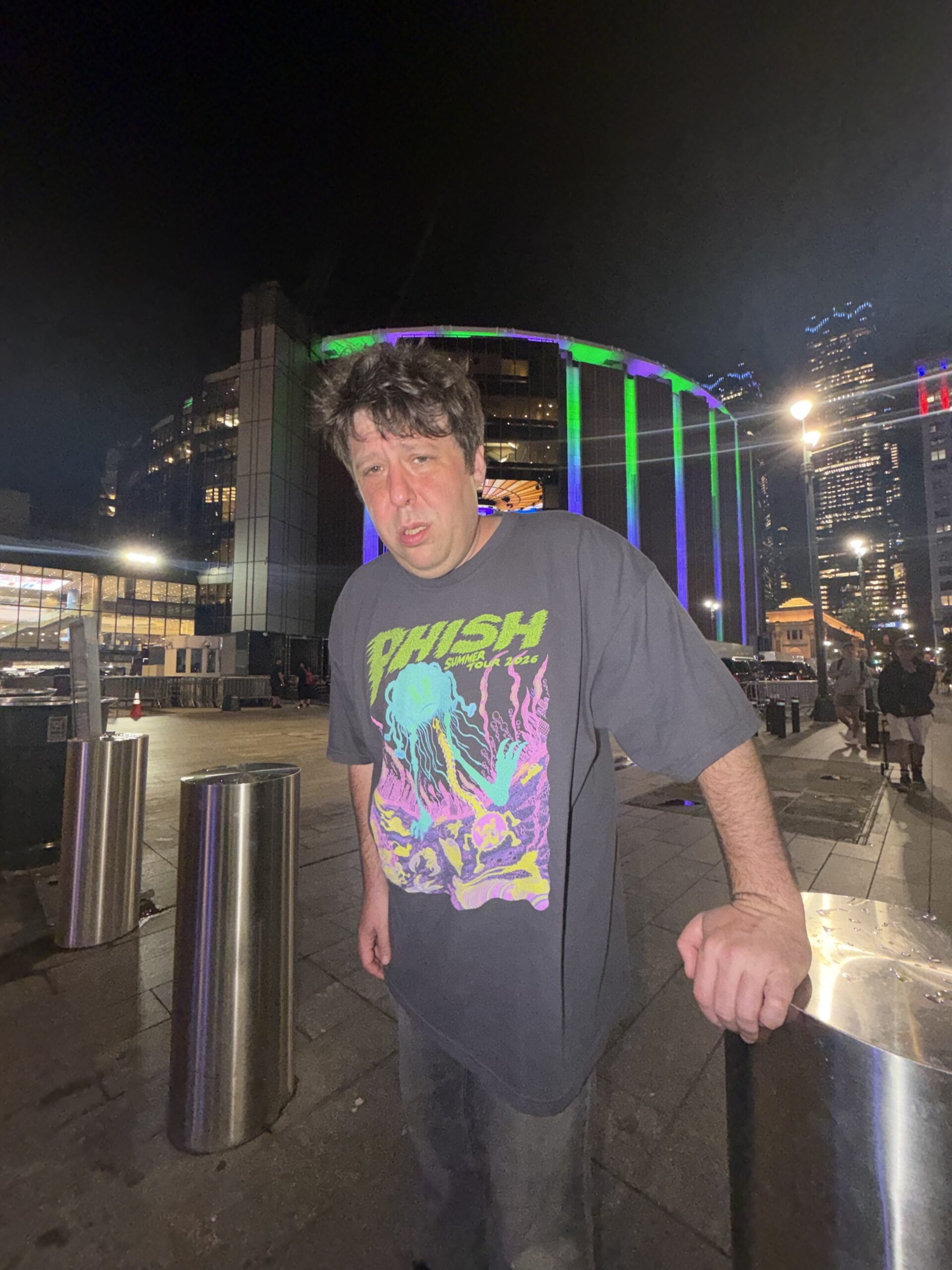

All photos courtesy of Jim E. Brown.
On Monday July 26, 2026, Jim E. Brown—the Rick Owens model and self-proclaimed 19-year-old pop star from Manchester, UK—landed in New York to see his favorite band Phish perform live at Madison Square Garden for the first time in his short life. Just a few days beforehand, I was asked to assist his producer, Burt Murder, in filming the momentous occasion. I have filmed things for Jim in the past. In my experience, he is both an enigmatic auteur and a glum, image-obsessed diva. But with over 260k Instagram followers, this is par for the course. His official bio has become its own copypasta: “Jim E. Brown is an obese 19-year-old singer/songwriter from Didsbury, Manchester who suffers from various degenerative diseases and alcoholism. He was born on September 10, 2001, one day before ‘the’ 9/11.” Which, yes, as his fans will eagerly tell you, still makes him 19 years old. He’s written six books, recorded over 10 albums, fathered at least two sons (both named Tanner), and has sold out of every used, damp napkin available for purchase on his Bandcamp. Some of his most popular songs include: “I’m Quitting Prozac to Continue Drinking,” “I’m Naked in My Room Huffing Nitrous Balloons,” and from his latest album Dirt, “I Am the Fattest Person in the World.” Jim is vocal about his struggles with substance abuse and body image—in fact he never shuts up about them—and that brazen, world-weary shamelessness is part of his charm.
On the night of the Phish show, before we even entered the Garden, Jim was propositioning strangers for crack. A crowd began to gather around him while we filmed and exploited his plight for content. The sun was high. The streets were steaming. Donning his signature wool tweed sports coat and mustard yellow turtleneck, I watched the sweat bead around Jim’s temples through the camera lens. There appeared to be no lot, no shakedown street in sight, no whooshing of nitrous balloons within earshot. He was desperate for a drink, or a hit, or a drag of anything. When an odorous wook draped in patchwork and tie-dye offered up a sip from a brown bag, I zoomed in on Jim’s grimace as he guzzled the offering, his face flashing with the good light of momentary relief.
Someone asked, “Who is that guy?” I was busy, I couldn’t respond, but I didn’t need to. Someone else in the crowd shouted, “That’s Jim E. Brown!”
“Is he famous?” The confused man asked next, though the question quickly answered itself as a stream of fans approached the young artist.
“Is he for real?” A dude licking an ice cream cone asked, thumbing to him while looking at me.
I remembered I was wearing dark, cat-eye sunglasses and a giant t-shirt that read, “I’m an Obese Alcoholic,” a reference to one of Jim’s earliest hits, “I’m an Obese Alcoholic.”
“I signed an air-tight NDA,” I replied.
“All I needed to hear,” he nodded and continued on with his cone.
Luckily, no NDA violation was needed for the writing of this article. Jim and I chatted on the phone a few days after the Phish concert, once he had returned to the other side of the pond, to discuss his devastatingly disappointing experience and lingering feelings of ennui after watching his favorite band perform.
FRIDAY 3:45 PM JULY 31, 2026 NEW YORK CITY
———
KELLY KARIVALIS: Hey, what’s up.
JIM E. BROWN: Hi.
KARIVALIS: How are you feeling after the Phish show?
BROWN: A bit shit, really. I was extremely dissatisfied by it. I don’t really like music. Phish is one of my favorite bands, but I found the concert to be extremely disappointing for many reasons.
KARIVALIS: Such as?
BROWN: Well, first of all, the Guinness cost $21 USD at Madison Square Garden. The stodge was alright, but, like, the battered chicken sandwich cost $20 USD as well. So to be an obese alcoholic in that circumstance—one who needs to eat and drink alcohol to excess at all times—it’s a rather costly endeavor at a Phish concert. I feel that the show was a bit discriminatory towards people that binge eat and binge drink.
KARIVALIS: Right.
BROWN: And the music was also really shit.
KARIVALIS: Do you have a favorite Phish song?
BROWN: I lost my virginity to Darlene whilst listening to “Wolfman’s Daughter.” It’s not my favorite, but it’s a distinctive memory.

KARIVALIS: In one of your books, didn’t you say you first traveled to the American city of Philadelphia because you were trying to see Phish? Is that right?
BROWN: No, I don’t believe so. In Brown on Brown: The Autobiography of Jim E. Brown, Volume One: The Early Years, I mention Phish because they’re my favorite band and I spent many hours on the Phantasy Tour Phish Forum.
KARIVALIS: Oh.
BROWN: And I formulated a lot of my social dynamics and social skills via the Phantasy Tour website. In that book, I wrote I always dreamed of Phish coming to the United Kingdom, but they never did. And I had a fantasy about meeting Trey [Anastasio] in a pub and talking to him, but then I found out that he was sober. That was a bit shattering for me.
KARIVALIS: How do you feel about him being sober, as a non-sober person?
BROWN: I don’t judge those who are sober, but I cannot see myself doing that. Alcohol is too important to my lifestyle and it would be a betrayal of my individuality if I were to ever stop drinking—and I have attempted to. I’ve had sober periods of an hour or two here and there, but it was far too painful.
KARIVALIS: Do you think Trey was a better musician before he got sober?
BROWN: I don’t know because I’ve only listened to the Phish studio albums, and they’re lovely. But the live Phish experience is just, like I said, very disappointing, extremely meandering, lots of improvisation, which was very boring, people being happy and dancing. It was just not appealing to me.
KARIVALIS: The vibe was very positive there, which I would imagine feels very alienating as a depressed person.
BROWN: Yes, it felt very alienating. I’m physiologically incapable of smiling or laughing, but I’m also incapable of feeling excitement. But I felt a small lilt in the pit of my stomach, something that approached excitement, before the gig because they’re my favorite band. And to have that expectation and then to have it shattered by the shit-ness of the concert, it just sunk me into a dark hole.

KARIVALIS: Are you feeling even more depressed now after seeing them than you were before?
BROWN: Yes, absolutely. It was one of the most disappointing moments of my recent memory.
KARIVALIS: They say never meet your heroes.
BROWN: I did meet Trey Anastasio of Phish once, inadvertently, and that was lovely, in fact.
KARIVALIS: How did you meet him? What was he like?
BROWN: I don’t remember. I was thoroughly intoxicated. I think he was kindly and empathetic, but he may have been gruff and crass. It’s hard to recall.
KARIVALIS: So maybe you would’ve been better off if you just kept it at that one in-person meeting and never saw him perform live.
BROWN: Yes, I think so. But then some of the other Phish fans, y’know, who aren’t really my cohort, did tell me, “Well, you should’ve seen night one or night three.” So maybe I could see them again and it would be alright, but I don’t think so.
KARIVALIS: I was curious about that. Because each of the five shows at MSG was supposed to be a different night of the ‘90s they were emulating—it was like ‘93, ‘94, ‘95, ‘96, or something, and I think [you, your producer Burt Murder, and I] went on the ‘95 night? I was looking at the forums afterwards, and people seemed pretty annoyed that Trey was wearing his “Jah Volunteer” shirt on 1995 night when he actually wore it in, like, 1998 or something?
BROWN: [Groans.]

KARIVALIS: I don’t know.
BROWN: I didn’t really clock that.
KARIVALIS: It’s interesting you mention the Phantasy Tour forum because that was a crazy moment. When your producer and I were filming you during intermission, we heard word was spreading on the forums about you being at the show.
BROWN: Oh. Right.
KARIVALIS: How did it feel to see so many people there that were fans of you?
BROWN: I have mixed feelings about it. The negative side is that I had to talk to these people. The positive side is that several of them purchased me beer, so it was both good and bad.
KARIVALIS: Would you consider going to events where you think your fans will be so that you could maximize the amount of free drinks you could get?
BROWN: Absolutely.
KARIVALIS: Did anyone buy you food?
BROWN: No, they were too stingy.

KARIVALIS: That’s a shame.
BROWN: I did purchase a t-shirt. That is one of the nice things about Phish, they are very supportive of their obese fans. They had sizes such as 2XL, 3XL. I purchased a 3XL shirt—I barely fit into anything else. So, it was nice to wear that.
KARIVALIS: You looked like you were getting pretty hot in your wool blazer and turtleneck.
BROWN: It was a bit humid and hot with all those sweating Phish people.
KARIVALIS: The other thing people were excited about on the forums was that Trey brought out a mini drum kit?
BROWN: Yes, I saw him twiddling on that. I only watched about two minutes of the show before exiting. That’s all I could tolerate.
KARIVALIS: But you saw him twiddling on the drum set?
BROWN: A bit, yeah.
KARIVALIS: Did that feel painful to watch?
BROWN: It didn’t feel painful, I just felt a deep apathy about it. I’m familiar with Trey soloing on guitar. This time he was just, like, diddling on some drums, so it was like, “Oh, the bloke is playing drums now…alright.” Not much else to say about it really.

KARIVALIS: Do you ever play drums?
BROWN: No, not really.
KARIVALIS: Would you ever do something like that on stage?
BROWN: If the price was right.
KARIVALIS: If somebody paid you enough, you’d play a mini drum kit on stage?
BROWN: I think so.
KARIVALIS: And you had to leave the show kind of early?
BROWN: I didn’t have to, but I chose to.
KARIVALIS: You chose to.
BROWN: Yes.

KARIVALIS: Because it was unbearable.
BROWN: It was unbearable. It was horrendous, really.
KARIVALIS: Are you disappointed that you missed out on the nitrous balloon scene?
BROWN: Yes, that was another massive disappointment. I had always heard that these Phish concerts were essentially open-air drug markets. My favorite drug is alcohol—and that was accessible, but for a large fee. But I also quite like nitrous oxide. It’s one of my favorite tipples. And I was not able to find any. I also asked at least 30 people where to get some crack cocaine.
KARIVALIS: Oh.
BROWN: I like a bit of crack.
KARIVALIS: Right.
BROWN: But apparently everyone was doing LSD and mushrooms and things like that. There was not much crack cocaine and that was a big disappointment for me.
KARIVALIS: Have you done psychedelics before?
BROWN: I don’t remember.

KARIVALIS: Would you?
BROWN: I don’t know. Marijuana I’m not very fond of. It provokes a bit of psychosis in me, which is uncomfortable to say the least. I suppose I would dabble. The last time—oh yes, I do recall doing mushrooms recently, but I was just crying uncontrollably.
KARIVALIS: Mmm.
BROWN: Which, you know, I often do cry at least once or twice per day, but it felt more uncontrollable with the mushrooms.
KARIVALIS: Did you feel relief? Is it relieving at all to cry that much?
BROWN: No, not really.
KARIVALIS: Was there a particular reason that you were crying? Did you hallucinate?
BROWN: No, not really. I just was crying and really felt sad. But it was a little—one positive part about taking the mushrooms is that when I looked in the mirror, I did not see demons.
KARIVALIS: Hm!
BROWN: Usually, when I look in the mirror, I see demons. So that was nice.

KARIVALIS: That is nice.
BROWN: But LSD? It doesn’t really interest me. It’s not the type of drug that you can use excessively and binge because apparently you can only—I think you can’t feel the effects of it if you do it two days in a row. You have to wait, like, a week. It’s not really my style. I like to binge, I like to drink, like, dozens of beers per day, and eat lots of food per day, smoke many pipes of crack per day. But with the LSD, you do, like, one little one, you know? It’s just not for me.
KARIVALIS: I couldn’t really imagine you doing much LSD either because—I don’t know how familiar you are with Alcoholics Anonymous. Have you ever attempted to look into AA or anything like that?
BROWN: Uhhh. A bit, yeah. A bit.
KARIVALIS: Well, the founder of AA, Bill W., was experimenting with LSD as a cure for alcoholism. He did clinical acid tests in the 1950s with Aldous Huxley, I think. So it might be dangerous for you to do LSD if it cures your alcoholism. Do you think something like that could happen?
BROWN: That’s an interesting thing to think about. If I were ever to choose to be sober again for more than an hour, I could try dropping a bit of acid. Getting in touch with some, like, subconscious bits and bobs might be nice, I don’t know.
KARIVALIS: Speaking of subconscious, as somebody who’s died many times, (such as 15 minutes after filming the music video for “I Texted You a Photo of the Sunset and You Never Responded,” 30 minutes after filming the video for “I Opened My Mouth Too Wide Today (And It Hurts),” and 45 minutes after filming “I’m an Obese Alcoholic”), do you feel comfortable talking about what it’s like to be dead?
BROWN: Well, I don’t know that I’ve died. I mean, it’s possible, but…If I did, I just don’t really recall any of it. I get too blotto when I drink, so it’s possible it’s happened. I don’t really recall.
KARIVALIS: You don’t recall seeing anything religious or…?
BROWN: No, not really. The most religious experience I’ve had is when I dreamed of kissing Judge Miranda Roberts.

KARIVALIS: That’s right.
BROWN: I mean, sorry. Her ghost visited me in my dreams. And kissed me.
KARIVALIS: Do you believe in an afterlife?
BROWN: Uhhh. Only because I’ve seen evidence of it, but I’m still skeptical. Perhaps it was just a hallucination, but it seemed quite real in the moment.
KARIVALIS: Do you believe in god?
BROWN: I’m not opposed to the idea of god, I just, I’ve not seen much evidence of his existence. But I think it does make a bit more sense that some bloke—like god, for example—just built humankind. Because the idea of evolution just doesn’t make sense to me. Evolution suggests progress, and I don’t see any progress. I just see regression constantly. So, it makes more sense that an imperfect deity just created an imperfect world.
KARIVALIS: And you see yourself as an imperfect person, so you would be a creation of an imperfect deity.
BROWN: Yes.
KARIVALIS: Do you think god made you in his image?
BROWN: No. I don’t think anyone who is as foul or disgusting as me would want to reproduce. Although, I have reproduced multiple times. But not on purpose.

KARIVALIS: True. Your son Tanner, and your other son Tanner, who you said suffers from narcissistic personality disorder.
BROWN: Right.
KARIVALIS: I’m sorry, I didn’t mean to get too sidetracked. Any final thoughts on Phish? Or god?
BROWN: Just for the purpose of earning some money, I would like to promote this tour of the United States that I have coming in September 2026. I will also be playing in Canada, which is a country that is adjacent to the United States, in Vancouver. But beyond that, no. Oh, and my forthcoming book of course, Brown on Brown: Volume Four, should be available soon.
KARIVALIS: Awesome, cool. Well, thank you.
BROWN: Yeah.
