

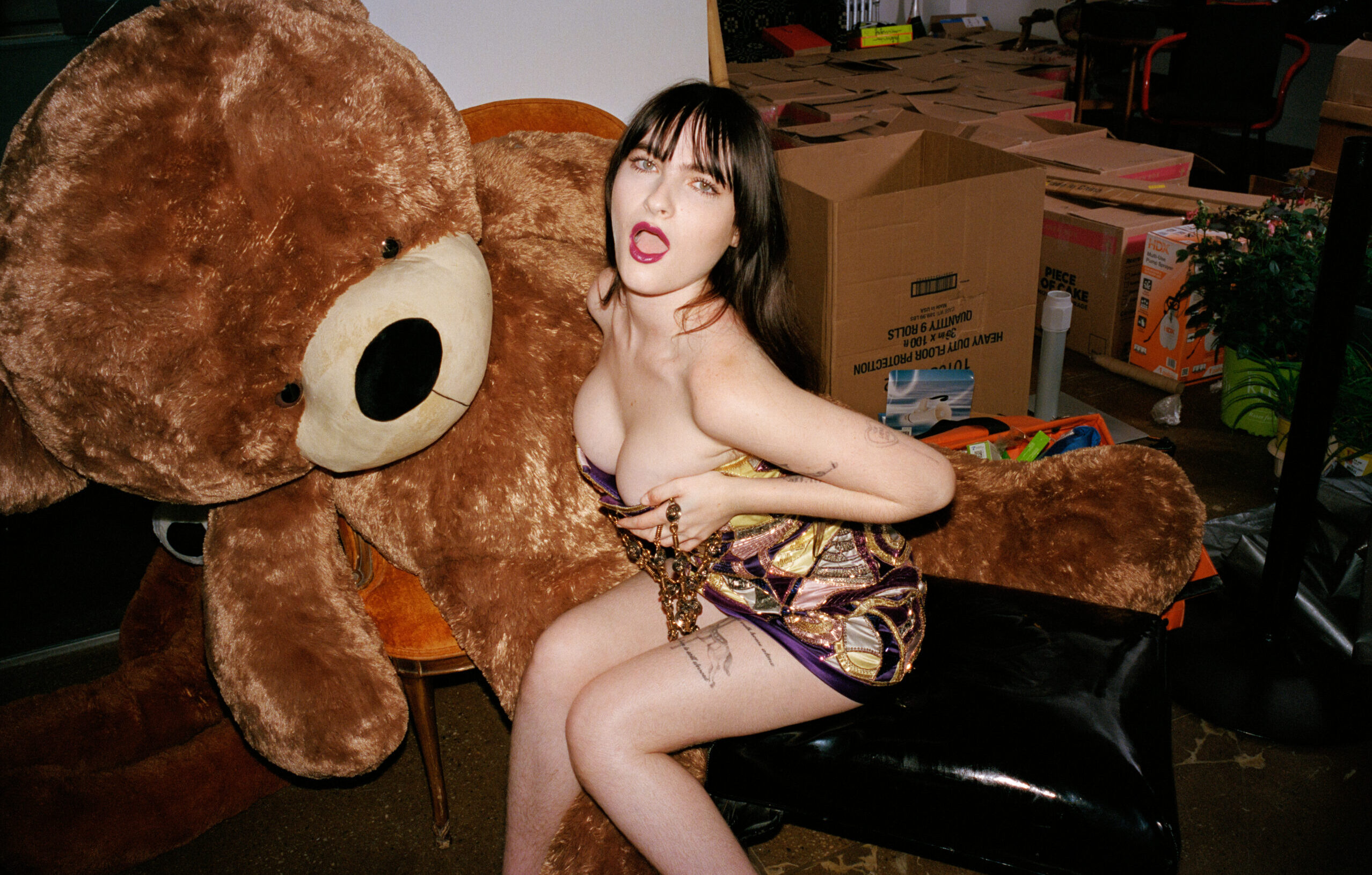

Ivy Wolk wears Dress and Necklace (worn on hand) Versace.
Ivy Wolk is the girl your gay friends won’t stop screenshotting. Known online as @wolkmindvirus2, the 22-year-old has gained notoriety with takes that are equal parts unhinged and self-lacerating, delivered with the chutzpah of someone who’s not scared of being too much. But Wolk isn’t just a preternaturally skilled troll—she’s landed standout roles in the FX comedy English Teacher and the Oscar-winning Anora, and carved out a real place for herself in stand-up. Her sharp tongue and raw nerve have drawn comparisons to one of comedy’s original provocateurs, Sandra Bernhard, who Wolk has worshipped since she was a teenager. So we made the introduction.
WEDNESDAY 11 AM JUN. 24, 2026 LA
———
IVY WOLK: Hi, Sandy.
SANDRA BERNHARD: Hi!
WOLK: I don’t care if you don’t have a single question for me, all I want to do is talk to you.
BERNHARD: That is so sweet. I want to say I decided I wasn’t going to wash my hair or put on any makeup, because I figured we’d just start with a blank slate and be totally who we are.
WOLK: I didn’t wash my hair either!
BERNHARD: Are you in L.A. or New York?
WOLK: I live in New York, but I’m in L.A. right now for work. Are you still in France for The White Lotus?
BERNHARD: I haven’t gone yet. I don’t start working until August.
WOLK: I’m so excited for you.
BERNHARD: I know, it’s wonderful.
WOLK: How’s Mike White? Is he awesome?
BERNHARD: I’ve known Mike for I don’t even remember how long, and I’ve been waiting for him to write something for me. I kept looking at my watch until he finally came up with something. I’m very happy.
WOLK: You guys are going to France?
BERNHARD: They’re going back and forth. I think they’re heading to Paris soon, and then we go back to the Saint-Tropez area.

Shirt, Jeans, Belt, and Shoes Chloé.
WOLK: Have you been there before?
BERNHARD: I was at the Cannes Film Festival for The King of Comedy in 1983, but that’s the last time I was there in any official capacity. I don’t even know if I’m shooting there because there are a lot of different locations. I’m going and leaving myself wide open; after all these years of being in this business and anticipating what things are going to be like, I found it’s best to roll with the punches. I’m sure you’ve already discovered that.
WOLK: I’ve done a lot of jobs where you just fly somewhere and they send you the script two days before and you’re like, “Okay, I’ll figure it out.” Usually that involves making a random, wacky, bold choice and then having to stick to it.
BERNHARD: What are you doing right now?
WOLK: I’m shooting. I can’t really talk too much about it, but I keep thinking, “Gay guys are really going to have a lot of fun with all this footage of me in various states of distress.”
BERNHARD: You feel like the gay guys are your biggest following?
WOLK: They really, really love me. Mostly it’s young women and gay guys. I just went to the New York arm of the Folsom Street Fair because I was like, “I need to witness people being free.” A lot of gay guys in latex dog masks were coming up to me, being like, “Just wanted to say I love your work!” And then they would go off and get smacked in the face.
BERNHARD: [Laughs] Amazing.
WOLK: It was incredible. It makes me very happy when I see proof that I’m a voice for freaks. At my shows, the first row is always girls in full goth regalia. There’s a girl who always comes wearing ears and a tail and corpse paint—like Gene Simmons KISS makeup—and every time I see her, I’m like, “Thank god. Thank god for you.”
BERNHARD: I’ve always felt my work is about empowering people to set themselves free. Without even necessarily being conscious of it or making it be a statement, I was always like, “Why are we all so uptight about what everybody else is doing? Just be comfortable in your own skin, and if you’re not comfortable being around these people, don’t go to the places where they are.” That’s sort of been my philosophy, so I love to hear that. How old were you when you started doing work onstage?
WOLK: When I was in middle school, I started performing sketch comedy and cabaret stuff in L.A., but I started taking stand-up really seriously three years ago when I was 18. It’s really, really wonderful. Lifesaving.
BERNHARD: What are some main jumping-off places for your comedy?
WOLK: My solo show right now is called Age of Consent. It’s basically a commentary on sex and my sexuality, and how both were formed by the conditions of the world I grew up in.
BERNHARD: What sort of things influenced you and at what age? I feel like it’s harder and harder to have space to really evolve into yourself.
WOLK: A lot of it was informed by growing up in L.A. I understood from a really young age the inherent irony of growing up in a place like this.

Bra R&M LEATHERS. Hat Alias Costume.
BERNHARD: Tell me about the irony.
WOLK: It’s sort of hard to grow up in a place where the local industry is entertainment, because it makes everyone so image-conscious. There are a lot of expectations foisted on young women here—both implicit and explicit—and from a really young age, people here do things just for the sake of being seen doing them. Los Angeles has a very mimetic culture, which was hard for me, because everything I aspired to do was not really that popular.
BERNHARD: Everything in L.A. really is about entertainment, so what’s the alternative? What are people doing to separate themselves from that these days?
WOLK: When I was growing up, a lot of people really wanted to be visual artists. A lot of people wanted to be musicians. A lot of girls ended up being models. I felt like the cool people I grew up around were not in any way interested in things like acting or comedy. Our parents are Gen X, so we are the last generation of Los Angeles–raised children whose parents could have a middle-class life doing steady work in entertainment as below-the-line employees, like set decorators or prop designers or Foley editors or whatever. I was very aware of the economic shifts that made that kind of life less and less possible. At the end of high school, I started befriending people whose parents were actually famous celebrities for the first time.
BERNHARD: And you suddenly fell into a different milieu of L.A. kids.
WOLK: Yes. I found myself at house parties in these massive homes, and I would look around feeling like I was very outside of the flow—like I was an impostor in a way other people weren’t recognizing. My father works in the control room on Jimmy Kimmel Live. He’s been in a below-the-line job since before I was born, but he’s also obsessed with Hollywood. He’s obsessed with star-fucking and chasing the shine of celebrity. He’s obsessed with being in the orbit of fame.
BERNHARD: Stop. Stop, because so many things you’re saying are so interesting. He is obsessed with it because he doesn’t want you to be a part of it, or he wishes he was more in it?
WOLK: Both.
BERNHARD: He feels he’s missed out on something?
WOLK: He was very reticent about me wanting to be a performer. Even now that I have achieved some minor fame, he’s uncomfortable with it, regardless of the fact that it’s something he hunts for in other people. My parents split when I was two and I grew up with my single mom—who is not at all industry affiliated—and we lived a very normal but poor-for-Los Angeles life. Eventually, I found myself around these wealthy children who were sort of aimless in a different way than my other friends. They were desperate to disentangle their identities from their parents, but they still wanted access to the family business. I watched them wrestle with that conflict, which was very strange, but I think it also inspired a lot of the work I’ve done. L.A. is also a very sexually fraught place to grow up. A lot of drugs and drinking and sexual mishaps; people were having sex really early here, but I was not. There were a lot of high school sex scandals, and I was always mystified by them because I—
BERNHARD: For instance? I’m fascinated by this.
WOLK: I talk about this in my show. There was a massive Me Too movement in L.A. high schools around COVID time, because basically it was revealed that there was a high school sexual assault epidemic here. A lot of it was drug-fueled and insane. All these boys had become so blind to human empathy and feeling because they were completely dulled from drug use. And it was really—
BERNHARD: Awful.
WOLK: It was awful. And it was crazy to wake up to that, because I was late to the game. I lost my virginity at 18, which is late for somebody from Los Angeles, because people in L.A. are doing anal for the first time at 12 years old—they’re having all kinds of advanced sex really, really young. During my junior year, everybody was a lesbian. All those girls for the most part are practicing heterosexuals now, but for that one year, absolutely everybody was gay. I knew a lot of girls who had torrid, life-ripping lesbian relationships before they ever had their first high school boyfriend. I had no understanding of my own sexuality whatsoever until I was an adult, so I was just observing all these sex and class issues, while at the same time dealing with the drama of my own drive to do something other people really didn’t understand. I also felt Los Angeles was a hostile, self-curatorial place, and I always felt like I was too gauche to fit into the fabric of it.

Dress, Gloves, and Shoes Balenciaga.
BERNHARD: What do you mean too gauche?
WOLK: I’ve always been a naturally garish, loud, and chatty person. The expectation here is for women from the time you’re young to be slight and mysterious.
BERNHARD: Really?
WOLK: Yeah. When I was a teenager, being a cool girl meant being mysterious—not dancing too wildly, not talking too much, curating yourself for the sake of the images and stories that circulated about you.
BERNHARD: It sounds like a throwback to a much more patriarchal time.
WOLK: It definitely felt that way, and it was jarring. Everybody was kind of an artist in their own right, and everybody was very talented. But a lot of people sacrificed talent, opportunity, and expression for the sake of presenting a speculative image, and I was never someone people could really speculate about. From the time I was 13 years old, my main drive has been to put all my shit out there and be as self-expressive as possible. But Sandy, I want to ask you questions.
BERNHARD: I think this is more of a conversation. What’s interesting about you is that you go off on a lot of different tangents and it’s fun to jump in and stop you and get specific, which is what I just did. It makes talking so much more interesting. I have a radio show once a week and I talk to a lot of people, and sometimes I’m like, “Oh shit, this is a disaster,” because people are only used to speaking in soundbites. I’m very impressed that at your tender age, you’re able to be so stream-of-consciousness. One of my favorite things is to just go and not stop until somebody interrupts you.
WOLK: I often soliloquize.
BERNHARD: You’ve obviously read a lot, because your vocabulary is quite impressive.
WOLK: I’m a big reader.
BERNHARD: You said your mom’s not in the business. What does she do?
WOLK: She works at a landscape architecture firm, which is a new job for her. When I was little, she was a personal trainer and water aerobics instructor. She taught old people about swimming. We grew up pretty broke, which I was always cognizant of.
BERNHARD: It’s unusual to be from L.A. and segue into the business—and be successful—without being part of the upper echelons. I’m very critical of all that, which I won’t go into because it’s probably inappropriate, but I think it’s more and more important and impressive for somebody to come into the business fully enriched by things that are not business related.
WOLK: It’s important to establish your own identity, but I’m definitely less obsessed with the industry and Hollywood now that I’m an adult. When I was younger and trying to break in by myself, I was really invested in how it operated, because I wanted to understand it. I was mystified by it, probably because my father was so mystified and obsessed, and it was a way into him. Unlearning that was the most important thing—my art and my work are the most important things to me. Other people can handle everything else.
BERNHARD: Okay, but keep your eye on your money.

Coat, Gloves, and Bag Gucci.
WOLK: Of course.
BERNHARD: Don’t let anybody else take control of that. And never lose too much weight!
WOLK: [Laughs] I agree.
BERNHARD: As the years have gone on, I put on 10 pounds every, I don’t know how often and I don’t know for how long, but if I was the weight I was at your age, I’d be, like, emaciated. I feel like everybody is losing their fucking shit with the eating and the skinniness. It’s like, “What is everybody fucking doing?”
WOLK: It’s crazy. I was anorexic for many years.
BERNHARD: You were?
WOLK: Yeah. Everybody in Los Angeles is.
BERNHARD: Wow.
WOLK: In L.A., you’re supposed to go to rehab before you’re 18.
BERNHARD: Oh my god. You’re shocking me!
WOLK: All the kids I grew up with were deeply mentally ill, and a lot of them were sent away. It’s a weird irony, because the city is so big and sprawling, yet you have to somehow find yourself in all this desolate spread-outedness. It’s very hard for people to cope with, so we found freedom in controlling ourselves and getting fucked up. I was anorexic for a very long time, and now I’m like, “Never, never, never again.” You can’t do anything of value while you’re com- mitted to the anorexic lifestyle, because your brain is turning into dust in your skull.
BERNHARD: I’m glad you could get past it.
WOLK: You and I are both people who focus a lot of our work on celebrity and celebrity culture, or—as the gays call it—diva worship. It’s interesting, because I feel like you are somebody who gays worship as a particular diva, and now I’m becoming somebody gays worship as a particular diva. I myself also practice diva worship as a spiritual, almost religious practice with other female artists and celebrities. Which celebrity ignited your obsession with celebrity culture? What was the first moment where you saw somebody and felt like, “I need to know more about this person, and therefore I need to know more about people like this as a whole.”
BERNHARD: I lost my mind when I was 8 years old and my parents took me to see Carol Channing in Hello, Dolly! at the Fisher Theatre in Detroit. I wanted to be this person, I wanted to become this person. When we finally met, she came to my one-woman show and said, “I am your spiritual grandmother.” It was amazing and incredible to have all these decades go by, and then there’s Carol Channing backstage at my show.
WOLK: The first person I ever really found myself being entranced by was Honey Boo Boo, from Toddlers & Tiaras. At 8 or 9 years old, my friends and I dressed in these skanky little ostentatious outfits and filmed ourselves in this kind of kid-on-kid drag. My mother, a Gen X feminist, was like, “This is anti-feminist, this is degrading.” My father was like, “It’s disgusting. It’s white trash,” but I was like, “Honey Boo Boo, everything you represent is deeply fascinating to me and I immediately want to know everything about you.” I guess the first artist I really cared about is Amy Winehouse. I have a tattoo of Courtney Love and Amy Winehouse on my arm.

Sweater and Pants McQueen.
BERNHARD: Wow.
WOLK: My screensaver on my phone, Sandy, is you and Courtney.
BERNHARD: Oh my god, that’s hysterical. Very cute.
WOLK: I’ve read all your books, by the way, and I’m obsessed with the stuff you’ve written about Courtney, like, “Who’s going to fix that heart, baby girl,” or whatever you said. I’m wondering if there’s ever been a time where you’ve gotten yourself into social trouble by talking about somebody onstage or in your work?
BERNHARD: I probably could have skipped talking about a few things, but I have also talked about people who then came to a show and ended up becoming friends. There’s only been a couple of times where I was like, “Oh, maybe I should not have done that.” I’ve been careful, I’ve chosen my battles, and I don’t like cheap shots. As you know, I would never talk about somebody’s looks, except maybe Donald Trump, but in general I always like to do something that comes out of left field. In terms of the famous people I have known, I would never say anything really revealing or betraying. Even if we’re not friends anymore, even if something bad happened and I feel hurt, I will never talk about somebody or reveal a vulnerable moment we shared.
WOLK: How did people react to or understand your performances in traditional club settings when you first started? After considering myself more of an alternative comedy performer for a long time, I’ve recently been thrust into working at traditional comedy clubs. I get a really mixed reaction from crowds expecting to see normal setup-punchline-tag comedy.
BERNHARD: Night to night, I never knew what I was going to encounter. My stuff was completely antithetical to anything that had ever been done in that setting, so there were nights where people would just stare at me. Sometimes I wouldn’t go on until 1 in the morning, and there’d be seven or eight people left. Those could actually be some of my best nights because people’s defenses were down. That was sort of amazing, because it gave me an indomitable spirit, knowing I could work through any kind of roadblock. It made me double down on things I knew were funny, and it gave me the courage and the backbone that has carried me throughout my entire career. As you know, when you get on stage, sometimes you’re vibrating internally because you know it’s going to be a slog and a battle. When you breathe and get through it, there’s nothing more exhilarating.
WOLK: I think a lot of people use the comedy club format to distill their work so it’s more palatable to normal, middle-of-the-road people, but I’ve never been interested in that as a performer. That’s the utility of some comedians, but it’s not my utility. I’m using comedy as a medium for unfettered self-expression; I want to try to get people to understand me, as much as they can in 10 minutes. I’ve never been focused on making the audience feel comfortable or like they’re not going to be challenged. I want them—even if they don’t laugh, even if they’re not interested—to leave the room with a further understanding of who I am and how I really feel about things. That’s sometimes a real gamble in those traditional comedy clubs. Sometimes I do really well and sometimes it’s really hard because people are looking at me fucking gobsmacked. The other night I did my closing joke and walked off-stage. No laughs. Truly everybody in the crowd went, “Awww.”
BERNHARD: Where were you performing?
WOLK: I was at the Stand, which is this big club in Gramercy in Manhattan. I’m not even bothered by it, but I think a lot of comedians take a bomb to heart in a real way. I very quickly grew out of that, within my first year of doing standup, because I know what I’m saying is good and interesting, and I know it works for people who get it. If people don’t understand it, that’s fine.
BERNHARD: Exactly. You just have to go, “That’s what I am.” And if it’s authentic to you, of course you’re not going to second-guess it. This has been an incredible conversation. I hope we can meet in person one of these days.
WOLK: I would love that. I would really love that.
BERNHARD: Yeah, for sure, we will. I’m really impressed and proud of what you’re doing. Just stay on your path. It seems like you’ve worked through all the bumps up until now, and I doubt anything will throw you off course. That’s really an accomplishment, so just keep on that track, okay?
WOLK: It was so nice to talk to you. I love your work and I love you so dearly. You’re wonderful.
———
Hair: Kabuto Okuzawa using Oribe Hair Care at The Wall Group.
Makeup: Frankie Boyd using Tom Ford and Gucci Beauty at Streeters.
Nails: Nori Yamanaka using Dior Vernis at See Management.
Market Director: Lucy Gaston.
Set Design: Joonie Jang.
Photography Assistant: Eduardo Silva.
Makeup Assistant: Jefferson Raposo Santiago.
Set Assistant: Max Pavlichenko.
Production Director: Alexandra Weiss.
Photo Producer: Georgia Ford.
