

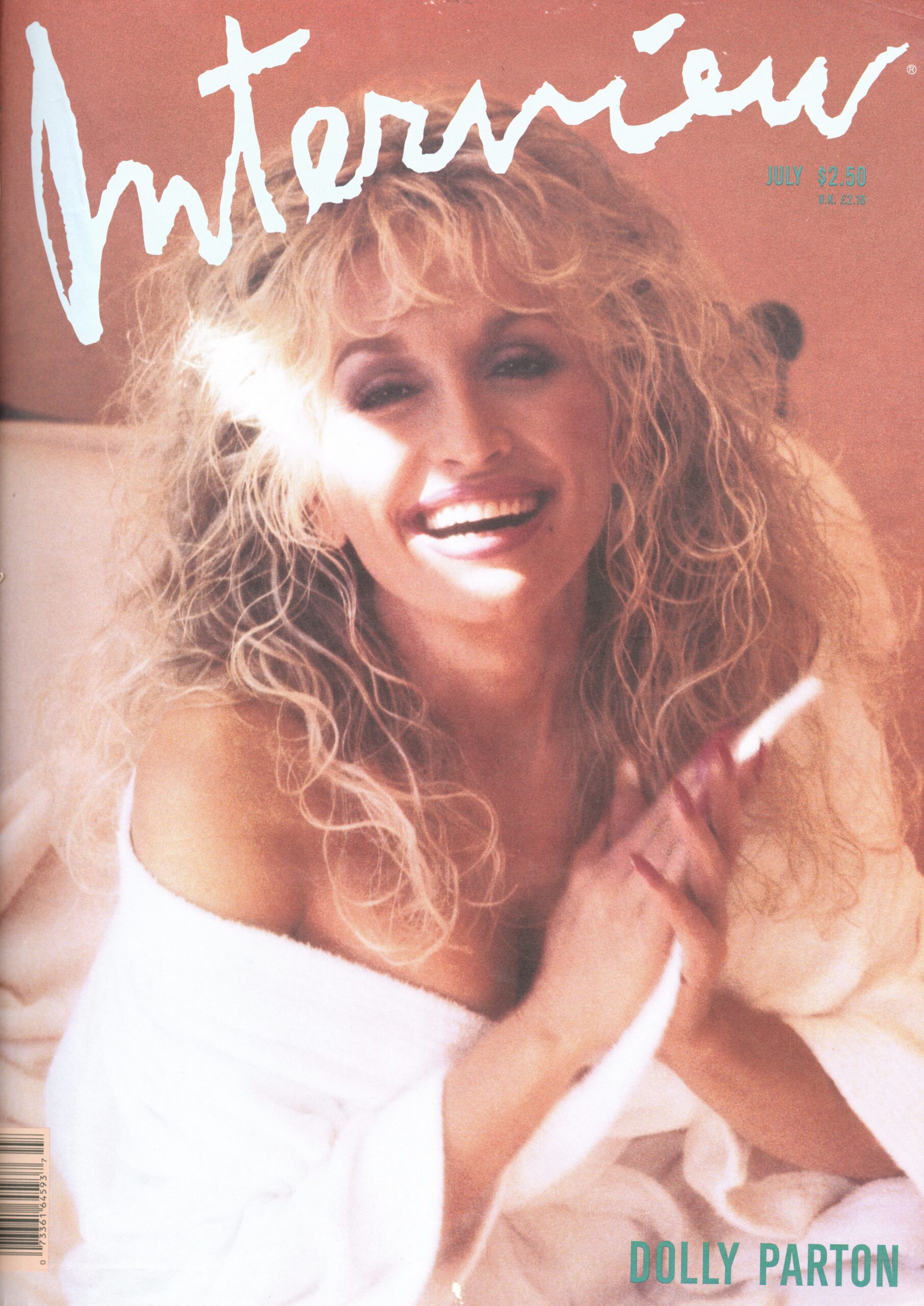

Following the tragic news of her passing, Interview unearthed our two cover stories with Dolly Parton to commemorate the life and legacy of the country icon that meant so much to so many.
July 1984
———
ANDY WARHOL: Where is Maura? Maybe she got caught in the parade.
DOLLY PARTON: Maybe she got hooked up with a horny leprechaun somewhere, dressed in green with no pants on.
WARHOL: Do you want some lunch?
PARTON: I’d love a glass of white wine.
WARHOL: How did you like working with Sylvester Stallone?
PARTON: I think he’s beautiful. I’d never seen him in person before I started on Rhinestone. I was surprised when I first saw him because I thought he would be gigantic. When I had my surgery, I decided I had to get myself in better shape, eat better, because I just turned 38. I lost all of my weight before I even met Sly. He’s a great inspiration to be around, though. He was more than happy to help me. I loved working with him, he’s a great person.
WARHOL: [Doorbell rings] Oh, maybe that’s the magic person. Oh, there she is. You’re late, Maura.
MAURA MOYNIHAN: Hi, it’s nice to meet you.
PARTON: You’re Irish and we forgive you.
MOYNIHAN: You look wonderful. When did you finish Rhinestone?
PARTON: We finished filming about three and a half weeks ago. I’m the musical supervisor. I’m still working because I wrote all the music, and so I’ll be working with it till it comes out June 22nd. I had the best time doing the movie.
MOYNIHAN: Whorehouse wasn’t as fun?
PARTON: Well, Whorehouse was not fun. I loved Burt Reynolds and Jim Nabors and all those people, but at that particular time I was ill, and coming from a Broadway play, we already had everything against us.
MOYNIHAN: You got great reviews.
PARTON: I was happy with the success of it; it was just a hard one to do.
MOYNIHAN: How many wigs do you have?
PARTON: I don’t know, I’ve got better things to do than count them. But I wear one every day of the week, so probably 365.
MOYNIHAN: You have all these different ones so you can completely change your hairstyle any time you please.
WARHOL: How long were you sick?
PARTON: I’d never really been sick in my life until a couple of years ago, and then I was sick for 18 months to two years. It was brought on by a lot of emotional problems that I was having. I had to make a lot of decisions with a lot of people I had been with for years and years, and we were not helping each other emotionally. We did great business together, but it was just very hard. I just had to shuffle a lot of things around in my life and make some decisions that were very painful, and I’m a very sensitive person.
MOYNIHAN: Did you have to fire some people?
PARTON: Yes, but I’ve always done my own hiring and firing. But in this particular case, I was going through a lot of problems with family and stuff.
MOYNIHAN: With [your husband] Carl?
PARTON: No, me and Carl are fine. We have no problems at all. We’ve been together for 20 years, and we’ve been married for 18. First time for him and first time for me.
MOYNIHAN: How did you meet?
PARTON: I met him the first day I got to Nashville in 1964. I graduated on a Friday night, went to Nashville on a Saturday morning with dirty clothes, and I went to a Laundromat looking for anything but love. I had just left two boyfriends back home and I wasn’t looking to get involved because I had gone to Nashville to really get started in the business. I met him at the Why Washy and he’s been wishy washy ever since. We dated for two years before we got married. I often get myself in love trouble because I’m so passionate; I love so much and so deep. But Carl’s a special guy, I didn’t have any problems with him.
MOYNIHAN: Do you get lonely on the road?
PARTON: Yes, but I can fix that shit. Though it causes me trouble. At the time, I was making some decisions, making myself go way, way back to muddy waters. When you spend your whole life working… In fact, out of this came a book I’m writing called Life After Success. To me, that’s when you should be the happiest. I had to make some decisions that I needed to make for years, but I kept holding on because I loved these people so much, a person in particular, but we were just destroying each other emotionally because we loved each other so much.
MOYNIHAN: Was this a personal affair and somebody you were working with?
PARTON: Yes, it was a personal business affair. It was just very painful. I have a tendency to be awfully big-hearted and it’s very hard for me to say no, even when I need to. I can handle the business—the bigger they are, the better I like dealing with them—but when it gets into business where I’m very attached to the people, it’s hard. I was going through a period of time that the nerves and the tension and the stress were actually what got me sick. So then it was like, which came first, the chicken or the egg? I just kept getting worse and worse, and then I started having stomach problems, ulcers, and intestinal problems. But it was the best thing that ever happened to me. It made me really smart. When I was flat on my back, I realized that I could never retire, that I hated it, that I would never get myself in that place again.
WARHOL: You could be a great preacher.
PARTON: What do you mean? I am a great preacher.
MOYNIHAN: Your grandfather was a preacher.
PARTON: Yes, he was with the Church of God.
MOYNIHAN: Do you go to church regularly?
PARTON: No, I don’t.
MOYNIHAN: Do you pray?
PARTON: Yes, all the time. As a child, I was scared to death of hellfire and brimstone, but I loved to sing. Out of that, I started to remember the things that really stuck in my mind, and I think that’s followed me through the years, things like “Through God, all things are possible.” I just remember the positive. I just thought, “I can’t deal with this shit. There cannot be a god that is that mean and cruel, and if there is then I’m too afraid to deal with him anyway.” So I had to decide who I was, and what god meant to me. I feel that sin and evil are the negative part of you, and I think it’s like a battery: you’ve got to have the negative and the positive in order to be a complete person. I used to punish myself a lot for things I felt, and then I’d just say, “Well, if it’s wrong for me to feel this why do I feel it?” I used to have a lot of problems with all the stuff I felt. One of the songs on the jukebox in Rhinestone has the line, “Torn between two lovers,” and I’m thinking how I could have written that song. See, to me it’s how you deal with it yourself.
MOYNIHAN: Do you work out?
PARTON: Not much, but I do some.
WARHOL: What did you stop eating?
PARTON: It’s not what I stopped eating as much as how I stopped eating. I was always just a hog, I still am. I’m short and I have a big appetite. I can’t do nothing just a little. It’s the same with anything I do. It’s very hard for me to love a little, have sex a little, to eat a little. I like to do everything, and I like to do it all the way that I want to do it. I was always a junk food person, still am. I didn’t stop anything. I just try to eat less and I try to think of my diet now like a job, five days a week. I try to eat fish and vegetables, things that are better for me, but on the weekends…If I get crazy, if it’s three pizzas I want, that’s what I’ll go out and eat. I gained a lot of weight when I was sick. I was taking a lot of hormones for female problems I was having. I’m only five feet tall.
MOYNIHAN: You don’t look it.
PARTON: I walk tall, I got a tall attitude. But I’m just a little bitty person. When people see me in airports, they stop me and say, “Gee, I thought you were a big person.” When I was doing Whorehouse was when I got so sick. It was right after that diet that I gained so much more back. That was my second film, and it was so close to my personality as far as me getting to say what I wanted to say, dress the way that I like to dress, that I was real comfortable in the part. Like 9 to 5, I always joke about playing a secretary. That was good, but that was not really my true nature.
WARHOL: You were great in that.
PARTON: I make a better whore than a secretary.
WARHOL: No. You made 9 to 5 a big hit.
PARTON: That was a special thing. I was real proud of that. I’d never even seen a movie made when I walked into that one. I always laugh at myself. I learned everybody’s part, which was great because I didn’t have to study at night. It’s easy for me to memorize because I write. I knew that script back and forth in two weeks.
MOYNIHAN: Does acting come naturally to you?
PARTON: If it’s acting that I do, it does. I don’t think I’m a great actress. I think I can act or I can react. Coming from a musical background and being a dramatic singer and writer, when I write stuff I really feel it. So I sing it like it comes from here. That’s how I do the acting. I’ve done three movies now and I think I could do some good acting. I think I did some good things in Rhinestone, but I think now I could do a dramatic part, something real serious where I’m not a comedian or a country singer.
MOYNIHAN: What are your favorite movies?
PARTON: My favorite movie of all time is Doctor Zhivago, and I love Gone With the Wind. I’d love to play some Southern belle or something where I owned a plantation.
MOYNIHAN: Isn’t your Tennessee farm called Tara?
PARTON: No, I don’t know how that ever got started. They say that in all the magazines, but we don’t call it anything. It’s just a big, old house with 23 rooms that we’re about to sell. We built it, but it’s just too big for us. Back when I had the kids, my brothers and sisters, it made more sense, but it’s just too much for us now. It’s got 65 acres, and me and Carl are both at the age where we don’t want to be tied down to it, so we’re going to find a smaller place in Nashville. We just bought a house in Hawaii where we’ll spend a lot of time now. We don’t have kids, and we’re free, and he’s independent as he can be. We don’t like to be together all the time. Nobody likes somebody to be stuck in their face all the time—that’s why we get along so good, because when we are together we have a good time.
MOYNIHAN: Did you have a happy childhood?
PARTON: I think I did. At that time, I wanted more. I lived in fairy tales and storybooks, and I knew that we were missing a lot that I saw in books, but we were real happy. You see, mom and dad stayed together. We had our problems. Daddy, he often ran around and he had some children outside of us, but he was a good father and a good husband. He always came home. He was just a little wild, and I can certainly understand that, because I’m a combination of both of them. But he always loved mama and always treated us good. It was hard times. Mama was sick a lot and there were a lot of depressing times. What was good about it was we lived out in the country. We were very close to nature and free to grow up the way we did. We didn’t have cars to get hit by, we didn’t have neighbors to get raped by, we just lived way out in the woods. We lived close to god and close to nature. I think coming out of that gate gave us a real good solid foundation, a good wholesome attitude.
WARHOL: Did you ever think of leaving?
PARTON: Yes, I did. I was probably a real pain in the ass when I was little because I had such dreams. And I needed a lot of attention that I didn’t get. My folks loved us, they loved us all the same, but I had a sister and two brothers older than me. My older sister, of course, being the first, was more responsible and got more attention. My older brothers, being boys, were just stronger and bigger, and me, I was born in an odd spot and was a very sensitive kid. My feelings could get hurt so easily because I always wanted to be loved, I wanted to be touched, I wanted to touch somebody. I wanted everybody to love me, so I think I was louder than I should have been. I was just trying to get attention. I always felt like I was somebody special, maybe it’s because I needed to be somebody special. I just always knew I was going to be a star. I was always going to be rich so I could buy things for mommy and daddy, so that I could buy them a big house and we could have things.
MOYNIHAN: Did you have a lot of confidence?
PARTON: Oh yes, I’d sing for anybody.
MOYNIHAN: Do you still have a lot of confidence?
PARTON: Yes. You couldn’t scare me as a kid because we lived hard and we worked the fields. We were strong little kids. I was always a tomboy. And I can’t even believe now that I’m so fragile, so to speak. I have little, short hands, so I like long nails, and I’m short, so I like high heels. I never could get my hair to do what I wanted it to do, so I started wearing the wigs. It all came from a very serious place. I wanted to look a certain way.
MOYNIHAN: How did you survive when you first went to Nashville?
PARTON: Real well, although I didn’t have a radio, or car, or friend, or phone. When I first moved to Nashville I stayed with my Uncle Bill. He was the one who saw so much in me. I’d beg anybody to take me around, take me to sing. I was first on the radio when I was ten years old on a local station in Knoxville. I was scared to death, but my desire to do it was greater than my fear. I didn’t even know what the hell I was doing. I didn’t even know what a microphone was. I just played my guitar and sang the songs I wrote. Then, when the crowd loved me, that gave me that confidence that I was always going to need. I know now it wasn’t because I was good, it was just because I had the nerve to do it.
MOYNIHAN: What do you want to do now?
PARTON: I just want to be free to work. I want to think, I want to write better songs, I want to write different styles of music; I want to write Broadway plays, which I am; I want to write books, which I will. I’m going to write a lot of positive thinking books. I’m writing a book now called I Am, which is an individual awareness method.
MOYNIHAN: I read somewhere that you were going to set up awareness centers around the country.
PARTON: Yes, and I will do that. People need help and I can help.
MOYNIHAN: Do you think pop stars are like spiritual vehicles for a lot of people?
PARTON: Being brought up very religious, I have a fear of people that look to idol gods. But we are idols and we’re all gods, so to speak, and I think that celebrities should acknowledge their responsibility because we are in a position to help. That’s why it hurts me so bad to see what happened to people like Elvis. So many people need you so much. Just look at people like Jim Jones. See, you have to be responsible. I understand how people can commit suicide, how people can get on drugs and alcohol. It would be wrong of me to try and give anybody advice, and I won’t do it unless people ask. I love everybody, and I go right through the bullshit and I go right to the core of every person because we are all one, we are all the same. A lot of people say to me, “There are so few worthwhile people in the world,” and I say “That’s the biggest crock of shit I ever heard.” I don’t ever meet a freak. The biggest freaks in the world for me are my favorite people, like you, like me.
MOYNIHAN: Do you think you could ever lose your following or fans?
PARTON: I think about it, but I don’t worry about it. I think this could all end tomorrow. That’s all the more reason that I’m grateful, but I would be a star wherever I was. Being a star just means that you just find your own special place and that you shine where you are. To me, that’s what being a star means. It’s just that I wanted to be a bigger star, I wanted to do bigger and greater things. If I was a waitress, I’d be Flo. I would own my own club. If I was a barmaid, I’d be Miss Kitty. I would tell the worst jokes, I would make everybody happy, I would loan everybody money, I would have a good time. If I worked in a factory, I’d be the one making cookies for everybody at Christmas. I would always make a living. I don’t have children, and I’ve done the best I can by my people.
WARHOL: Why didn’t you have children?
PARTON: I couldn’t have children, I tried to for years. I’ve never been pregnant in my life. When I was a girl and fooling around, I was scared to death I’d get pregnant, and then when I got married and wanted to have children, I couldn’t have any. But I don’t miss it. I did for awhile, but I realize that I am everybody’s mother. I’ve raised five of my younger brothers and sisters, and now their kids call me Aunt Grannie. I’m like the grandma and the aunt.
MOYNIHAN: Where do you go in New York?
PARTON: Everywhere. I go to eat, I go to the clubs, I love to get out and have fun. I’ll never let myself get trapped. I think that one of the bad things that stars do, that deprives them of a real life of their very own, is they won’t get out. They’re scared to death somebody is going to kill them, to kidnap them. I think you have to be aware and alert , that’s only smart, but I think when you close yourself off…When I was sick those 18 months, I got to where I didn’t want to go out because I didn’t feel like I looked great. But then I thought, I’ve got to stop this because I love people. I want to be out there. I’d rather take a chance. If they couldn’t protect the president of the US and the great leaders of the world that have been shot and killed, how do I think they’re going to protect me.
MOYNIHAN: Do you carry a gun?
PARTON: I do because I’m a mountain person. We grew up in the mountains where you just have guns around. If an animal comes up to your porch at night or the kids are out in the yard and you’ve got to kill a snake…So guns were not foreign to me, and being a young woman in the world by myself, I know how to shoot one and I know how to handle it. It’s not that I’m really into weapons, it’s mostly just for protection. But then the press made such a to-do that I really don’t say anymore whether I do or don’t. I just say, don’t mess with me.
MOYNIHAN: What do you do for yourself, for your own pleasure?
PARTON: I go out with friends. I love to dance, I love to laugh a lot, I love to go to parties, I love to camp out. My husband and I love to travel by car, we love to go for two or three weeks. We went to Yellowstone Park once and stayed two weeks. We had a great time. We camp out and I unravel all the wigs, and the high heels and the makeup.
MOYNIHAN: Would you ever appear in public without your wig?
PARTON: No, not in public. Well, I might without my wigs, but not without being dressed up, because people expect it of me as much as I expect it of myself. Anybody can be tacky. In fact, I’ve often thought that some spring, in some great magazine, that I might do a layout on the new spring fashions and not wear the wigs. I’m not a bad-looking person and I’ve got fairly good features. I have baby-fine hair, but I have plenty of it.
MOYNIHAN: Do you spend a lot of money on clothes?
PARTON: Well, yes, but they’re not expensive clothes. I spend a lot of money on cheap clothes. I don’t go buy just one or two things. I can thank the lord I can do whatever I want. I wear the same things over and over and over. I look a certain way and I like it because I’m comfortable with it. I was impressed with kings and queens and velvet and jewelry when I was young. When I was a freshman in high school, hair teasing came out. I’d already bleached my hair and got in big trouble. I have blonde hair, but it just wasn’t radiant. It’s sandy blonde, it wasn’t yellow and white and bright. When teasing came out, I just thought I had died and gone to heaven. Being creative with my hands, I started teasing. I fixed everybody’s hair. I had the biggest hair in school. I had lots of teachers that had a hard time dealing with me because I felt sexy.
WARHOL: You have the smallest waistline.
PARTON: That was always one of my best assets. I loved wearing tight things around the waist. My dad used to think I was making myself sick because he thought I was pulling myself that tight. I had a real pretty body when I was a girl, though it’s kind of gone downhill since then. When I went to Nashville, they liked my personality and I never sold myself out. I never went to bed with anybody unless I wanted to, never for business reasons.
MOYNIHAN: Is the country music business hard for a woman to break into?
PARTON: Back then it was. I don’t think it is now. I think anybody who can sell records for any businessman or any company—if you got something special they’ll grab you. I don’t think it makes any difference whether you’re male, female, gay, Boy George, or whatever. I don’t think it matters any more, business is that open. The first record I made was when I was ten-and-a-half, eleven years old. The first record I ever made…was on Gold Band records, and it was called “Puppy Love.” On the back was this real tender love song, me ten years old singing, “I’m a girl left alone, there’s no hope for me.” It was a song that me and my uncle had wrote.
WARHOL: Did you have the same kind of voice you have now?
PARTON: It was little and a lot of trill. I’ve worked hard through the years, but it was always something I loved. I was not a great singer. I’m still not a great singer, but I got a style, I like that part. But anyhow, that was my first encounter.
WARHOL: What happened to the record?
PARTON: Nothing. It played in my hometown and became a collector’s item. Gold Band records still sells it; many people have it now.
WARHOL: Did you do a lot of records before that?
PARTON: Well, I did that song on Gold Band when I was ten or eleven, and then I did a record when I was fifteen on Mercury. I was walking down the streets saying, “Look, you got to record me because I’m going to be a star, I’ll make us a lot of money.” I recorded a song called, “It May Not Kill Me, But It Sure Gonna Hurt.” It only got played in my hometown too. But I had made some other tapes. When I moved to Nashville, I got real lucky. I’d already started to record for Monument Records just when I moved to Nashville. I got a contract immediately. Then I recorded “Dumb Blonde,” which was like one of the top ten country records. So that was my first big chart record. Then came a song called “There’s Something Fishy Goin’ On.” That was when I was still on my own. Then I started working with the Porter Wagoner Show in 1966.
MOYNIHAN: How many songs have you written?
PARTON: I’ve published 3,000. Since I was five years old I’ve been writing songs. I started playing guitar when I was seven, I started making up stuff before I could write. I don’t have to work now, but I like to. I like to give it all away so that I have reason to work.
MOYNIHAN: Do you have good investments?
PARTON: Yes.
MOYNIHAN: How many businesses do you own?
PARTON: Many. First of all, I have a lot of money in my publishing company, that’s a very stable thing. I have a lot of property. I invest in property, like farms, cows, hardware stores, hogs, and macadamia trees. You’d be surprised. I make more money on my outside heartfelt investments like farm equipment, garden centers, than I do even from record royalties. The thing that I am proudest of is my publishing company, because you not only write songs you get your royalties from, but you own your publishing—you have it all. Like with Rhinestone, I’ve written 20 songs for this. I get paid a large amount of money for the use of the songs, plus I publish them. I don’t have to do it—they want me, they come to me.
MOYNIHAN: Do you make all your own business decisions?
PARTON: Yes, I have good management and good accountants, but I go outside of all of them to make my own decisions. I need them mostly for advice in certain areas and to negotiate certain things. So I don’t have to work, I love to work. But I think everybody has to work. What’s a million dollars or three or ten or fifteen if you’re not happy doing what you’re doing? At least it’s good to know if you want to take off for a year you can. But if I took off and didn’t feel creative, I’d just get stale. I can’t even go on vacation. I do know how to have a good time, and I do, but when I’m on vacation I can just have the best time doing whatever. Right in the middle of some great time something will hit my mind, and I’ll make myself stop and write it down.
WARHOL: Are you working on another movie now?
PARTON: I have written a movie for me and Jane [Fonda] and Lily [Tomlin] I’m going to produce. One of the things I’m real proud of is I just made a deal with 20th Century Fox, and I’ve got my own production company now. I’m developing some television and movies for other people because I have a lot of fresh new ideas. To write is what I love the most. I’m starting some movies of the week and some TV series and writing my own movies.
MOYNIHAN: What do you think of the women’s movement?
PARTON: The women’s movement has a great respect for people in general. I’m not really a political-type person, meaning that I don’t really make great stands or whatever, but if you ask me a direct question I say it shouldn’t matter who you are, whether you’re Black, white, green, gay, male, female. If you can do a job and do it well, you should be paid for it, you should be respected for it, and you have to be responsible. I think sometimes people can go too far trying to make a point. I think they should just make their point and go on about.
MOYNIHAN: Do you have groupies? Do you have men following you?
PARTON: Of course I do, and women. I got a huge gay following and some really macho-looking women. To me, people are people, but I always say, “You like me because you want to look like me? I can tell you where I get my stuff.” So, many of my friends are gay, male and female. I don’t judge people. I don’t care what people do in their bedrooms and people shouldn’t care what I do in mine, but yes, I do have a lot of groupies.
WARHOL: You have groupies who actually just follow you around?
PARTON: I don’t think there’s an artist on the road that doesn’t have groupies. I have a huge group of people who follow me from town to town. They know your show and they sit out there and sing every word you sing. They know what you’re going to do before you get it done.
WARHOL: You should buy Monument Records.
PARTON: You’d be surprised how close you are. I am trying.
MOYNIHAN: Do you think success has changed you much or not?
PARTON: To the better.
MOYNIHAN: Do you think it’s been a burden?
PARTON: No, it never was. I had hard times, I’ve been burdened, but overall it has not been a burden.
MOYNIHAN: Do you think the sexual revolution went too far?
PARTON: I’m just not going to say, because I cannot do that and not be a hypocrite. My fantasies carried me to where I wanted to go. My imagination is greater than the reality. I really get into whatever I get into, and I do it my own way. I like to think that somewhere down inside me there’s still a Garden of Eden. I’m still innocent and sweet in a wonderful way.

July 1989
———
WILLIAM STADIEM: They never get the South right in movies, do they?
DOLLY PARTON: Hardly ever. The Hollywood version of the country and mountain people has always bothered me. They usually make us look a lot more stupid and dumb than we really are. It’s a very distorted view. But I guess the fact that they even notice us at all is something.
STADIEM: Did you see Mississippi Burning?
PARTON: No, I didn’t.
STADIEM: It made us all look like a bunch of cavemen down there.
PARTON: [Laughs] I guess there’re parts of that area of the country where folks can be pretty backwoods-y. There’re some parts that are as bad as Deliverance. But the majority of the people are very sweet, very religious, very kind, very giving. It’s only when you get into those rural areas, the very mountainous areas, that they don’t know how to protect themselves other than with crude behavior and violence.
STADIEM: You grew up in the Smoky Mountains.
PARTON: I grew up at the foot of the Smoky Mountains—the actual area is called Mountainview. Some called it Locust Ridge; we called it Over in the Holler. It was up in the mountains, but there were some valleys and our little ol’ house in between the mountains. I was born in a one-room cabin on the banks of the Little Pigeon River, on January 19, 1946.
STADIEM: It must have been a cold day.
PARTON: [Laughs] It was. I was born at home, and it was snowin’, they say. There’s twelve of us kids, and six were born at home. I was one of the first six. I have a sister and two brothers who are older than me, and eight are younger than me
STADIEM: All your family is still back in Tennessee?
PARTON: Yes, all of my people live in Tennessee.
STADIEM: Where is your home now?
PARTON: Well, my main home is Tennessee, always will be—that’s my home, that’s my heart. I moved to Nashville in 1964—my husband, Carl, is from Nashville, born and raised in that area—so that’s where my big house is, my dream house, so to speak. My roots are in the Smokies, so I bought the old Tennessee mountain home and fixed that up for a retreat for myself. But I spend a lot of time in L.A. and have an apartment in New York, so it’s kind of like my home is where my work is. But my real home I would definitely have to say is Tennessee.
STADIEM: Did they get the South right in Steel Magnolias?
PARTON: I think they did. That was written by a southern boy, Bobby Harling. It’s a true story, centered in Natchitoches, Louisiana. We did it all there on location. In the movie, it’s called Chinquapin—they changed the names of some of the places to protect the guilty, I guess. [Laughs] Natchitoches is a beautiful old southern town; the people are very sweet. they used a lot of the local people for atmosphere. I definitely was a country girl, and my part was Truvy, the beautician. Olympia Dukakis plays the mayor’s wife; Shirley MacLaine plays Ouiser, the eccentric old rich lady; Julia Roberts plays the young girl; Sally Field plays the mother; and Daryl Hannah plays the assistant in the beauty shop. Sam Shepard plays my husband, and Tom Skerrit is Sally Field’s husband. All those people have a great deal of love and respect for the South, and they studied the dialogue; they depended on me and Bobby Harling a great deal to show them how the people really speak. They tried very hard, and I think Herbert Ross did a great job of directing it. They’ve done as good a job of capturing the South as I’ve ever seen.
STADIEM: Shirley MacLaine is sort of a southern girl—she’s from Richmond.
PARTON: Yeah, she is. And I bet Julia Roberts is from Georgia or Alabama—a southern town, that’s for sure.
STADIEM: And they got their accents right?
PARTON: Yeah, they were good, I thought. It wasn’t hard for me because that’s the way I talk. I think that movie’s very special: it’s a comedy—it makes you laugh a lot—but it’s got some parts where you’ll cry your heart out. It’s just about this town, and its people, and the love, and how everybody knows everybody’s business but sticks together anyway. It’s a story about this young girl who dies from complications from diabetes because she’s very headstrong. She’s not supposed to have a baby, and that’s what kills her. That’s the sad part of the movie, but it’s a comedy. It’s the people, really, the characters and personalities, that make the movie.
STADIEM: Did you see the play Off-Broadway before you agreed to do it?
PARTON: Yes, they asked me about doing it and I read the script, but I couldn’t get much out of it, so they sent me to New York to see it. I went there and met Bobby Harling. I liked the play and thought I could play that part. And it was the chance of a lifetime work with all those people ’cause I was hearing about who they were trying to get to be in the movie and that they were definitely interested in doing it. I took it and I’m glad I did. I’m real curious to see what the outcome will be.
STADIEM: Do you get to sing in it?
PARTON: No, I’m just a country girl who owns a beauty shop. My contract called for me to write the theme song, and I could have pushed that on through, but after we saw the movie, my character was so different from just Dolly Parton that I didn’t really nave a chance to do it. The movies I’ve been in before were more personality pieces; they were very much Dolly Parton. I think if I did the song up front it would take away from my character because you’d be thinkin’ Dolly Parton too much.
STADIEM: You said once that if you hadn’t become a star you probably would have been a beautician.
PARTON: If I hadn’t been in the business I would have been a missionary or a beautician. I love being with people, and I love working with them and being out with them. I think that in a beauty shop, when you make people feel pretty or feel good about themselves, that’s great. That’s why this part was really good for me, really related to it. I love to play with hair and makeup, and I love gaudy things—it’s true.
STADIEM: Now, speaking of missionary, what was it like working with Shirley MacLaine? Did she try to get you out on a limb with her?
PARTON: [Laughs] I think we had a mutual respect for each other. I’m very definite about my faith and my religious beliefs, and I really like Shirley a lot. We became good friends, and it was not based on whether or not I believed in her faith. We didn’t have any conversations about anything of a spiritual nature. I wasn’t that curious about what she’s into.
STADIEM: She wasn’t trying to convert the cast?
PARTON: No, not at all. People asked her a lot of questions, and she was always talking about her beliefs, but I wasn’t one of the ones who were curious. I know all that sort of thing; I’ve studied all kinds of religions and faiths. And that’s all fine—it works for her, and it’s good. It’s not to say that I believe or don’t believe—I’m open for everything.
STADIEM: You grew up in the Pentecostal church. Are you still active in it?
PARTON: I never go to church. I believe faith is in the heart. I’m not a religious person, but I’m very spiritual. I believe that god is love, and I’ve always been a firm believer in that thing that is greater than us, that great energy, that great love, and I’ve used that all my life. I think a lot of my achievements have come from the strength that came from my faith in god.
STADIEM: Have you seen the Madonna video “Like a Prayer”?
PARTON: No, I’ve heard a lot about it. But I would have no comment about it anyway. I don’t judge other people’s work. I believe we do the best we can, and do what we think is the best for us at the time. But I know there was a lot of controversy about it. I think Madonna is very talented, and I’m sorry for the public, and for her that things didn’t turn out better.
STADIEM: I love the title song of your new album, White Limozeen, in which you talk about Daisy Mae in Hollywood, who is rising, “from the breadlines to the headlines.” How autobiographical is that song?
PARTON: Oh, totally. It’s not everything I’ve ever done or all that I’ve ever felt, but it’s all Dolly, totally based on who I am and my trips to Hollywood, and just the whole idea of a country girl trying to make it big in show biz, concerts, etc. I’ve had equally hard times in Nashville, trying to make it big, walking the streets from the breadlines to the headlines, trying to become a star. That’s a song I wrote with Mac Davis, a good friend of mine, one of the great songwriters. We co-wrote two songs in one night, and they’re both on this album.
STADIEM: In one night? They’re so great. You want to get up and dance to them.
PARTON: I enjoyed working with Mac. He’s been very good to me since my early days. He was responsible for getting me together with Sandy Gallin, my business manager, when back in the ’70s I was looking to move from Nashville, trying to expand my horizons and looking for management. He helped me. Then, Mac was very kind and let me open some of his shows in those early days. We had often talked about writing together. So when I got ready to do this album, I called Mac and said, “Why don’t you put your golf clubs in the closet and get your guitar out?” ‘Cause Mac’s very well-to-do now and he doesn’t have to work if he doesn’t want to. He plays a lot of golf. I said that I missed his writing, and why didn’t he come do this with me. And he did. I told him I wanted to write like we were hungry again. I had a white limousine when I had The Dolly Show, and I had a person to drive me back and forth to work. I got hysterical in the back of the car thinkin’, “Here I am, in the back of a white limousine being driven up to Mac’s mansion in Beverly Hills, and we’re gonna write like were hungry again…yeah, right.” It just hit me real funny. So I was laughin’, and when I got out of the car I told him how tickled I was, so he said, “Let’s just write that.” So we did. His beautiful wife, Lisa, came into the room just as we finished “White Limozeen,” and I said, “Why don’t we write about your beautiful wife?” They were kissing and acting just like newlyweds, very much in love. So that’s how we came to write “Wait ‘Til I Git You Home.” That’s how good we write together, how right it was. I think the time is perfect for me to do country music again. It’s kind of come back around to that traditional sound that it had when I could make a living at it years ago and wanted to get out and expand. The time’s perfect for that, so I got Ricky Skaggs to produce the album. He had a better understanding of who I am because he grew up in eastern Kentucky, very similar to the way we did, and his people are like my people. He knows that Appalachian music, the Irish-English-Dutch influence that came there to the Appalachian mountains. And I felt that if I was gonna do a true country album in a big way again, it was important to have somebody who has an understanding of my roots, all of them— bluegrass, country, the mountains, the gospel—not just country music as we’ve come to know it. I just felt we’d be right for each other. He played a lot of instruments on the album, did a lot of background singing, and I think he did a wonderful job.
STADIEM: I think the album transcends country. I think anybody would like it.
PARTON: That’s what I’m hopin’. I’ve hoped and wished that I could be accepted with the music that I do best—not only by the country fans but by a broader audience. And I’m hopin’, with all the groundwork I’ve laid through the years and all the fans I’ve acquired through the movies and television and the many things I’ve done, that once I have that good music, they’ll accept that as just Dolly’s music instead of saying it’s country or pop or whatever.
STADIEM: Did you do a video for any of the songs?
PARTON: I just did a video of the first single, which is “Why’d You Come in Here Lookin’ Like That?”
STADIEM: There’s one line that I just loved—
PARTON: “Big ideas and a little behind”?
STADIEM: Yeah, that’s right: “A wanderin’ eye and a travelin’ mind/Big ideas and a little behind.” Is that your type of guy?
PARTON: Yeah. But I like those with little ideas and big behinds too. [Laughs]
STADIEM: The love songs on the album are very touching—they’re songs about heartbreak. And yet you’ve been married ever since you were a little girl, and I know all of your music comes from the heart. How do you get into that?
PARTON: But that doesn’t mean that I’ve been dead…that I’ve been blind…that I haven’t suffered. My life’s very colorful. Yeah, I’ve been married for twenty-three years, and I have a great husband and he’s also a great friend. But I’ve done a whole lot of things, and as a writer I draw not only from things I’ve experienced but from things that I see people go through, people that I know and love. So, it’s certainly easy for me to write sad things; I grew up with that. It’s like some kind of a chord struck in me every time I take a guitar in my hand—I want to write sad songs. I guess it’s just those songs that’ve been embedded in my body, those old songs mama used to sing, those Appalachian songs, songs of tragedy, and story songs that I grew up with. And I love them. Country music’s famous for that. There are some good love songs on this album.
STADIEM: Tell me about the song about Jesus, “He’s Alive.”
PARTON: It’s a beautiful song. I found it years ago. My husband and I were drivin’ back to Nashville from California, out in the middle of nowhere, and we couldn’t get a big radio station. We were just punching around, and on this local station in the desert we heard this song. We pulled into the next gas station and called them up to see who it was. It was Don Francisco, and they gave us the information off the back of the album, and when we got back to Nashville we looked the record up. I’ve been wanting to record that song for years. It’s the story of the Crucifixion through Peter’s eyes. Peter was the one who betrayed Jesus. It’s so emotional. Bein’ very spiritual, I like to say something about god somewhere in my albums.
STADIEM: You’re about to go on tour, aren’t you?
PARTON: I haven’t had a full band together in almost seven years. I took off ill and I lost my band. I’ve had pickup bands, and I’ve done shows, but not a full show with a theme. I’ve put together a new group called the Mighty Fine Band. What I want to do is record with my group and perform on the road. I have a show put together that’s the story of my life—just tellin’ about the early days, the hit songs, my first record, through the Porter Wagoner days, the comedy, the talk, puppy love, and all that—and so I think I have a real special show. I have leased buses for goin’ on tour out into the rural areas. I’m gonna be on the road for a lot of years now with this show, and I’m very excited about that. I will take off to do movies and special projects, but I’m taking my music a lot more seriously than I’ve been able to do in a lot of years.
STADIEM: Did you ever meet Roy Orbison?
PARTON: Oh yeah. I knew Roy. He was the sweetest person. I hadn’t seen or talked to Roy in many years. He was someone I’ve been with on different occasions, a very warm person. Yes, I’ll miss him. He was so gentle.
STADIEM: You never met The King, Elvis?
PARTON: I’m not sorry that I didn’t because there was something about him that I held sacred within myself. On many occasions I had a chance to meet him. He wanted to record “I Will Always Love You.” He loved the song and was gonna record it. I had my own publishin’ company, and as the writer I wouldn’t give Colonel Tom Parker the song, because I didn’t want to start doin’ that, you know, leavin’ myself open, because then everybody would record it. So Elvis didn’t do it and I’m sorry. I would have loved to have had somethin’ of mine recorded by him. He also liked “Coat of Many Colors,” and he tried for a few years to find a way he could do it and make sense of it, but I wouldn’t have given up the publishing rights on that either.
STADIEM: The Colonel had to have the publishing?
PARTON: Yeah. It was heartbreaking.
STADIEM: You’ve become a Hollywood mogul through your Sandollar Productions. It’s one of the most powerful production companies in Hollywood.
PARTON: Yes, I think there’s gonna be a lot of wonderful things coming out of it. I like being involved in the business. One of the things I’m real proud of, in addition to the production company, the Hollywood end of it, is Dollywood. That’s one of the dreams of my life—to be able to go back home to do something great for that part of the country.
STADIEM: How far is it from Pigeon Forge?
PARTON: It’s in Pigeon Forge. It’s about ten miles from where I grew up. It’s a theme park, not an amusement park, though we do have an amusement area. We have a couple of hundred acres of beautiful land there. We add a couple of new things each year—it’s kind of a culture thing, arts and crafts—and it’s a way to preserve the Smoky Mountain heritage.
STADIEM: How many people do you employ?
PARTON: A few thousand. It’s provided lots of jobs not only in the park, but in the area—hotels, motels, restaurants, new shops.
STADIEM: So it’s becoming an important tourist attraction?
PARTON: Yes, it is. The Smoky Mountains National Park is the most visited national park in the U.S. Most people don’t know that 10 million people come through there every year. They have the biggest assortment of trees. It’s a great thing to have up there. We do a lot of work not only for that—we also have what we call the Dollywood Foundation, a foundation set up for the education and health care of the people in Sevier County. We focus mostly on the education of the kids. We have the highest dropout rate of any place in the U.S., and that’s sad. We work very hard to give scholarships to those kids. We have what we call the Buddy Plan to get these kids to stay in school. It started out with seventh and eighth graders, potential dropouts. If they help each other stay in school, they get $1,000 when they graduate. It’s not much money, but that’s for them. We have a hotline to the Dollywood Foundation in case they get in trouble. The reason we have such a high dropout rate is that we have a lot of poor people there. Kids don’t have clothes to go to school, and they’re ashamed. A lot of their parents didn’t go to school, so it’s not a high priority with them. We have to show them the importance of staying in school. We get them clothes and things they need. And now we’re getting a lot of colleges involved. They’ve offered to match what we put out from the Dollywood Foundation—scholarships, grants, student loans, jobs for students. We’re gettin’ all those people involved. I do a lot of work around the country for different charities, but mostly I try to help in my part of the country. They say charity begins at home, and I believe that.
STADIEM: Have you ever thought of getting into politics?
PARTON: [Laughs] No. If I ever ran in east Tennessee, I’d probably win. I’m just jokin’, but I have been asked to run, to be involved. But I don’t want to get into that. Too much pressure.
STADIEM: Did you ever get involved in fundraising for politicians?
PARTON: No. I don’t get involved in politics. I just have my own views, and I usually don’t tell people my opinions; I keep them to myself.
STADIEM: You’ve been writing songs since you were five. When you came to Hollywood you were already a big star. Can you compare Hollywood and Nashville?
PARTON: The people in Nashville are simple country people. Everybody is like family.
It’s not cutthroat and high-pressure, but it’s never easy anywhere. I love the energy and the high power of the city.
STADIEM: When you came out to Hollywood, how did you get into 9 to 5?
PARTON: Jane Fonda produced that movie, and she had a definite idea of getting a country girl with a lot of strength and power. So she approached me with it. I had never seen a movie being made, so even if I do something that wins an award, nothing will ever be as special as that. That was fun. Whorehouse I wasn’t sure about. I wanted to do it and I didn’t want to do it. I told my manager I didn’t want to do it, I didn’t feel right about it, it was gonna be a heartache for me. That movie turned out to be nothin’ but a bloodbath. It was the hardest project I’ve done in my life. So much fightin’, so much trouble. It made a lot of money, but it was a disaster as far as the critics were concerned.
STADIEM: Had you seen the Broadway play?
PARTON: Yeah. I wish we could have captured all that. It was very good, very colorful.
I loved working with Burt [Reynolds], with Dom DeLuise and Charles Durning; they were just precious. But it was very hard for me. I wasn’t in good health, I was on medication, I was having surgery, I was going through a broken heart during that whole time that was as hard for me as 9 to 5 was a joy. When I was doing that I thought, “Boy, this is fun, this is just great.” I got spoiled. Then, I found out in the second movie how hard it is. I realized how important it was for me to have some sort of control over the projects that I did from then on.
STADIEM: But on Rhinestone you didn’t have any control.
PARTON: No, I had no control over the movie, but it was the first project I did after I was ill and had been out of work for eighteen months, and it was a hit with me. Being around Stallone was fun—I really enjoyed doing it. It was a disaster, but fun, cute.
STADIEM: The writer, Phil Robinson, complained that he had written a wonderful script but that Stallone decided he knew better and rewrote it.
PARTON: Well, Sylvester Stallone does get very involved in writing and rewriting.
STADIEM: He didn’t sing in that, did he?
PARTON: He tried.
STADIEM: [Laughs] He did?
PARTON: [Laughs] It’s a matter of opinion. I’ve done two movies with people who can’t sing. Burt Reynolds and Stallone both knew they couldn’t sing. They were good sports about it—it’s not like they were trying to prove they could.
STADIEM: There’s always been talk, since 9 to 5, of you and Jane Fonda and Lily Tomlin doing another movie together.
PARTON: We’ve talked about it. We’ve had some scripts. I even came up with a few ideas of my own. But I’m not sure that’s meant to be. When you do something great, you don’t know if it’s wise to go back. I’ve never liked sequels, and I’ve often said I don’t like to chew my tobacco more than once. To do it again, you’ve got to be twice as good as you were the first time—and the chances of us being that good again are slim. Like the Trio album with Linda Ronstadt and Emmylou Harris. Lord, it took us ten years before we tried it, and it was a hit—it was such a wonderful thing; it was so good. Now, everybody’s talking about us doing another one. But the chances of that are also slim. Could we ever find the time again? Should we? But the trio opened up the way for me to decide that the people had really missed hearing me sing country, and a lot of people had wanted me to do an album on my own that was similar in nature and simple. So that was really a turning point in my music career. I really don’t know if I’ll ever do another thing with Linda and Emmylou, or if I’ll ever do anything again with Lily and Jane. But I loved doing both those things the first time. I work great with women; my greatest successes have been with women; and now, here we are with Steel Magnolias. I’m hopin’ that one is charmed and blessed too. I think I work well with women because I like women. I have all these sisters, all these aunts that I love, my mother, good girlfriends. I enjoy the men, but I just don’t have the same success—except with Kenny Rogers, who is a magical man, and I love workin’ with him.
STADIEM: Is there any star you’re dying to work with?
PARTON: I’ve always—I don’t know why I wanted to work with Dudley Moore. I think he’s just eternally cute, and we’d maybe be able to do something great if it was the right thing, but neither of our movie careers is on the upswing at the moment.
STADIEM: A lot of people compare you to Marilyn Monroe. You’re both very blonde and pretty; you’re both voluptuous, sweet, and likable. Do you see any parallels? You both came from adverse backgrounds and became stars.
PARTON: Well, I don’t see any similarities. We’re very different kinds of people. I don’t relate to her. I would relate more to somebody like Mae West—I’m little and overexaggerated, very outgoing and ballsy. I’ve had more people compare me to her. I’m very complimented either way, but I’ve never patterned myself after either of them. I was grown before I even saw their movies.
STADIEM: You didn’t have any movies or TV where you grew up, did you?
PARTON: No, I was a big girl before I saw movies. I think it’s good, because that way I wasn’t musically influenced by anybody. Most of the people I was influenced by were my family—my mother’s family are musical. I grew up singin’ in the church, hearin’ my uncles and aunts sittin’ around pickin’ guitars and banjos and mountain instruments and singin’—that, more than the big stars, was my introduction to music. I was pretty much established and on the radio before I paid that much attention to other people.
STADIEM: You once said that you got your style from the Bible.
PARTON: From the Bible?
STADIEM: Yes. I read somewhere that you got your ideas from the kings and queens—
PARTON: Oh, yes, from the fairy tales and from Bible stories—witches and kings and queens from the fairytale books. That’s how I knew there was a world beyond the Smoky Mountains. I thought you were saying that was where I got my look, the way I dress, the image I have, with the clothes and the makeup and the hair. I’ve always said—and it’s the truth—that it came from a serious place: a country girl’s idea of what glamour is. I was impressed with what they called “the trash” in my hometown. I don’t know how trashy these women were, but they were said to be trashy because they had blonde hair and wore nail polish and tight clothes. I thought they were beautiful.
STADIEM: How old were these girls you were noticing? High-school girls or—
PARTON: No, these were streetwalking women, not schoolgirls. These were like “strollops”, as my mother called them—strumpets and trollops. [Laughs]
STADIEM: You’ve always said, “I have bad taste.” It’s almost as if you revel in it, as if you’re wearing a costume.
PARTON: Oh yeah. I don’t care what the style is. I like to look a certain way, and I’m happy when I look a certain way, the way I feel most comfortable. And like I say, I’ve made the most of it. When I first started being even more outrageous than I really am was when people started payin’ a lot of attention to me and tellin’ me how I should change my hair and the way I dress. And I just thought to myself, not only will I not change it, I’ll make it even more exaggerated. But it’s worked for me. It’s fun. I’m like a kid playin’ with crayons. I love hair, makeup, shoes—as I say, it’s born out of my idea of what glamour is. I wear long nails because I have short, little, fat hands, I wear high-heeled shoes because I’m short, and I wear my hair real big because my hair won’t do everything I want it to. I love the makeup because it makes me feel radiant. I just feel that part of the magic that I may have is that I look totally artificial, but I’m totally real.
STADIEM: How does it feel being so skinny? You’re as thin as a fashion model now.
PARTON: I love it. I never was a fat person. I always had a nice body, always weighed about 110 to 115 pounds. I’m five-one, or five-two if I stretch. It was when I was about twenty-eight that I started to gain weight, when I started to be able to go out to finer restaurants and wasn’t so active anymore. Then I started having a lot of health problems. But I was eatin’ like a hog. I love to eat.
STADIEM: Well, southerners like to eat everything fried.
PARTON: All the time I grew up eating that stuff, it didn’t pile up on me, but from the time I was thirty until I was forty I gained. I love being slim. Everybody says I’m too thin, but I’ve found the place where I’m comfortable, and everybody’ll just have to get used to it—if I’m lucky enough to stay there.
STADIEM: You probably have the smallest waist I’ve ever seen on a woman. It looks like an eighteen-inch waist.
PARTON: Well, it’s small. Even when I was heavy, though, I had a small waist. It runs in my family. That’s the one thing that kept me from being the same size all over.
STADIEM: Have you started to change your wardrobe now?
PARTON: Oh, yes. I used to have three or four sizes in my closet, cause I never knew what I was going to fit into. But I’ve pretty much maintained my weight for about a year and a half now, within five to ten pounds.
STADIEM: Do you stay on a diet, or do you just eat small amounts of things?
PARTON: I eat what I want; I just don’t eat a lot of it. I eat a lot of small meals: I eat the sweet things, the pizza. I cook my own stuff. I don’t have maids or servants. People come and clean my house once a week.
STADIEM: What do you do for exercise? Do you do Jane Fonda’s workout?
PARTON: Oh, no. I hate to exercise. I don’t do it. I’m trying to get myself used to it, but I’m particular about who I sweat with, so I don’t go to these sweatshops. I’ve always been real self-conscious about that. Even in high school, I would make every excuse in the world not to have to exercise with the rest of the kids. I was embarrassed. I just don’t like to work out with other people.
STADIEM: How do you like to spend your time when you’re in Hollywood? Are there any places you like to go to when you’re here, or is it always work?
PARTON: No, it’s not always work. I like to go out to restaurants. One thing I love about Hollywood is the great restaurants.
STADIEM: Do you have a big fan club here? Are people always coming up to you?
PARTON: You know, it’s really amazin’—I go everywhere I want to, I do everything I want; people are very nice, in general. I guess it depends on who you are, the type of personality you have. When somebody speaks to me, or a few people want an autograph, I don’t consider that being bothered. Now, that drives some people crazy. I speak to everybody, and smile and am friendly. A lot of times that’s all people expect of you. But then, because I’m nice and friendly and sweet, lots of people come up who wouldn’t normally go up to someone. But it’s just a matter of “Hi, how ya doin’? Will you sign this?” To me it’s much easier to be nice.
STADIEM: That’s because you’re from the South.
PARTON: I love people. I guess some people might think I’m squirrelly and odd, but I don’t mind that kind of thing. I do have fans here. Thank goodness.
STADIEM: Have you performed all over the world—in Europe, Japan?
PARTON: All over the world.
STADIEM: Are you popular in Japan?
PARTON: I guess they like short blonde women with big boobs. They really do. I’m little, so they relate to me. The men really love women with big boobs. I guess I’m intriguing to them.
STADIEM: I think you brought big breasts back into style. Here in Southern California, these plastic surgeons are doing land-office business. What do you think of that?
PARTON: Whatever makes somebody feel good about herself… If you’ve got the money and you’ve got the nerve, if you’ve got the desire, whatever makes you feel good, I think you should do. I’m certainly not one to condemn anybody for anything like that. I think that if you feel better about yourself, you work better. If it makes you a better person for everybody, I say more power to you. I’m for anything that makes your life richer and fuller and better.
STADIEM: Do you have a favorite designer?
PARTON: I have a great designer who’s the best for me: Tony Chase. He’s from New York. He does things for a lot of people, but he does a lot for me—all the stuff on my TV show, the things I’m gonna wear today for Interview. He sure has made me look better than anybody else has. He knows how to coordinate things. He’s the only person I would let touch me anymore.
STADIEM: Does your family come out here to L.A. and spend much time with you? Or do they stay back in Tennessee?
PARTON: My family’s welcome wherever I am. I’m crazy about my family. Some of my best friends are in my family.
STADIEM: Do they like Hollywood?
PARTON: Well, they love it the way they come here, because I show them the best times.
STADIEM: You give them the “White Limozeen” treatment?
PARTON: Yes, I do. That’s no joke. I love for my family to come and visit. It’s a treat for them, and it’s a treat for me. I love to take them around and show them the things I enjoy.
STADIEM: Do any of your brothers or sisters want to be stars?
PARTON: Lots of them are involved in the business—they write and sing. A lot of my family works at Dollywood, performing there on the grounds, singing. Years ago, I had a whole show with my family. That was very difficult for them and for me. I was like the mother; I felt extremely responsible. And then, of course, they were growin’, and they had girlfriends and boyfriends and were gettin’ married—it was hard to keep them all together. I had a wonderful time while it was happening. I wouldn’t take nothin’ for the experience, and neither would they. It was fun, but it was hard, because it’s hard when it’s family. You worry about them if they’re sick, you worry about them if things aren’t right, or whatever. But it was not the best situation for any of us
STADIEM: Your husband, Carl, doesn’t like to fly, does he?
PARTON: Carl’s flown only one time in his life, years ago. That was when I threatened to kill him if he didn’t go with me to Hawaii. See, I love to travel; I love to go all around the world. So I have all these great friends, all these male friends, and that’s why I always get accused of cheatin’ and all that, because some of my best friends are men. Carl would prefer that I be with men if I’m gonna go out and do things. For the safety, if for nothing else. So he doesn’t mind the escorts that I have, and I have many good friends. I’ve traveled with other people much more than I have with Carl.
STADIEM: You said it was very easy for you to communicate with the woman, Liz Landrum, on whom your part in Steel Magnolias was based, because you’re a southern girl and not some Hollywood actress. When I was growing up in the South, those southern girls were pretty good actresses too. The southern women were always very calculating, wanting to get that rich man. There was a lot of that, and I see many of the same things here in Hollywood. What would you say is the difference between the ambitious southern girl and the actress who comes to Hollywood?
PARTON: I don’t think that’s just southern women. There are those types of women who are just out to get whatever. But that’s why I’ve always been so proud that I’ve had my own success—that I’ve never had to depend on a man for it. Never wanted a man for his money; I always wanted a man for his body. [Laughs] Liz is very special. I got to meet her, and she’s just a real down-home girl. There isn’t a pretentious bone in her whole body. I related to her character because she’s just a real outgoing, sweet, friendly, warm, wonderful person, and she related to me because, being a southern girl, she knew me from the Porter Wagoner days. She loves country music—that’s her style—so she was happy that I was playin’ her part, instead of somebody that she didn’t relate to. She knew that I had a heart. She knew that I grew up poor. She knew that I was so much of who she was. So that is what I meant about my playing the part rather than having Meryl Streep come in to play a country girl.
STADIEM: You were one of the girls.
PARTON: Exactly.
STADIEM: Were the low ratings of your television show a big disappointment for you? Everybody thought that it was going to be the biggest show since Ed Sullivan’s.
PARTON: Well, that was one of the reasons that it wasn’t. Too much was expected. Too much publicity and promotion. It put all of the pressure on me, really. It was not so much my doing. I would have preferred just to build the show into what it should have been and let people grow into lovin’ it. But anytime you talk about all the money and the stuff that’s up-front, people resent you. It’s like if you’re gonna make that much money, and you’re gonna brag about it that much, then they just throw up their arms, sit back, and say, “Show me.” Right out of the chute I had problems. I saw in the first three months that the show wasn’t gonna work, ’cause I didn’t have the right staff; I didn’t have the right people with me. That’s another thing about havin’ city people with me—Hollywood versus Nashville, city versus country. I had a totally different idea of what the show should have been and could have been. I knew right away it wasn’t gonna make it; I knew it was impossible for me to put it the way it ought to go—it was too far-gone. Too much attention, and there wasn’t anything to talk about…and I’m easy to write and talk about. I take full responsibility for it. I’m not blamin’ anybody for it. The people involved did their best; it just wasn’t good enough. I managed to enjoy it, though. I decided to do the most with the parts that were workin’ and enjoy that, and not to let it drive me crazy. I loved the clothes, I loved the guests that we had, I loved to get the chance to meet the people, I loved the chance just to do it. And I learned a lot—what to do and what not to do. I don’t think the show hurt my career. If I’d continued with the show for another season, it could have done great damage to my career, because people would not have respected me for going on with it.
STADIEM: But you had a commitment. You could have continued if you had wanted to.
PARTON: Well, it was mutual. I didn’t want to continue. They felt that it was best not to. It was just not coming together. It didn’t sour me on TV. I will do specials, of course, and movies of the week, and produce other things for people, and I still would like to do a great variety show, but more like behind the scenes, bein’ out with real people, performin’ onstage. So I’m tryin’ to develop a sitcom for myself, about the real life of a person, very much like the Dolly Parton story. Very much like what you go through, the battles you have to fight with the network, the family that you have comin’ to see you, the problems you have traveling—the real thing. I think there’s a magical way to do it, and I’m tryin’ very hard to develop that, and I have people workin’ on it. And when the time comes, I will stick my neck right back out again and try. I may not even do it in Hollywood. Now, don’t get me wrong—I’m not down on Hollywood. I have a lot of great friends here who’ve helped me do a lot of great things, and they’ve made me rich—you know, with things that I might never have made money with at all. I’m not sayin’ that this is a bad town—this has been a good town to me. I’m specifically talkin’ about the TV show now. But let’s put it this way: I don’t regret it. I’m only sorry it didn’t do all it could have. I apologize to the public for that. I’ll never apologize for tryin.
STADIEM: You were writing a book at one point, weren’t you?
PARTON: There are so many things I want to do, and some things take priority over others. There will come a time—especially when I’m older—when I will publish a lot of the things that I’m writin’. I had a deal with Simon and Schuster. I said, I don’t want any pressure, and I’ll get the book out when I’m done with it, in the next two years. But then they started pullin’ and tuggin’, and they put other writers on it, but I didn’t want to do it like that, so I pulled out of the whole deal. But I’m still writin’. I still hope to do my story. A lot of people are writing the Dolly Parton story, though I don’t know how anybody could write the Dolly story like me—I tell everything; they just get their information out of magazines and make up the rest. Anyhow, someday I hope to do a Broadway musical, the story of my life through music. So that’s one of the things I’m interested in. But there’s no book comin’ out. Everybody on earth has a book right now, and I don’t want mine to be one of them.
STADIEM: Are there any people in Hollywood whom you’re dying to meet and have never met?
PARTON: No, ‘cause if there were people I wanted to meet, I’m here so much that I would just make a point of meeting them. I just take every day as it comes; I just live life easy. If there’s something I want to do in life, I’ll find a way to do it.
STADIEM: You said the two keys to your life were luck and love. You still think that’s true?
PARTON: Oh yeah. And I like to think that talent is a plus, because I think I do have talent. But I’ve had good luck, I’ve had a lot of great people surrounding me, and I am full of love. I love what I do and I love people. And that’s why I don’t take myself so serious or take the work so serious that I can’t enjoy it. I’m not a perfectionist. You know, I like things done properly, but not at the risk of not gettin’ to enjoy the work period, where everything is like a big to-do. It ain’t fun for me to sit and do an interview. Why can’t we have lunch, and why can’t we have a glass of wine, rather than just sit and say, “Let’s get this over with”? I like to make the most of each person I meet. I was curious about your name and I couldn’t wait to meet you. I was thinkin’, “Now, where does ‘Stadiem’ come from?” I wondered if it was a show name or what.
STADIEM: It sounds like a show name, doesn’t it?
PARTON: So, you see, I even enjoy the simplest parts of me.
STADIEM: Because southerners are naturally friendly-
PARTON: And curious.
STADIEM: And naturally curious. One last question: where do you see yourself in ten years? Can you think that far down the road?
PARTON: Well, I think that I’m not a superstar yet. I would like to see my music really take hold, and to make really great records and keep goin’ and have it be a continuous thing rather than a record here and there, a hit album now and then. I’d like to do another TV show, of the right kind. I’d like to make children’s albums, do a day show for kids or something. And I’m gonna have a line of cosmetics. I’m gonna publish a lot of the things I’ve written. I wanna see this production company do great. I would like to make some more great movies. And the Broadway show is something I’d like to have done within this ten-year period. I want to make the most of what I’m doin’ so far, and wake up tomorrow with a new dream and get to work on that.
