

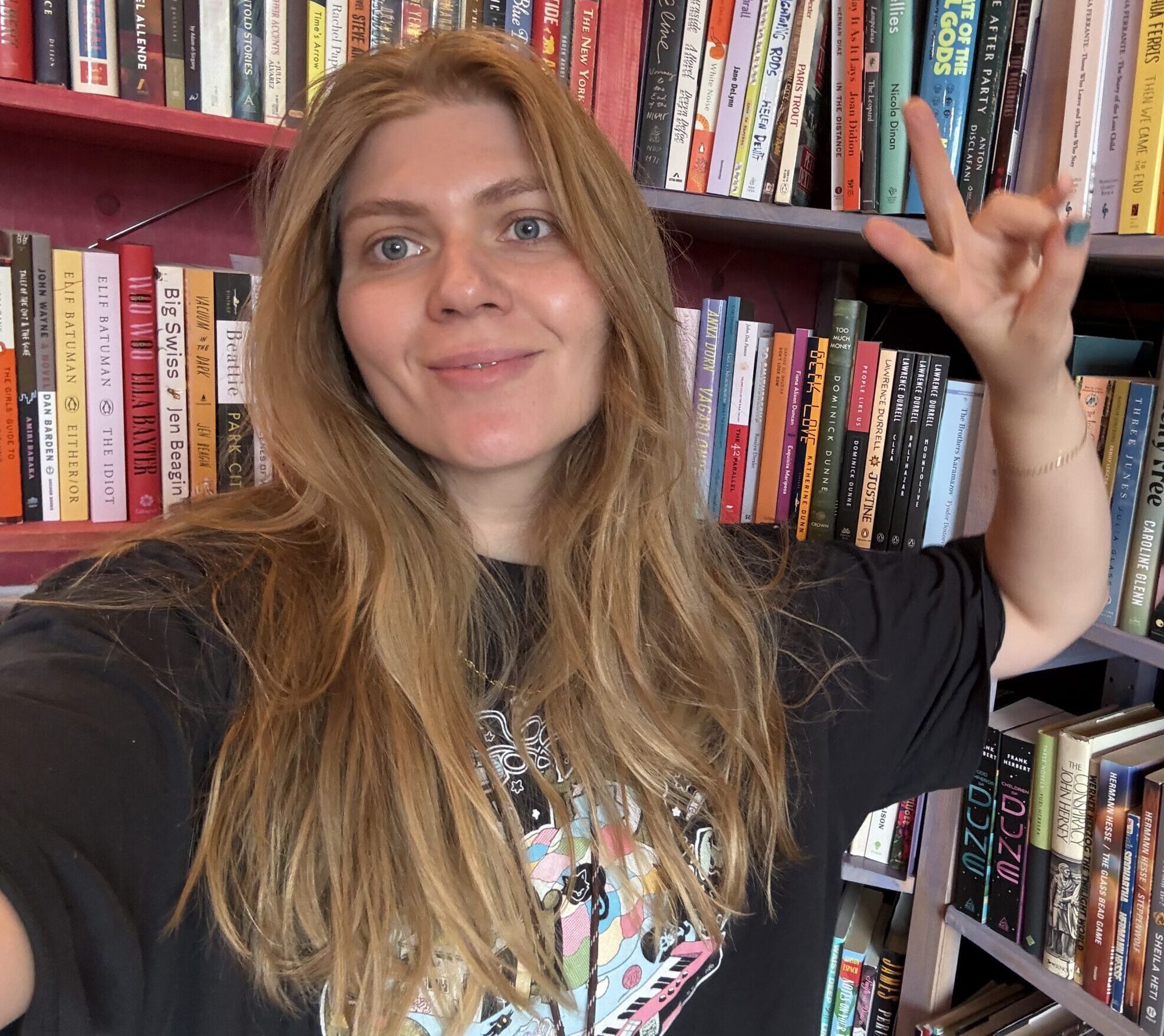

Photo courtesy of Claire Carusillo.
Two decrepit crones hit the road, telling a possibly tall tale with verve. They’ve survived not one, but two shipwrecks, experiences they alchemize into a vaudeville show in the early twentieth century. The eldest woman is an off-brand, drug-addled Ariel, rendered speechless by her viscous trauma and prone to moaning and opioids. She emerged improbably unscathed from the sinking of the RMS Empress of Ireland in 1914 with everything but her faculty of speech intact, even her prized beaver stole managed to survive. She ends up in a Victorian almshouse awaiting rescue by her daughter, who undergoes her own near-death naval experience en route. A few generations later, one of their diagonal descendants is a disgraced beauty blogger in our own era, whose foray into 23andMe sparks a long-forgotten cold case to go hot.
The narrator of this raucous, acerbically poignant novel, The Responsible Party, is said blogger, and she happens to share a name with its author, Claire Carusillo. When the novel opens, Claire the character is living with her mother Kath in the Chicago suburb where those wily old ladies raised her. When a cop shows up asking to swab some more familial spit, Claire starts asking her mother questions. Women speak in codes of all sorts in this book: morse, anguished groans, horoscopes. The narrative is a love letter to women’s care and communication, even when it’s been tainted by men, and murder, and money, forced into the kind of stealth familiar to any girl who’s ever sat two to a bathroom stall whispering secrets. Rife with roiling seas, spotlit stages, internet rabbit holes, true crime, fast friendships, shitty almost-boyfriends, lost virginities and rediscovered heirlooms, Carusillo’s story is a thrilling autofictional knot. The real Carusillo comes from a family of shipwreck survivors, but as I learned recently, she has never had a product recommendation go quite as awry as her character, and she works as a book-and-skate store proprietor as well as a writer. Last week, Carusillo and I met up in the appropriately carnivalesque, aquatic atmosphere of South Street Seaport to discuss trash, religion, Gwyneth Paltrow, Grey Gardens, hysteria, lying, and more.
THURSDAY 11 AM AUGUST 20, 2026 SOUTH STREET SEAPORT
———
EMMELINE CLEIN: You have described this novel as “disrespectful historical fiction.” It is that, and it is absurdist miniseries bait, and earnestly satirical autofiction. What does genre do in this book?
CLAIRE CARUSILLO: I thought about this recently because someone asked me a question about my background as a blogger, which is not a job that exists anymore. It captures a certain micro-era, in that I originally wanted it to be a beauty blogger’s voice taking on a historical mystery. The prose became flouncier than what I would use as a blogger, but that is the perspective I was trying to nail. In some ways, that voice is disrespectful to history, and it’s autofictional too, but it’s also all a lie.
CLEIN: Lately, I’ve been wondering if we’re in a slightly post-white girl autofiction era. Obviously they’re still at it—nevertheless, she persisted—but I felt like you were sending up the genre with nostalgia.
CARUSILLO: A lot of autofiction that I’ve read and enjoyed is pretty quotidian: a lot of quiet stories about girls with neuroses navigating love and life. It was never something I found I had any knack for. I lived in New York when I was writing this book, and I was living the same lives as a lot of people in those autofictional stories, but I never wrote about my actual life. The joke of the book is the narrator who is telling an autofictional story has had absolutely nothing interesting happen to her until she is prompted to look back into this epic story of her ancestors. It’s a story about ancestry with an autofictional wink, which is a way to make a character whose name is the same as mine seem more interesting when nothing has ever happened to her.
CLEIN: She’s committing grand theft generational trauma from an early e-girl perspective, if you will. Do you think inherited trauma is stolen valor or the body keeping the score here?
CARUSILLO: It’s about mining generational trauma to tell a more interesting story. And yet, if the body’s keeping the score, it’s already there. The satire bit is interesting because that’s not something I ever thought this was until a few people have called it that. I’m like, wait, what am I satirizing?
CLEIN: I thought you might have been satirizing—and elegizing—that 2010s blogger cadre, the vocal fry intelligentsia?
CARUSILLO: It’s funny, the nostalgia part of it. It took me so long to write this book that though it might seem nostalgic now, at least for a while the writing was simply true to the moment. I’m about to turn 35, and the narrator in this book is 31, and that is because I wanted to split the difference between the age I am now and the age I was when I started it, which was over eight years ago.
CLEIN: This book is also about beauty, but where most novels engaged with beauty standards obsess over the male gaze, these characters are trying to impress their crazy aunt or a stranger on the internet, experiences that are written about less but are often just as formative to our aesthetic identities.
CARUSILLO: This book is about beauty in the sense that everybody is always striving to be more beautiful, and the characters are shilling things as part of their ultimate pursuit of that. Men are mostly written out of the book, for comedic effect. Most of the evil that’s done in this book is by women, sometimes even by seemingly unsuspecting elderly women. They’re all trying to reach for a level of fame, beauty, or composure that they can’t really access for themselves, but see a very nearby model or paragon they’re trying to emulate.
CLEIN: There’s a female hysteria thread in this book, which is an illness that often involves unreliable narration. For women, when is lying about who you are and what’s happened to you a way of coping with your life circumstances? How did you get interested in Victorian women’s ailments?
CARUSILLO: Last night at McNally Jackson, I read an excerpt from the old-timey section where the older generation, Sarah and Fanny, get involved in the medicine show circuit. In an autofictional way, while I was writing, I was working as a beauty writer—shilling goos at all times. I’ve always been very interested in hucksters and magic bullets. The character with the name Claire almost kills a girl: a reader follows her supplement recommendations and literally turns blue. I wanted that to be an echo of her ancestors getting involved in the patent medicine scene and selling dangerous products. All of these women are victims of advertising, but also shilling snake oil on their own. In college, I was a women’s studies major. I read a lot of Victorian literature written by women, who often write about these strange nervous disorders.
CLEIN: Me too. This is an extremely safe space for finding seizing and fainting incredibly compelling.
CARUSILLO: I love Charlotte Perkins Gilman’s story “The Yellow Wallpaper.” There’s a passage about a smudge along the wallpaper, which means she’s probably been crawling around in circles, but there are also allusions to there being chains on the walls, and you don’t know if it’s a kid’s jungle gym or if she’s insane in there. I love when you’re not sure whose head you’re in.
CLEIN: Right, the only thing chicer than a woman seizing is a woman hallucinating.
CARUSILLO: Exactly. Tangent, but two months ago I opened a bookstore and skate shop.
CLEIN: Congratulations. I saw this, it’s called Storyboard, right? I was wondering if that was a surfboard reference, riffing on surfing the waves that caused all your ancestors’ shipwrecks?
CARUSILLO: No, it’s about skateboards and storylines. It’s a pun some seventh graders my boyfriend was teaching thought was clever. We’ve been together about five years, and he taught me how to skateboard.
CLEIN: Wow, so you’re coming out as a pick-me after writing an entire book about vaudevillian girls’ girls? Are you posting Instagram Reels of yourself skateboarding?
CARUSILLO: I guess so. [Laughs] Especially because, when I was learning how to skate, I was posting. You’re not going to see me body barreling though. Wait, what was I saying about “The Yellow Wallpaper”? Since I’ve been a bookseller for two months, I’m finding—and I don’t spend any time on BookTok or Goodreads because I’ve been told it’s bad for my mental health—but it seems like the girls are rediscovering The Bell Jar in spades. What I really want to tell them is, read “The Yellow Wallpaper.” First of all, it’s shorter, and second of all, the aesthetic is cuter. But yeah, I like to cruise.
CLEIN: Fabulous aquatic connection. Oceans and lakes play a central role in this book. They are watery graves, but also escape routes and disguises.
CARUSILLO: The oldest generation of women in this book, their big moment was on the ocean. And then the next generation down, her big moment in the book is on Lake Michigan, which is a smaller body of water. It’s one of the Great Lakes, but it’s also landlocked. I thought it was a really funny idea: a nautical novel taking place in Illinois. Somewhere there is a lot of water, but there’s no maritime culture to speak of. The big thing in the narrator’s life is this creek that’s dried up. I wanted everybody’s relationship to their own body of water in this book to be dwindling and desiccating. At the same time, this is a book with a lot of wetness in it, a lot of humidity, and a lot of products that are wet. But there’s also a lot of climate panic going on too.
CLEIN: Before we leave Victorian times behind, and since we’re proving to be two relatively verbose women, I want to talk about the Victorian ‘Scold’s Bridle’ machinery used in this book.
CARUSILLO: That’s real. It is a deranged device. It’s literally a cage put around a woman’s head to keep her from speaking. Someone asked about this last night, and I think I said that it was used until the 1940s. I actually have no idea if that’s true. And in my book, a character has it used on her because she can’t stop moaning.
CLEIN: No one wants to hear a woman whine. Now they just shadow ban us. Why is metal headgear sounding refreshingly straightforward? Gossip is a mode of oral history here, which made me wonder how working as a gossip blogger at Gawker informed your stylistic choices?
CARUSILLO: If we’re using the throughline of disrespectful historical fiction, that is all that gossip is, really. I do think bringing that tone to not only history, but also things that actually happened in my family is very funny, but also that is the way in which I’ve heard these stories. The shipwreck stories are all true to my family’s history. What happened after, I totally fabricated: the vaudeville plot, the salad crisper spray invention, my mom is not named Kath, and I’ve never sent anyone to the hospital with my product recommendations.
CLEIN: You still have time. Gwyneth [Paltrow] is supposedly hosting a dinner for Sam Altman in Amagansett, so I’m sure you could crash that and recommend someone a dangerous peptide.
CARUSILLO: True. Actually, another part of the novel that is true is that I went to the Goop conference many years ago in Culver City for a story. I got a 23andMe sample kit and, without thinking about it or telling my family, I submitted my sample. My family was so mad at me, and it was funny because their reaction did make me suspicious. The Gwyneth of it all is part of this, and she’s a spark of inspiration for this book.
CLEIN: I got Grey Gardens energy while reading this. Do those divas mean anything to you?
CARUSILLO: They mean a lot to me. I watched that movie in middle school, and it was a really early example of something that gave me a different model of womanhood than I was used to. It wasn’t inspiring, it really freaked me out. There’s a long tradition of two spinsters living in a decrepit house that I find really interesting. I also love the idea of making it Midwestern. Big and Little Edie are the pinnacle of WASPs. And my family is not WASPy. I actually learned last night that I was baptized Catholic. I had always been told that my mom got into a fight with a priest and so I couldn’t get baptized. But I learned last night that though she did get into a fight with a priest I was still baptized because my siblings were.
CLEIN: Wow. A Catholic pick-me skateboarder?
CARUSILLO: Yeah. Isn’t that crazy? It’s very intellectual to be Catholic lately. And it gets better: I’m Italian-American.
CLEIN: There’s a poignant moment when the narrator is listening to her mother tell a story, and thinks to herself “I’ve got questions, but I let her keep talking.” How do you see the identities of journalist and daughter intersecting for this character, and you?
CARUSILLO: My mom gets so annoyed with me, because every time she starts a story I’m asking 12 follow-up questions when all she wants to do is get six sentences out. She would be telling me an anecdote about working at McDonald’s when she was 14, and I’d be like, “Wait did they have jungle gyms back then with ball pits?” And she’s like, “This has literally nothing to do with my emotional journey.” I’m always trying to create a scene in my head. A lot of the back-and-forth between Claire the character and her mother in the book is modeled off of the way that I don’t let my mom tell stories and the way she thinks she does tell me stories, but I’m always interjecting with my own examples or trying to co-opt her story into something that means something about myself.
CLEIN: The type of theater and writing these characters value could be called “trashy”—which I mean complimentarily, of course—and one of their favorite modes of storytelling is gossip, which often gets demonized as trash, and one of them even invented a product that indirectly led to the creation of a trash heap in the ocean. What does trash mean or do in this book?
CARUSILLO: There’s a lot of “trash” in the book to move through. There are prior generations that hoard what we might call trash or litter, and there are pieces of trash that survive unexpectedly—a box of teeth or some ratty, old stole. In the very first lines of the book, the narrator mentions a basement memorabilia pile that was flooded before the narrator was born, which maybe happened and maybe didn’t. You’re supposed to wonder, did her mother destroy that? There is also a lot of record-keeping that looks like trash in the book. The older womens’ kitchen has clippings all over it. These people carry quite a lot of trash with them, especially when they’re on the road in the vaudeville, but is it trash if it’s become precious and saved trash?
CLEIN: This book has magicians, housewives, journalists, dynastic families, and a lot of twists, so I came up with a demented version of MFK vaguely inspired by your novel. Marry, Fuck, Kill or Interview: Harry Houdini, Hunter Biden, Andy Cohen, Gwyneth Paltrow.
CARUSILLO: I’d fuck Houdini. Obviously, he was really sexy. Very sexy, gone too soon. I’d marry Gwyneth. Great lifestyle. Kill Andy Cohen. Hunter is a chestnut, and I think I could unlock him. I mean, verbally. So I’m interviewing Hunter, and we’re going to get to the bottom of some things.
CLEIN: Is there anything you haven’t been asked about this book that you wish someone would ask?
CARUSILLO: People have wondered what’s true in this book, but not a single person has been like, did your mom kill someone? So I’d like to say, on the record, not that I know of.
