

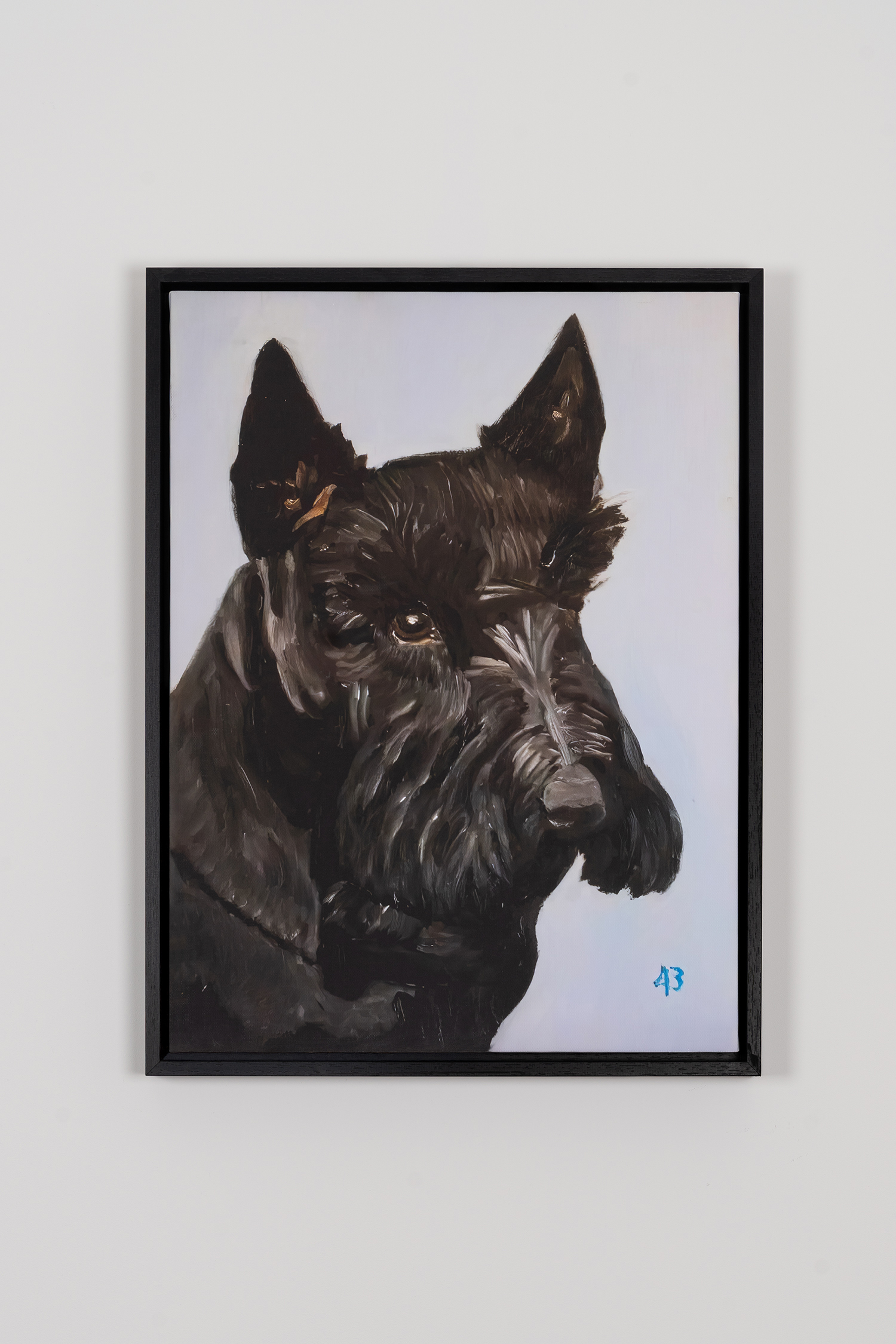

Photo courtesy of Ferrari x2.
Writer Sofia Hallström goes hunting for answers about London’s newest, most mysterious gallery, Ferrari x2, that boasts shows with major artists like John Baldessari, George W. Bush, and Louise Bourgeois. The gallery hosts exhibitions that most people will never see, and maybe never happened at all.
———
“Meet me in West Brompton at 8pm.” I receive this mysterious text on Sunday night of the World Cup final between Argentina and Spain. London is sat in front of screens across the city bracing for ninety minutes of collective anticipation, and somewhere in the middle of all that—allegedly—there’s a joint exhibition happening between former US President-turned-amateur painter George W. Bush and French-American artist Louise Bourgeois, whose work excavated childhood trauma, the body, and sexuality. The combination is transparently unhinged. It’s showing at Ferrari x2, the year-old, deeply enigmatic gallery with no information about it published online. My friend and accomplice for the evening RSVP’d and was sent coordinates in West Brompton where he was told a black car arranged by the gallery would collect us and take us on to the exhibition. It’s 7:13 pm. I’m in Paddington, a short journey from West Brompton. Neither of us knows where the gallery actually is. I am, in the parlance of spies and idiots, going in blind.

One of the cars that arrived to the coordinates but wasn’t a Ferrari x2 car.
Every stranger on the street is suddenly suspect. Is that woman heading to a Ferrari x2 car too? Does the man walking his dog have Ferrari x2 credentials I don’t? I know gallerists who RSVP’d weeks ago and still haven’t received confirmation. At the meeting point, I do the only reasonable thing I can think of: start asking parked cars where they’re headed. I lean into tinted SUV after tinted SUV like a deranged concierge, and the drivers are understandably baffled when I admit I have no idea where I’m going. “You’re going to a George W. Bush exhibition?” That’s right, sir. Dubya, best known for his involvement in the Iraq war, is now a painter. Neither of us knows what to do with that information.
Meanwhile, my accomplice is hurtling across the city from Hackney, arriving at 8:14 pm. The car that was supposedly coming for us has gone. Un-turn-back-able, according to the gallery, which communicates via curt, one-line emails. At this point, we know no one else going. Most people I’ve been in contact with haven’t even heard of this gallery, which I’ve now decided has dialed up its entire business model to a paranoid, smoke-and-mirrors extreme that would make a Berlin nightclub bouncer blush. We wait on the pavement watching BMWs and Mercedes glide past sleek, smug, and never for us. “It’s pretentious,” texts a journalist friend with the weary authority of someone who has seen this exact bit done a million times before.

Defeated, art world contacts exhausted, and dignity in tatters, we trudge back to the tube like two people who lost a scavenger hunt with no prize. In a last, unhinged act of detective work, I open Find My Friends—genuinely the greatest app ever built—to locate another friend I know is also trying to attend the private viewing. He’s in Bethnal Green, site of the last Ferrari x2 opening, which is odd since I know he lives in West London. I call him. No answer. I decide to go to Bethnal Green to see for myself.
By now, the city has emptied into pubs and I am alone on the eerily silent streets of East London, chasing a rumor of a gallery that may or may not exist, for art that may or may not be real. The map pin blinks when I arrive. It’s a quiet, residential back street lined with Victorian conversion flats. A couple of lights are on upstairs, but all the curtains are drawn. No black Mercedes in sight, no bouncers. I stand staring up at a building that has never hosted an art opening and, from the looks of it, never will.
My accomplice has, by this point, sensibly abandoned ship. Before leaving, he fires off one last piece of intel—the number of a journalist who covered the inaugural Ferrari x2 show with John Baldessari last year. It’s 10:30 pm on a Sunday. I throw a Hail Mary and call the number anyway. At this point, I’ve lost all common sense.
“Hello?,” a slightly bewildered French man answers the phone and is immediately suspicious of me. I launch into an explanation of my situation, asking for the location. “Was it here? Do you remember? Please?” I am begging a stranger for scraps of information, and he hangs up. It would be rude, if it wasn’t so exactly and totally understandable.

Undeterred—or possibly just too far gone to feel shame anymore—my accomplice pivots to email, because if you can’t reach a man by phone at 10:30 pm, naturally, the next best move is to write to him. “Sorry for the late email, long story short, Sofia is on a wild goose chase looking for the mysterious Ferrari x2 address. She’s currently in Bethnal Green. Do you have the address you initially had or remember the street?” An hour later, by which point I have long given up cosplaying as the world’s least convincing private investigator, he replies. He thinks the gallery has moved to a new, undisclosed location. Somewhere out there, Ferrari x2 is having its George W. Bush and Louise Bourgeois opening in a location I will never find, whilst I am standing on a residential street in Bethnal Green holding nothing except for, increasingly, a grudge.
A week later, the gallery gets in touch to arrange a car to take me to their space so that I can see the show. The day before my visit, they email: “Dear Sofia, I am sorry to inform you that after an incident yesterday that resulted in a condition issue with multiple artworks, we have made the difficult decision to close the exhibition prematurely. Unfortunately, this means we must cancel all upcoming visits, including your booked slot…” I am instead put in touch with the gallery’s mononymous curator, Neil. His assistant can’t promise me more than five minutes on the phone with him. It’s 4 pm on a Wednesday when he calls a week later. He’s in a busy restaurant and speaks in a slightly dubious, soft American accent.

Photo courtesy of Ferrari x2.
NEIL: Hey, listen. I’m so sorry. We’ve got five minutes here, so please fire away.
SOFIA HALLSTRÖM: What made you want to bring Louise Bourgeois and George Bush together in this exhibition?
NEIL: We like working on dual shows, but there isn’t a huge amount I can tell you beyond that. The show was interesting, and I was really pleased with it. It was more a question of relational aesthetics than about the specific works themselves. Actually, part of why we wanted to speak to Interview magazine is because we’re great admirers of [Andy] Warhol, and we’d love to put on a show connected to him. The difficulty is finding the right artist to pair him with.
HALLSTRÖM: So you’re looking for an artist to pair with Warhol?
NEIL: Potentially, yes.
HALLSTRÖM: Right. I wanted to ask about Ferrari x2 as there’s no real paper trail or public address. Is that a deliberate, performative element of the gallery?
NEIL: We don’t feel we need to give away more information than is strictly necessary.
HALLSTRÖM: I’m curious who the audience for Ferrari x2 actually is, given how hard it is to find the gallery.
NEIL: That’s a very good question. I’ll leave that to your imagination.
HALLSTRÖM: How would you describe the guiding philosophy behind Ferrari x2? What kind of identity are you trying to build as a gallery?
NEIL: We want to see how it evolves, put it that way.
HALLSTRÖM: Could we talk a bit about the vandalism? What happened?
NEIL: I’d call it an accident.
HALLSTRÖM: An accident from within the team, or external?
NEIL: I can’t really discuss that, I’m sorry.
HALLSTRÖM: Was it vandalism actively targeting the George Bush paintings specifically?
NEIL: I can’t discuss it I’m afraid.
HALLSTRÖM: Please could you tell me a bit about the team behind the gallery?
NEIL: We had some difficulty with another magazine and we weren’t happy with what they wrote about us. It made us fairly wary of working with journalists. As I mentioned, we like Interview and Warhol, and we looked into your work and we like it too. It’s not antithetical to what we’re trying to do. So I hope that explains my reluctance around some of these questions, and I’d appreciate it if we could move on.
HALLSTRÖM: Of course, I understand. Are you more comfortable speaking about your relationship with George’s work?
NEIL: Those works came from private lenders and the emphasis, I’m afraid, is on the private part of that.
HALLSTRÖM: Was it the same with the Bourgeois artworks—also private lenders?
NEIL: Yes.
HALLSTRÖM: I’ll leave the artist questions there then. I’m interested to get a bit more insight into the exhibition itself, since I wasn’t able to see the show. Please could you tell me a little about the artworks that were on display.
NEIL: I will send you photographs of the show.
HALLSTRÖM: I’d like to ask about the team behind Ferrari x2. How did you all come to work together?
NEIL: We’ve all worked in various areas of the arts industry, and we’re committed to professionalism. We’re a close-knit team.
HALLSTRÖM: Are all of you involved in the curatorial decision making?
NEIL: You’ll find out.
HALLSTRÖM: What does that mean?
NEIL: We just work well together.
HALLSTRÖM: What’s next for Ferrari x2?
NEIL: We have to go, but we’ll invite you to the next show.
HALLSTRÖM: Thank you, I would love to hear what’s next, if—
NEIL: I really appreciated your questions, I’ve got to go. It’s been a pleasure.

Empty streets in Bethnal Green.
Ferrari x2 reminds me of The Shed At Dulwich, the fictional restaurant a Vice writer built out of his garden shed in south London in 2017, turning it into one of the city’s top-rated restaurants on TripAdvisor with a handful of fake reviews. Both prove that scarcity and secrecy can manufacture desirability with no real substance required. If you’re not going to let people see the thing, you only invite more questions. It doesn’t make the art world look clever so much as expose how much of its authority rests on people either being denied access or simply not checking. Bush, of all people, should know how that works. Nobody ever found the so-called weapons of mass destruction either.
The same week Ferrari x2’s show opens, I’m invited by Soho Reading Series to do a live in-conversation with author C.D. Rose about his novel We Live Here Now, a slyly satirical take on the art world built around a fictional artist, Sigismunda Conrad, famous in part for being untraceable. The book never resolves whether one of her works has actually vanished, or whether the disappearance itself is the piece. Spending an evening trying to physically locate a gallery with no address, you start to wonder the same thing: was the show ever really the point, or was it the hunt? There’s a scene in Scorsese’s 1985 film After Hours where two art punks size up a sculpture: “The art sure is ugly, man.” “That’s how much you know. The uglier the art, the more it’s worth.” Mystery is the currency. There’s something pointed in choosing a former president with his own well-documented war record to show his paintings of dogs in a gallery nobody can find. Some questions, it turns out, are easier to ask when there’s no address to knock on.
By the time I’d been passed between a gallery assistant who wouldn’t confirm a location and a curator who wouldn’t confirm a story, I’d stopped asking whether the show created an engaging curatorial dialogue, and I started asking whether it happened at all. I’m told, secondhand, that an Italian journalist did attend the private view. So something was on the walls, but was it the exhibition that was advertised? Ferrari x2 seems happy to leave that gap open. That’s the business model. In an age when the concept outruns the object, a rumor of a show performs almost as well as the show itself. So it barely matters whether Ferrari x2 is a gallery, a ruse, or performance art—the ambiguity is its operation.

Photo courtesy of Ferrari x2.
