

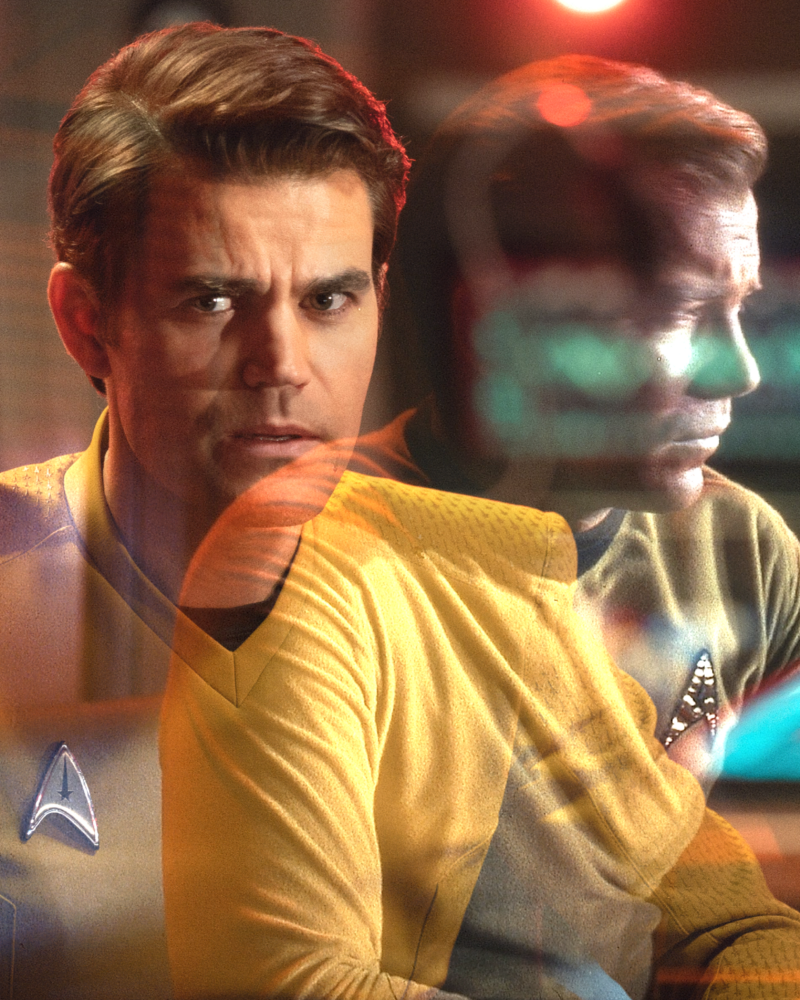

All photos courtesy of Paramount.
Two Captain Kirks fifty years apart enter a Zoom chat. Both Paul Wesley and William Shatner have played the iconic Star Trek character on screen, in 2022’s Star Trek: Strange New Worlds and the original 1966 series respectively, but each managed to make the role completely and unforgettably their own, capturing new generations of fans across the decades. Both actors credit their youthful confidence with initially securing the part, but their willingness to experiment and delve deeper into Kirk’s psyche with keeping it Ahead of the Star Trek: Strange New Worlds season finale this week, Wesley and Shatner compared notes on the audition process then and now, learning to trust their craft, and not overthinking where your career takes you. Even when where it takes you is to the far-flung reaches of outer space.
WEDNESDAY 1:13PM AUGUST 12, 2026 LOS ANGELES
———
PAUL WESLEY: Bill, how are you?
WILLIAM SHATNER: So well. Yourself?
WESLEY: I’m good. It’s lovely to see you. I’m really happy to be doing this with you.
SHATNER: Great. Me too.
WESLEY: I guess I’m kicking it off.
SHATNER: Why not?
WESLEY: So 60 years later, do you remember the moment that you found out that you got the part on the original series? And not knowing the Star Trek universe would live on for another 60 years, what journey did you think that you were embarking on at that time?
SHATNER: Well, my story is Paramount made a previous pilot with another actor. Do you remember his name?
WESLEY: Yeah, Jeffrey Hunter.
SHATNER: Right, Jeffrey Hunter—very popular, good-looking guy, really wonderful actor. And they cast him as Captain Pike, wasn’t it? So they made a pilot, and they had all these characters, including Spock who smiled a lot. Nobody quite grasped the character they were going to play. They presented it to NBC, and NBC said, “We don’t like it, but it’s sufficiently interesting and curious and different.” And then they said something that I’ve never heard of before or after. They said to Paramount, “We’ll give you another amount of money”—whatever that was—”to make another pilot, but rewrite it, do another draft of another script, and recast it.”
I was in New York and they called me up and said, would I come to L.A. to take a look at this pilot with the idea of playing the captain? So I came back to Los Angeles, saw the pilot, and thought, “My gosh, that’s really different and interesting.” They recast everybody except Leonard [Nimoy], who grasped the role, made it his own, and we made another pilot and this one sold.
So all that premature stuff that so many actors have to go through to see whether management wants them to play the part, I didn’t have to go through. I was doing a lot of TV out of New York, and I suppose they had seen enough of me to make a conclusion based on everything I had been doing. So we begat Star Trek on that pilot.

WESLEY: And when you finished the pilot, did you have a sense that it would be what it ended up being? Or did you just kind of go, “Okay, well, let’s see what happens,” and move on?
SHATNER: Well, I came out of Canada and I was living in New York doing live television. I was very popular in live television because I had spent my whole life being on stage in front of an audience. So I had many, many years of being an experienced actor in contrast to so many of the young men that would’ve competed for the same thing I was, who either had never acted before, or were models, or had been in university on stage. So when I was working in New York, I got a lot of offers because I had a certain experience, an equanimity about hitting marks and stuff like that. What about you? What’s your experience like going to audition?
WESLEY: Well, I started acting at a pretty young age. I got my first pilot when I was 16, I tested in L.A., and after that I decided to stay. That pilot didn’t get picked up. I would sometimes do five auditions a day. You’re just throwing darts at a wall and seeing what sticks.
SHATNER: And what was the audition process? Because now I’ve discovered that actors film themselves and send the film [in]. I mean, the studios are all over the city, you arrive at the audition wet with sweat trying to find this little office that you’re supposed to be at. Now, of course, you got a GPS system.
WESLEY: But there’s a certain romanticism and nostalgia to that. Because now, I’ll make tapes and I’m trying my best to connect with whoever the heck it is that is going to be watching it, but I don’t know who’s watching it. I grew up doing theater, and I miss the feeling of walking into a room a complete underdog and seeing 20 guys that look exactly like you and going, “I’m going to steal this role and I’m going to take this energy from the room.” You don’t have that luxury anymore. Everything’s digital. I miss that.
I mean, the last pilot season I did was when I got The Vampire Diaries, and then I haven’t done one since. I did that show for eight years and it was a huge success. I think about so many actors that are so wildly talented that I remember I used to see in those rooms and they didn’t get as lucky. They didn’t get a show that really popped and became a bit of a phenomenon.
SHATNER: What do you think was the difference? What do you think was the reason you popped in and got it and they popped in and didn’t get it? Have you ever analyzed that?
WESLEY: I have. When you’re young, you don’t overthink as much. I used to go in with a sense of ownership—not for every audition, but for the ones that worked. I knew the role was mine before I even got it. I just felt it in my body. And I think there’s a way to transmit that confidence in a room full of people.
SHATNER: And that’s the word that’s very operative. They are unsure of themselves anyway.
WESLEY: That’s exactly right.
SHATNER: Deeply unsure of themselves and then superficially unsure of themselves. “I don’t know whether that actor’s going to do it. Will he blow up? Can he play it?” They are very unsure of themselves and in many cases, I’ve discovered, rightfully so. They should be unsure of themselves because they didn’t know what they were doing. So if somebody comes along with an air of, “I’ve got this and here’s what I will do. I, the actor, will take care of you.” They’ll cotton to that even without knowing it.
WESLEY: That’s right. And I think what you did with Kirk, you had such a confidence on screen. You had such a sense of ownership of that character, and you were the captain. They needed that. They needed someone who they felt would be someone that the rest of the crew would listen to. And there would be no doubt in the audience’s mind that was the captain of that ship. That is the thing that differentiated you from everyone else, in my opinion. I think that’s what they saw, and that’s why they cast you.

SHATNER: Although in my case, in this particular role, he said, “Would you like to play it?” And I said, “Yeah, maybe.” Because in that pilot, I was attracted to the magic, the imagination behind that pilot with the swollen heads and the pulsing. It was such wonderful makeup. It was intriguing from many points of view. I saw what NBC must have seen, a certain pomposity, a certain, “To the starboard, sir.” That character was just in my wheelhouse, I guess.
But there was a magic about the pilot, and that became the magic of Star Trek that caught the imagination of the audience. Spock with his ears—the first thing they said with Spock is, “Get rid of the ears.” And bless our management, they said, “No, we’re not getting rid of the ears.” And the ears being an example of the crazy magic of science fiction. You can have weird people coming out of a rock and saying, “These are the people who live on this planet,” and accept it because you don’t know who’s living on that planet in the sky.
WESLEY: That’s amazing.
SHATNER: That science fiction magic was a big propellant in the popularity of Star Trek.
WESLEY: Yeah, I think it was a curiosity and escapism that people were yearning for.
SHATNER: I know they’ve fixated on a group of questions for us. I’m willing to carry on—
WESLEY: Throw it out the door.
SHATNER: —a conversation that they’ll bite their nails at, but I think the audience would be more interested in what we have to say.
WESLEY: I think so as well.
SHATNER: So tell me, how did you get it? What was your reaction? Can you remember specifically what they said? Telephone rings, you pick it up. “Hey, it’s Paramount.” Your heart’s in your mouth. Are you going to be able to send your kids to college or not?
WESLEY: It was an odd experience for me because it was actually a little bit similar to yours. I had finished my series. I did Vampire Diaries for eight years, and then I did another series after that for two years. Then, I was sitting around figuring out what am I going to do?
SHATNER: What were your choices in terms of what you want to do? Does that mean do I want to act, or do I want to sail a boat?
WESLEY: No, it’s not like my phone was ringing left and right and I was getting 90 offers a day. It wasn’t that kind of thing. It was more, what can I do next that makes sense for me?
SHATNER: You mean like a career move?
WESLEY: Yeah.
SHATNER: I disregarded career moves. My belief is life is such an accident that for you to be able to choose something and say, “Well, I’m going to go do that,” is like an exercise I’ve never done.

WESLEY: I totally agree with you. So many people ask me like, “Well, what’s your advice?” And I said, “I don’t have a lot of advice because, at the end of the day, you’re sitting at a blackjack table and you’re waiting to get 21.” And the reality is, we all need to have a little bit of luck. You can plan all you want, but at the end of the day, luck is such a huge part of our lives, especially in the entertainment industry. So to answer your question, I couldn’t find it. I wasn’t like, “Oh, this is what I want to play—Kirk.” It didn’t even occur to me. I was a little bit lost.
SHATNER: Wait a minute. What do you mean you were a little bit lost? You’re either lost or you’re not lost.
WESLEY: Oh no, I was lost.
SHATNER: Okay. And lost in what way?
WESLEY: I was lost in the way that I felt defined by the show that I had done for many years, which became a big—not as big as Star Trek, of course, but it still had an impact and it had some pop-cultural significance. People only looked at me for that character, and the character was not as sophisticated as…I’m not trying to disparage the show, but it was appealing to a younger audience. It was a much more teenage, a lot of girls, and I was a 30-something-year-old man at that time. I was trying to [figure out], “How can I be more expressive of who I am, which is not this angsty teenage drama?” And I couldn’t find it. I was still searching.
SHATNER: Forgive me, dear, because it’s so interesting and intricate. You are conditioning you’re lost by saying, “I was a little bit lost.” But what does that really mean psychologically in you, being lost?
WESLEY: I guess I felt defined by the role.
SHATNER: And you didn’t want to be defined that way?
WESLEY: I suppose not. I suppose I wanted to understand the next chapter. Because unlike you, we weren’t doing movies of the series. It was like that chapter had closed, and I was still hungry as an actor, but not to do just anything. I wanted something special.
SHATNER: Could you define that?
WESLEY: Something with the magic that comes once in a lifetime to an actor where something has meaning to others—a deep meaning to others and a true impact.
SHATNER: I’m not sure you can see that to begin with.
WESLEY: I know, you’re absolutely right. You’re trying to find something that’s perfect.
SHATNER: Exactly.
WESLEY: You’re chasing this elusive thing rather than creating something.
SHATNER: That’s exactly right, because it’s totally malleable.
WESLEY: It’s a really good lesson in creativity, actually. It’s a good lesson in understanding that you can make something out of anything.
SHATNER: Because there are people who think like you. There are the producers saying, “Hey, we can’t spend any more money.” But you’re saying, “No, not more money. Just react with a sadness or anger at these.” So you write another couple of lines, and slowly you build a character that has characteristics the audience will recognize. Within those 13 shows, you can twist the character a little, is my point.
WESLEY: Yeah, and at the time before I got the call for this show, I was definitely feeling like a bit of a lost wanderer. But I got a call from my agent and he said, “Hey, you want to talk to Akiva Goldsman on Zoom?” Akiva and Henry Alonso Myers, the two showrunners of Stranger Worlds. I said, “I know who Akiva is and he’s an incredible writer. I would love to get on the phone, but what is this about?” “Oh, it’s Star Trek: Strange New Worlds.” And I hadn’t seen it. I said, “Yeah, sure. I’ll get on the phone.”
SHATNER: Did your heart leap or did you think, “Meh”?
WESLEY: No, I was kind of like, “Why do they want to talk to me?” And then when they said, “It’s for Kirk and they only want to talk to you.” I thought, “Well, this is crazy.”
SHATNER: Why is it crazy?

WESLEY: Well, because you doubt yourself. And here I am searching for this ambiguous, amorphous thing that I think I’m going to suddenly create myself, which is so silly of me. It’s so naive and egotistical. Then suddenly, you get a call and something’s just put in your lap in this bow. And you’re like, “Kirk?” I get on the Zoom with them and we’re chatting, and I’m just like, “Hold on a minute.” I was like, “Guys, nobody has played Kirk on television other than William Shatner. This is a very big deal.” It didn’t dawn on me until I said those words. Saying it made me feel this immense whoa, butterflies in my stomach kind of thing. In any case, it was a Zoom and I didn’t audition for it. They wanted to talk to me and they wanted to just understand who I was, and they wanted to talk about the character and my connection to the character. That’s how the whole thing went down.
SHATNER: Wow. Have you started to film?
WESLEY: So I came in season one finale, and then the show’s been airing for a couple years now. We just started airing season four, and we’ve already shot season five.
SHATNER: No kidding?
WESLEY: The entire series is wrapped.
SHATNER: Are you younger or older?
WESLEY: Younger.
SHATNER: Everybody’s younger than me at this point.
WESLEY: Well, funnily enough, I’m older than you were when you shot your show. But yeah, so I’m Lieutenant Kirk on the Farragut, which is a neighboring ship.
SHATNER: Fantastic. I wish you all the best. I hope they renew and you enjoy playing it. I just wanted to be sure that you knew that I’ve got a podcast out there that I’d like to publicize a little. My daughter and I had stage four cancer three years ago. We both are cancer free, and we have a podcast going, and a couple of books, and a couple of movies, and stuff like that.
WESLEY: What’s the podcast? Where can we find it?
SHATNER: The podcast is called No Time But Now. It’s my daughter and I talking about live your life now, because I’m an authority figure on the limited amount of time we have to live. Make your life worthwhile by being aware because all the cliches are true.
WESLEY: Yeah. Well, I want to say how incredible it is that you both managed to beat this, just defying the odds.
SHATNER: [She had] breast cancer and I had melanoma. My friend, it’s been good. I wish you luck, Paul. I hope our paths cross. It’s been a joy to talk to you.
WESLEY: It’s been a joy to talk to you as well. Good to see you.
