

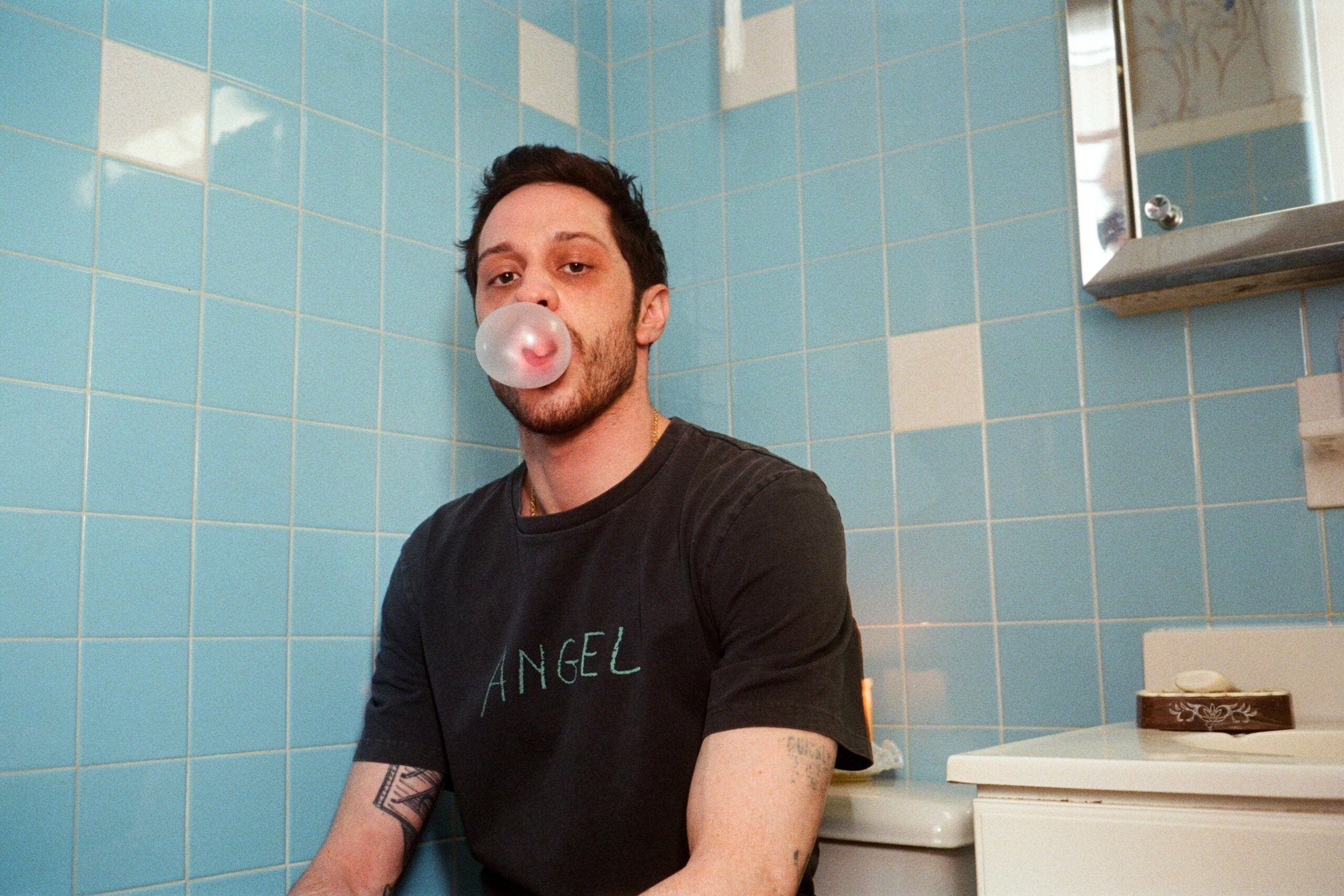

T-shirt stylist’s own.
Pete Davidson is one of the most talked-about comedians of his generation, but not always for the right reasons. During his eight-year stint on SNL, the famously Staten Island–bred comic’s offscreen exploits often threatened to overshadow his work. But beyond the headlines, Davidson has been steadily building a second act as a serious actor willing to take real swings, and How to Rob a Bank, David Leitch’s heist thriller about a crew of masked robbers who livestream their crimes, gives him one of his most dramatically demanding roles yet. To talk about where he’s headed next, he linked up with his friend Charlamagne tha God, who pressed him on fatherhood, legacy, and why he’s done being underestimated.
MONDAY 12 PM JUNE 15, 2026 NEW YORK CITY
———
CHARLAMAGNE THA GOD: P.D. What’s up, my guy?
PETE DAVIDSON: I’m good. Just put the baby in the stroller.
CHARLAMAGNE: Yo, I loved your new movie, How to Rob a Bank. I can’t believe you’re old enough to play a war veteran now.
DAVIDSON: It made me laugh when you texted me that, but it also made me feel like, “Fuck. What happened?”
CHARLAMAGNE: When you first read the script, what did you think?
DAVIDSON: This is not a cool thing to say, but I saw David Leitch, Nick Hoult, Zoë Kravitz, and John C. Reilly were all attached, and I just said yes. I didn’t read it until we started pre-production, and then I was like, “Whoa, this is pretty intense social commentary.” I think that’s a very tricky thing to do right now; no one wants to put their hand in that basket, but I knew if anyone could pull it off, it’s [the director] Leitch.
CHARLAMAGNE: Without giving too much away, it’s about a crew of bank robbers who broadcast their heists online for the public to watch.
DAVIDSON: Yes.
CHARLAMAGNE: The title is pretty self-explanatory, but these characters aren’t doing it just for clout, right? They’re doing it because they’re trying to survive. The big question this movie asks is at what point does desperation start to blur the line between right and wrong?
DAVIDSON: It’s a tricky thing, because these characters are committing crimes and definitely getting that dopamine rush from knowing everyone is watching every single move, but there is also a Robin Hood–type moral compass that makes you feel like they’re doing it for the right reasons. There’s a really cool part in the movie where all the characters are internally wondering, “Is this worth it? Are we still doing it for the right reasons?” It’s a really fine line, and that’s why you end up rooting for everyone in this movie. Rooting for everyone is very confusing, but the point is you like both sides.

Shirt Ami Paris. T-shirt Noah.
CHARLAMAGNE: Yeah, usually if you root for the bad guy, there’s a reason. Great movies justify why the villain is a villain.
DAVIDSON: Right.
CHARLAMAGNE: Why do you think that is? Why are audiences so willing to root for outlaws?
DAVIDSON: Historically, we always love an antihero. In real life, everyone has to toe the line and there are tons of repercussions if your actions go outside the law, so we’re like, “Fuck, I wish I could do that.” In movies, we get to live vicariously through a Tony Soprano or a Walter White. Leitch did a great job of not making this movie preachy and annoying—there’s no agenda being pushed, so it’s up to the audience to decide. That’s important in today’s social climate, because everybody’s fucking furious about the state of the world. Everybody has an opinion. A lot of people are struggling while a lot of people are doing too well, and there’s no happy medium. This movie is so current it’s almost—
CHARLAMAGNE: Scary.
DAVIDSON: It’s so scary. It’s the perfect time for something like this. The Luigi Mangione shit happened just before we started filming, and I was like, “How the fuck did they write this so goddamn fast?” But apparently it was written before. When we were filming it, we were like, “Is this still going to be a topic of discussion when it comes out?” I think it is, probably even more now.
CHARLAMAGNE: Yeah, it’s one of those things that comes out at exactly the right time. I was having a conversation with somebody this weekend and I was saying how I feel like at some point there’s going to be a great disconnect, and everybody’s going to get off social media because—
DAVIDSON: Ah, please.
CHARLAMAGNE: There’s a great book called Technofeudalism: What Killed Capitalism [by Yanis Varoufakis], about how these algo bosses monetize our emotions because the greatest cloud capital is conflict. If we know we’re getting on these platforms and they’re literally trying to stir us up on purpose just to keep us all in a state of confusion and conflict, at some point we’ve got to disconnect. I was saying this and my guy was like, “Well, how are we going to communicate with each other?” And I was like, “The same way we did before social media.” Art is going to play a big role in that, and I feel like that’s what this film does. This film gives a very distinct, clear message about where we are.

Shirt Todd Snyder. Sunglasses Thistles. Tie Paul Smith. Watch Pete’s own.
DAVIDSON: I’ve been saying this forever about social media. It’s fucking poison. I’ve never gone on social media and felt good after. I’ve never gone to look something up or check on someone or whatever and been like, “Oh, so glad I did that.” It’s a trap and you get caught. You go on initially to look at one thing, and then there’s another over here, another over there, and before you know it, you’re watching people get evicted from their homes. Anything to rile you up and get you pissed off. All this access we have through the phone is not fucking healthy or sustainable. It gets everybody anxious. I miss cordless phones and answering machines, and I hope you’re right, that there is some sort of reset. I heard the youngest generation are using flip phones, so hopefully that plays over.
CHARLAMAGNE: Was your baby born before you did this movie, or after?
DAVIDSON: I found out I was having a kid the week I said yes to the movie, and then it just so happened to be a little girl. It was pretty emotional because I also have a daughter in the movie. And yeah, it felt different, for sure.
CHARLAMAGNE: Amen.
DAVIDSON: It was the first time I ever played someone where I was like, “This is kind of trippy. This’ll actually be me in two years.”
CHARLAMAGNE: You play a father and husband who is dealing with a lot, on top of fighting lung cancer. What did that teach you about fear?
DAVIDSON: Well, I’m sober now, which is awesome, but it brought into focus that I will do whatever it takes to be here for my daughter. When you have a kid, as you know, because you have a bunch—
CHARLAMAGNE: Hold on, I got four with my wife. Don’t make me sound like Nick Cannon.
DAVIDSON: [Laughs] No, no, you have four traditional children.
CHARLAMAGNE: That’s right.
DAVIDSON: Yeah. You traditionally have four traditional kids with the love of your life that you’ve been with for—

Shirt Lee X J. Crew. Pants Drake’s. Watch Omega. Shoes Manolo Blahnik.
CHARLAMAGNE: Ever. That’s right.
DAVIDSON: I behave differently now. Every decision is different. You don’t really know how you’re going to feel until you have a kid. You’re like, “Am I going to be protective? Am I going to keep my shit together?” And for me, it’s easy because I look at her and I’m like, “Alright, I don’t want to fuck this up.” It’s a blessing. It’s also been great for work. Now we get offered stuff and I’m like, “How long am I going to be away? Is it worth it? Where are we shooting?” It’s put things into perspective. This shit we do doesn’t matter that much, really.
CHARLAMAGNE: Word.
DAVIDSON: That kind of hurt my ego a lot, too. I was like, “Man, I’ve spent a lot of time being life or death on dick jokes.” Like, “I will die on this hill.” And now I know this shit don’t matter at all, dude. This shit’s a fucking joke. Having my daughter is the best thing that’s ever happened to me for a billion reasons.
CHARLAMAGNE: Your character has a young child and you have a young child now. Did that aspect of the role make you think differently about legacy and what parents are willing to sacrifice?
DAVIDSON: Yeah. I have a lot to live up to because my dad is a hero, but it really made me think about shit. I want my daughter to be proud of both her parents. When she starts going to school and having friends, I want her to be proud of where she’s from, and I want her to be comfortable and feel safe. Not having a dad growing up has definitely made it a lot more real, because I’m going to get to see things with my kid that my dad didn’t get to see. I’m very excited to get that experience.
CHARLAMAGNE: Did it scare the shit out of you when you went back and watched this movie and you got this mustache, and it looks like your dad is staring right back at you from the screen?
DAVIDSON: Yeah, it’s pretty wild, dude. Usually when I’m in a movie, I look at myself and it’s just like, “That’s me.” It’s not like when you watch Nick Hoult, who is a giant superstar but is also an actor who really disappears into his roles. When Nick Hoult is playing Lex Luthor, you’re like, “That’s Lex Luthor.” I don’t have that luxury because everyone knows everything about me. They know everything about me, so for this movie we were like, “Maybe I could grow this fucking ridiculous fucking mustache and maybe put on a little weight.” I think it worked a little.

T-shirt Hanover.
CHARLAMAGNE: Do you think your character sees himself as a criminal, or does he see himself as a provider?
DAVIDSON: I think he was just trying to provide. He’s in a very tight situation, and I think most people would do the same thing he does. I definitely would do the same thing for my family. I didn’t feel like my character was doing anything wrong.
CHARLAMAGNE: The character is dealing with cancer, war trauma, fatherhood, financial pressure. Which burden did you find hardest to portray?
DAVIDSON: The war aspect of it. I didn’t grow up with a lot of money, but I grew up very lucky because I was sheltered from a lot of things. I’ve never had to be in combat or do any of that shit. That part was definitely the toughest, and even though I did a lot of research and training, I have never experienced anything close to that and I can’t pretend like I have. I know what PTSD and trauma feel like, but I don’t know what it’s like to actually fucking fight in a life-or-death situation. You want to make those guys proud because they’re real-life heroes.
CHARLAMAGNE: Me and you always talk about dealing with our mental health, and you’ve always been very open about dealing with grief. Did portraying somebody facing his own mortality and trying to leave something behind for his family force you to think about your own life differently?
DAVIDSON: Yeah. I’m not an actor-actor, where I turn into some other person for two months. When you yell, “Cut,” I’m Pete, right?
CHARLAMAGNE: Mm-hmm.
DAVIDSON: I have to do that for my health. I would love to be able to really delve into it, but I have to separate the two. But when you play a part like this, it reminds you that it could be a lot fucking worse. Even when it’s bad, it could always be so much worse. I’m very grateful I have my health, my family, and people who care about me. I definitely feel blessed.
CHARLAMAGNE: When I watched this movie, I was thinking to myself, “Damn, I’m wondering if Pete feels like this is one of those roles an actor takes when they want people to see another side of them.” You also have Tommy Karate coming up. Are you trying to show people different sides of Pete Davidson now?

Pants Hermès. T-shirt and Socks stylist’s own.
DAVIDSON: Yes. I’ve been playing myself for a long time, which made it difficult for me to get roles I actually like. I feel like everyone has underestimated me—and this is fucking in print, so it’s going to sound horrible—but I feel like I’ve been super underestimated my entire career, even though staying relevant for over a decade is no easy feat. I think that should be acknowledged, and I want to show everyone why. People have all these questions about me, like, “Why did he do this? Why is he with her? Why is he still around?” I’m hoping How to Rob a Bank, Tommy Karate, and this Doug Liman movie, Bitcoin, coming out soon will start to shift the conversation. I want to be like, “I’m still around because I can do this kind of work too, motherfucker.” I was just never given a way to prove it until now. Then as I get older and I’m just a boring dad, I hope the tabloid bullshit stops. That’s my goal.
CHARLAMAGNE: Why was Tommy Karate your dream role? You’re playing a mobster named Tommy Pitera.
DAVIDSON: First of all, it’s the best book I’ve ever read—and I’ve read maybe five—but I read this book. It’s the best true mob story never told, and when I read it I was googling, “Where’s this movie?” It’s about a fucking Italian guy who gets bullied in high school, goes to Japan to learn karate, and then comes back and becomes an enforcer for the Bonanno crime family. It’s so great; it’s dark and fucked up, and no one believes I can do it. If you’ve read the comments under any articles related to this movie, none of them are positive. I’m very inspired and fueled to prove myself.
CHARLAMAGNE: I can’t wait to see this shit, man.
DAVIDSON: It’s going to be fun, dude. We’re shooting next month. It’s wacky, so I’m excited.
CHARLAMAGNE: After seeing you in How to Rob a Bank, I’m like, “Oh, I want to see Pete stretch it.”
DAVIDSON: Hey, thank you. I’m trying to stretch it. I’m very grateful to Leitch and Liman and everyone who has given me an opportunity, because there are 90 other great actors everyone knows would do a good job. I’ve been very lucky these guys have been giving me these shots.
CHARLAMAGNE: Who do you hope people have more compassion for after watching How to Rob a Bank? Do you want more compassion for the criminals, the veterans, the fathers, or just the human beings who are trying to hold it all together in this system that’s designed to make everything fall apart?
DAVIDSON: I think compassion and empathy for our society as a whole is really important. Sometimes people act a certain type of way and there’s definitely a reason for it. That’s why when I see people acting out or they’re having a tough time in the news—and I’ve been there—I know there’s always layers to it. It’s not like most of these people are just choosing to be a problem. Yes, there are exceptions, but we need to have empathy for people in general; we need to stop adding fuel to the fire and making it more difficult for people who are really going through something. If you see someone struggling or acting out of character, the first thing you should do is make sure they’re okay, because there’s a reason for what they’re doing. I’m hoping for that in general, and in terms of the movie itself, I just hope people enjoy it.

Jacket and Pants Saint Laurent by Anthony Vaccarello. T-shirt Hanover. Sunglasses Thistles.
CHARLAMAGNE: Yeah, man. Tell everybody it’s a horror movie, though. If you tell everybody it’s horror, it’s a win.
DAVIDSON: It’s a horror flick and it was shot for $9. [Laughs]
CHARLAMAGNE: Yes.
DAVIDSON: That’s how you get people to go see a movie now.
CHARLAMAGNE: A hundred percent.
DAVIDSON: Did I mention it was shot on a Flip cam?
CHARLAMAGNE: [Laughs] My guy.
———
Groomer: Jenny Sauce using 111Skin and Rōz Hair.
Styling Assistant: Abby McDade.
Production Director: Alexandra Weiss.
Photo Producer: Georgia Ford.
On-set Producer: Tashi Bhutia.
Production Assistant: Giselle Quinones.
Location & Props: Bailey Lecat.
