

Anyone expecting rubberized lace or lava dresses at Christopher Kane’s Mulberry debut had reason to think otherwise after a glance at his Instagram account. Ahead of the beloved London designer’s highly anticipated runway return, three years after closing his namesake label, he posted a tightly cropped reel of an axe stripping bark from a tree. The gesture suggested an arborist’s intervention: clearing away loose bark to allow the tree to flourish anew. It was an apt metaphor for Mulberry’s first runway show in nearly a decade. Gone were the fantastical Claridge’s sets of the British heritage brand’s 2010s It Brit heyday, when giant mushrooms and inflatable monsters decorated the runway and Alexa Chung and Kate Moss were among the front-row regulars. In its place: the hulking Queen Elizabeth II Centre, a convention hall furnished with rows of plain office chairs.
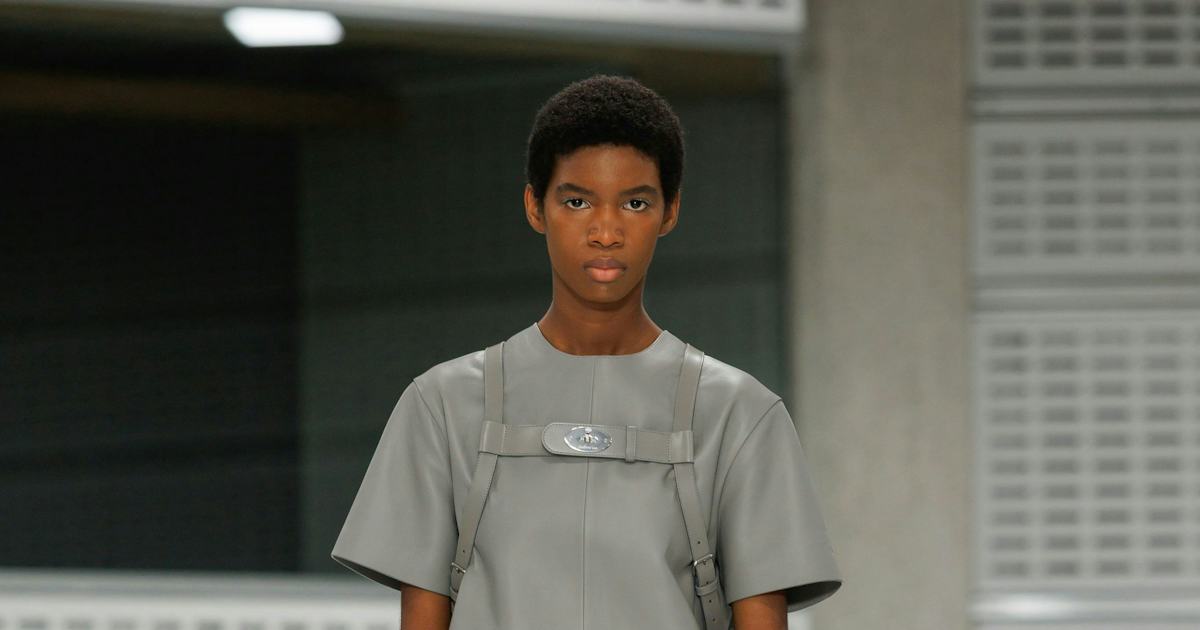
The Bayswater, Mulberry’s iconic structured top-handle bag named for the posh London neighborhood, remained the star of the show—perhaps even more so without all the runway theatrics. Its distinctive flap, with semicircular cutouts framing the handles, became a recurring motif, its curved contours translated into the ready-to-wear. The leather-heavy lineup featured tailored jackets with cutaway front edges and skirts with scallops that ranged from subtle notches at the hem to dramatic, thigh-baring slits. A series of fluttering minidresses appeared to be fashioned entirely from overlapping bag flaps, layered one atop another to create a fringelike effect. “I’ve just always loved that bag, so it just felt right that we were using the flap like a logo,” Kane said backstage. “It’s seen, but it’s not seen. It’s not screaming.”


Elsewhere, Mulberry’s more overt branding made an appearance, from the logotype to the instantly recognizable tree logo designed by founder Roger Saul’s sister. The former appeared on oversize sweatshirts and rugby shirts, a nod to the designer sportswear favored by football casuals, the British youth subculture through which Kane first encountered Mulberry growing up in Motherwell, Scotland. The Bayswater’s signature Postman’s Lock was another recurring detail, blown up into oversize belt buckles and adorning the straps of loafers. “It was the start of the house that he built, and it was from making leather belts at the kitchen table,” Kane said of Saul, who founded Mulberry in Somerset in 1971 with £500. “And that’s how I started too. I started in my bedroom. So small things, they grow into bigger things.”


