


Photo courtesy of Joseph Yaeger.
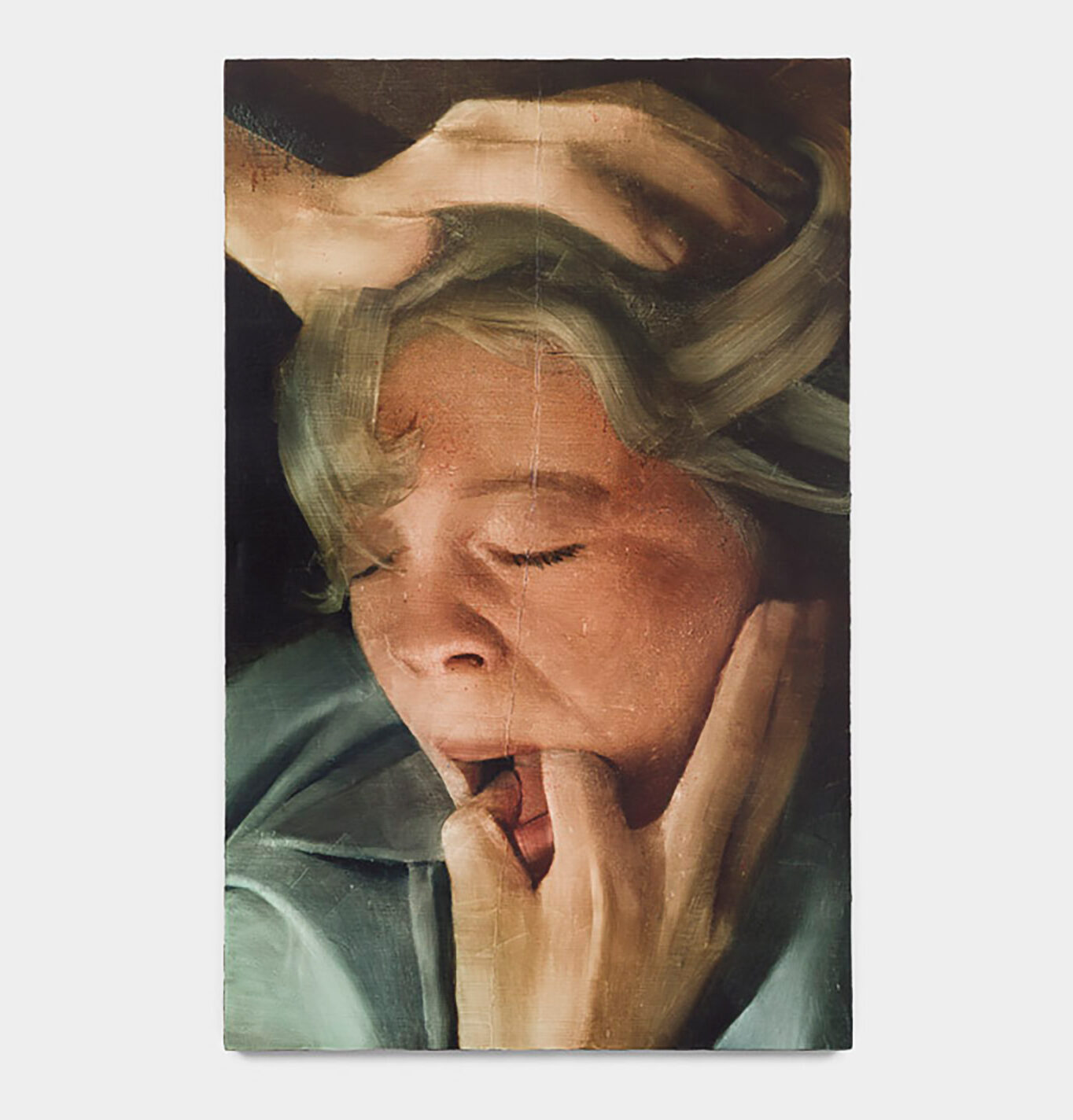
Before he found his way to painting, Joseph Yaeger was dead set on becoming a writer. Then, in 2013, around the same time he encountered Ottessa Moshfegh’s work, he had a revelation. “I felt like I could never quite push through that drywall where I don’t think about comparisons or similarities between my own work and other people’s,” he told the novelist when the two got on the phone earlier this summer. But painting proved to be a different story. In his eerie, cinematic watercolors, Yaeger works quickly, letting the material force him into decisions before he has time to second guess them. “I always feel like I cease to exist as soon as I start painting,” he explained. Moshfegh knows the feeling. Fresh off finishing a novel that took her several years to write, she had plenty of thoughts about disappearing into the work, hitting creative ceilings, and letting the work take over. Ahead of Yaeger’s first solo exhibition at Gladstone, the two got on the phone to compare notes.
FRIDAY 1 PM JULY 31, 2026 NEW YORK CITY
———
OTTESSA MOSHFEGH: How are you?
JOSEPH YAEGER: I am okay. How are you doing?
MOSHFEGH: I’m good. I’m well. It’s exciting to talk to you. I just discovered your work, and I’m into it a lot.
YAEGER: Well, I’m very flattered. I have been following you since Bettering Myself.
MOSHFEGH: Oh, wow.

Be that as it may, 2025. 74 3/4 x 47 1/4 inches. Courtesy the artist, Modern Art, and Gladstone. Photo by Modern Art.
YAEGER: I remember encountering that in 2013, or whatever. It blew my mind, so it’s really an honor to talk to you. I feel there’s like that weird, cantilevered balance issue here where I know more about you than you know about me.
MOSHFEGH: Well, I want to know why you paint. What’s your relationship to paint as a material?
YAEGER: I use watercolor, and there is something about its ability to situate you so immediately within the—and I’m hesitant to use this word—but the “image,” that makes it so there’s almost no barrier between thought and action. I love that. Watercolor dries immediately, so there’s a panic right away; you have to make decisions really quickly. I always feel like I cease to exist as soon as I start painting, and that feeling will extend for six hours or however long I’m in the studio. Then, when I come out of it, I feel like I get resituated in reality. It feels like a kind of exhausting surfacing, but I think that’s also the attraction. Paint gets me there now, but writing used to. At the time I first encountered your work, I was dead set on becoming a writer.
MOSHFEGH: Oh, wow. So what happened?
YAEGER: I think that I knocked directly into the ceiling of my abilities with writing. It’s really funny to be talking to you because I feel like one of those editors who recall reading Infinite Jest in the ’90s and deciding, “Oh, okay, I’m not going to write anymore.”

The peripheral defines the field, 2025. 51 3/8 x 33 5/8 inches. Courtesy the artist, Modern Art, and Gladstone. Photo by Modern Art.
MOSHFEGH: Oh, I know who you’re talking about.
YAEGER: I think that reading your work helped guide me in an apophatic way away from writing. I felt like, “Oh, okay. It can be done this way, but I can never get myself there.” The level of expression that I can actually access in writing has become a buttress to painting; the paintings all fit within the containers of texts that I construct before I ever start painting.
MOSHFEGH: Do you think that’s about ability or purpose?
YAEGER: I think it’s about ability. I think I’m a decent writer, but I think that whatever I have to communicate in that format is very narrow and it’s not very interesting. I never accessed the thing that happened with painting, which is that I don’t ever really think about influence. With writing, I could never quite push through that drywall into that chamber where I don’t think about comparisons or similarities between my own work and other people’s.
MOSHFEGH: Yeah, I totally understand that.

Everything is measured by after, 2025. 74 3/4 x 47 1/4 inches. Courtesy the artist, Modern Art, and Gladstone. Photo by Modern Art.
YAEGER: That’s such a free moment. I remember listening to an interview where you spoke about what happens with playing classical music, how you practice so intensely that eventually everything becomes muscle memory and you have freedom to just exist within the beauty of the music. That’s how painting is for me now, but I never accessed that muscle memory in writing. It’s Sisyphus. It’s like I have no wings in writing.
MOSHFEGH: Have you ever experienced a ceiling in terms of your visual work?
YAEGER: Yeah.
MOSHFEGH: Can you tell me more?
YAEGER: The ceiling is always a kind of encounter. It’s like getting to the same river and looking down and thinking, “I’ve already addressed this and I can see the bottom, but I have to just walk a little bit farther along because there’s something else I need to explore more.” I think the ceiling in painting is more like a limit that I can then manipulate. If I end up hitting the same themes in my work, it’s simply an indication that I need to go deeper into the thing that I’ve maybe already done before. I always need to ask myself, “What is another facet or crevice in this?” There is so much texture in hitting a ceiling; it never presents as a smooth or mirrored surface where I’m like, “Oh fuck, I’m looking at myself in the ceiling.” It’s like I can always find some little runnel to go up when I’m painting, and that’s actually the most exciting part. I love when I’m like, “Fuck, I’m screwed. There’s nothing left here.” I know that if I just keep pushing at that wound that it will eventually hurt again.

What you’re waiting for has already happened, 2026. 66 7/8 x 90 1/2 inches. Courtesy the artist, Modern Art, and Gladstone. Photo by Modern Art.
MOSHFEGH: I relate to that very much.
YAEGER: Are you in the middle of something right now?
MOSHFEGH: I finished a novel in May that was excruciatingly difficult. I started it in 2022 or 2023. I usually write a first draft of a novel pretty quickly, but this novel required a different process. I would work on it very intensely, I would put it away and then bring it back up, and it lived with me for years. A lot of shit happened in those years, and this novel was really dictating its own terms and sort of controlling/reflecting my life. Finishing it was exhausting and ecstatic and unbelievable; I cannot believe I finished it. I feel like when you pose a challenge to yourself and then meet it, it’s sort of like, “Oh shit, now what?” I feel simultaneously like I can do anything I can imagine, and also like I am a newcomer again. I have no idea. I have no clue. This has been a nice period because I’ve always been a workaholic and burning the candle at both ends, and this summer, I’m finally in one place again. I relate very much to what you’re saying, that you disappear when you’re painting. I want that. I feel in some ways that the portal into the work is finding this weird blind spot where I disappear and the consciousness of the work can blossom with me letting it.
YAEGER: Do you feel like that disappearance has any kind of resonance in the finished book when it’s done? I don’t want to talk out of school, but I’ve always wanted to ask you about this. I remember being so dazzled by McGlue. Having read your short works in The Paris Review, it seemed to me like the biggest left turn, and I was like, “Yes, fuck yes, like, I can’t believe somebody had the courage to do this.” It thought you totally disappeared in McGlue, but then in Eileen, it seems like you were intensely there. The books themselves are like differently done steak or something. McGlue feels, like, almost blue; if you cut into it, it would be really, really, really raw steak, whereas Eileen feels almost well-done. Like you’d press it, and it would be super firm. Rest and Relaxation feels like some combination of the two, almost like you were in and out of it. More than any writer I can think of, it seems like I can almost tell where your consciousness was when you were writing them.
MOSHFEGH: Yes, I think that’s true. It’s maybe less like a steak and more like a snake actually. I know what you’re saying, and the comparison between how much I was there for McGlue and how much I was there for Eileen is interesting to me because they were completely opposite processes and originated with totally diverging ambitions and intentions. In Eileen, I was more conscious and aware of the reason I was doing what I was doing, because the intention was to write a novel. I really thought it was a commercial form I would never enjoy or relate to, even though I love novels, but I was just so wrong. I became a novelist writing Eileen. It was miraculous and so fun and difficult. I think I was experiencing it more presently and it was more of an immediate experience. I don’t know how to say it, but I know what you’re talking about the texture of how cooked the steak is. I know this sense of it being palpable.
McGlue, for me, was just straight up possession, really painful. Like brain pain, and very deeply personal and deeply felt, way more deeply felt than Eileen in many ways. I think that, like you were saying, it was just not interesting enough— something needs to feel new and forbidden. I always think left turns are interesting. They take longer, at least in the United States.

Edge of the unintended, 2026. 63 x 47 1/4 inches. Courtesy the artist, Modern Art, and Gladstone. Photo by Modern Art.
YAEGER: I love the feeling when I’m making a painting and it suddenly starts reflecting a kind of scintillation back at me, like there is an indication that I’ve transgressed in some weird way. I know what you mean where it feels as if you’ve trespassed into a zone that feels slightly off limits, and you want to get just near enough to it that you’re not being flagrant. I love the feeling of being really embarrassed by certain paintings, like, “Oh, I’ll be judged for this because this is not what polite people do. They don’t paint boys with breasts in their mouths.” But then you read Grapes of Wrath or Pero and Simone and you remember that they absolutely do. They just might not do it in America right now. When I look at this particular image, I think, “This is a classical painting. It’s not in any way fetishistic, or even really salacious. It’s tender.” You know what I mean? But again, the Catholic boy in me is ashamed, and I’ll feel like I need to go confess. But then I’ll get all the way back around to where I think, “No, there’s a precedent and this is totally reasonable. And fuck you for thinking that it’s not.”
MOSHFEGH: I get that a lot. I understand. That churning around for me is very innervating and invigorating. Whenever a book is about to come out I think, “Oh my god, am I going to be completely misunderstood?” On the day it comes out, I feel horrible, I feel like the entire world hates me. I think you do kind of pay a price for creativity in a way.
YAEGER: The bill is always in the mail.
MOSHFEGH: Yeah, totally. This enormous exchange of energy, like I’ve just strangled it and put it into my book is now being like, “How could you?” There’s a vacuum now and it’s scary. But yeah, I always feel terrible.
YAEGER: When you finish a book, do you have a Caravaggio-esque “I’m going to go on a bender and kill somebody while playing tennis,” or is it like, “I’m so depleted that I don’t want to leave bed for the next three days”? Or is it neither?

No rebuttal, 2026. 63 x 98 3/8 inches. Courtesy the artist, Modern Art, and Gladstone. Photo by Modern Art.
MOSHFEGH: It’s sort of neither. There’s a lot of distraction. I try to distract myself a lot and compartmentalize, move on. But I’ve gotten to a place where I need to talk about my relationship to my work with my friends. It’s too much the center of my life to pretend like I just show up and go to work every day and go home.
YAEGER: That’s hopeful for me because I’m still very much in the latter, like it’s entirely compartmentalized out of my life. I very much enter the studio and then we don’t talk about what happens in there.
MOSHFEGH: I know what you’re saying; I think we should be friends.
YAEGER: Let’s be friends.
MOSHFEGH: This has been really great. I’m sure we’ll talk again.
YAEGER: I would love that.

There are still songs to sing past man, 2026. 47 1/4 x 63 inches. Courtesy the artist, Modern Art, and Gladstone. Photo by Modern Art.
