

I will never forget the words Prabal Gurung told me over the phone late last year: “Why are clothes chic, and who gets to decide?” Answering his own question, the designer responded: “The colonizers do.” The idea started looming over my interest in fashion. Gurung’s words had moved me the same way people might feel when discussing a midlife crisis. I’ve lived the history of the European Court Dress through coffee table books in my home, watched numerous Galliano-era Dior Couture shows, and studied the rise, fall, and now, resurgence of the house of Schiaparelli. Even before my start in the fashion industry, I traced the collections birthed by the major European houses dominating the scene: Valentino, Prada, Burberry, Versace. But when it came to how fashion played a role in the Philippines, the base of my familial lineage, I was clueless. Has mainstream fashion forced me to unknowingly oppress my appreciation for traditional Filipino clothing?
While the question burned in the back of my mind, the recent surge of hate crimes against Asian Americans took place. I refuse to shed a light on the specifics of these intolerable acts, but I will say this: The deranged few who have let the racist sentiments of “Kung-Flu” and “Chinese Virus” get the best of them are attempting to push Asian Americans into a corner of shame. They want us to minimize ourselves more than we already have, and to that, I push back by celebrating my Asianness even more. I realized it was time to wear my Asian culture like a badge of honor, and to acknowledge just how influential the AAPI community is on fashion and beauty (just look at the influence our natural features have on the beauty industry, and how our ancestors’ healing practices are now mainstream wellness techniques). As someone who has always used clothes as a tool of expression, pride, and fantasy, this manifests into a new, long-overdue embrace of the two distinct forms of Filipino formal attire: the Barong Tagalog and Filipiniana Dress.
My novel enthusiasm for the Barong Tagalog is actually pretty shameful, considering I grew up surrounded by the garment (which, perhaps, proves Gurung’s point). To learn more, I decided to turn to my best source: my own family. Because I’ve spent much of my life studying European fashion history, this would be my first lesson in the way style shaped the culture of the Philippines.
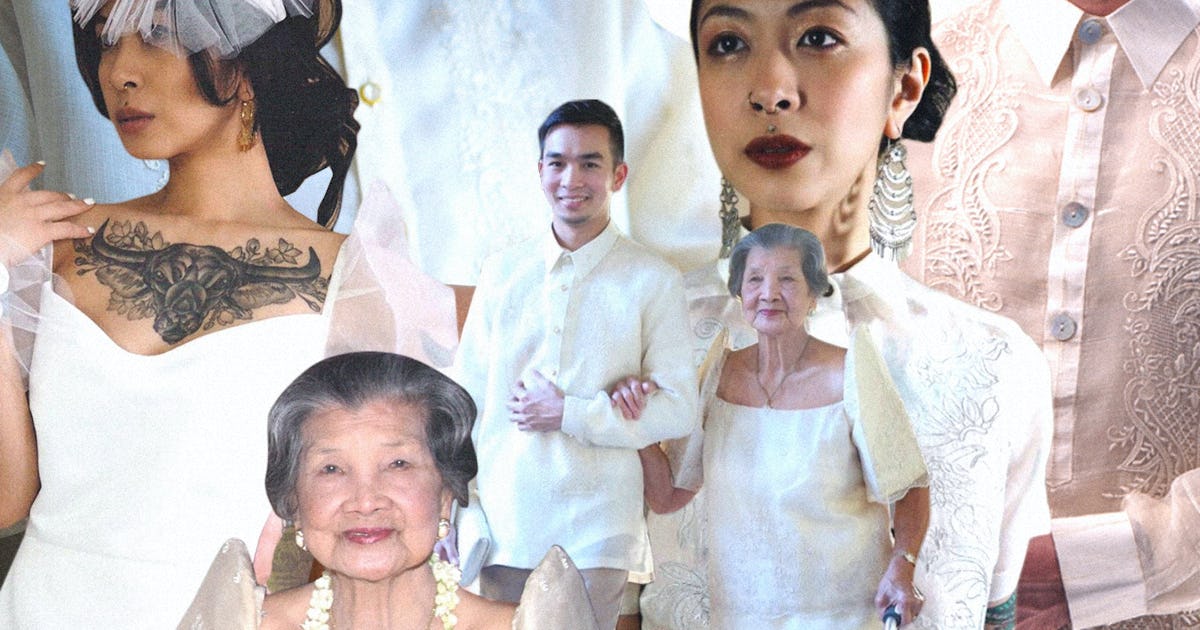
As something of a treat for me, my cousin and aunt pulled out every example of the Barong Tagalog they own during a FaceTime chat. For men, the Barong Tagalog is identified by straight lines, mild transparency, and intricate embroidery topped with a Mandarin collar and is worn for formal events—think: black tie attire for the Philippines. The elements are paralleled in the women’s renditions, except they’re accompanied by a shawl (for added drama!). My cousin, grandfather, and father each donned one during their weddings. Like London’s Savile Row, small shops like Vinta Gallery and Exclusively His Tailoring are keeping the native tradition alive by specializing in tailored, bespoke Barong Tagalogs. “It’s not another European piece of clothing,” my father told me. “I only wore one when I needed to be at my best, my most proud.”

While I sifted through these memories, my cousin pulled out a framed photo of my grandmother, Erlinda. Immortalized within the brass frame, she dons a white dress that could easily be mistaken as a piece from a haute couture bridal collection. With a straight neckline and butterfly wings that would put Givenchy’s ’90s power shoulders to shame, the Filipiniana dress is a symbol of esteemed pride. My grandmother reigned as my family’s matriarch, so the piece takes on a regal air when she wears it. According to my cousin, Kate, my grandmother donned the gown for the final time in the Philippines at my cousin Dyan and Colt’s wedding in 2015. “Well, I never expected to have a grand wedding, but I knew I wanted to pay tribute to our heritage,” Dyan said to me. While the dress on my grandmother easily signified her rank in our family, Dyan’s wedding entourage wore renditions of the same Filipiniana dress—some hemmed shorter, some worn traditionally, but still, with those signature butterfly shoulders.
Learning more about the Barong Tagalog and the Filipiniana dress did give me an ounce of regret for not appreciating these garments sooner. The Barong Tagalog was a beacon of pride for my father. The Filipiniana dress is a symbol of my loving grandmother’s legacy. And Dyan insisting on placing Filipino heritage at the forefront of her wedding reminded me why I even fell in love with fashion in the first place. While I’ve had plenty of discussions about combatting racism, attended protests, and tweeted a few sentences denouncing the rise of hate crimes against Asian Americans, it seems I’ve let white supremacy take a hold of me in a very different way.
Looking into my own closet, I see 10 different designers: four are Italian, two are Parisian, two are American, one is English, and one is Japanese. None are Filipino. None are even from Southeast Asia. And while the cosmopolitan garments hanging in my room are surely chic, what’s the point of a wardrobe without some personal history behind it? And what is the desire to accumulate heirlooms if none are directly linked to where my parents are from, or where my grandmother is from? While I take notice of the seeming disappearance of the Barong Tagalog and Filipiniana dress in my generation of Filipino Americans, I’ve already begun the hunt for the nearest Barong Tagalog tailors. I figure it’s also good timing, with summer on the horizon. For European fashion junkies, call it bespoke resort-wear. For other Filipino Americans, call it pride.
This article was originally published on
