

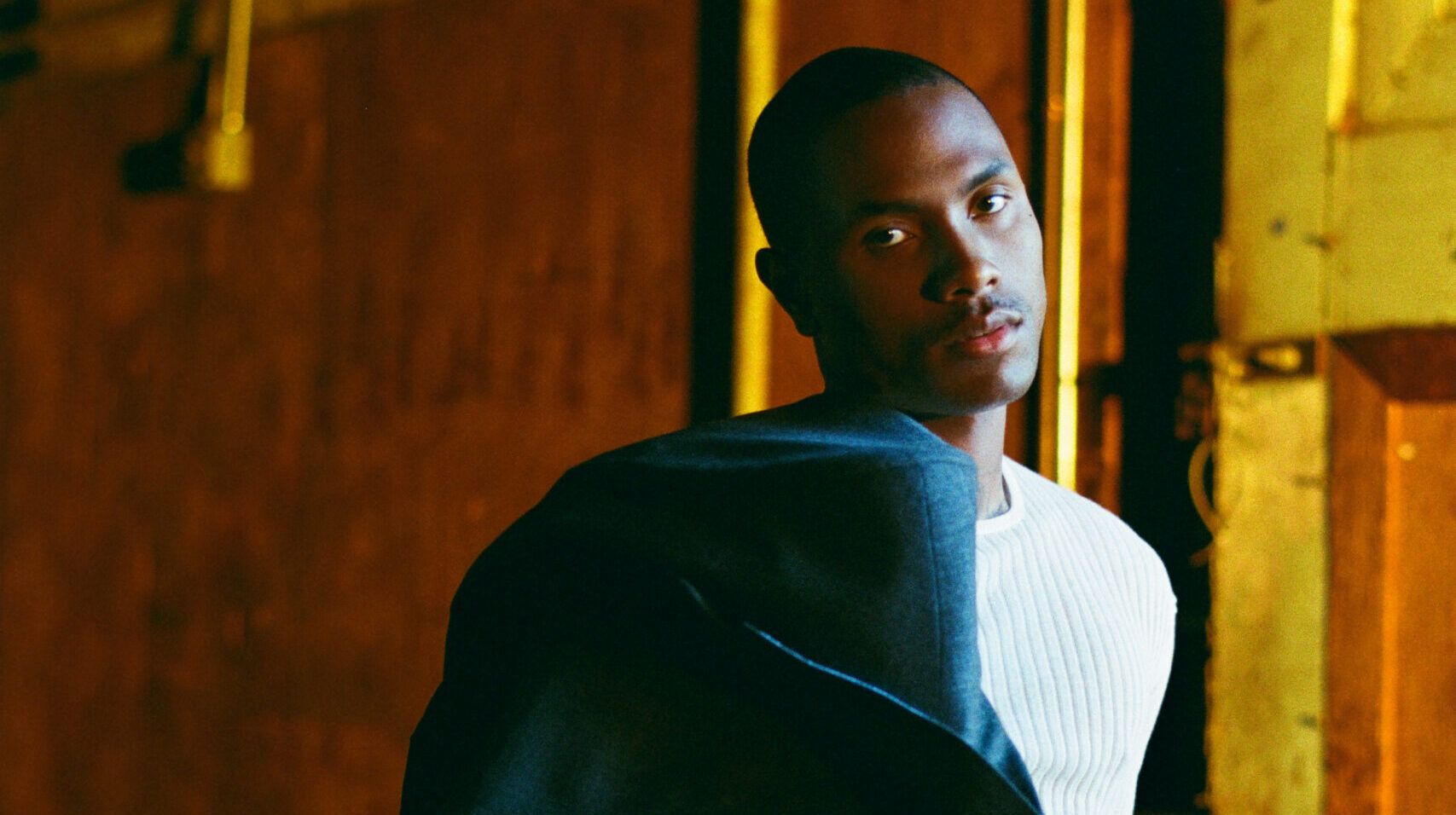

Steve Lacy wears Shirt, Sunglasses, Tie, and Gloves Tom Ford.
How do you follow one of the biggest hits of the TikTok era? If you’re Steve Lacy, you just keep doing you. The “Bad Habit” singer’s new album, Oh yeah? swings between loose, unresolved breakup songs and glossier, more polished ones, testing how far he can stretch without losing the parts of himself that made people care in the first place. To talk about where he’s landed, he connected with Miranda July, a kindred spirit who’s been playing the album on loop since it came out.
WEDNESDAY 3 PM JULY 15, 2026 L.A.
———
STEVE LACY: Hello?
MIRANDA JULY: Hi.
LACY: It’s so good to talk to you and see your face.
JULY: I’ve been loving this album, just kind of swimming in it.
LACY: Your movie Me and You and Everyone We Know was a part of this process. It captured how I feel in my head, and not a lot of things can do that. I kept watching it and then showed it to other people so it felt new again for me.
JULY: Wow, crazy. That means so much. Where are you?
LACY: I’m in L.A. What about you?
JULY: I’m in L.A. too.
LACY: Shut up.
JULY: Yeah! I have some questions for you; they’re loose, so take them as they come.
LACY: Okay.
JULY: What’s something a lover has done recently that you’ve liked a lot?
LACY: Damn, that’s—
JULY: A hard one.
LACY: It’s a great question though.
JULY: I’m a bad interviewer! It’s a great question, but it’s really hard to answer. I hate it. Okay.
LACY: I think it goes one of two ways. You can say, “They opened the car door for me,” or you can say, “We’ve been dating on and off for a year, and they sent me a long message with bullet points, and it was just written so beautifully.”
JULY: My lover surprised me recently by getting really detailed about how something felt for him, namely that it hurt. Something I’d done unintentionally hurt him, and it was a trip because it felt like no one had said anything like that, where it wasn’t my problem to fix it. He wasn’t even saying I caused it or did anything wrong, he was just saying, “I want you to know how to know me.” It made me feel respectful instead of in trouble, which is a go-to feeling for me.
LACY: Me too. That’s the answer I had too, and I’m not even trying to copy you.
JULY: Is your song “pure colour” named after the book Pure Colour by Sheila Heti?
LACY: It is, but it was actually a different song. The first one was just a beat, an idea that was composed but didn’t make the album. When we were renaming all the songs and seeing how everything looked together as words on the track list, we were like, “What if we took the name from this idea and put it onto this other song?” It just kind of happened that way.
JULY: That’s a really cool, unexpected ref.
LACY: I’m reading a book right now and you’re on the cover.
JULY: Oh my god.
LACY: This one.

Suit and Shoes Loewe.
JULY: Is it How Should a Person Be? Sheila’s a dear friend. She gave it to me to read at the start of our friendship, when it was only out in Canada. I remember being like, “Oh, I want to blurb this.” Usually, you’re asked, and you do it as a favor, but I asked her, “Can I blurb this book?” I just wanted to be associated with it.
LACY: That’s fire. I’m halfway through it. I’m into it.
JULY: I’ll tell her. Okay, next question. When people write love songs about me, I want them to explain all the lyrics, to tell me how they thought of each part and what it means to them, but people have strongly not wanted to do this. Would you do this, or is it important to just let it stand and play it cool?
LACY: Yeah, I think I would. I did a good amount of that while I was working on the music.
JULY: That’s in the music?
LACY: Sometimes it’s difficult because it’s drama, so you emphasize certain parts to make the story sound better than it was. Sometimes it’s like, “This is exactly what happened,” but that’s rare. This song is about a breakup that happened six years ago and finally let it hit me now. I was running, and I thought, “Oh wait, I still haven’t caught up with that.”
JULY: This album is that for you?
LACY: Yeah. Someone asked me what I think my album sounds like. It’s hard for me to explain in terms of genre, but I can explain in terms of energy. To me it sounds like post-nut clarity. I also believe in telepathy, so there’s moments with this person where I’m like, “I’m not even in charge of this. I know you’re doing this. You need to stop thinking about me so I can stop thinking about you.”
JULY: Yeah. I believe that, too. Let’s see. This question is kind of—I was on a real tear with long voice messages for a while. I’m trying to pull back a little on that.
LACY: You send them?
JULY: I send them, and I also receive them. I’m in these dynamics with different people where we’re sending podcasts back and forth, and I just started to realize they’re very valuable to me, but it was almost like I wasn’t writing things down anymore. It was just a few months, and it was fun and it was crazy, but I don’t think I can keep it up. So the question is, how much and when do you talk to your friends, and using what media?
LACY: I’m a big FaceTimer.
JULY: Really?
LACY: Yeah. I don’t voice message as much as I could. And even when I receive them, I feel like sometimes I can only give attention when I can sit down and really be there with it. I might take a second to reach that moment; I even might see it or read it and then make a note to myself to go back, but if I’m in the middle of doing something, I forget.
JULY: Do you cold FaceTime people? That is always so alarming.
LACY: Yeah.
JULY: You do? Okay. I would not be able to be friends. But that’s a confident move.
LACY: I think about what they could be doing first. I see their time zone and I’m like, “Okay, now might not be a good time.” I have a good internal clock for when it might feel right, but if we’re texting each other fast and responding fast, I’m going to call you.
JULY: That’s a crazy feeling, even with a friend. It’s a little romantic.
LACY: Right.
JULY: Here’s a question. You know Cody Chesnutt’s album? I assume you do.
LACY: Yeah, The Headphone Masterpiece.
JULY: I think of that as a pretty influential album in terms of a lot of what’s happening now, like a precursor to this sort of R&B, lo-fi emo thing. Is that true? I’m not a musician, but I sometimes listen back to it and think, “This is so ahead of its time.” Is it ever a reference? Maybe not for you, but culturally?
LACY: I think so. Whether people know it or not, I would say it is. I was making stuff like that already, and when I found Cody, I was like, “This is great.”

Pants Gucci. Watch Cartier.
JULY: Yeah.
LACY: I had songs that sounded like Prince before I started listening to Prince; it’s so freaky how that can happen. But yeah, Cody Chesnutt is awesome.
JULY: I’m always surprised he’s not—I don’t know his story. Maybe he did something terrible.
LACY: I have no idea. Maybe he was just doing it at a time when people weren’t seeing that for Black people. Because it’s definitely a thing to be Black and R&B or alternative, or to not make the R&B that is classified as R&B on the R&B station. Did you see that Q Lazzarus documentary?
JULY: No.
LACY: You know the song “Goodbye Horses?” There’s a documentary about the woman who wrote that, and it was just the saddest thing ever.
JULY: Oh no.
LACY: Yeah, going back to this Black alternative R&B thing, it’s heartbreaking, but it’s beautiful. And it makes me care about what I’m doing even more, because I think about all the people doing this before me who were just too early.
JULY: Did you like the Robyn show we said hi at?
LACY: I did. I was a new Robyn fan at that point, but I was deep into it. Some people I just know are icons. Do you know that song “With Every Heartbeat?”
JULY: Gosh, I really only know the hits.
LACY: You might’ve heard “With Every Heartbeat.” I don’t think it’s a hit, but it’s still up there. I was trying to wrap my head around that song’s writing and production. I listened to it on the way home one day, and my face was so wet. I was like, “Oh my gosh,” and I reached out to her to be like, “Hey, I’m off Instagram, but if you can text or call me when you get a chance, I need to talk to you.” It touched me in this place and I was just like, “How did you get to this fucking song?” I think she ended her set with it.
JULY: Did you talk to her about it?
LACY: Yeah, she sent me a long message that said something like, “Essentially, I think every song I’ve ever written about heartbreak is somehow about my parents’ divorce.” I was like, “Damn.” But that song, it’s not even doing or saying anything super graphically or literally sad. Sometimes the curation of choices leads you to certain feelings, whether she put them there or not. There’s a line where she says, “Just a little, little bit better,” and then after that she says, “Good enough to waste some time.” It’s like…
JULY: Oh god.
LACY: It just fucked me all the way up, these fragments of thoughts. I wanted to put a lot of that kind of thing into this album—it’s not necessarily happening in your face, it’s just choices.
JULY: I do voice notes. How do you write stuff down?
LACY: I write a good amount in my notes, but when I’m in the studio I’ll just go into the booth with a loose idea.
JULY: I envy that. Because everything anyone writes, it’s all improv.
LACY: It is.
JULY: I feel like for me, not that it’ll be captured, but you can document it.
LACY: Right. It’s pretty fun. I’ll go in with a light melody or whatever, and when I know how the flow feels, I’m like, “Alright, I’m just going to figure it out.”
JULY: I don’t know who-all is in the recording booth, but do you go all the way into the feelings in there? I guess you do many takes, but still, it’s like acting. Did you ever cry while recording this album?

Suit, T-shirt, and Belt Bottega Veneta.
LACY: Yeah. There was crying. It would mostly happen by myself though. I don’t think I ever cried on the spot. But there was a lot of waiting for these verses to happen, because they’re based on real things I was going through over the span of three and a half years. A lot of it was just living through it, thinking I had it, and then being like, “No, I suck. I need to travel or date someone.”
JULY: Yeah.
LACY: I was showing up every day, but the verses came when they felt like it. It was like, “Eat another weed gummy, or stop eating weed gummies, or stop doing coffee. Start working out.” Just trying to listen to, “Okay, how do I find this presence?” That’s what I look for. It came through in the form of this breakup from six years ago.
JULY: Wow, that’s inspiring. I always like stories of people taking longer to do something because it gives me permission to do that. And it’s true; so much of making something is living into it. You have to get your life to meet the work.
LACY: It’s interesting because in that span of time, you’re also learning yourself again. You completely change from project to project, from the moment you start to the very last day. You’re probably still promoting it or talking about it or still on that press run, but until the day you say, “I’m done promoting this thing,” you’re a completely different person. That’s something to sit with. It takes a second to understand where you are, and where everyone else thinks you are. There’s so much psychology to actually wrap your head around, along with being a creative person. That also takes time, because it is kind of weird.
JULY: Yeah.
LACY: I’m not going to have a story right away about something that just happened. That takes time. I hope I can take a four-year break this time, but taking a long time comes with a lot of crazy expectations. If you take 10 years, you better come with the Bible. I’m like, “Fuck, man.” Even four years feels too deep for me. I think I can stand behind it, but I know with every year comes a bigger expectation. That’s the consequence of taking time, at least in music.
JULY: That’s true.
LACY: But yeah, they want to be like, “Okay, if you took this time, I know you got some gray hairs and I know you’re older, so I need to feel that impact of how old you’ve gotten.” And it’s like, Jesus Christ, people.
JULY: Well, this is why you have to do little things. Right now, I need to just let light and air in. I’m saying yes to collaborations and things that aren’t the big thing that has to be so good.
LACY: Absolutely.
JULY: That’s where I’m at.
LACY: Your work tells me you’re a person I could talk to for days. It’s cool to know that can really happen.
JULY: I know. It’s so nice to talk to you for real. Do you want my phone number?
LACY: Yeah.
JULY: That’d be cool.
———
Groomer: Marcela Osegueda using Dior .
Props Stylist: Chris Katus.
Photo Assistant: Joshua Elan.
Digi Tech & Photo Assistant: Jason Macdonald.
Styling Assistant: Michelle Smith.
Production Director: Alexandra Weiss.
Photo Producer: Georgia Ford.
On-set Producer: Lily Hyde.
Location: Studios 60.
