

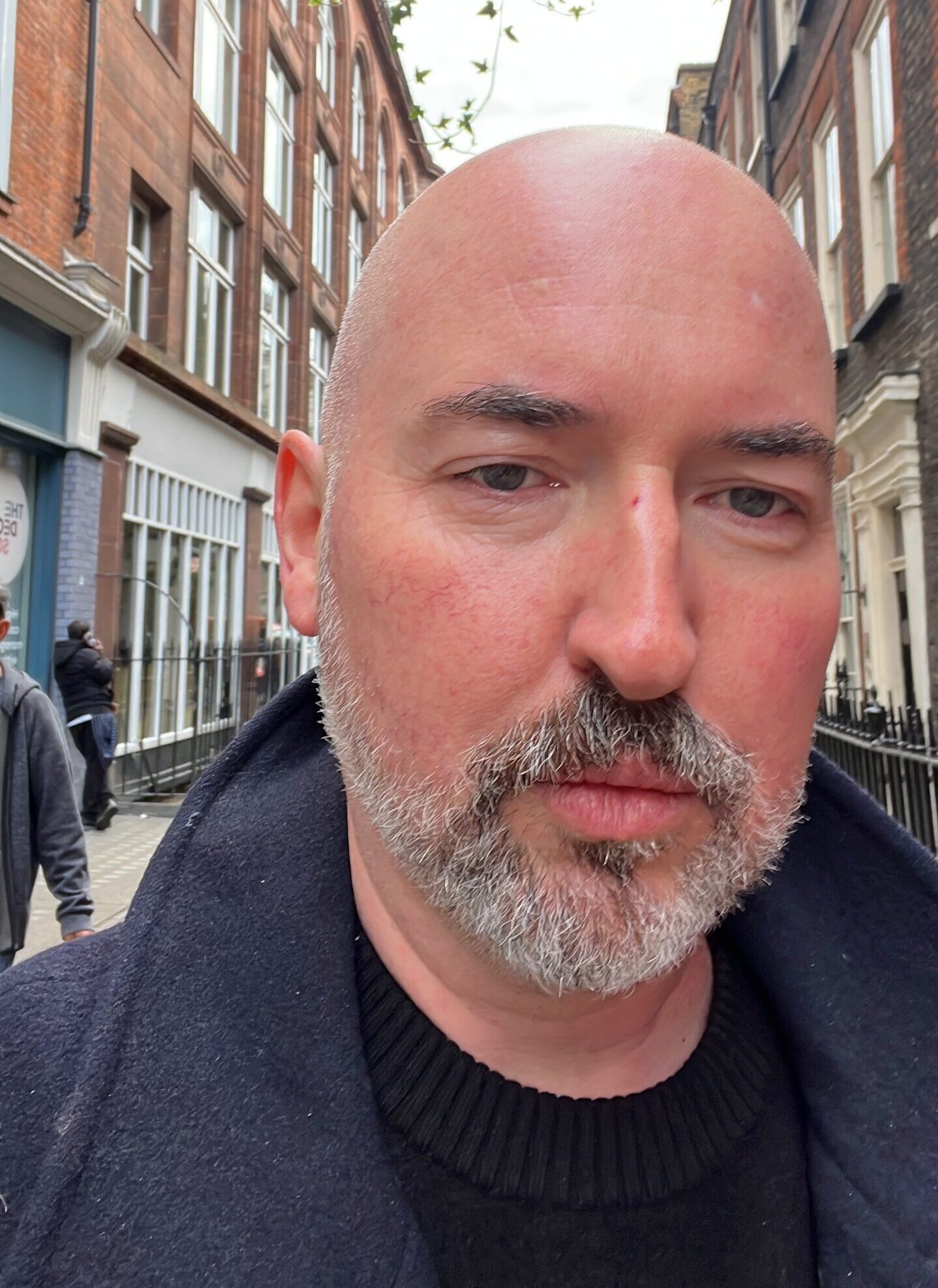
Photo courtesy of Douglas Stuart.
Douglas Stuart didn’t set out to write the great gay Scottish novel, but he’s now written three of them. The Booker Prize winner follows up his modern classics Shuggie Bain and Young Mungo with a third, quietly devastating act, John of John. Set on the wind-battered Isle of Harris in the Outer Hebrides (a place so stark it feels lunar, like the edge of the world, as Stuart tells it), the novel follows Cal, a young man who comes home after studying textiles in Edinburgh. Waiting for him is a house thick with silence. An oppressive father, a fiercely devout Calvinist community, and a truth neither man can say out loud. Both father and son are gay, yet unwilling and unable to broach it. Cal discovers the aching misery of what love between men can look like when no one is watching. A few weeks before publication, Stuart called up his fellow Scotsman and Emmy winning actor Alan Cumming to talk about the ferocious love between gay Scottish boys and their grannies, what it costs to love someone you’re not allowed to name, and why John of John might be Stuart’s last novel set in Scotland.
———
THURSDAY, 5:30 PM, APRIL 30, 2026 LONDON
———
ALAN CUMMING: How’s it going, Douglas? I’ve just done a matinee of The High Life in Inverness.
DOUGLAS STUART: It’s going good. I feel very privileged to see the master at work, seeing you behind the stage getting ready for a performance.
CUMMING: My wig is not here, but I wish you could see it. It’s insane. It’s up to here in black, and I’ve got all my jewels.
STUART: Oh my god.
CUMMING: And it’s such a beautiful day. Look at Inverness.
STUART: Ah, don’t. You’re making me homesick. How does it feel to be home, like a homecoming?
CUMMING: Yeah, sort of. We definitely live here as well as in New York. You know what I mean?
STUART: Yeah.
CUMMING: I told you this the other day at dinner, but I love this book so much. It’s so fascinating to see which bits of your own experience you put into these three novels. The thing about textiles and going to college, just like you did, and the way the characters talk about color, with their weaving background—I love that. And, I mean, there was hope in your other books. It’s not that I’m saying they were hopeless, but there’s so much more hope now. You’re lightening up as the years go by, maybe that’s what it is.
STUART: I’m mellowing a little bit, yeah. Thank you for saying that, and also for being one of the first readers. It was nice to write about working men making something beautiful because, often when I write about the working class, they’re doing hard jobs. But these are two men that are concerned with color, pattern, cloth, and beauty. But also I’d never been to the Outer Hebrides before I started to write the book. I grew up in the city and we didn’t have money to get out, so when I set out I didn’t have a plan for what I was going to do. But I just thought, “I’m going to commit to 12 weeks on the islands and if I don’t come away with some new writing, at least I’ll know my own country better.”
CUMMING: Were you thinking you wanted to write a story about that place?
STUART: Yeah. I’d been writing about queer loneliness, but I’d always been writing about it from an urban point of view. I realized that growing up in the ’80s and ’90s, if you were queer and rural, it was totally different and I wondered what that was like. I knew two people on the islands, and I just rented all these different rooms in people’s little houses, and I would talk to anybody that would talk to me. I finally arrived on the Isle of Harris and, as you know, the landscape on the East Coast is like nothing else in the world. It’s so lunar, it’s so barren. It was that place where also all those weird things converge that don’t exist to anybody else in the world, like Gaelic, and very devout Calvinism, and tweed weaving, and sheep farming, and crofting. I just thought, “This is it,” and that’s when the book came together.
CUMMING: You know in Shuggie Bain and Young Mungo, there’s this love affair between the boys, and there’s this ache of love that you do so well. But now, it’s between older people. Shuggie and Mungo are both kids, and they’re not in control of their own destinies. Whereas now, Kyle is just on the brink of that. But John and Innes, it’s sad to feel like, “Oh, just do it. Find it, go find your destiny.” I don’t want to spoil the end, but it’s just magical.
STUART: Thank you.
CUMMING: The granny is such a beautiful character. Queer, Scottish boys have a particularly great relationship with our grannies. I mean, probably all queer boys, but there’s something about rural Scotland. I had my Granny in Inverness and, in a funny way, that’s why I live here, because I spent so much time here as a child and I felt safe. She was eccentric and sort of a little bit nuts. Did you have a granny like that?
STUART: Yeah, you’re right. Gay boys love their Scottish grannies because they both survived the patriarchy at the opposite end. Those were women that didn’t have much agency, and yet my granny and her friends absolutely ran the world. But they had to do it from the back. They were coping with men that had control over everything, from work, to labor, to worship. And yet, the men were not ready to face the emotional truth of the world. They loved their husbands very much, but when they passed, suddenly they didn’t have to be in service to someone their whole life. Ella, the character, was the most fun I’ve ever had writing a character. I loved every time she was on the page. But I also needed a Harold and Maude relationship between her and her grandson.
CUMMING: That’s very hard to do.
STUART: Right. So when they say, “You have to come home and take care of your granny,” at the beginning of the book, she’s a woman worthy of his love and his sacrifice. He says, “I’ll come. I’m on my way.”
CUMMING: Oh, the reveal about… That is a piece of color.
STUART: Yeah. Ella’s a character that loves insults, loves to hear new swear words, and just is tickled by things that are inappropriate, and my granny was like that. My granny spent her whole life being an appropriate woman that when she could have that moment of just being unfettered, she loved it. She always encouraged irreverence. Whenever there’s youth in a gay story, the universal story is about coming out and what that’ll do to disrupt a family. But every time I write, I always end up thinking, “What about all of their forefathers? What about all the men and women that couldn’t be who they wanted to be in the place that they were, and how they never got to record their story?”
CUMMING: Yeah. Religion is really fascinating because it’s a joke that we have in Scotland about how fervent and strict that type of Hebridean religion is, but it’s still very powerful. Right now, our deputy first minister is deeply religious, and that’s terrifying to me. She said she wouldn’t have voted for marriage equality. She thinks that women shouldn’t have children outside of wedlock. And she’s the second most powerful person in politics in Scotland.
STUART: It was fascinating to be embedded there, right? Because it is a minority religion, and it’s really often centered on the Highlands and Islands. Their strength is they don’t negotiate with scripture. They take the word of god as the word of god, so they live a very traditional life. But when your belief is that you’re born to depravity and sin and that god will save only a few, it’s quite a hard road. Yet under that is a very gentle, community-based people who have to look out for one another.
CUMMING: You really see how devastating it can be to people, especially because fear and shame is about what other people will think.
STUART: He says in the book, “I love Innes, and I love God, and God hates that I love Innes,” and he can’t square those two things in his life. Because it’s a religion of conversion where you have to give yourself to god. But when you do, you’re told to leave everybody that hasn’t behind. As a child, to see your parent do that does feel a little bit like an abandonment, so it’s Cal’s big problem in the book. Even though I’m not a Free Presbyterian, I felt oppressed by it from a distance because I knew that it was an oppositional force to me just being myself. It’s got a really big effect on the larger psyche of Scotland, the feeling of being run by a government from England.
CUMMING: We have a dark side to us, the idea of not being found out, the idea that you’re going to be looked down upon.
STUART: I was too soured on religion as a kid. But when I got to the East Coast of Harris, I believed in something much bigger than me suddenly. The sky is so big and the sea is so angry, and there’s no evidence that man is there. It feels very untouched by the modern world. It wasn’t a religious feeling I had, but I had a spiritual feeling. It moved me deeply.
CUMMING: Who’s Cal’s friend again?
STUART: Doll?
CUMMING: Doll. Oh my god, just a beautiful character.
STUART: Well, Cal and Doll are in that relationship where Doll, being a straight man, can’t find someone to love, and Cal, being a gay man, also can’t find someone to love. In my youth, I always ended up in relationships that were so obviously wrong and unhealthy, and yet I sort of felt it was the best I was going to get. They were using me and I was tolerating being used. I wanted to explore that because many gay people have had that as an awakening.
CUMMING: It’s out of convenience as well.
STUART: There’s a sexual release for the straight guy, and you get scraps of affection. But it was something I hadn’t written about before. Humans still have needs, and it’s when you deny them you really get into trouble.
CUMMING: Early on, I got so triggered by the scene in the car when John punches him because I was expecting a lot of violence. There’s a lot of incredible descriptions, and you really create a world where you feel the darkness and the smell of it.
STUART: Thank you.
CUMMING: Then, you’re lulled into a false sense of security because he’s coming back, but he’s got connections and he’s had sex with people. He’s doing drugs. He’s young, and he’s even got a shag on the island as well. Then all of a sudden, fucking whoa, and he busts his face up. It just blew my mind.
STUART: The first thing I had to figure out was the rhythm of the islands, because nothing happens dramatically. I had to build slowly with the novel. You’ve written so much about violence in your own memoir, Not My Father’s Son, and I was thinking a lot about that. John feels very far from Cal, because he feels like Cal doesn’t respect him. My dad left when I was four years old, so I never knew what a father’s love was. And the book is my attempt to imagine that. Can a father and son love each other when one hates himself, and the other thinks the hate for self is hate for him?
CUMMING: A lovely bit was when they don’t speak for weeks, and then one day he just goes into the weaving shed, brings him a cup of tea, and they start talking again. As a reader, you’re relieved. Because even though you think, “Wow, he smashed your face up. How terrible is that?” They can get around this man’s terrible temper and suppressed shame, rage, and gay hate.
STUART: As a queer community, we often are so focused on our own story, our own freedom, and our own coming of age, and I was just thinking about what would you do if your parent was also gay? How could you enjoy your life if you didn’t liberate your parent too? The biggest demonstration of love that men can have for one another is filial love. When you sacrifice yourself for your parents so that your parents can know happiness, and that’s what Cal does.
CUMMING: It would also be such a beautiful film, Douglas.
STUART: Oh, thank you.
CUMMING: I know certain people who would be really great in one of the roles.
STUART: Everybody’s fascinated about queer stories now because of Heated Rivalry, Alan. I also find Scottish men really sexy, and I’ve always wanted to be in love with a farmer.
CUMMING: Oh, god, yes.
STUART: We should also let readers know that you’re currently sitting in front of me shirtless between two productions of The High Life, and so I would love to see you in an apron and a nice, floral dress.
CUMMING: I could pull it off. You know how in The High Life, there was an episode when we entered the song for the Eurovision competition, and it was called “Pif Paf Pof.” We sing it again in the musical and wear these hilarious outfits. We do a rip away, like they do in Eurovision. Now we’ve got gold suits on. It’s all magnets and they rip it away. That’s the gag.
STUART: I love it. You’ve not had a wardrobe malfunction yet? I remember Madonna having her cape ripped off on stage and coming all the way down the stairs.
CUMMING: I did catch my nipple with the buckle and my lederhosen the other day.
STUART: I just saw a trailer for your new project and it looks really exciting, for [Russell T.] Davies’ Tip Toe. Are you excited?
CUMMING: Yes. Oh, it’s the complete antithesis of what I’m doing right now. It’s so prescient. It’s about the normalization of violence and hatred in our culture right now. Russell T Davies, who’s a genius, is really bold and theatrical in his writing, as well as his ideas.
STUART: Lucky you, Mr. Cumming. I’m excited to see it. I mean, it’s got the wonderful David Morrissey in it as well.
CUMMING: Dave and I have known each other since the ’80s. He’s been such a good friend to me, so it made us able to go even deeper into darker places, because really terrible things happen. I can’t imagine doing it with anyone else.
STUART: And as an actor, what is the emotional cost for you? Do you leave it behind?
CUMMING: I was like a monk. I mean, I could probably count on one-and-a-half hands the number of restaurants I went to in four months. It was so intense, and I came down with something, and I never got better. At the end of it, I remember thinking, “I’ve had such a great time doing this, but I’ve never looked forward to leaving a character behind more.” Then, right after, I did a digital fast. I didn’t even have my iPad to read books. I just read real books. Can you imagine?
STUART: I’ve done that. It’s heaven. I mean, I guess when you finish a book as well, there’s a cost to it if you’re doing it right.
CUMMING: Yes.
STUART: Oftentimes, when I finish a novel, I can’t write anything for months. I’ve got to get myself back onto an even keel of mental health so I can start again. There are no words for the violence or isolation you feel, and the novel’s my way to catalog it, to say it happened. Because so much of it happens in the shadows.
CUMMING: Your characters have gotten older as each year’s gone by. Do you think that will keep going?
STUART: I think so, but also I’m done with Scotland for now. These three books felt like a triptych to me. I wanted to look at a child, and then a teenager, and then a young man who were all working class. We grew up in the Merchant Ivory era, where all the great canons of queer literature took place in a boarding school with people who had money. I could relate to the desire, but I couldn’t relate to the lack of options. Scotland has utterly transformed. It has become the most liberal country in Europe. I’m so grateful for it, but I also feel like maybe my journey’s done there. Maybe I’ll be coming to New York in my writing next. I’ve been promising myself that for a while. Got to write about my days in fashion and all that other stuff.
CUMMING: You going to college and the textile thing, is that part of it?
STUART: Yeah. When I was writing the book, I would say to myself, “Oh. I can’t believe I’m writing about weaving.” But I’ve got two degrees in weaving, so in a way it was inevitable. That’s also a chapter in my life I had to process, let go, put on the page, and then say “Good luck” to the characters. So, we’ll see.
