


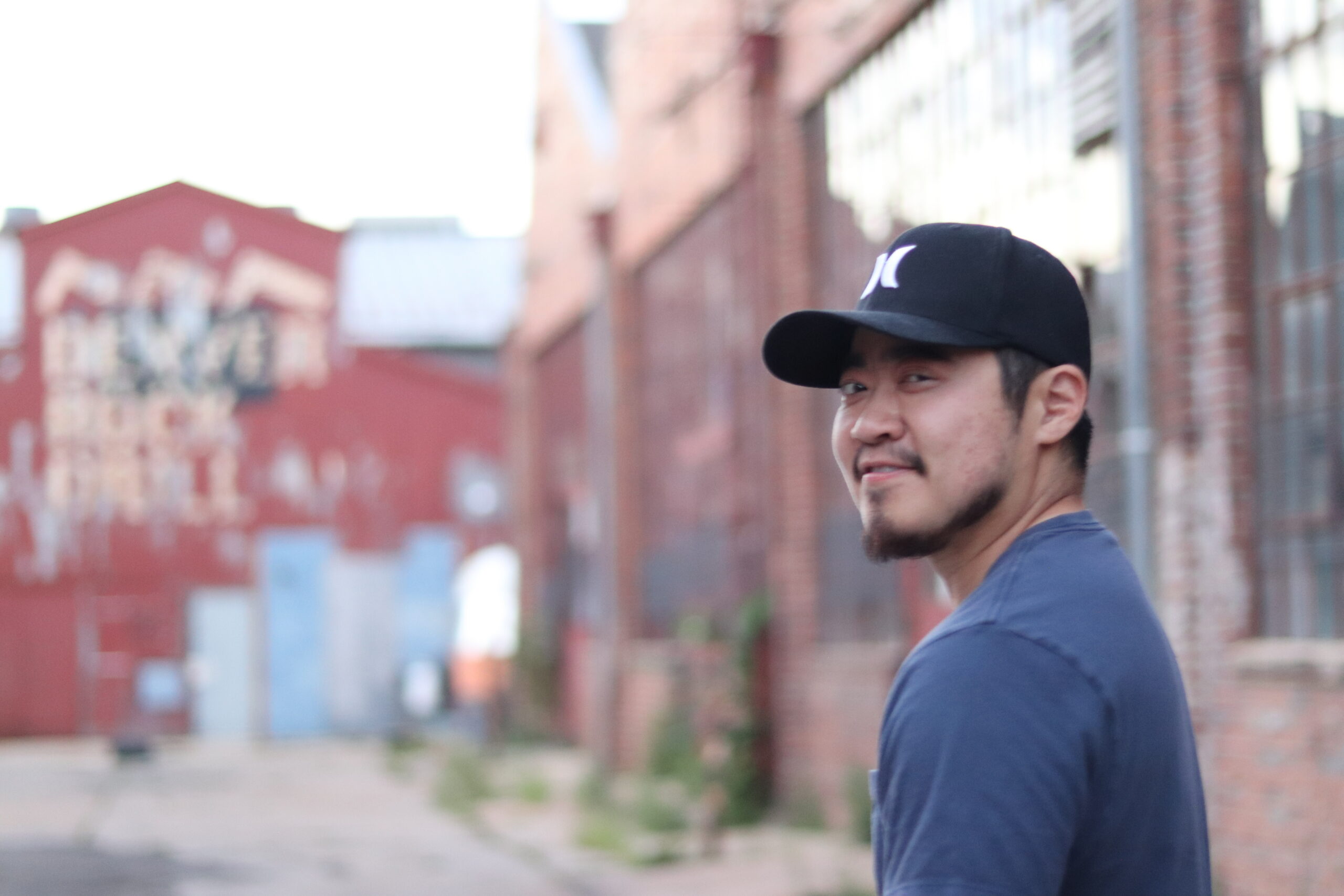
Photo courtesy of Patrick Cottrell.
The subject matter of Patrick Cottrell’s new novel, Afternoon Hours of a Hermit, is tragic. The narrator Dan returns to suburban Milwaukee on the anniversary of his younger brother’s suicide to conduct a metaphysical investigation. He is isolated from his family, who on the whole are dismissive of his recent gender transition. His sense of reality is slipping and grief permeates nearly every page. Why, then, are half of the margin notes in my copy of Hermit “Hahaha,” “wtf,” “so, so, funny,” and “!!!”? On the other hand, seemingly random digressions hit hard. At the end of a long paragraph about contact lenses, for example, I wrote, “my god, so sad.” Part of the thrill of Cottrell’s work is the way he subverts expectation, leans into digression, and lets Dan—a high-caliber eccentric—have free reign. The protagonist wanders impulsively through the terrain of suburban Milwaukee, applying for apartments he has no intention of inhabiting, masquerading as a former Abercrombie employee, and attempting to force a local high school to stage a reading for him, all while pretending he is a detective. None of these plot details ought to feel so poignant, but Cottrell is a genius of misdirection, and the surprise pleasures of these moments feel like watching Magic Johnson make a no-look pass. Cottrell lives in a small house on the outskirts of Denver where he teaches writing. Last month, I called him to talk about his new novel. We dove into whether or not it’s a thriller, the necessity of reinvention in a trans novel, and the intersection of horror and humor.
———
HALLE BUTLER: I was looking through my inbox to see if I could find the PDF because I wanted to do a search for how many times Dan says “psychological thriller.” Halfway through the book I was like, “I think he’s said ‘psychological thriller’ over a hundred times…”
PATRICK COTTRELL: Oh, no.
BUTLER: And there’s just this insistence, “this is a psychological thriller.” “I’m writing a psychological thriller.” “My psychological thriller…” And that was really making me laugh because, on one level, it’s like is this a psychological thriller? Because it seems like it’s just this guy visiting his family in Milwaukee, but then…
COTTRELL: I think on one level it is, but you’d have to read it in a particular way. There’s a French writer I really like, Marie NDiaye, and her books on the surface do not seem like they would be categorized as psychological thrillers. But when you read them, the experience is upsetting in a way that feels like a psychological thriller.
BUTLER: Afternoon Hours does feel way more like a thriller than your first one. It’s almost like the surrealist thriller remake of your first book.
COTTRELL: It honestly never occurred to me that I was rewriting my first book when I was writing this one. Is that weird? I was thinking about how the relationship between the two books could be a metaphor for how trans people contend with encountering their pasts. Like a trans Proust or something.
BUTLER: That’s cool.
COTTRELL: I wanted my narrator to be on the brink of losing touch with reality. He’s also being pushed into this territory by people who are making him unstable, in the sense that they refuse to acknowledge who he is in the present. They’re all stuck in the past.
BUTLER: But Dan is completely stuck in the past, too. And, in some sense, the whole book is stuck in the past. So, there’s this energy that creates some surprising associations, almost off the page. I’m thinking of when Dan is driving his brother’s car for the first time, he says “I could almost trick myself into thinking nothing had changed about the circumstances of the car or the person who once drove it; if I focused on the road and the traffic lights and the houses and the people and the trees, I could almost ignore its transformation from a perfectly functioning car into a death mobile.” It’s a crushing moment, and my sympathy immediately tipped over into sympathy for Dan’s mom feeling the same way about Dan’s transition. Because she’s sort of doing that—focusing on the road, ignoring the transformation. And there’s a relationship between these ideas that I can’t imagine Dan having a direct thought about, but I can observe him having a sort of inverted experience that I think lends the book a broader, more prismatic, or complex sense of sympathy that I don’t think could be arrived at directly. Were you thinking about setting up these moments?
COTTRELL: I think it just comes out naturally from the situation. Something I like about writing is that if you set up the situation in the “right” way, then these things will unfold naturally. And you don’t have to really control them or contrive them. I think that’s why the beginning of a book is so loaded, because you have to set up these situations in the right way. And I think that’s why a lot of novels are so easy to abandon. They’re just not set up the right way and things aren’t unfolding the way they need to.
BUTLER: Yeah, totally.
COTTRELL: But I think that, if the book is working, these resonances and these relationships, they will occur naturally from what the author has set up for themselves. So I think some of these push-pull dynamics of, like, one character wants things to stay the same, the other wants things to stay the same in some ways, but they also want to move into the future and they want acknowledgement that things are different, I think it all unfolds naturally from the circumstances that have been set up. You have to have the right question and you have to have the right setup. That’s what I lean on a lot.
BUTLER: I feel like one of the questions that I found so moving in the book was, “What am I to you? And what are you to me?” You’ve set up things about the parameters of identity, creating tensions between these opposites, like Korean/Midwestern, family/stranger, support/burden, metaphysical detective/erratic child. No offense to Dan…
COTTRELL: [Laughs]
BUTLER: But there are all these tensions between opposite realities that are really exciting. Dan’s narrative voice is like this steel-nerved, cerebral gumshoe voice, and the interaction between that voice and what he’s actually describing can be really funny. Like when he says, “I began to feel as if I might pass out from hunger, so I stopped at a brick-walled café next to a beauty salon. The Chocolate Goose was where I had my first part time job, which involved sweeping the kitchen and greeting people at a counter where I was expected to sing joyfully and dance in place while scooping house-made ice cream and sorbet.” I mean, it’s very funny to picture someone who thinks of themselves as a hard-boiled detective dancing joyfully and scooping ice cream. But also, sometimes these more absurd or funny moments unfold into something darker later, or sadder. Do you want to talk a little bit about how you were thinking about humor? I mean, especially thinking about humor in a book about suicide and alienation?
COTTRELL: Again, I think it just happened naturally. I think anytime you have a narrator who has some narcissistic tendencies and can’t fully see what’s happening around him, I mean, naturally, that’s going to be funny. But I guess I’d have to say, too, that I think that something that’s very different about this book compared to my first book is that this book is, for lack of a better word, anti-suicide. I don’t know if my first book took that stance, but I think that this book is about someone who is questioning whether or not they want to stay alive. And I think that this book ultimately lands on a stance of being anti-suicide. I think the book is saying that writing, reading, talking to people, all that can go towards making a case for being anti-suicide. But I guess your question is about humor.
BUTLER: Well, humor is part of it.
COTTRELL: Yeah, maybe. I don’t think Dan has a humorous outlook, though. Maybe something about the seriousness, the heaviness of that question in the air, perhaps it tilts everything into a darkly humorous direction.
BUTLER: When I read this book, I feel the things that I like about being alive. I’m laughing, I’m smiling, I’m enjoying Dan’s company. I’m feeling some kind of forgiveness for myself. And I think there’s a lot of love in this book and a lot of gentleness towards Milwaukee and towards the parents and towards his brother, so I’m feeling these feelings too. And these are the textures of being alive. So, in that way…
COTTRELL: That’s what I mean by anti-suicide.
BUTLER: I think there’s definitely anger in Dan about his brother Kevin’s suicide, but it doesn’t feel like there’s anger towards Kevin at all. So, it feels anti-suicide in its sympathy and human texture.
COTTRELL: Yeah, I would agree with that. Also, I’m thinking about this idea of rewriting a book, or reinventing a book and the stance it takes, that could be, in a way, a metaphor for transitioning. Because a trans novel has to be some kind of, for lack of better word, reinvention. A rewriting of something. I think the main reason I had to return to this setting is that I wanted to depict a very particular experience that I’ve not encountered in fiction, which is a character who has transitioned returning to a place. I’ve read a lot of trans books that describe taking hormones, surgeries, and the medicalization itself. There’s a place for those, but I wanted to depict the absolute absurdity of some of the aftermath, like dealing with family members who simply cannot see or refuse to see a person for who they are. I think that’s also the key to the psychological horror. It’s depicting an experience where people don’t acknowledge that you’re changing. It’s like, “Can you tell that I’m different?”
BUTLER: Well, it’s like the psychological horror and the humor at once. A lot of the humor seems to happen off screen, for lack of a better term, from things you’re suggesting might happen later or from finally seeing things we didn’t see before. I’m thinking of the part where Dan has on the aviator sunglasses and he’s going to go into the restaurant to spy on his family. ‘The aviator sunglasses, which covered half my face and would betray no emotion whatsoever. No one would recognize me, especially if I smiled.” So I get this vision of Dan’s face with these huge glasses and a huge grin, and that made me laugh out loud.
COTTRELL: It sounds so creepy when you read it out loud though.
BUTLER: It is a little creepy, but it’s more ridiculous because of how self-serious Dan is. And one page later he runs into his aunt and he’s randomly grabbed a baseball cap off of the counter to further his disguise. And his aunt is like, “Your hat says Playboy. Do you read Playboy?” It feels like a joke about what we see, what he doesn’t see, how we see him seeing or not seeing his situation. She also says, “Dan, is that you?” and he says, “No, not really.” Which is just so surprising and funny, as a response.
COTTRELL: Yeah. No, I agree, I’m glad you think it’s funny. People should read the book if they like to smile and laugh.
BUTLER: Do you laugh while you’re writing?
COTTRELL: Not really. I mean, I think writing can be really fun and entertaining, but no laughter really. I think it’s more akin to a trance. I’m glad you thought it was funny. I don’t have a good sense of what’s funny to other people.
